
Mohsin RS F8
Story post NO:12
Class: Foundation Level
Made by Me
The Earth’s Chemistry: Connecting Biology and Chemistry
The Earth is a remarkable system where chemistry and biology are deeply connected. Everything around us—from the air we breathe and the water we drink to the soil, plants, animals, and even our own bodies—is made of chemical substances. Chemistry helps us understand what Earth is made of, while biology shows us how living organisms use these substances to survive, grow, reproduce, and interact with their environment.
Water, carbon dioxide, oxygen, minerals, and many other chemical compounds play essential roles in life. Plants use water and carbon dioxide during photosynthesis to produce food and release oxygen. Animals and humans depend on oxygen and nutrients to obtain energy and maintain their bodies. At the cellular level, countless chemical reactions happen every moment, allowing cells to function and living organisms to remain healthy.
Earth’s natural cycles also demonstrate the powerful connection between chemistry and biology. The water cycle, carbon cycle, nitrogen cycle, and oxygen cycle continuously move important substances through the atmosphere, oceans, soil, plants, animals, and microorganisms. These cycles help maintain balance in ecosystems and provide the materials that living things need.
Soil chemistry is another important example. Plants require minerals and nutrients from the soil to grow, while microorganisms help break down organic matter and return nutrients to the environment. In the oceans, chemical processes influence water quality, carbon storage, climate, and marine ecosystems. Even the rocks and minerals beneath our feet are part of Earth’s ongoing chemical processes.
Understanding the connection between chemistry and biology is also important for solving real-world problems. Scientists use this knowledge to improve agriculture, protect ecosystems, develop medicines, understand climate change, create cleaner technologies, and find sustainable ways to use Earth’s resources.
In conclusion, chemistry is more than a subject studied in a laboratory—it is one of the fundamental languages of nature.
Story post NO:12
Class: Foundation Level
Made by Me
The Earth’s Chemistry: Connecting Biology and Chemistry
The Earth is a remarkable system where chemistry and biology are deeply connected. Everything around us—from the air we breathe and the water we drink to the soil, plants, animals, and even our own bodies—is made of chemical substances. Chemistry helps us understand what Earth is made of, while biology shows us how living organisms use these substances to survive, grow, reproduce, and interact with their environment.
Water, carbon dioxide, oxygen, minerals, and many other chemical compounds play essential roles in life. Plants use water and carbon dioxide during photosynthesis to produce food and release oxygen. Animals and humans depend on oxygen and nutrients to obtain energy and maintain their bodies. At the cellular level, countless chemical reactions happen every moment, allowing cells to function and living organisms to remain healthy.
Earth’s natural cycles also demonstrate the powerful connection between chemistry and biology. The water cycle, carbon cycle, nitrogen cycle, and oxygen cycle continuously move important substances through the atmosphere, oceans, soil, plants, animals, and microorganisms. These cycles help maintain balance in ecosystems and provide the materials that living things need.
Soil chemistry is another important example. Plants require minerals and nutrients from the soil to grow, while microorganisms help break down organic matter and return nutrients to the environment. In the oceans, chemical processes influence water quality, carbon storage, climate, and marine ecosystems. Even the rocks and minerals beneath our feet are part of Earth’s ongoing chemical processes.
Understanding the connection between chemistry and biology is also important for solving real-world problems. Scientists use this knowledge to improve agriculture, protect ecosystems, develop medicines, understand climate change, create cleaner technologies, and find sustainable ways to use Earth’s resources.
In conclusion, chemistry is more than a subject studied in a laboratory—it is one of the fundamental languages of nature.
Mohsin RS F8 🎓✨
Story post NO:12
Class: Foundation Level 📚
Made by Me 💻🚀
The Earth’s Chemistry: Connecting Biology and Chemistry
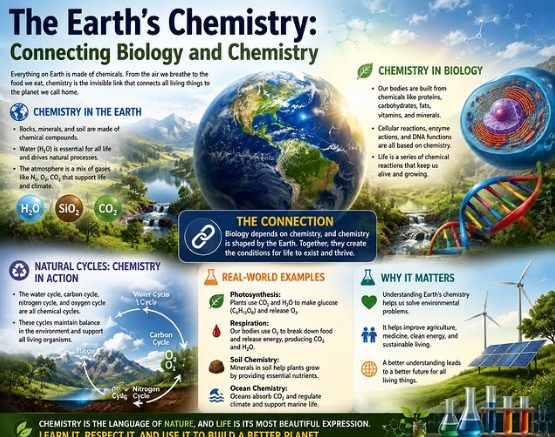
The Earth is a remarkable system where chemistry and biology are deeply connected. Everything around us—from the air we breathe and the water we drink to the soil, plants, animals, and even our own bodies—is made of chemical substances. Chemistry helps us understand what Earth is made of, while biology shows us how living organisms use these substances to survive, grow, reproduce, and interact with their environment.
Water, carbon dioxide, oxygen, minerals, and many other chemical compounds play essential roles in life. Plants use water and carbon dioxide during photosynthesis to produce food and release oxygen. Animals and humans depend on oxygen and nutrients to obtain energy and maintain their bodies. At the cellular level, countless chemical reactions happen every moment, allowing cells to function and living organisms to remain healthy.
Earth’s natural cycles also demonstrate the powerful connection between chemistry and biology. The water cycle, carbon cycle, nitrogen cycle, and oxygen cycle continuously move important substances through the atmosphere, oceans, soil, plants, animals, and microorganisms. These cycles help maintain balance in ecosystems and provide the materials that living things need.
Soil chemistry is another important example. Plants require minerals and nutrients from the soil to grow, while microorganisms help break down organic matter and return nutrients to the environment. In the oceans, chemical processes influence water quality, carbon storage, climate, and marine ecosystems. Even the rocks and minerals beneath our feet are part of Earth’s ongoing chemical processes.
Understanding the connection between chemistry and biology is also important for solving real-world problems. Scientists use this knowledge to improve agriculture, protect ecosystems, develop medicines, understand climate change, create cleaner technologies, and find sustainable ways to use Earth’s resources.
In conclusion, chemistry is more than a subject studied in a laboratory—it is one of the fundamental languages of nature.
0 تبصرے
0 شیئرز
74 ویوز