


To avoid fatal accidents, ease congestion, reduce massive and lethal air pollution (both diesel-burning emissions, and toxic tire rubber particulates) a massive restructuring of the flow of Karachi port related heavy traffic is required. Such a step will greatly improve the quality of life for the citizenry of Karachi.
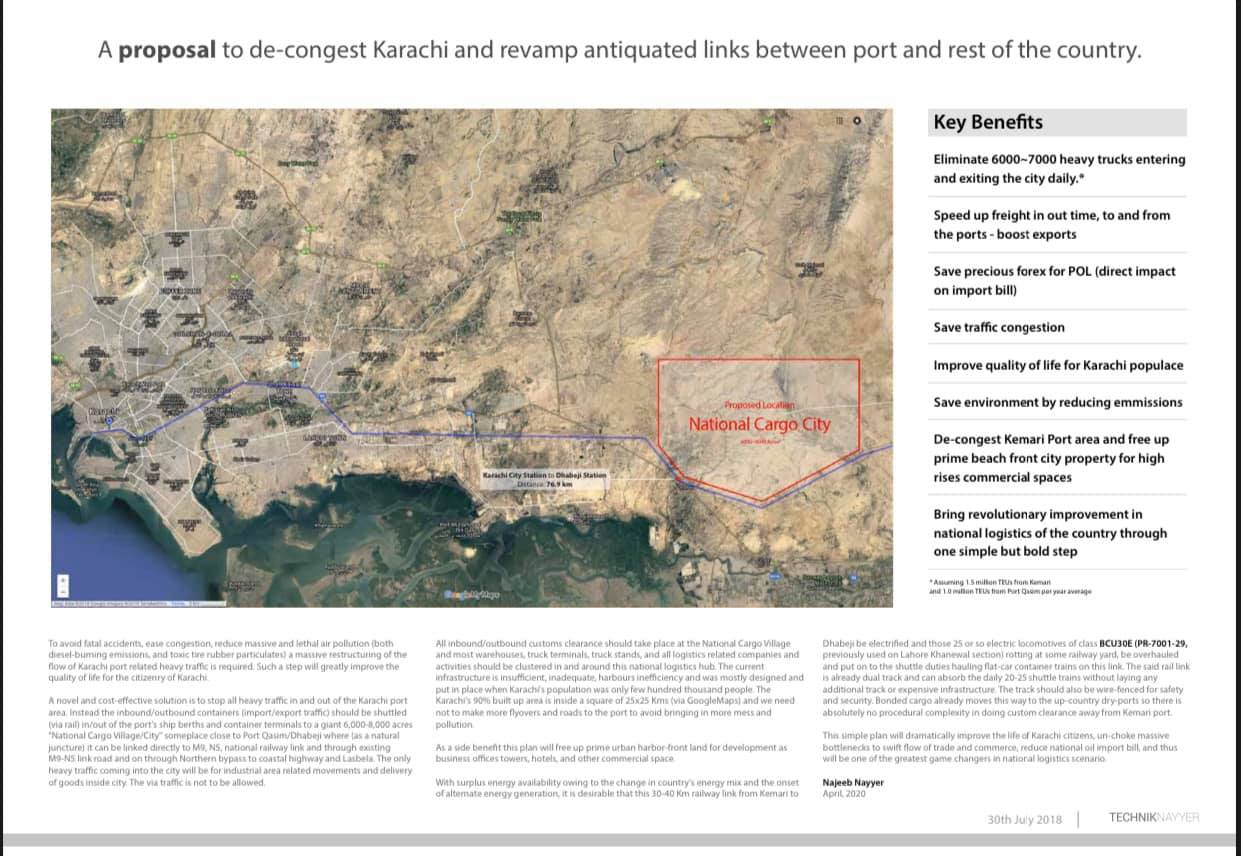
A novel and cost-effective solution is to stop all heavy traffic in and out of the Karachi port area. Instead the inbound/outbound containers (import/export traffic) should be shuttled (via rail) in/out of the ports ship berths and container terminals to a giant 6,000-8,000 acres "National Cargo Village/City" someplace close to Port Qasim/Dhabeji where (as a natural juncture) it can be linked directly to M9, N5, national railway link and through existing M9-N5 link road and on through Northern bypass to coastal highway and Lasbela. The only heavy traffic coming into the city will be for industrial area related movements and delivery of goods inside city. The via traffic is not to be allowed.
All inbound/outbound customs clearance should take place at the National Cargo Village and most warehouses, truck terminals, truck stands, and all logistics related companies and activities should be clustered in and around this national logistics hub. The current infrastructure is insufficient, inadequate, harbours inefficiency and was mostly designed and put in place when Karachis population was only few hundred thousand people. The Karachis 90% built up area is inside a square of 25x25 Kms (via GoogleMaps) and we need not to make more flyovers and roads to the port to avoid bringing in more mess and pollution.
As a side benefit this plan will free up prime urban harbor-front land for development as business offices towers, hotels, and other commercial space.
With surplus energy availability owing to the change in countrys energy mix and the onset of alternate energy generation, it is desirable that this 30-40 Km railway link from Kemari to Dhabeji be electrified and those 25 or so electric locomotives of class BCU30E (PR-7001-29, previously used on Lahore Khanewal section) rotting at some railway yard, be overhauled and put on to the shuttle duties hauling flat-car container trains on this link. The said rail link is already dual track and can absorb the daily 20-25 shuttle trains without laying any additional track or expensive infrastructure. The track should also be wire-fenced for safety and security. Bonded cargo already moves this way to the up-country dry-ports so there is absolutely no procedural complexity in doing custom clearance away from Kemari port.
This simple plan will dramatically improve the life of Karachi citizens, un-choke massive bottlenecks to swift flow of trade and commerce, reduce national oil import bill, and thus will be one of the greatest game changers in national logistics scenario.
Najeeb Nayyer
April, 2020
A novel and cost-effective solution is to stop all heavy traffic in and out of the Karachi port area. Instead the inbound/outbound containers (import/export traffic) should be shuttled (via rail) in/out of the ports ship berths and container terminals to a giant 6,000-8,000 acres "National Cargo Village/City" someplace close to Port Qasim/Dhabeji where (as a natural juncture) it can be linked directly to M9, N5, national railway link and through existing M9-N5 link road and on through Northern bypass to coastal highway and Lasbela. The only heavy traffic coming into the city will be for industrial area related movements and delivery of goods inside city. The via traffic is not to be allowed.
All inbound/outbound customs clearance should take place at the National Cargo Village and most warehouses, truck terminals, truck stands, and all logistics related companies and activities should be clustered in and around this national logistics hub. The current infrastructure is insufficient, inadequate, harbours inefficiency and was mostly designed and put in place when Karachis population was only few hundred thousand people. The Karachis 90% built up area is inside a square of 25x25 Kms (via GoogleMaps) and we need not to make more flyovers and roads to the port to avoid bringing in more mess and pollution.
As a side benefit this plan will free up prime urban harbor-front land for development as business offices towers, hotels, and other commercial space.
With surplus energy availability owing to the change in countrys energy mix and the onset of alternate energy generation, it is desirable that this 30-40 Km railway link from Kemari to Dhabeji be electrified and those 25 or so electric locomotives of class BCU30E (PR-7001-29, previously used on Lahore Khanewal section) rotting at some railway yard, be overhauled and put on to the shuttle duties hauling flat-car container trains on this link. The said rail link is already dual track and can absorb the daily 20-25 shuttle trains without laying any additional track or expensive infrastructure. The track should also be wire-fenced for safety and security. Bonded cargo already moves this way to the up-country dry-ports so there is absolutely no procedural complexity in doing custom clearance away from Kemari port.
This simple plan will dramatically improve the life of Karachi citizens, un-choke massive bottlenecks to swift flow of trade and commerce, reduce national oil import bill, and thus will be one of the greatest game changers in national logistics scenario.
Najeeb Nayyer
April, 2020
To avoid fatal accidents, ease congestion, reduce massive and lethal air pollution (both diesel-burning emissions, and toxic tire rubber particulates) a massive restructuring of the flow of Karachi port related heavy traffic is required. Such a step will greatly improve the quality of life for the citizenry of Karachi.
A novel and cost-effective solution is to stop all heavy traffic in and out of the Karachi port area. Instead the inbound/outbound containers (import/export traffic) should be shuttled (via rail) in/out of the port's ship berths and container terminals to a giant 6,000-8,000 acres "National Cargo Village/City" someplace close to Port Qasim/Dhabeji where (as a natural juncture) it can be linked directly to M9, N5, national railway link and through existing M9-N5 link road and on through Northern bypass to coastal highway and Lasbela. The only heavy traffic coming into the city will be for industrial area related movements and delivery of goods inside city. The via traffic is not to be allowed.
All inbound/outbound customs clearance should take place at the National Cargo Village and most warehouses, truck terminals, truck stands, and all logistics related companies and activities should be clustered in and around this national logistics hub. The current infrastructure is insufficient, inadequate, harbours inefficiency and was mostly designed and put in place when Karachi's population was only few hundred thousand people. The Karachi's 90% built up area is inside a square of 25x25 Kms (via GoogleMaps) and we need not to make more flyovers and roads to the port to avoid bringing in more mess and pollution.
As a side benefit this plan will free up prime urban harbor-front land for development as business offices towers, hotels, and other commercial space.
With surplus energy availability owing to the change in country's energy mix and the onset of alternate energy generation, it is desirable that this 30-40 Km railway link from Kemari to Dhabeji be electrified and those 25 or so electric locomotives of class BCU30E (PR-7001-29, previously used on Lahore Khanewal section) rotting at some railway yard, be overhauled and put on to the shuttle duties hauling flat-car container trains on this link. The said rail link is already dual track and can absorb the daily 20-25 shuttle trains without laying any additional track or expensive infrastructure. The track should also be wire-fenced for safety and security. Bonded cargo already moves this way to the up-country dry-ports so there is absolutely no procedural complexity in doing custom clearance away from Kemari port.
This simple plan will dramatically improve the life of Karachi citizens, un-choke massive bottlenecks to swift flow of trade and commerce, reduce national oil import bill, and thus will be one of the greatest game changers in national logistics scenario.
Najeeb Nayyer
April, 2020
0 Comentários
0 Compartilhamentos
119 Visualizações