


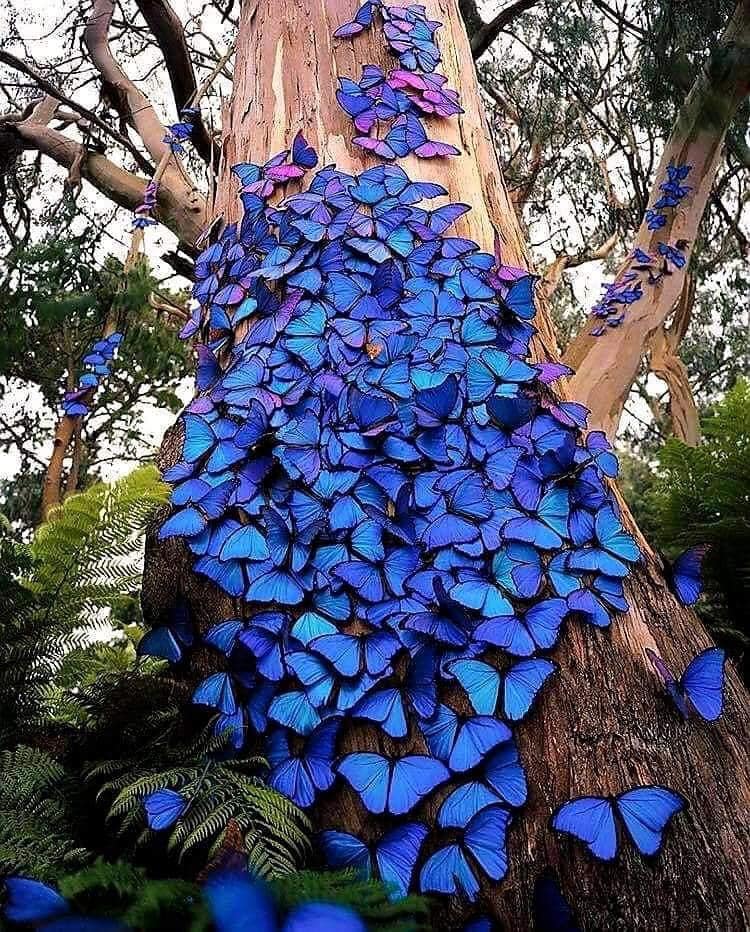
Colors in nature come mainly from three sources: pigments, structural colors, and bioluminescence. Such is the case of blue and green colors, compared to reds and the rest because they can be structural colors.
Colors in nature come mainly from three sources: pigments, structural colors, and bioluminescence. Such is the case of blue and green colors, compared to reds and the rest because they can be structural colors.
Structural coloring is the result of microscopically fine structured surfaces that interfere with visible light, sometimes in combination with pigments. For example, peacock tail feathers are brown pigmented, but because of their microscopic structure, they also reflect blue, turquoise and green light. And they are often iridescent. Thus, structural coloring is a classic optical effect of interference and diffraction, rather than a quantum property of photon absorption and emission, which is responsible for color in pigments (as plants, which efficiently absorb red light and the green is reflected) and bioluminescence.
Learn more about the biophysics of the natural world in the free Unified Science Course in the Resonance Academy at ResonanceScience.org
Photo by Kelvin Hudson
Colors in nature come mainly from three sources: pigments, structural colors, and bioluminescence. Such is the case of blue and green colors, compared to reds and the rest because they can be structural colors.
Structural coloring is the result of microscopically fine structured surfaces that interfere with visible light, sometimes in combination with pigments. For example, peacock tail feathers are brown pigmented, but because of their microscopic structure, they also reflect blue, turquoise and green light. And they are often iridescent. Thus, structural coloring is a classic optical effect of interference and diffraction, rather than a quantum property of photon absorption and emission, which is responsible for color in pigments (as plants, which efficiently absorb red light and the green is reflected) and bioluminescence.
Learn more about the biophysics of the natural world in the free Unified Science Course in the Resonance Academy at ResonanceScience.org
Photo by Kelvin Hudson
Colors in nature come mainly from three sources: pigments, structural colors, and bioluminescence. Such is the case of blue and green colors, compared to reds and the rest because they can be structural colors.
Colors in nature come mainly from three sources: pigments, structural colors, and bioluminescence. Such is the case of blue and green colors, compared to reds and the rest because they can be structural colors.
Structural coloring is the result of microscopically fine structured surfaces that interfere with visible light, sometimes in combination with pigments. For example, peacock tail feathers are brown pigmented, but because of their microscopic structure, they also reflect blue, turquoise and green light. And they are often iridescent. Thus, structural coloring is a classic optical effect of interference and diffraction, rather than a quantum property of photon absorption and emission, which is responsible for color in pigments (as plants, which efficiently absorb red light and the green is reflected) and bioluminescence.
Learn more about the biophysics of the natural world in the free Unified Science Course in the Resonance Academy at ResonanceScience.org
Photo by Kelvin Hudson
0 Commentarii
0 Distribuiri
1666 Views