


#rsisb
Roll no.239
Foundation Level
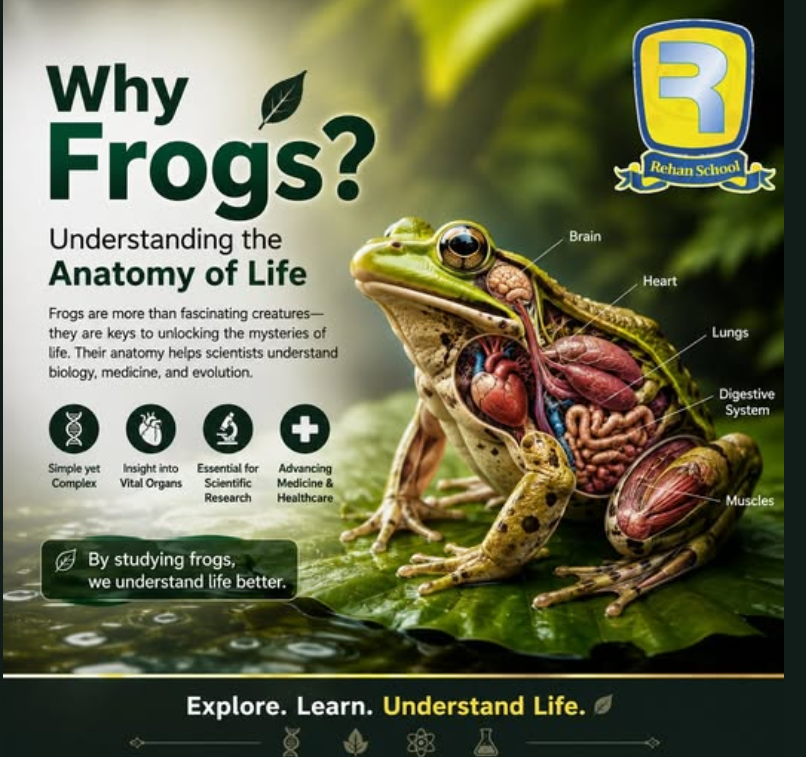
Frogs are often studied in biology because their bodies provide a clear way to understand **basic animal anatomy and physiology**. Their organs and organ systems are relatively easy to observe, while still showing many of the same fundamental structures found in other vertebrates.
### What Can Frogs Teach Us?
* **Heart:** A frog’s three-chambered heart demonstrates how blood circulates through the body.
* **Lungs and skin:** Frogs breathe through both their lungs and moist skin, showing different methods of gas exchange.
* **Digestive system:** Their digestive organs demonstrate how food is broken down and nutrients are absorbed.
* **Muscles and skeleton:** Powerful hind-leg muscles and a specialized skeleton explain how frogs jump and move.
* **Nervous system:** The brain, spinal cord, and nerves coordinate movement and responses.
* **Kidneys:** These organs help remove waste and maintain the body's internal balance.
genui{"biology_anatomy_physiology":{"type_id":"BLOOD_CIRCULATION","locale_override":"en-US"}}
### **Why Are Frogs Important in Biology?**
Frogs are useful study organisms because their anatomy helps students connect **structure with function**. By examining how different organs work together, we can better understand a central idea of biology: **life depends on coordinated systems working as one whole organism.**
In short, studying a frog is not simply about studying one animal—it is a way to explore the **anatomy, physiology, adaptation, and organization of life itself**.
Roll no.239
Foundation Level
Frogs are often studied in biology because their bodies provide a clear way to understand **basic animal anatomy and physiology**. Their organs and organ systems are relatively easy to observe, while still showing many of the same fundamental structures found in other vertebrates.
### What Can Frogs Teach Us?
* **Heart:** A frog’s three-chambered heart demonstrates how blood circulates through the body.
* **Lungs and skin:** Frogs breathe through both their lungs and moist skin, showing different methods of gas exchange.
* **Digestive system:** Their digestive organs demonstrate how food is broken down and nutrients are absorbed.
* **Muscles and skeleton:** Powerful hind-leg muscles and a specialized skeleton explain how frogs jump and move.
* **Nervous system:** The brain, spinal cord, and nerves coordinate movement and responses.
* **Kidneys:** These organs help remove waste and maintain the body's internal balance.
genui{"biology_anatomy_physiology":{"type_id":"BLOOD_CIRCULATION","locale_override":"en-US"}}
### **Why Are Frogs Important in Biology?**
Frogs are useful study organisms because their anatomy helps students connect **structure with function**. By examining how different organs work together, we can better understand a central idea of biology: **life depends on coordinated systems working as one whole organism.**
In short, studying a frog is not simply about studying one animal—it is a way to explore the **anatomy, physiology, adaptation, and organization of life itself**.
#rsisb
Roll no.239
Foundation Level
Frogs are often studied in biology because their bodies provide a clear way to understand **basic animal anatomy and physiology**. Their organs and organ systems are relatively easy to observe, while still showing many of the same fundamental structures found in other vertebrates.
### 🐸 What Can Frogs Teach Us?
* **Heart:** A frog’s three-chambered heart demonstrates how blood circulates through the body.
* **Lungs and skin:** Frogs breathe through both their lungs and moist skin, showing different methods of gas exchange.
* **Digestive system:** Their digestive organs demonstrate how food is broken down and nutrients are absorbed.
* **Muscles and skeleton:** Powerful hind-leg muscles and a specialized skeleton explain how frogs jump and move.
* **Nervous system:** The brain, spinal cord, and nerves coordinate movement and responses.
* **Kidneys:** These organs help remove waste and maintain the body's internal balance.
genui{"biology_anatomy_physiology":{"type_id":"BLOOD_CIRCULATION","locale_override":"en-US"}}
### **Why Are Frogs Important in Biology?**
Frogs are useful study organisms because their anatomy helps students connect **structure with function**. By examining how different organs work together, we can better understand a central idea of biology: **life depends on coordinated systems working as one whole organism.**
In short, studying a frog is not simply about studying one animal—it is a way to explore the **anatomy, physiology, adaptation, and organization of life itself**.
0 Commentarii
0 Distribuiri
3500 Views