


#rsisb
Roll no.239
Foundation Level
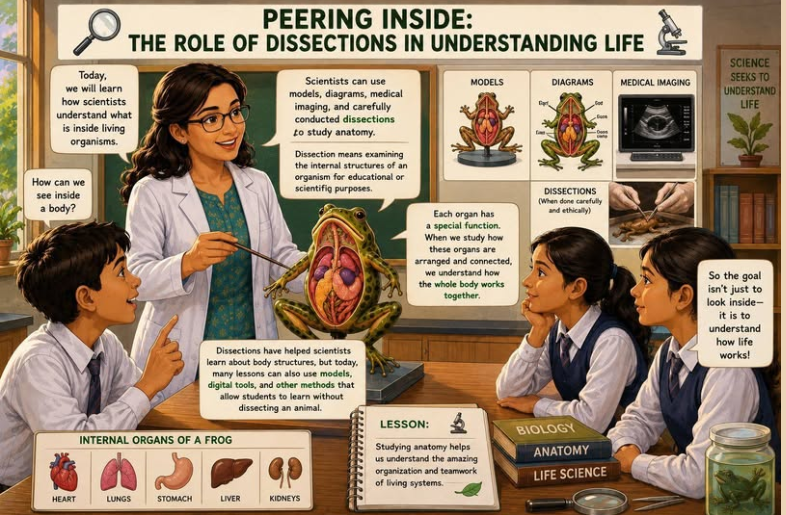
**Dissection** is an important method used in biology to understand the internal structure of living organisms. By carefully examining organs, tissues, and body systems, students and scientists can learn how different parts of an organism are arranged and how they work together.
Dissections provide a practical experience that books and diagrams cannot always provide. For example, studying a frog dissection can help students understand the **heart, lungs, liver, stomach, intestines, and other organs** in their natural positions. This hands-on learning can make biological concepts easier to understand and remember.
Dissection also plays a role in **medical education and scientific research**. It has helped humans develop a deeper understanding of anatomy, disease, and the relationships between different body systems.
However, dissections should always be performed responsibly, following **ethical guidelines, safety procedures, and respect for living organisms**. Modern alternatives, such as digital simulations and 3D anatomical models, can also provide valuable learning experiences.
Overall, dissections help us **“peer inside” life** and transform biological knowledge from something we simply read about into something we can observe and understand more clearly.
Roll no.239
Foundation Level
**Dissection** is an important method used in biology to understand the internal structure of living organisms. By carefully examining organs, tissues, and body systems, students and scientists can learn how different parts of an organism are arranged and how they work together.
Dissections provide a practical experience that books and diagrams cannot always provide. For example, studying a frog dissection can help students understand the **heart, lungs, liver, stomach, intestines, and other organs** in their natural positions. This hands-on learning can make biological concepts easier to understand and remember.
Dissection also plays a role in **medical education and scientific research**. It has helped humans develop a deeper understanding of anatomy, disease, and the relationships between different body systems.
However, dissections should always be performed responsibly, following **ethical guidelines, safety procedures, and respect for living organisms**. Modern alternatives, such as digital simulations and 3D anatomical models, can also provide valuable learning experiences.
Overall, dissections help us **“peer inside” life** and transform biological knowledge from something we simply read about into something we can observe and understand more clearly.
#rsisb
Roll no.239
Foundation Level
**Dissection** is an important method used in biology to understand the internal structure of living organisms. By carefully examining organs, tissues, and body systems, students and scientists can learn how different parts of an organism are arranged and how they work together.
Dissections provide a practical experience that books and diagrams cannot always provide. For example, studying a frog dissection can help students understand the **heart, lungs, liver, stomach, intestines, and other organs** in their natural positions. This hands-on learning can make biological concepts easier to understand and remember.
Dissection also plays a role in **medical education and scientific research**. It has helped humans develop a deeper understanding of anatomy, disease, and the relationships between different body systems.
However, dissections should always be performed responsibly, following **ethical guidelines, safety procedures, and respect for living organisms**. Modern alternatives, such as digital simulations and 3D anatomical models, can also provide valuable learning experiences.
Overall, dissections help us **“peer inside” life** and transform biological knowledge from something we simply read about into something we can observe and understand more clearly.
0 التعليقات
0 المشاركات
179 مشاهدة