


#rsisb
Roll no.239
Foundation Level
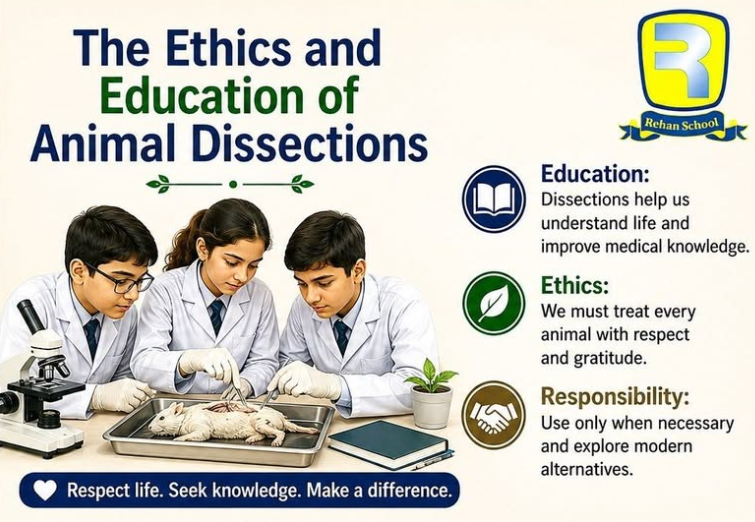
Animal dissections have been used in biology education to help students understand **anatomy, organs, tissues, and body systems**. By examining specimens directly, students can connect what they learn from textbooks and diagrams with real biological structures.
However, dissections also raise important **ethical questions**. Students and educators should consider animal welfare, the purpose of the dissection, and whether suitable alternatives are available. Dissections should be conducted with respect, following appropriate ethical and safety standards.
Modern education can also use **3D models, digital simulations, videos, and virtual dissections**. These tools can provide valuable anatomical learning while reducing or eliminating the need to use animal specimens.
The goal of education should be to develop scientific knowledge while also encouraging **responsibility, compassion, and respect for life**.
**In simple words: Animal dissections can provide valuable biological knowledge, but responsible education should balance scientific learning with ethical considerations and appropriate alternatives.**
Roll no.239
Foundation Level
Animal dissections have been used in biology education to help students understand **anatomy, organs, tissues, and body systems**. By examining specimens directly, students can connect what they learn from textbooks and diagrams with real biological structures.
However, dissections also raise important **ethical questions**. Students and educators should consider animal welfare, the purpose of the dissection, and whether suitable alternatives are available. Dissections should be conducted with respect, following appropriate ethical and safety standards.
Modern education can also use **3D models, digital simulations, videos, and virtual dissections**. These tools can provide valuable anatomical learning while reducing or eliminating the need to use animal specimens.
The goal of education should be to develop scientific knowledge while also encouraging **responsibility, compassion, and respect for life**.
**In simple words: Animal dissections can provide valuable biological knowledge, but responsible education should balance scientific learning with ethical considerations and appropriate alternatives.**
#rsisb
Roll no.239
Foundation Level
Animal dissections have been used in biology education to help students understand **anatomy, organs, tissues, and body systems**. By examining specimens directly, students can connect what they learn from textbooks and diagrams with real biological structures.
However, dissections also raise important **ethical questions**. Students and educators should consider animal welfare, the purpose of the dissection, and whether suitable alternatives are available. Dissections should be conducted with respect, following appropriate ethical and safety standards.
Modern education can also use **3D models, digital simulations, videos, and virtual dissections**. These tools can provide valuable anatomical learning while reducing or eliminating the need to use animal specimens.
The goal of education should be to develop scientific knowledge while also encouraging **responsibility, compassion, and respect for life**.
**In simple words: Animal dissections can provide valuable biological knowledge, but responsible education should balance scientific learning with ethical considerations and appropriate alternatives.**
0 Commentarii
0 Distribuiri
2855 Views