


#rsisb
Roll No.240
Story No.14
Foundation Level
**Sound Waves: The Physics of Hearing and Communication**
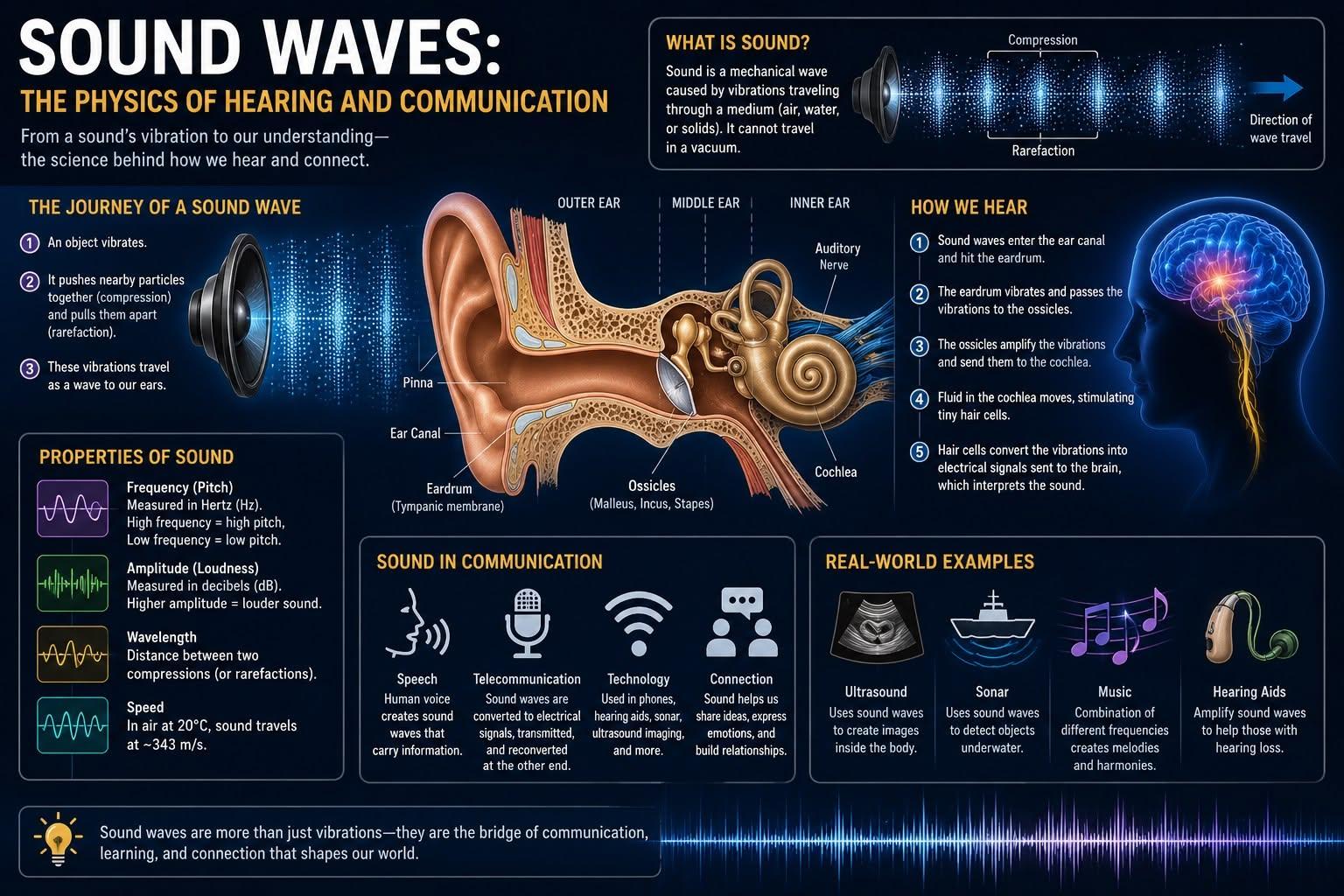
Sound waves are invisible vibrations that travel through air, water, and solids, allowing us to hear and communicate with the world around us. Every sound begins when an object vibrates, creating waves that move through a medium until they reach our ears. These waves carry energy, not matter, and their frequency determines the pitch while their amplitude controls the loudness of the sound.
Inside the human ear, sound waves follow an incredible journey. They enter through the outer ear, vibrate the eardrum, and pass through three tiny bones called the ossicles. These vibrations then reach the cochlea, where thousands of tiny hair cells convert them into electrical signals. The auditory nerve carries these signals to the brain, which interprets them as speech, music, or other familiar sounds.
Sound plays a vital role in communication, education, entertainment, medicine, and technology. From conversations and musical performances to ultrasound imaging, sonar systems, and hearing aids, the science of sound has transformed countless aspects of modern life. Understanding how sound waves travel and interact with different materials helps scientists and engineers develop better communication systems and innovative technologies.
The study of sound waves demonstrates the fascinating connection between physics and everyday life. By exploring concepts such as vibration, frequency, wavelength, amplitude, and wave speed, we gain a deeper appreciation of how hearing works and how sound enables people to connect, learn, and share ideas across the world.
Rehan School Islamabad Campus
Asma Shaheen EducationWali
Irum Asim
Saima Happinesswali
Roll No.240
Story No.14
Foundation Level
**Sound Waves: The Physics of Hearing and Communication**
Sound waves are invisible vibrations that travel through air, water, and solids, allowing us to hear and communicate with the world around us. Every sound begins when an object vibrates, creating waves that move through a medium until they reach our ears. These waves carry energy, not matter, and their frequency determines the pitch while their amplitude controls the loudness of the sound.
Inside the human ear, sound waves follow an incredible journey. They enter through the outer ear, vibrate the eardrum, and pass through three tiny bones called the ossicles. These vibrations then reach the cochlea, where thousands of tiny hair cells convert them into electrical signals. The auditory nerve carries these signals to the brain, which interprets them as speech, music, or other familiar sounds.
Sound plays a vital role in communication, education, entertainment, medicine, and technology. From conversations and musical performances to ultrasound imaging, sonar systems, and hearing aids, the science of sound has transformed countless aspects of modern life. Understanding how sound waves travel and interact with different materials helps scientists and engineers develop better communication systems and innovative technologies.
The study of sound waves demonstrates the fascinating connection between physics and everyday life. By exploring concepts such as vibration, frequency, wavelength, amplitude, and wave speed, we gain a deeper appreciation of how hearing works and how sound enables people to connect, learn, and share ideas across the world.
Rehan School Islamabad Campus
Asma Shaheen EducationWali
Irum Asim
Saima Happinesswali
#rsisb
Roll No.240
Story No.14
Foundation Level
**Sound Waves: The Physics of Hearing and Communication**
Sound waves are invisible vibrations that travel through air, water, and solids, allowing us to hear and communicate with the world around us. Every sound begins when an object vibrates, creating waves that move through a medium until they reach our ears. These waves carry energy, not matter, and their frequency determines the pitch while their amplitude controls the loudness of the sound.
Inside the human ear, sound waves follow an incredible journey. They enter through the outer ear, vibrate the eardrum, and pass through three tiny bones called the ossicles. These vibrations then reach the cochlea, where thousands of tiny hair cells convert them into electrical signals. The auditory nerve carries these signals to the brain, which interprets them as speech, music, or other familiar sounds.
Sound plays a vital role in communication, education, entertainment, medicine, and technology. From conversations and musical performances to ultrasound imaging, sonar systems, and hearing aids, the science of sound has transformed countless aspects of modern life. Understanding how sound waves travel and interact with different materials helps scientists and engineers develop better communication systems and innovative technologies.
The study of sound waves demonstrates the fascinating connection between physics and everyday life. By exploring concepts such as vibration, frequency, wavelength, amplitude, and wave speed, we gain a deeper appreciation of how hearing works and how sound enables people to connect, learn, and share ideas across the world.
Rehan School Islamabad Campus
Asma Shaheen EducationWali
Irum Asim
Saima Happinesswali
0 Kommentare
0 Anteile
6015 Ansichten