


#rsisb
Roll no.247
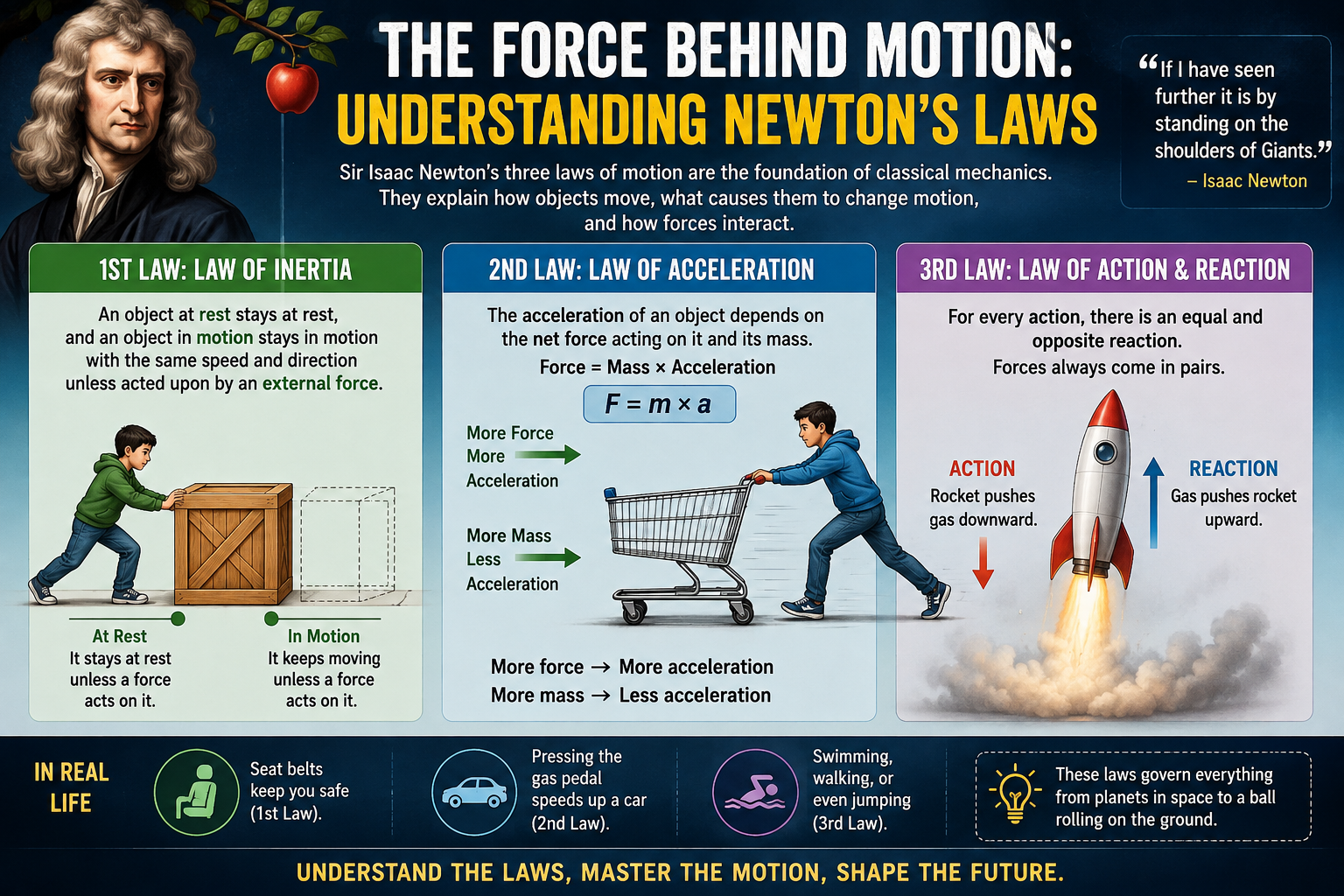
Foundation level **The Force Behind Motion: Understanding Newton’s Laws**
Have you ever wondered why objects move, stop, speed up, slow down, or change direction? The answer lies in one of the most important ideas in physics: **Newton’s Laws of Motion!**
In this fascinating journey, we explore the three laws developed by **Sir Isaac Newton**, which help us understand how forces affect the motion of objects. From a ball rolling across the ground to a rocket launching into space , Newton’s laws are everywhere around us!
**Newton’s First Law – The Law of Inertia:**
An object tends to remain at rest or keep moving in a straight line unless an external force acts upon it. This explains why objects don’t simply change their motion on their own.
**Newton’s Second Law – Force and Acceleration:**
This law shows how force, mass, and acceleration are connected. The famous equation **F = ma** helps us understand why applying more force can produce greater acceleration.
**Newton’s Third Law – Action and Reaction:**
For every action, there is an equal and opposite reaction. This principle helps explain how we walk, swim, jump, and even how rockets move upward!
Newton’s laws are not just formulas written in a textbook—they are principles that describe motion in our everyday lives. Whether you are riding a bicycle , playing sports , pushing a door , or watching a car accelerate , physics is working all around you!
In this topic, we’ll discover how **force, mass, acceleration, inertia, and action-reaction pairs** work together to explain the motion we see every day. It’s a perfect opportunity for students, science lovers, and curious minds to explore the amazing world of physics.
**Key Topics:**
Newton’s Three Laws of Motion
Understanding Force and Motion
Inertia and Mass
Force, Mass & Acceleration
Action and Reaction
Real-Life Examples of Newton’s Laws
The Role of Physics in Everyday Life
Applications in Transportation, Sports, Space, and Engineering
**Physics is everywhere!** Once you understand Newton’s laws, ordinary movements can become extraordinary scientific discoveries. So get ready to explore the forces that shape motion and uncover the science behind the world around us!
Like, share, and follow for more exciting educational content!
#NewtonLaws #NewtonLawsOfMotion #Physics #ForceAndMotion #Science #PhysicsEducation #ScienceForStudents #Newton #IsaacNewton #LawOfInertia #Acceleration #Force #Mass #Motion #ActionAndReaction #FEqualsMA #STEM #ScienceLearning #PhysicsExplained #LearnPhysics #EducationalVideo #ScienceEducation #AmazingScience #EverydayPhysics #SpaceScience
Roll no.247
Foundation level **The Force Behind Motion: Understanding Newton’s Laws**
Have you ever wondered why objects move, stop, speed up, slow down, or change direction? The answer lies in one of the most important ideas in physics: **Newton’s Laws of Motion!**
In this fascinating journey, we explore the three laws developed by **Sir Isaac Newton**, which help us understand how forces affect the motion of objects. From a ball rolling across the ground to a rocket launching into space , Newton’s laws are everywhere around us!
**Newton’s First Law – The Law of Inertia:**
An object tends to remain at rest or keep moving in a straight line unless an external force acts upon it. This explains why objects don’t simply change their motion on their own.
**Newton’s Second Law – Force and Acceleration:**
This law shows how force, mass, and acceleration are connected. The famous equation **F = ma** helps us understand why applying more force can produce greater acceleration.
**Newton’s Third Law – Action and Reaction:**
For every action, there is an equal and opposite reaction. This principle helps explain how we walk, swim, jump, and even how rockets move upward!
Newton’s laws are not just formulas written in a textbook—they are principles that describe motion in our everyday lives. Whether you are riding a bicycle , playing sports , pushing a door , or watching a car accelerate , physics is working all around you!
In this topic, we’ll discover how **force, mass, acceleration, inertia, and action-reaction pairs** work together to explain the motion we see every day. It’s a perfect opportunity for students, science lovers, and curious minds to explore the amazing world of physics.
**Key Topics:**
Newton’s Three Laws of Motion
Understanding Force and Motion
Inertia and Mass
Force, Mass & Acceleration
Action and Reaction
Real-Life Examples of Newton’s Laws
The Role of Physics in Everyday Life
Applications in Transportation, Sports, Space, and Engineering
**Physics is everywhere!** Once you understand Newton’s laws, ordinary movements can become extraordinary scientific discoveries. So get ready to explore the forces that shape motion and uncover the science behind the world around us!
Like, share, and follow for more exciting educational content!
#NewtonLaws #NewtonLawsOfMotion #Physics #ForceAndMotion #Science #PhysicsEducation #ScienceForStudents #Newton #IsaacNewton #LawOfInertia #Acceleration #Force #Mass #Motion #ActionAndReaction #FEqualsMA #STEM #ScienceLearning #PhysicsExplained #LearnPhysics #EducationalVideo #ScienceEducation #AmazingScience #EverydayPhysics #SpaceScience
#rsisb
Roll no.247
Foundation level 🚀⚙️ **The Force Behind Motion: Understanding Newton’s Laws** ⚙️🚀
Have you ever wondered why objects move, stop, speed up, slow down, or change direction? 🌍✨ The answer lies in one of the most important ideas in physics: **Newton’s Laws of Motion!** 🧠🔬
In this fascinating journey, we explore the three laws developed by **Sir Isaac Newton**, which help us understand how forces affect the motion of objects. 🏃♂️⚽🚗 From a ball rolling across the ground to a rocket launching into space 🚀🌌, Newton’s laws are everywhere around us!
📚 **Newton’s First Law – The Law of Inertia:**
An object tends to remain at rest or keep moving in a straight line unless an external force acts upon it. 🛑➡️ This explains why objects don’t simply change their motion on their own.
⚡ **Newton’s Second Law – Force and Acceleration:**
This law shows how force, mass, and acceleration are connected. The famous equation **F = ma** helps us understand why applying more force can produce greater acceleration. 💪📐
🔥 **Newton’s Third Law – Action and Reaction:**
For every action, there is an equal and opposite reaction. 🌟 This principle helps explain how we walk, swim, jump, and even how rockets move upward! 🚶♂️🏊♂️🚀
🌎 Newton’s laws are not just formulas written in a textbook—they are principles that describe motion in our everyday lives. Whether you are riding a bicycle 🚲, playing sports 🏀, pushing a door 🚪, or watching a car accelerate 🚗💨, physics is working all around you!
🔍 In this topic, we’ll discover how **force, mass, acceleration, inertia, and action-reaction pairs** work together to explain the motion we see every day. It’s a perfect opportunity for students, science lovers, and curious minds to explore the amazing world of physics. 🧪📖✨
🎯 **Key Topics:**
🔹 Newton’s Three Laws of Motion
🔹 Understanding Force and Motion
🔹 Inertia and Mass
🔹 Force, Mass & Acceleration
🔹 Action and Reaction
🔹 Real-Life Examples of Newton’s Laws
🔹 The Role of Physics in Everyday Life
🔹 Applications in Transportation, Sports, Space, and Engineering 🚗🏀🚀
🌟 **Physics is everywhere!** Once you understand Newton’s laws, ordinary movements can become extraordinary scientific discoveries. So get ready to explore the forces that shape motion and uncover the science behind the world around us! 🌍🔬💫
👍 Like, share, and follow for more exciting educational content! 📚✨
#NewtonLaws #NewtonLawsOfMotion #Physics #ForceAndMotion #Science #PhysicsEducation #ScienceForStudents #Newton #IsaacNewton #LawOfInertia #Acceleration #Force #Mass #Motion #ActionAndReaction #FEqualsMA #STEM #ScienceLearning #PhysicsExplained #LearnPhysics #EducationalVideo #ScienceEducation #AmazingScience #EverydayPhysics #SpaceScience 🚀🔬🌍
0 Commentaires
0 Parts
7646 Vue