


#rsisb
Roll no.239
Canva Post no.49
Foundation Level
Sound is an essential part of our everyday lives. We hear people speaking, music playing, birds singing, and many other sounds around us. But have you ever wondered how sound travels from one place to another? The answer lies in **sound waves**—vibrations that carry energy through a medium such as air, water, or solids.
Sound is produced when an object **vibrates**. These vibrations cause nearby particles to move back and forth, creating a series of compressions and rarefactions. This movement travels outward as a wave. Unlike light, sound cannot travel through a vacuum because it needs particles to carry the vibrations.
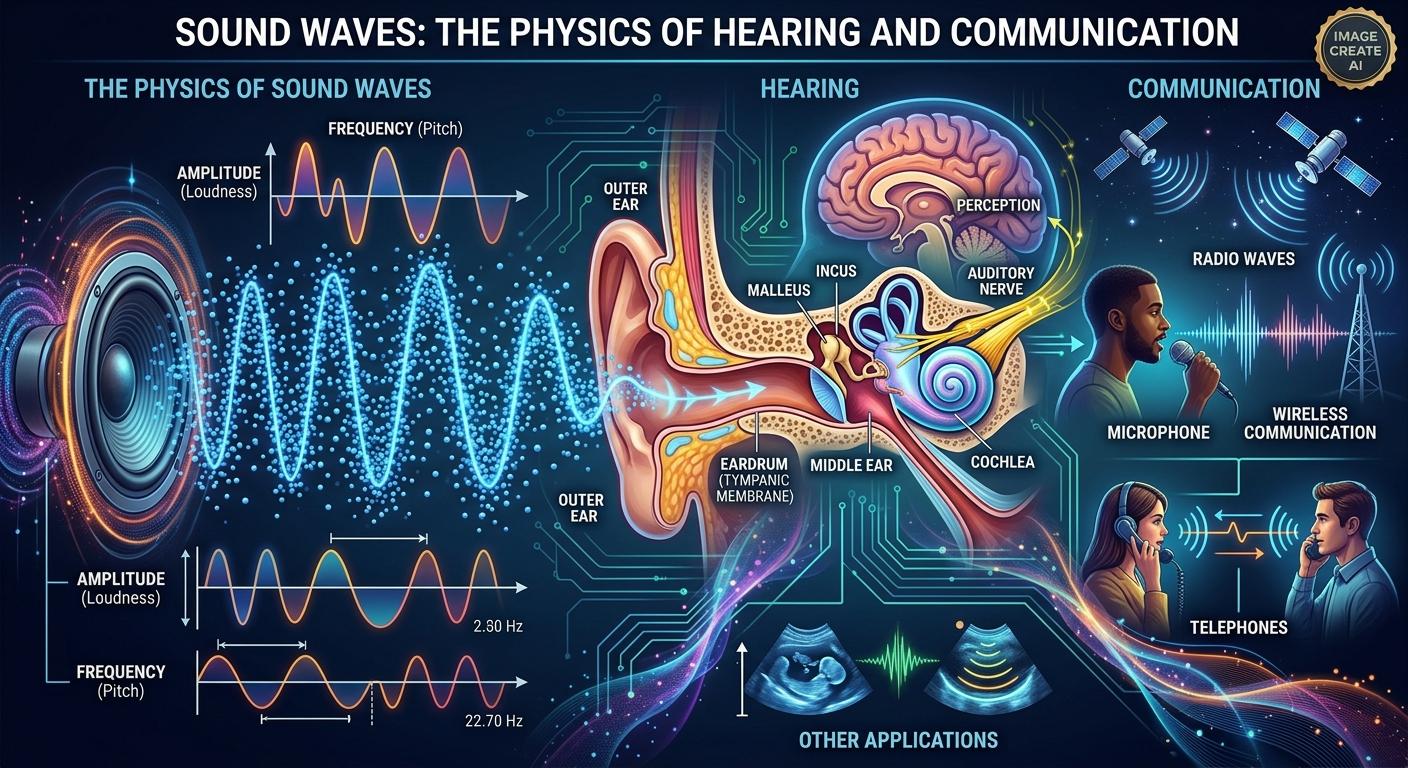
The characteristics of sound include **frequency, amplitude, wavelength, and speed**. Frequency determines the **pitch** of a sound: higher frequencies produce higher-pitched sounds, while lower frequencies produce deeper sounds. Amplitude is related to the **loudness** of a sound. Larger vibrations generally create louder sounds.
Our ears are remarkable organs designed to detect these waves. Sound waves enter the ear and cause the **eardrum** to vibrate. These vibrations are transmitted through tiny bones in the middle ear and eventually reach the inner ear, where specialized cells convert them into electrical signals. The brain then interprets these signals as meaningful sounds.
Sound waves also play a vital role in **human communication**. When we speak, our vocal cords vibrate and produce sound waves. These waves travel through the air to another person's ears, allowing them to hear and understand our words. Modern technology uses the same principles in telephones, microphones, radios, and other communication devices.
The study of sound helps us understand not only hearing and communication but also music, medicine, engineering, and technology. From the simple vibration of a guitar string to advanced ultrasound technology, sound waves demonstrate the fascinating connection between **physics and everyday life**.
**Sound is more than something we hear—it is energy in motion, carrying information and connecting us with the world around us.**
#SoundWaves #Physics #Science #Hearing #Communication #Education #Learning #Waves #Technology
Roll no.239
Canva Post no.49
Foundation Level
Sound is an essential part of our everyday lives. We hear people speaking, music playing, birds singing, and many other sounds around us. But have you ever wondered how sound travels from one place to another? The answer lies in **sound waves**—vibrations that carry energy through a medium such as air, water, or solids.
Sound is produced when an object **vibrates**. These vibrations cause nearby particles to move back and forth, creating a series of compressions and rarefactions. This movement travels outward as a wave. Unlike light, sound cannot travel through a vacuum because it needs particles to carry the vibrations.
The characteristics of sound include **frequency, amplitude, wavelength, and speed**. Frequency determines the **pitch** of a sound: higher frequencies produce higher-pitched sounds, while lower frequencies produce deeper sounds. Amplitude is related to the **loudness** of a sound. Larger vibrations generally create louder sounds.
Our ears are remarkable organs designed to detect these waves. Sound waves enter the ear and cause the **eardrum** to vibrate. These vibrations are transmitted through tiny bones in the middle ear and eventually reach the inner ear, where specialized cells convert them into electrical signals. The brain then interprets these signals as meaningful sounds.
Sound waves also play a vital role in **human communication**. When we speak, our vocal cords vibrate and produce sound waves. These waves travel through the air to another person's ears, allowing them to hear and understand our words. Modern technology uses the same principles in telephones, microphones, radios, and other communication devices.
The study of sound helps us understand not only hearing and communication but also music, medicine, engineering, and technology. From the simple vibration of a guitar string to advanced ultrasound technology, sound waves demonstrate the fascinating connection between **physics and everyday life**.
**Sound is more than something we hear—it is energy in motion, carrying information and connecting us with the world around us.**
#SoundWaves #Physics #Science #Hearing #Communication #Education #Learning #Waves #Technology
#rsisb
Roll no.239
Canva Post no.49
Foundation Level
Sound is an essential part of our everyday lives. We hear people speaking, music playing, birds singing, and many other sounds around us. But have you ever wondered how sound travels from one place to another? The answer lies in **sound waves**—vibrations that carry energy through a medium such as air, water, or solids.
Sound is produced when an object **vibrates**. These vibrations cause nearby particles to move back and forth, creating a series of compressions and rarefactions. This movement travels outward as a wave. Unlike light, sound cannot travel through a vacuum because it needs particles to carry the vibrations.
The characteristics of sound include **frequency, amplitude, wavelength, and speed**. Frequency determines the **pitch** of a sound: higher frequencies produce higher-pitched sounds, while lower frequencies produce deeper sounds. Amplitude is related to the **loudness** of a sound. Larger vibrations generally create louder sounds.
Our ears are remarkable organs designed to detect these waves. Sound waves enter the ear and cause the **eardrum** to vibrate. These vibrations are transmitted through tiny bones in the middle ear and eventually reach the inner ear, where specialized cells convert them into electrical signals. The brain then interprets these signals as meaningful sounds.
Sound waves also play a vital role in **human communication**. When we speak, our vocal cords vibrate and produce sound waves. These waves travel through the air to another person's ears, allowing them to hear and understand our words. Modern technology uses the same principles in telephones, microphones, radios, and other communication devices.
The study of sound helps us understand not only hearing and communication but also music, medicine, engineering, and technology. From the simple vibration of a guitar string to advanced ultrasound technology, sound waves demonstrate the fascinating connection between **physics and everyday life**.
🌟 **Sound is more than something we hear—it is energy in motion, carrying information and connecting us with the world around us.**
#SoundWaves #Physics #Science #Hearing #Communication #Education #Learning #Waves #Technology 🔊🌍🎵
0 Commenti
0 condivisioni
50 Views