


Day:-48
rollno:-006
foundation level
Story Post
# The Journey of Dinosaurs: A Scientific Perspective
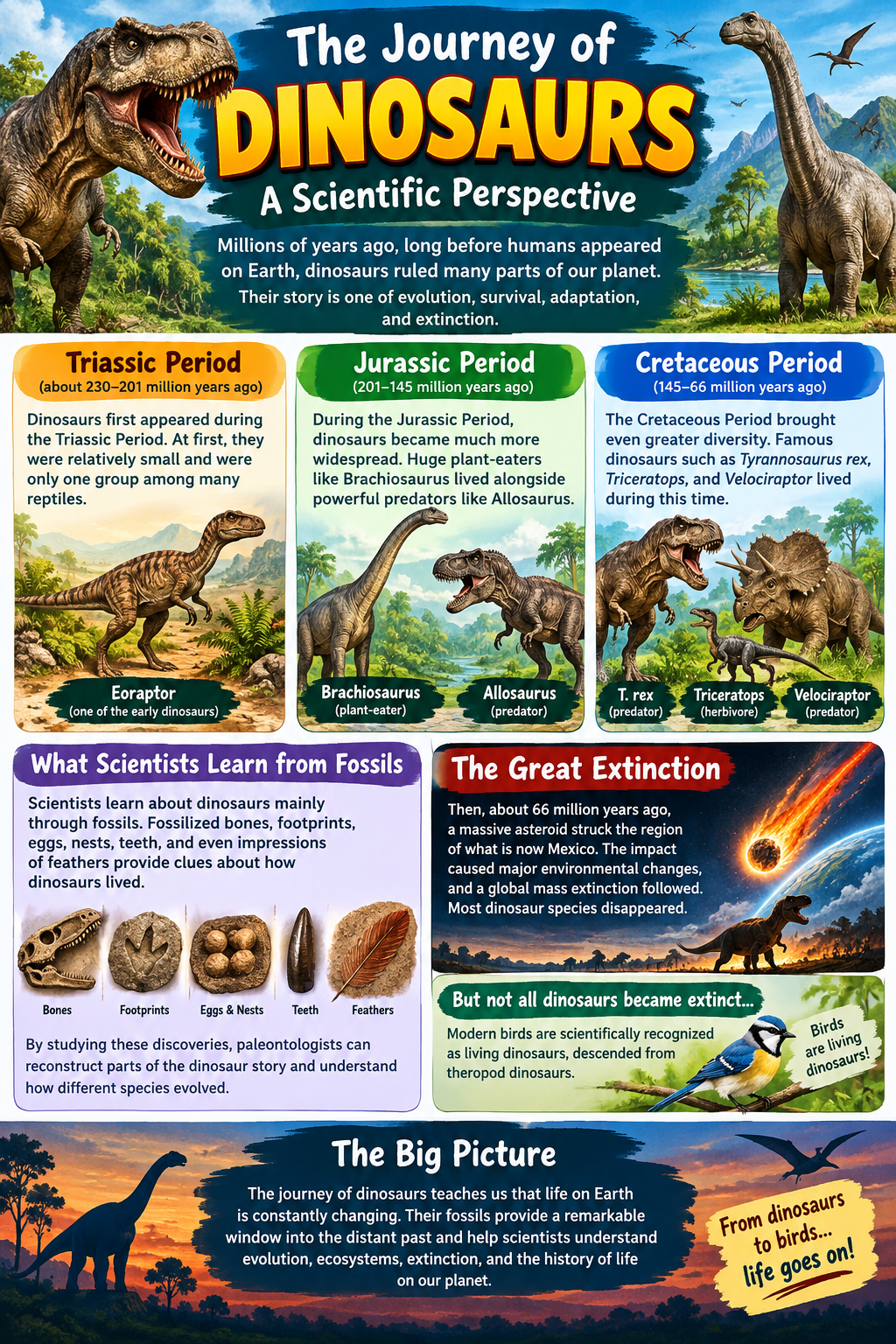
Millions of years ago, long before humans appeared on Earth, dinosaurs ruled many parts of our planet. Their story is one of evolution, survival, adaptation, and extinction.
Dinosaurs first appeared during the **Triassic Period, about 230 million years ago**. At first, they were relatively small and were only one group among many reptiles. Over millions of years, however, dinosaurs evolved into an incredible variety of species.
During the **Jurassic Period**, dinosaurs became much more widespread. Huge plant-eating dinosaurs such as *Brachiosaurus* lived alongside powerful predators such as *Allosaurus*. Some dinosaurs developed long necks, sharp teeth, armor, horns, or other features that helped them survive in their environments.
The **Cretaceous Period** brought even greater diversity. Famous dinosaurs such as *Tyrannosaurus rex*, *Triceratops*, and *Velociraptor* lived during this time. Scientists believe dinosaurs occupied many different habitats and had complex behaviors, including nesting, caring for young, hunting, and possibly communicating with one another.
Scientists learn about dinosaurs mainly through **fossils**. Fossilized bones, footprints, eggs, nests, teeth, and even impressions of feathers provide clues about how dinosaurs lived. By studying these discoveries, paleontologists can reconstruct parts of the dinosaur story and understand how different species evolved.
Then, about **66 million years ago**, a massive asteroid struck the region of what is now Mexico. The impact caused major environmental changes, and a global mass extinction followed. Most dinosaur species disappeared. However, not all dinosaurs became extinct.
Modern birds are scientifically recognized as **living dinosaurs**, descended from theropod dinosaurs. This means that although non-avian dinosaurs such as *T. rex* are gone, their evolutionary legacy continues today in birds.
The journey of dinosaurs teaches us that life on Earth is constantly changing. Their fossils provide a remarkable window into the distant past and help scientists understand evolution, ecosystems, extinction, and the history of life on our planet.
rollno:-006
foundation level
Story Post
# The Journey of Dinosaurs: A Scientific Perspective
Millions of years ago, long before humans appeared on Earth, dinosaurs ruled many parts of our planet. Their story is one of evolution, survival, adaptation, and extinction.
Dinosaurs first appeared during the **Triassic Period, about 230 million years ago**. At first, they were relatively small and were only one group among many reptiles. Over millions of years, however, dinosaurs evolved into an incredible variety of species.
During the **Jurassic Period**, dinosaurs became much more widespread. Huge plant-eating dinosaurs such as *Brachiosaurus* lived alongside powerful predators such as *Allosaurus*. Some dinosaurs developed long necks, sharp teeth, armor, horns, or other features that helped them survive in their environments.
The **Cretaceous Period** brought even greater diversity. Famous dinosaurs such as *Tyrannosaurus rex*, *Triceratops*, and *Velociraptor* lived during this time. Scientists believe dinosaurs occupied many different habitats and had complex behaviors, including nesting, caring for young, hunting, and possibly communicating with one another.
Scientists learn about dinosaurs mainly through **fossils**. Fossilized bones, footprints, eggs, nests, teeth, and even impressions of feathers provide clues about how dinosaurs lived. By studying these discoveries, paleontologists can reconstruct parts of the dinosaur story and understand how different species evolved.
Then, about **66 million years ago**, a massive asteroid struck the region of what is now Mexico. The impact caused major environmental changes, and a global mass extinction followed. Most dinosaur species disappeared. However, not all dinosaurs became extinct.
Modern birds are scientifically recognized as **living dinosaurs**, descended from theropod dinosaurs. This means that although non-avian dinosaurs such as *T. rex* are gone, their evolutionary legacy continues today in birds.
The journey of dinosaurs teaches us that life on Earth is constantly changing. Their fossils provide a remarkable window into the distant past and help scientists understand evolution, ecosystems, extinction, and the history of life on our planet.
Day:-48
rollno:-006
foundation level
📖 Story Post
# 🦖 The Journey of Dinosaurs: A Scientific Perspective
Millions of years ago, long before humans appeared on Earth, dinosaurs ruled many parts of our planet. Their story is one of evolution, survival, adaptation, and extinction.
Dinosaurs first appeared during the **Triassic Period, about 230 million years ago**. At first, they were relatively small and were only one group among many reptiles. Over millions of years, however, dinosaurs evolved into an incredible variety of species.
During the **Jurassic Period**, dinosaurs became much more widespread. Huge plant-eating dinosaurs such as *Brachiosaurus* lived alongside powerful predators such as *Allosaurus*. Some dinosaurs developed long necks, sharp teeth, armor, horns, or other features that helped them survive in their environments.
The **Cretaceous Period** brought even greater diversity. Famous dinosaurs such as *Tyrannosaurus rex*, *Triceratops*, and *Velociraptor* lived during this time. Scientists believe dinosaurs occupied many different habitats and had complex behaviors, including nesting, caring for young, hunting, and possibly communicating with one another.
Scientists learn about dinosaurs mainly through **fossils**. Fossilized bones, footprints, eggs, nests, teeth, and even impressions of feathers provide clues about how dinosaurs lived. By studying these discoveries, paleontologists can reconstruct parts of the dinosaur story and understand how different species evolved.
Then, about **66 million years ago**, a massive asteroid struck the region of what is now Mexico. The impact caused major environmental changes, and a global mass extinction followed. Most dinosaur species disappeared. However, not all dinosaurs became extinct.
Modern birds are scientifically recognized as **living dinosaurs**, descended from theropod dinosaurs. This means that although non-avian dinosaurs such as *T. rex* are gone, their evolutionary legacy continues today in birds.
The journey of dinosaurs teaches us that life on Earth is constantly changing. Their fossils provide a remarkable window into the distant past and help scientists understand evolution, ecosystems, extinction, and the history of life on our planet.
0 Kommentare
0 Anteile
1307 Ansichten