


#rsisb
Roll No 253
Foundation Level
Story Post 22
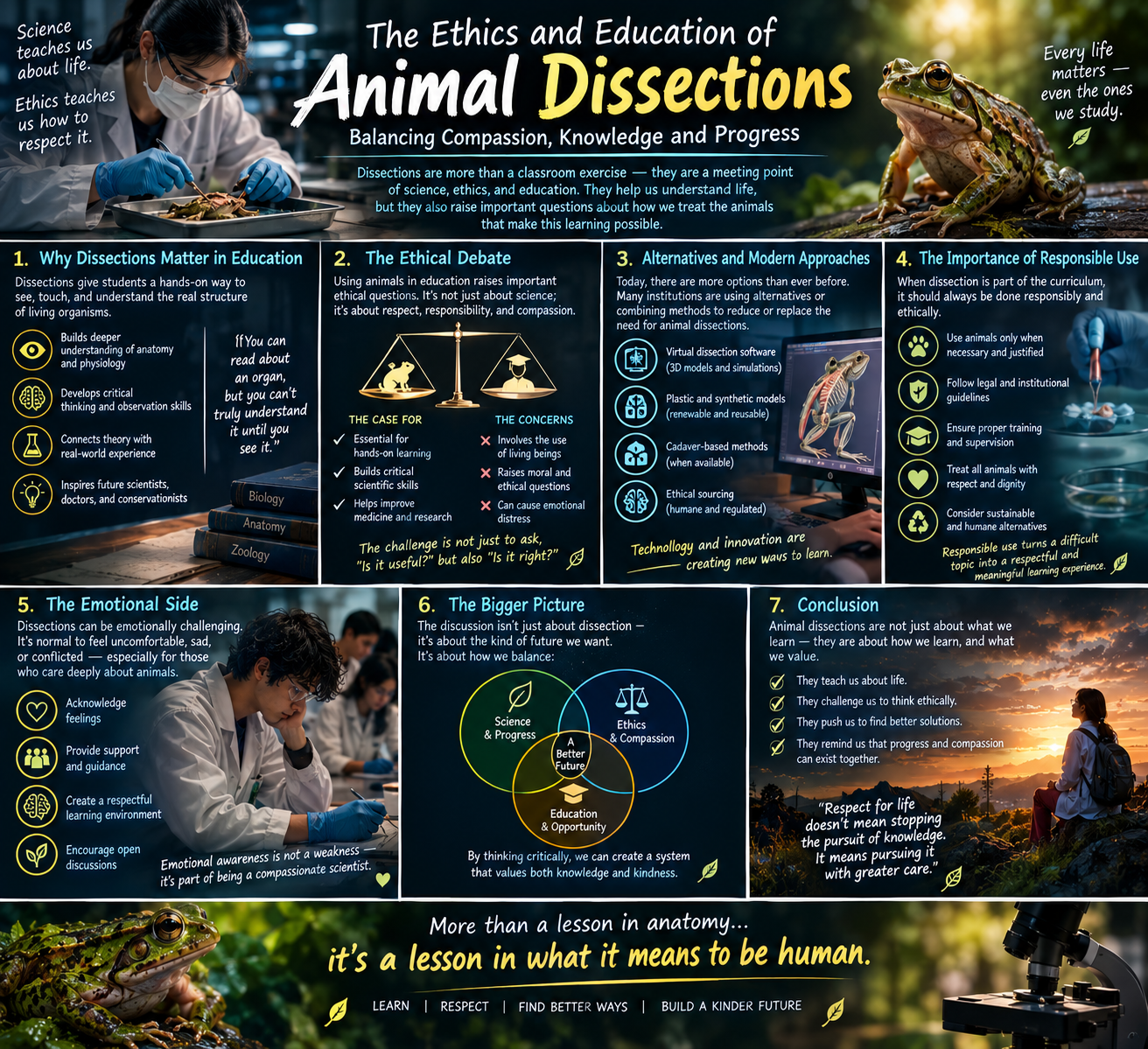
# The Ethics and Education of Animal Dissections
## Balancing Knowledge, Compassion, and Scientific Progress
Animal dissections have long been used to help students understand anatomy, physiology, and the remarkable complexity of living organisms.
But dissection is more than a scientific technique.
It also raises an important question:
### **How can we learn about life while treating life with respect?**
Understanding both the educational value and the ethical considerations surrounding dissections allows us to approach biology with greater knowledge, responsibility, and compassion.
---
## 1. Why Dissections Matter in Education
Dissections can provide students with a direct way to explore biological structures that are difficult to fully understand through diagrams or textbooks alone.
They can help learners:
Observe real anatomy
Develop critical thinking
Understand organ relationships
Connect theory with physical structures
Build curiosity about living systems
Instead of simply memorizing the location of an organ, students can investigate how structures are positioned and connected.
### **It turns biological concepts into something tangible.**
---
## 2. The Ethical Debate
Using animals for education creates a genuine ethical discussion.
On one side, supporters may point to the educational benefits of direct anatomical study.
On the other, concerns include:
The use of living organisms
Animal welfare
Moral responsibility
Whether alternatives can provide similar educational value
The central question isn't simply:
**“Is it useful?”**
It is also:
### **“Is it justified, and can the same learning goals be achieved another way?”**
Considering both questions encourages students to think scientifically **and ethically**.
---
## 3. Alternatives and Modern Approaches
Technology has created new ways to study anatomy without always relying on traditional dissection.
Modern educational approaches can include:
Virtual dissection software
3D anatomical models
Synthetic or plastic models
Interactive simulations
Microscopic analysis
High-quality anatomical imagery
These tools can allow students to explore structures repeatedly, change viewpoints, and investigate complex systems in ways that may be difficult with a physical specimen.
### **Technology is creating new possibilities for learning.**
---
## 4. The Importance of Responsible Use
When animal specimens are used for education or research, responsibility is essential.
Important principles include:
Following relevant laws and institutional guidelines
Providing proper training and supervision
Using animals only when scientifically or educationally justified
Treating specimens respectfully
Considering sustainable and humane alternatives
Responsible scientific education isn't simply about obtaining knowledge.
It is about **how that knowledge is obtained.**
---
## 5. The Emotional Side
Dissection can affect students differently.
Some may feel fascinated by anatomy.
Others may feel uncomfortable.
Some may experience sadness or conflict because they care deeply about animals.
These reactions shouldn't automatically be dismissed.
A respectful educational environment can encourage students to:
Acknowledge their emotions
Discuss concerns openly
Support one another
Maintain scientific curiosity
Develop compassion
### **Emotional awareness can be part of becoming a responsible scientist.**
---
# 6. The Bigger Picture
The debate surrounding animal dissection isn't simply about choosing **science or compassion**.
It is about finding ways for:
**Scientific progress**
**Ethical responsibility**
**Education**
**Compassion**
to coexist.
The goal is to create learning environments where students can develop strong scientific knowledge while also thinking carefully about the consequences of scientific practices.
### **Knowledge and compassion don't have to be opposites.**
---
## 7. What Dissections Can Teach Us
When conducted appropriately, anatomical study can teach lessons that extend beyond individual organs.
It can teach us about:
The complexity of life
Biological organization
Interconnected systems
Evolution and adaptation
Scientific observation
Ethical decision-making
A specimen can become more than an anatomy lesson.
It can become an opportunity to ask **how we learn, why we learn, and what responsibilities come with knowledge.**
---
# 8. The Real Question
Perhaps the deepest question isn't simply:
**“Should animals be dissected?”**
It is:
How can we improve biological education?
How can we reduce unnecessary harm?
Which alternatives can provide meaningful learning?
How should scientists balance discovery with responsibility?
How can future generations learn with greater compassion?
These questions don't have to end scientific exploration.
They can make scientific exploration **more thoughtful.**
---
# The Bigger Lesson
Animal dissections can teach us about anatomy—but the discussion surrounding them can teach us something even larger.
### **Science teaches us how life works.**
### **Ethics asks us how we should treat it.**
### **Education gives us the opportunity to understand both.**
The future of science isn't only about discovering more.
It's also about learning to discover **responsibly.**
So when we look inside an organism to understand its anatomy, we should also look beyond the specimen and consider the larger picture:
**Respect life.**
**Pursue knowledge.**
**Think critically.**
**Explore better alternatives.**
**Build a more compassionate future.**
## **More than a lesson in anatomy—it's a lesson in what it means to learn responsibly.**
Asma Shaheen EducationWali
Saima Empowerment Wali
Mishaal TrainingWali
Roll No 253
Foundation Level
Story Post 22
# The Ethics and Education of Animal Dissections
## Balancing Knowledge, Compassion, and Scientific Progress
Animal dissections have long been used to help students understand anatomy, physiology, and the remarkable complexity of living organisms.
But dissection is more than a scientific technique.
It also raises an important question:
### **How can we learn about life while treating life with respect?**
Understanding both the educational value and the ethical considerations surrounding dissections allows us to approach biology with greater knowledge, responsibility, and compassion.
---
## 1. Why Dissections Matter in Education
Dissections can provide students with a direct way to explore biological structures that are difficult to fully understand through diagrams or textbooks alone.
They can help learners:
Observe real anatomy
Develop critical thinking
Understand organ relationships
Connect theory with physical structures
Build curiosity about living systems
Instead of simply memorizing the location of an organ, students can investigate how structures are positioned and connected.
### **It turns biological concepts into something tangible.**
---
## 2. The Ethical Debate
Using animals for education creates a genuine ethical discussion.
On one side, supporters may point to the educational benefits of direct anatomical study.
On the other, concerns include:
The use of living organisms
Animal welfare
Moral responsibility
Whether alternatives can provide similar educational value
The central question isn't simply:
**“Is it useful?”**
It is also:
### **“Is it justified, and can the same learning goals be achieved another way?”**
Considering both questions encourages students to think scientifically **and ethically**.
---
## 3. Alternatives and Modern Approaches
Technology has created new ways to study anatomy without always relying on traditional dissection.
Modern educational approaches can include:
Virtual dissection software
3D anatomical models
Synthetic or plastic models
Interactive simulations
Microscopic analysis
High-quality anatomical imagery
These tools can allow students to explore structures repeatedly, change viewpoints, and investigate complex systems in ways that may be difficult with a physical specimen.
### **Technology is creating new possibilities for learning.**
---
## 4. The Importance of Responsible Use
When animal specimens are used for education or research, responsibility is essential.
Important principles include:
Following relevant laws and institutional guidelines
Providing proper training and supervision
Using animals only when scientifically or educationally justified
Treating specimens respectfully
Considering sustainable and humane alternatives
Responsible scientific education isn't simply about obtaining knowledge.
It is about **how that knowledge is obtained.**
---
## 5. The Emotional Side
Dissection can affect students differently.
Some may feel fascinated by anatomy.
Others may feel uncomfortable.
Some may experience sadness or conflict because they care deeply about animals.
These reactions shouldn't automatically be dismissed.
A respectful educational environment can encourage students to:
Acknowledge their emotions
Discuss concerns openly
Support one another
Maintain scientific curiosity
Develop compassion
### **Emotional awareness can be part of becoming a responsible scientist.**
---
# 6. The Bigger Picture
The debate surrounding animal dissection isn't simply about choosing **science or compassion**.
It is about finding ways for:
**Scientific progress**
**Ethical responsibility**
**Education**
**Compassion**
to coexist.
The goal is to create learning environments where students can develop strong scientific knowledge while also thinking carefully about the consequences of scientific practices.
### **Knowledge and compassion don't have to be opposites.**
---
## 7. What Dissections Can Teach Us
When conducted appropriately, anatomical study can teach lessons that extend beyond individual organs.
It can teach us about:
The complexity of life
Biological organization
Interconnected systems
Evolution and adaptation
Scientific observation
Ethical decision-making
A specimen can become more than an anatomy lesson.
It can become an opportunity to ask **how we learn, why we learn, and what responsibilities come with knowledge.**
---
# 8. The Real Question
Perhaps the deepest question isn't simply:
**“Should animals be dissected?”**
It is:
How can we improve biological education?
How can we reduce unnecessary harm?
Which alternatives can provide meaningful learning?
How should scientists balance discovery with responsibility?
How can future generations learn with greater compassion?
These questions don't have to end scientific exploration.
They can make scientific exploration **more thoughtful.**
---
# The Bigger Lesson
Animal dissections can teach us about anatomy—but the discussion surrounding them can teach us something even larger.
### **Science teaches us how life works.**
### **Ethics asks us how we should treat it.**
### **Education gives us the opportunity to understand both.**
The future of science isn't only about discovering more.
It's also about learning to discover **responsibly.**
So when we look inside an organism to understand its anatomy, we should also look beyond the specimen and consider the larger picture:
**Respect life.**
**Pursue knowledge.**
**Think critically.**
**Explore better alternatives.**
**Build a more compassionate future.**
## **More than a lesson in anatomy—it's a lesson in what it means to learn responsibly.**
Asma Shaheen EducationWali
Saima Empowerment Wali
Mishaal TrainingWali
#rsisb
Roll No 253
Foundation Level
Story Post 22
# 🐸🔬 The Ethics and Education of Animal Dissections
## 🌿⚖️ Balancing Knowledge, Compassion, and Scientific Progress
Animal dissections have long been used to help students understand anatomy, physiology, and the remarkable complexity of living organisms. 🧬🫀🔬
But dissection is more than a scientific technique.
It also raises an important question:
### **How can we learn about life while treating life with respect?** 🐾❤️
Understanding both the educational value and the ethical considerations surrounding dissections allows us to approach biology with greater knowledge, responsibility, and compassion.
---
## 🎓🔬 1. Why Dissections Matter in Education
Dissections can provide students with a direct way to explore biological structures that are difficult to fully understand through diagrams or textbooks alone. 📚➡️🔬
They can help learners:
👁️ Observe real anatomy
🧠 Develop critical thinking
🫀 Understand organ relationships
🔬 Connect theory with physical structures
🌱 Build curiosity about living systems
Instead of simply memorizing the location of an organ, students can investigate how structures are positioned and connected.
### **It turns biological concepts into something tangible.** ✨
---
## ⚖️🐾 2. The Ethical Debate
Using animals for education creates a genuine ethical discussion.
On one side, supporters may point to the educational benefits of direct anatomical study. 🎓🔬
On the other, concerns include:
🐾 The use of living organisms
❤️ Animal welfare
🧠 Moral responsibility
🌱 Whether alternatives can provide similar educational value
The central question isn't simply:
**“Is it useful?”**
It is also:
### **“Is it justified, and can the same learning goals be achieved another way?”** ⚖️
Considering both questions encourages students to think scientifically **and ethically**.
---
## 💻🧬 3. Alternatives and Modern Approaches
Technology has created new ways to study anatomy without always relying on traditional dissection. 🚀🔬
Modern educational approaches can include:
💻 Virtual dissection software
🧊 3D anatomical models
🧫 Synthetic or plastic models
🖥️ Interactive simulations
🔬 Microscopic analysis
📚 High-quality anatomical imagery
These tools can allow students to explore structures repeatedly, change viewpoints, and investigate complex systems in ways that may be difficult with a physical specimen.
### **Technology is creating new possibilities for learning.** 💡🌍
---
## 🧤🐸 4. The Importance of Responsible Use
When animal specimens are used for education or research, responsibility is essential. ⚖️🔬
Important principles include:
📜 Following relevant laws and institutional guidelines
🎓 Providing proper training and supervision
🐾 Using animals only when scientifically or educationally justified
❤️ Treating specimens respectfully
♻️ Considering sustainable and humane alternatives
Responsible scientific education isn't simply about obtaining knowledge.
It is about **how that knowledge is obtained.**
---
## 💭❤️ 5. The Emotional Side
Dissection can affect students differently.
Some may feel fascinated by anatomy. 🔬
Others may feel uncomfortable. 😟
Some may experience sadness or conflict because they care deeply about animals. 🐾❤️
These reactions shouldn't automatically be dismissed.
A respectful educational environment can encourage students to:
🧠 Acknowledge their emotions
💬 Discuss concerns openly
🤝 Support one another
🔬 Maintain scientific curiosity
❤️ Develop compassion
### **Emotional awareness can be part of becoming a responsible scientist.**
---
# 🌍⚖️ 6. The Bigger Picture
The debate surrounding animal dissection isn't simply about choosing **science or compassion**.
It is about finding ways for:
🔬 **Scientific progress**
⚖️ **Ethical responsibility**
🎓 **Education**
❤️ **Compassion**
to coexist.
The goal is to create learning environments where students can develop strong scientific knowledge while also thinking carefully about the consequences of scientific practices.
### **Knowledge and compassion don't have to be opposites.** 🌱✨
---
## 🧬📚 7. What Dissections Can Teach Us
When conducted appropriately, anatomical study can teach lessons that extend beyond individual organs.
It can teach us about:
🫀 The complexity of life
🧬 Biological organization
🔗 Interconnected systems
🌱 Evolution and adaptation
🔬 Scientific observation
⚖️ Ethical decision-making
A specimen can become more than an anatomy lesson.
It can become an opportunity to ask **how we learn, why we learn, and what responsibilities come with knowledge.** 🧠✨
---
# 🌅🌎 8. The Real Question
Perhaps the deepest question isn't simply:
**“Should animals be dissected?”**
It is:
❓ How can we improve biological education?
❓ How can we reduce unnecessary harm?
❓ Which alternatives can provide meaningful learning?
❓ How should scientists balance discovery with responsibility?
❓ How can future generations learn with greater compassion?
These questions don't have to end scientific exploration.
They can make scientific exploration **more thoughtful.** 🔬❤️
---
# 🐸💚 The Bigger Lesson
Animal dissections can teach us about anatomy—but the discussion surrounding them can teach us something even larger.
### **Science teaches us how life works.** 🔬
### **Ethics asks us how we should treat it.** ⚖️
### **Education gives us the opportunity to understand both.** 🎓
The future of science isn't only about discovering more.
It's also about learning to discover **responsibly.** 🌍🧬
So when we look inside an organism to understand its anatomy, we should also look beyond the specimen and consider the larger picture:
🐾 **Respect life.**
🔬 **Pursue knowledge.**
🧠 **Think critically.**
💡 **Explore better alternatives.**
🌱 **Build a more compassionate future.**
## ✨ **More than a lesson in anatomy—it's a lesson in what it means to learn responsibly.** 🐸🔬❤️
Asma Shaheen EducationWali
Saima Empowerment Wali
Mishaal TrainingWali
0 Kommentare
0 Anteile
117 Ansichten