


#rsisb
Roll No 253
Foundation Level
Story Post 25
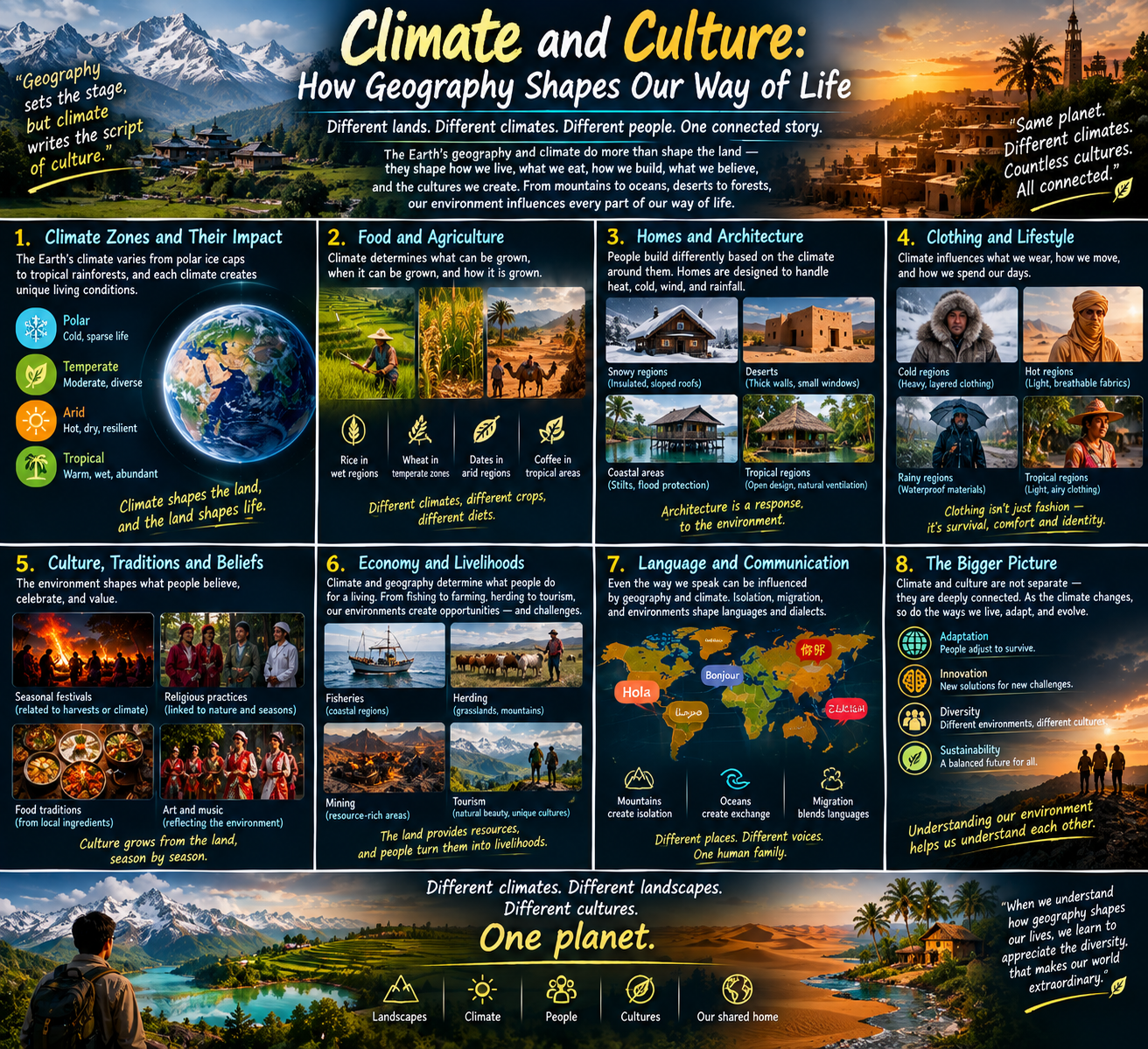
# Climate and Culture: How Geography Shapes Our Way of Life
Imagine placing a person in a frozen mountain valley , then moving them to a scorching desert , a tropical rainforest , or a coastline .
The landscape changes.
The weather changes.
And gradually, **the way people live changes too.**
Where we live influences what we eat , what we grow , how we build our homes , what we wear , how we earn a living , and even how communities develop traditions and identities.
---
# 1. Climate Zones and Their Impact
Earth contains an incredible variety of climates.
**Polar regions** — extremely cold and often sparsely populated
**Temperate regions** — moderate temperatures and diverse ecosystems
**Arid regions** — hot or dry conditions with limited rainfall
**Tropical regions** — warm temperatures and often abundant rainfall
These environments create different opportunities and challenges for human societies.
### **The climate shapes the environment—and people adapt to it.**
---
# 2. Food and Agriculture
Climate has a major influence on what can be grown and how agriculture is practiced.
Rice thrives in many warm, water-rich environments.
Wheat grows widely across temperate regions.
Dates are well adapted to hot, dry climates.
Coffee grows particularly well in suitable tropical highland environments.
These crops don't just provide food.
They can become part of a community's:
Cuisine
Economy
Festivals
Traditions
History
### **Different environments create different relationships with food.**
---
# 3. Homes and Architecture
Look at houses around the world and you'll often find clues about their environment.
**Cold regions** may use insulation and steep roofs to handle snow and retain heat.
**Desert regions** may use thick walls, shaded spaces, and smaller openings to reduce heat.
**Coastal regions** may use raised structures to reduce exposure to flooding.
**Tropical regions** often benefit from designs that encourage ventilation and manage heavy rainfall.
Architecture is therefore more than appearance.
### **Buildings are often human responses to climate.**
---
# 4. Clothing and Lifestyle
What people wear is also influenced by their environment.
Cold climates → layered and insulating clothing
Hot climates → lightweight, breathable fabrics
Rainy climates → water-resistant materials
But clothing isn't only about weather.
It can also express:
Identity
Tradition
Culture
Community
History
### **Clothing can be both practical and cultural.**
---
# 5. Culture, Traditions, and Beliefs
The environment can influence cultural practices in subtle and powerful ways.
Seasonal changes may shape festivals.
Harvest periods can become important community celebrations.
Local ingredients can influence traditional cuisine.
Natural landscapes may become part of stories, art, music, and cultural traditions.
Over generations, people develop ways of understanding and responding to the environments around them.
### **Culture grows through the interaction between people, place, and history.**
---
# 6. Economy and Livelihoods
Geography also influences how people make a living.
Coastal communities may depend on fishing.
Mountain regions may support tourism or livestock herding.
Fertile areas can support agriculture.
Resource-rich regions may develop mining industries.
Beautiful landscapes can attract tourism.
Climate doesn't determine a person's occupation by itself—technology, markets, history, politics, and many other factors matter too.
But geography can create **opportunities and constraints** that shape economic life.
---
# 7. Language and Communication
Human geography can even influence how languages develop and spread.
Mountains and difficult terrain can sometimes separate communities, allowing linguistic differences to develop over time.
Rivers, oceans, migration, trade, and cities can connect people and encourage languages to interact.
Languages carry traces of human movement and cultural exchange.
### **Different places can create different voices—while connection brings them together.**
---
# 8. The Bigger Picture
Climate and culture aren't isolated subjects.
They are part of a much larger system.
Climate influences environments.
Environments provide resources and constraints.
People adapt and innovate.
Communities develop ways of living.
Traditions and identities evolve.
Migration and technology create new connections.
And these relationships are constantly changing.
Climate patterns shift.
Technology advances.
Cities grow.
People migrate.
Cultures interact.
### **Human societies are always adapting to a changing world.**
---
# The Bigger Lesson
There is no single way to live.
Across our planet, humans have created extraordinary diversity in response to different landscapes, climates, histories, and social conditions.
From mountain villages to desert communities …
From tropical islands to northern settlements …
People have found creative ways to build homes, grow food, form communities, and create cultures.
Yet beneath all that diversity is something we share:
### **One planet. One interconnected human story.**
When we understand how geography and climate influence human life, we gain a deeper appreciation for why cultures can be so different—and why they are all part of the same extraordinary world.
# **Different climates. Different landscapes. Different cultures. One planet.**
Asma Shaheen EducationWali
Saima Empowerment Wali
Mishaal TrainingWali
Roll No 253
Foundation Level
Story Post 25
# Climate and Culture: How Geography Shapes Our Way of Life
Imagine placing a person in a frozen mountain valley , then moving them to a scorching desert , a tropical rainforest , or a coastline .
The landscape changes.
The weather changes.
And gradually, **the way people live changes too.**
Where we live influences what we eat , what we grow , how we build our homes , what we wear , how we earn a living , and even how communities develop traditions and identities.
---
# 1. Climate Zones and Their Impact
Earth contains an incredible variety of climates.
**Polar regions** — extremely cold and often sparsely populated
**Temperate regions** — moderate temperatures and diverse ecosystems
**Arid regions** — hot or dry conditions with limited rainfall
**Tropical regions** — warm temperatures and often abundant rainfall
These environments create different opportunities and challenges for human societies.
### **The climate shapes the environment—and people adapt to it.**
---
# 2. Food and Agriculture
Climate has a major influence on what can be grown and how agriculture is practiced.
Rice thrives in many warm, water-rich environments.
Wheat grows widely across temperate regions.
Dates are well adapted to hot, dry climates.
Coffee grows particularly well in suitable tropical highland environments.
These crops don't just provide food.
They can become part of a community's:
Cuisine
Economy
Festivals
Traditions
History
### **Different environments create different relationships with food.**
---
# 3. Homes and Architecture
Look at houses around the world and you'll often find clues about their environment.
**Cold regions** may use insulation and steep roofs to handle snow and retain heat.
**Desert regions** may use thick walls, shaded spaces, and smaller openings to reduce heat.
**Coastal regions** may use raised structures to reduce exposure to flooding.
**Tropical regions** often benefit from designs that encourage ventilation and manage heavy rainfall.
Architecture is therefore more than appearance.
### **Buildings are often human responses to climate.**
---
# 4. Clothing and Lifestyle
What people wear is also influenced by their environment.
Cold climates → layered and insulating clothing
Hot climates → lightweight, breathable fabrics
Rainy climates → water-resistant materials
But clothing isn't only about weather.
It can also express:
Identity
Tradition
Culture
Community
History
### **Clothing can be both practical and cultural.**
---
# 5. Culture, Traditions, and Beliefs
The environment can influence cultural practices in subtle and powerful ways.
Seasonal changes may shape festivals.
Harvest periods can become important community celebrations.
Local ingredients can influence traditional cuisine.
Natural landscapes may become part of stories, art, music, and cultural traditions.
Over generations, people develop ways of understanding and responding to the environments around them.
### **Culture grows through the interaction between people, place, and history.**
---
# 6. Economy and Livelihoods
Geography also influences how people make a living.
Coastal communities may depend on fishing.
Mountain regions may support tourism or livestock herding.
Fertile areas can support agriculture.
Resource-rich regions may develop mining industries.
Beautiful landscapes can attract tourism.
Climate doesn't determine a person's occupation by itself—technology, markets, history, politics, and many other factors matter too.
But geography can create **opportunities and constraints** that shape economic life.
---
# 7. Language and Communication
Human geography can even influence how languages develop and spread.
Mountains and difficult terrain can sometimes separate communities, allowing linguistic differences to develop over time.
Rivers, oceans, migration, trade, and cities can connect people and encourage languages to interact.
Languages carry traces of human movement and cultural exchange.
### **Different places can create different voices—while connection brings them together.**
---
# 8. The Bigger Picture
Climate and culture aren't isolated subjects.
They are part of a much larger system.
Climate influences environments.
Environments provide resources and constraints.
People adapt and innovate.
Communities develop ways of living.
Traditions and identities evolve.
Migration and technology create new connections.
And these relationships are constantly changing.
Climate patterns shift.
Technology advances.
Cities grow.
People migrate.
Cultures interact.
### **Human societies are always adapting to a changing world.**
---
# The Bigger Lesson
There is no single way to live.
Across our planet, humans have created extraordinary diversity in response to different landscapes, climates, histories, and social conditions.
From mountain villages to desert communities …
From tropical islands to northern settlements …
People have found creative ways to build homes, grow food, form communities, and create cultures.
Yet beneath all that diversity is something we share:
### **One planet. One interconnected human story.**
When we understand how geography and climate influence human life, we gain a deeper appreciation for why cultures can be so different—and why they are all part of the same extraordinary world.
# **Different climates. Different landscapes. Different cultures. One planet.**
Asma Shaheen EducationWali
Saima Empowerment Wali
Mishaal TrainingWali
#rsisb
Roll No 253
Foundation Level
Story Post 25
# 🌍🌦️ Climate and Culture: How Geography Shapes Our Way of Life
Imagine placing a person in a frozen mountain valley 🏔️❄️, then moving them to a scorching desert 🏜️☀️, a tropical rainforest 🌴🌧️, or a coastline 🌊🐚.
The landscape changes.
The weather changes.
And gradually, **the way people live changes too.** 🧑🤝🧑🌎
Where we live influences what we eat 🍚, what we grow 🌾, how we build our homes 🏠, what we wear 👕, how we earn a living 💼, and even how communities develop traditions and identities. 🎭🎶
---
# 🌡️🌍 1. Climate Zones and Their Impact
Earth contains an incredible variety of climates.
❄️ **Polar regions** — extremely cold and often sparsely populated
🌿 **Temperate regions** — moderate temperatures and diverse ecosystems
🏜️ **Arid regions** — hot or dry conditions with limited rainfall
🌴 **Tropical regions** — warm temperatures and often abundant rainfall
These environments create different opportunities and challenges for human societies.
### **The climate shapes the environment—and people adapt to it.** 🌱🧠
---
# 🌾🍎 2. Food and Agriculture
Climate has a major influence on what can be grown and how agriculture is practiced. 🌱☀️💧
Rice thrives in many warm, water-rich environments. 🍚
Wheat grows widely across temperate regions. 🌾
Dates are well adapted to hot, dry climates. 🌴
Coffee grows particularly well in suitable tropical highland environments. ☕
These crops don't just provide food.
They can become part of a community's:
🍽️ Cuisine
💼 Economy
🎉 Festivals
👨👩👧👦 Traditions
🏛️ History
### **Different environments create different relationships with food.** 🌍🍴
---
# 🏠🏔️ 3. Homes and Architecture
Look at houses around the world and you'll often find clues about their environment. 🔍🌎
🏔️ **Cold regions** may use insulation and steep roofs to handle snow and retain heat.
🏜️ **Desert regions** may use thick walls, shaded spaces, and smaller openings to reduce heat.
🌊 **Coastal regions** may use raised structures to reduce exposure to flooding.
🌴 **Tropical regions** often benefit from designs that encourage ventilation and manage heavy rainfall.
Architecture is therefore more than appearance.
### **Buildings are often human responses to climate.** 🏠🌦️
---
# 👕🌬️ 4. Clothing and Lifestyle
What people wear is also influenced by their environment. 🧥☀️
❄️ Cold climates → layered and insulating clothing
☀️ Hot climates → lightweight, breathable fabrics
🌧️ Rainy climates → water-resistant materials
But clothing isn't only about weather.
It can also express:
🎨 Identity
🕌 Tradition
🎭 Culture
👨👩👧 Community
📜 History
### **Clothing can be both practical and cultural.** 👕🌍
---
# 🎭🌿 5. Culture, Traditions, and Beliefs
The environment can influence cultural practices in subtle and powerful ways.
Seasonal changes may shape festivals. 🌱🌾🎉
Harvest periods can become important community celebrations. 🌾🥁
Local ingredients can influence traditional cuisine. 🍲🌶️
Natural landscapes may become part of stories, art, music, and cultural traditions. 🏔️🎶🎨
Over generations, people develop ways of understanding and responding to the environments around them.
### **Culture grows through the interaction between people, place, and history.** 🌍❤️
---
# 💼🌾 6. Economy and Livelihoods
Geography also influences how people make a living.
🌊 Coastal communities may depend on fishing. 🐟
🏔️ Mountain regions may support tourism or livestock herding. 🐐
🌾 Fertile areas can support agriculture.
⛏️ Resource-rich regions may develop mining industries.
🏝️ Beautiful landscapes can attract tourism.
Climate doesn't determine a person's occupation by itself—technology, markets, history, politics, and many other factors matter too.
But geography can create **opportunities and constraints** that shape economic life. 🌎💼
---
# 🗣️🌍 7. Language and Communication
Human geography can even influence how languages develop and spread. 🗣️✨
Mountains and difficult terrain can sometimes separate communities, allowing linguistic differences to develop over time. 🏔️
Rivers, oceans, migration, trade, and cities can connect people and encourage languages to interact. 🌊🚢🏙️
Languages carry traces of human movement and cultural exchange.
### **Different places can create different voices—while connection brings them together.** 🗺️🗣️
---
# 🔄🌱 8. The Bigger Picture
Climate and culture aren't isolated subjects.
They are part of a much larger system. 🔗🌍
🌦️ Climate influences environments.
🌱 Environments provide resources and constraints.
👨👩👧 People adapt and innovate.
🏠 Communities develop ways of living.
🎭 Traditions and identities evolve.
🌍 Migration and technology create new connections.
And these relationships are constantly changing.
Climate patterns shift. 🌡️
Technology advances. 💻
Cities grow. 🏙️
People migrate. 🚶♂️
Cultures interact. 🤝
### **Human societies are always adapting to a changing world.**
---
# 🌍✨ The Bigger Lesson
There is no single way to live.
Across our planet, humans have created extraordinary diversity in response to different landscapes, climates, histories, and social conditions. 🏔️🏜️🌴🌊
From mountain villages 🏔️ to desert communities 🏜️…
From tropical islands 🌴 to northern settlements ❄️…
People have found creative ways to build homes, grow food, form communities, and create cultures.
Yet beneath all that diversity is something we share:
### 🌎 **One planet. One interconnected human story.**
When we understand how geography and climate influence human life, we gain a deeper appreciation for why cultures can be so different—and why they are all part of the same extraordinary world. 🌍🤝❤️
# 🌦️🏔️🏜️🌴 **Different climates. Different landscapes. Different cultures. One planet.** 🌎✨
Asma Shaheen EducationWali
Saima Empowerment Wali
Mishaal TrainingWali
0 Commentarii
0 Distribuiri
90 Views