


Mohsin #RSF8
#Storypost10
Class: Foundation level
Made by Me
rool no:13
The Wonders of Geometry: Shapes and Philosophy
Geometry is one of the oldest and most fascinating areas of mathematics. It is not simply the study of lines, angles, and shapes; it is a way of understanding the structure, patterns, balance, and beauty of the world around us. From the smallest natural patterns to huge buildings and bridges, geometry plays an important role in our everyday lives.
The topic “The Wonders of Geometry: Shapes and Philosophy” explores the beautiful relationship between mathematics and the ideas that humans have developed about order, harmony, proportion, symmetry, and perfection.
The Beauty of Circles
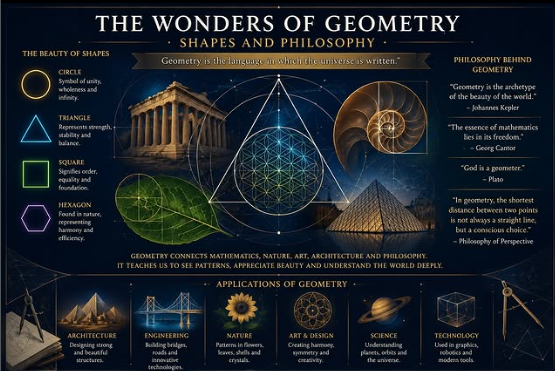
The circle is one of the most recognizable geometric shapes. It has no corners and every point on its boundary is the same distance from its center. Because of its continuous form, the circle is often associated with ideas such as unity, completeness, continuity, and infinity. We can see circles in wheels, clocks, planets, coins, lenses, and many designs around us.
The Strength of Triangles
Triangles are simple but incredibly important shapes. Their strong structure makes them useful in architecture and engineering. Bridges, roofs, towers, and other structures often use triangular designs because triangles provide stability. In geometry, triangles also help us understand angles, lengths, proportions, and many important mathematical relationships.
The Balance of Squares
The square represents equality, balance, order, and structure. All four of its sides are equal, and all four angles are right angles. Squares are commonly found in buildings, floor designs, windows, screens, tiles, artwork, and patterns. They demonstrate how mathematical rules can produce simple yet powerful designs.
⬡ The Harmony of Hexagons
Hexagons are another fascinating shape. They can be seen naturally in honeycombs and in various patterns found in science and nature. Hexagonal structures can efficiently cover a surface without leaving gaps, which makes them especially interesting from both mathematical and natural per
#Storypost10
Class: Foundation level
Made by Me
rool no:13
The Wonders of Geometry: Shapes and Philosophy
Geometry is one of the oldest and most fascinating areas of mathematics. It is not simply the study of lines, angles, and shapes; it is a way of understanding the structure, patterns, balance, and beauty of the world around us. From the smallest natural patterns to huge buildings and bridges, geometry plays an important role in our everyday lives.
The topic “The Wonders of Geometry: Shapes and Philosophy” explores the beautiful relationship between mathematics and the ideas that humans have developed about order, harmony, proportion, symmetry, and perfection.
The Beauty of Circles
The circle is one of the most recognizable geometric shapes. It has no corners and every point on its boundary is the same distance from its center. Because of its continuous form, the circle is often associated with ideas such as unity, completeness, continuity, and infinity. We can see circles in wheels, clocks, planets, coins, lenses, and many designs around us.
The Strength of Triangles
Triangles are simple but incredibly important shapes. Their strong structure makes them useful in architecture and engineering. Bridges, roofs, towers, and other structures often use triangular designs because triangles provide stability. In geometry, triangles also help us understand angles, lengths, proportions, and many important mathematical relationships.
The Balance of Squares
The square represents equality, balance, order, and structure. All four of its sides are equal, and all four angles are right angles. Squares are commonly found in buildings, floor designs, windows, screens, tiles, artwork, and patterns. They demonstrate how mathematical rules can produce simple yet powerful designs.
⬡ The Harmony of Hexagons
Hexagons are another fascinating shape. They can be seen naturally in honeycombs and in various patterns found in science and nature. Hexagonal structures can efficiently cover a surface without leaving gaps, which makes them especially interesting from both mathematical and natural per
Mohsin #RSF8🎓✨
#Storypost10
Class: Foundation level 📚
Made by Me 💻🚀
rool no:13
📐✨ The Wonders of Geometry: Shapes and Philosophy ✨📐
Geometry is one of the oldest and most fascinating areas of mathematics. It is not simply the study of lines, angles, and shapes; it is a way of understanding the structure, patterns, balance, and beauty of the world around us. From the smallest natural patterns to huge buildings and bridges, geometry plays an important role in our everyday lives.
The topic “The Wonders of Geometry: Shapes and Philosophy” explores the beautiful relationship between mathematics and the ideas that humans have developed about order, harmony, proportion, symmetry, and perfection.
🔵 The Beauty of Circles
The circle is one of the most recognizable geometric shapes. It has no corners and every point on its boundary is the same distance from its center. Because of its continuous form, the circle is often associated with ideas such as unity, completeness, continuity, and infinity. We can see circles in wheels, clocks, planets, coins, lenses, and many designs around us.
🔺 The Strength of Triangles
Triangles are simple but incredibly important shapes. Their strong structure makes them useful in architecture and engineering. Bridges, roofs, towers, and other structures often use triangular designs because triangles provide stability. In geometry, triangles also help us understand angles, lengths, proportions, and many important mathematical relationships.
⬜ The Balance of Squares
The square represents equality, balance, order, and structure. All four of its sides are equal, and all four angles are right angles. Squares are commonly found in buildings, floor designs, windows, screens, tiles, artwork, and patterns. They demonstrate how mathematical rules can produce simple yet powerful designs.
⬡ The Harmony of Hexagons
Hexagons are another fascinating shape. They can be seen naturally in honeycombs and in various patterns found in science and nature. Hexagonal structures can efficiently cover a surface without leaving gaps, which makes them especially interesting from both mathematical and natural per
0 Commenti
0 condivisioni
70 Views