


Mohsin RS F8
Story post NO:13
Class: Foundation Level
Made by Me
The Blueprint of Existence: Unraveling DNA and the Origins of Life explores one of the greatest scientific mysteries: what makes life possible, and how did life begin? At the center of this story is DNA, the remarkable molecule that stores and carries genetic information in almost every living organism. Often described as the “blueprint of life,” DNA contains the instructions that help cells grow, function, reproduce, and pass characteristics from one generation to the next.
DNA is built from four chemical bases—adenine, thymine, cytosine, and guanine—which are arranged in different sequences to encode biological information. Its famous double-helix structure allows genetic information to be stored efficiently and copied with remarkable accuracy. Small sections of DNA called genes provide instructions for producing proteins and regulating many of the processes that keep living organisms functioning. Although all humans share most of their DNA, small differences in our genetic sequences contribute to biological variation.
But the story of life reaches much further back than modern DNA. Scientists continue to investigate how the first self-replicating molecules and primitive cells could have emerged on the early Earth billions of years ago. The young Earth was very different from today, with active volcanoes, oceans, atmospheric changes, and numerous sources of chemical energy. These conditions may have allowed simple molecules to interact, combine, and gradually form increasingly complex chemical systems.
One important area of research focuses on the possibility that RNA-like molecules played an early role because RNA can both store information and participate in chemical reactions. Scientists also study ancient rocks, meteorites, laboratory experiments, and the chemistry of early Earth to understand which pathways could have led from non-living chemistry to the earliest forms of life. There is still no single confirmed explanation for exactly how life began, making the subject an active area of scientific research.
DNA also provides a powerful record of l
Story post NO:13
Class: Foundation Level
Made by Me
The Blueprint of Existence: Unraveling DNA and the Origins of Life explores one of the greatest scientific mysteries: what makes life possible, and how did life begin? At the center of this story is DNA, the remarkable molecule that stores and carries genetic information in almost every living organism. Often described as the “blueprint of life,” DNA contains the instructions that help cells grow, function, reproduce, and pass characteristics from one generation to the next.
DNA is built from four chemical bases—adenine, thymine, cytosine, and guanine—which are arranged in different sequences to encode biological information. Its famous double-helix structure allows genetic information to be stored efficiently and copied with remarkable accuracy. Small sections of DNA called genes provide instructions for producing proteins and regulating many of the processes that keep living organisms functioning. Although all humans share most of their DNA, small differences in our genetic sequences contribute to biological variation.
But the story of life reaches much further back than modern DNA. Scientists continue to investigate how the first self-replicating molecules and primitive cells could have emerged on the early Earth billions of years ago. The young Earth was very different from today, with active volcanoes, oceans, atmospheric changes, and numerous sources of chemical energy. These conditions may have allowed simple molecules to interact, combine, and gradually form increasingly complex chemical systems.
One important area of research focuses on the possibility that RNA-like molecules played an early role because RNA can both store information and participate in chemical reactions. Scientists also study ancient rocks, meteorites, laboratory experiments, and the chemistry of early Earth to understand which pathways could have led from non-living chemistry to the earliest forms of life. There is still no single confirmed explanation for exactly how life began, making the subject an active area of scientific research.
DNA also provides a powerful record of l
Mohsin RS F8 🎓✨
Story post NO:13
Class: Foundation Level 📚
Made by Me 💻🚀
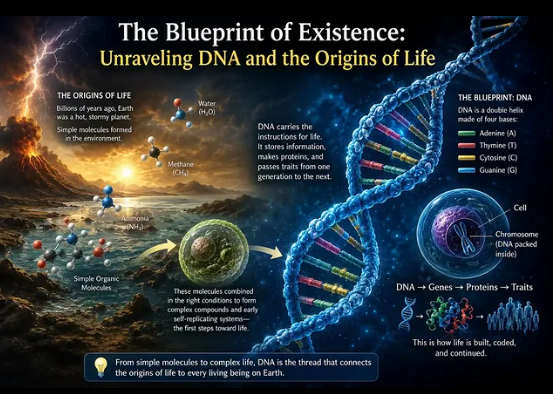
The Blueprint of Existence: Unraveling DNA and the Origins of Life explores one of the greatest scientific mysteries: what makes life possible, and how did life begin? At the center of this story is DNA, the remarkable molecule that stores and carries genetic information in almost every living organism. Often described as the “blueprint of life,” DNA contains the instructions that help cells grow, function, reproduce, and pass characteristics from one generation to the next.
DNA is built from four chemical bases—adenine, thymine, cytosine, and guanine—which are arranged in different sequences to encode biological information. Its famous double-helix structure allows genetic information to be stored efficiently and copied with remarkable accuracy. Small sections of DNA called genes provide instructions for producing proteins and regulating many of the processes that keep living organisms functioning. Although all humans share most of their DNA, small differences in our genetic sequences contribute to biological variation.
But the story of life reaches much further back than modern DNA. Scientists continue to investigate how the first self-replicating molecules and primitive cells could have emerged on the early Earth billions of years ago. The young Earth was very different from today, with active volcanoes, oceans, atmospheric changes, and numerous sources of chemical energy. These conditions may have allowed simple molecules to interact, combine, and gradually form increasingly complex chemical systems.
One important area of research focuses on the possibility that RNA-like molecules played an early role because RNA can both store information and participate in chemical reactions. Scientists also study ancient rocks, meteorites, laboratory experiments, and the chemistry of early Earth to understand which pathways could have led from non-living chemistry to the earliest forms of life. There is still no single confirmed explanation for exactly how life began, making the subject an active area of scientific research.
DNA also provides a powerful record of l
0 Commentarios
0 Acciones
96 Views