


**Roll No: 2**
**Batch: 14**
**Book: ACCL**
**Task No: 61**
# Periodic Table: The Language of Science
Long ago, scientists discovered that everything around us is made from tiny building blocks called **elements**. From the oxygen we breathe to the iron used in buildings, elements are everywhere. But scientists needed a way to organize this huge collection of elements.
In the 19th century, **Dmitri Mendeleev** developed an early version of the periodic table. He arranged elements according to their properties and atomic masses and even left spaces for elements that had not yet been discovered. His predictions later proved remarkably accurate.
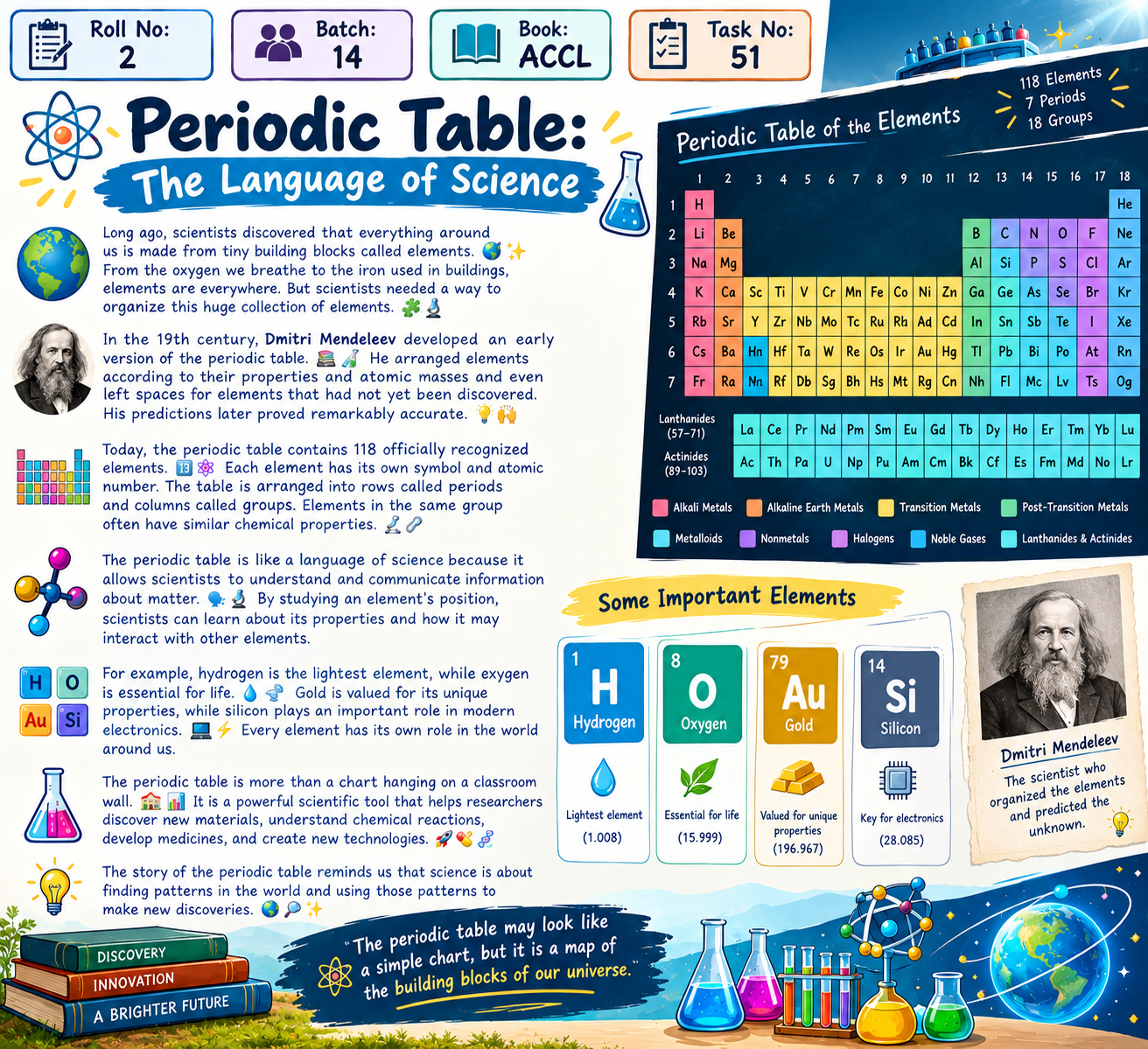
Today, the periodic table contains **118 officially recognized elements**. Each element has its own symbol and atomic number. The table is arranged into rows called **periods** and columns called **groups**. Elements in the same group often have similar chemical properties.
The periodic table is like a **language of science** because it allows scientists to understand and communicate information about matter. By studying an element's position, scientists can learn about its properties and how it may interact with other elements.
For example, hydrogen is the lightest element, while oxygen is essential for life. Gold is valued for its unique properties, while silicon plays an important role in modern electronics. Every element has its own role in the world around us.
The periodic table is more than a chart hanging on a classroom wall. It is a powerful scientific tool that helps researchers discover new materials, understand chemical reactions, develop medicines, and create new technologies.
The story of the periodic table reminds us that science is about finding patterns in the world and using those patterns to make new discoveries.
**The periodic table may look like a simple chart, but it is a map of the building blocks of our universe. **
**Batch: 14**
**Book: ACCL**
**Task No: 61**
# Periodic Table: The Language of Science
Long ago, scientists discovered that everything around us is made from tiny building blocks called **elements**. From the oxygen we breathe to the iron used in buildings, elements are everywhere. But scientists needed a way to organize this huge collection of elements.
In the 19th century, **Dmitri Mendeleev** developed an early version of the periodic table. He arranged elements according to their properties and atomic masses and even left spaces for elements that had not yet been discovered. His predictions later proved remarkably accurate.
Today, the periodic table contains **118 officially recognized elements**. Each element has its own symbol and atomic number. The table is arranged into rows called **periods** and columns called **groups**. Elements in the same group often have similar chemical properties.
The periodic table is like a **language of science** because it allows scientists to understand and communicate information about matter. By studying an element's position, scientists can learn about its properties and how it may interact with other elements.
For example, hydrogen is the lightest element, while oxygen is essential for life. Gold is valued for its unique properties, while silicon plays an important role in modern electronics. Every element has its own role in the world around us.
The periodic table is more than a chart hanging on a classroom wall. It is a powerful scientific tool that helps researchers discover new materials, understand chemical reactions, develop medicines, and create new technologies.
The story of the periodic table reminds us that science is about finding patterns in the world and using those patterns to make new discoveries.
**The periodic table may look like a simple chart, but it is a map of the building blocks of our universe. **
**Roll No: 2**
**Batch: 14**
**Book: ACCL**
**Task No: 61**
# 🧪 Periodic Table: The Language of Science 🌍🔬
Long ago, scientists discovered that everything around us is made from tiny building blocks called **elements**. 🌎✨ From the oxygen we breathe to the iron used in buildings, elements are everywhere. But scientists needed a way to organize this huge collection of elements. 🧩🔬
In the 19th century, **Dmitri Mendeleev** developed an early version of the periodic table. 📚🧪 He arranged elements according to their properties and atomic masses and even left spaces for elements that had not yet been discovered. His predictions later proved remarkably accurate. 💡👏
Today, the periodic table contains **118 officially recognized elements**. 🔢⚛️ Each element has its own symbol and atomic number. The table is arranged into rows called **periods** and columns called **groups**. Elements in the same group often have similar chemical properties. 🧪🔗
The periodic table is like a **language of science** because it allows scientists to understand and communicate information about matter. 🗣️🔬 By studying an element's position, scientists can learn about its properties and how it may interact with other elements.
For example, hydrogen is the lightest element, while oxygen is essential for life. 💧🌬️ Gold is valued for its unique properties, while silicon plays an important role in modern electronics. 💻⚡ Every element has its own role in the world around us.
The periodic table is more than a chart hanging on a classroom wall. 🏫📊 It is a powerful scientific tool that helps researchers discover new materials, understand chemical reactions, develop medicines, and create new technologies. 🚀💊🧬
The story of the periodic table reminds us that science is about finding patterns in the world and using those patterns to make new discoveries. 🌍🔎✨
**The periodic table may look like a simple chart, but it is a map of the building blocks of our universe. 🧪⚛️🌌**
0 تبصرے
0 شیئرز
76 ویوز