


Mohsin RS F8
Story post NO:15
Class: Foundation Level
Made by Me
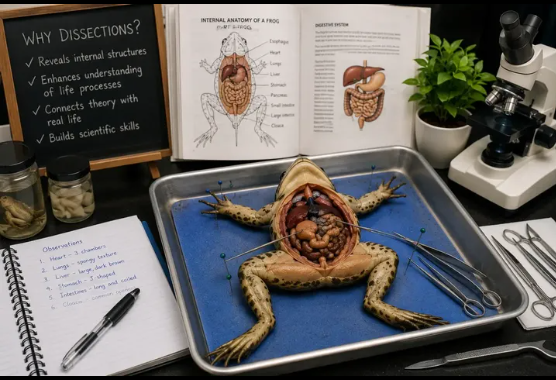
“Peering Inside: The Role of Dissections in Understanding Life” explores how dissection can help us understand the hidden structures of living organisms. While diagrams, textbooks, and digital models provide important information, studying anatomical structures directly can make biological concepts easier to understand and remember.
Dissection allows students and researchers to observe how organs are positioned, how different body systems are connected, and how structures work together to support life. It encourages careful observation, scientific thinking, curiosity, and evidence-based learning. By examining anatomy, students can connect what they learn in the classroom with real biological structures.
Dissections have also played an important role in the development of biological and medical knowledge. Understanding anatomy has helped scientists learn more about the human body, animal biology, diseases, and the functions of different organs. Today, traditional dissection can also be supported by modern tools such as microscopes, anatomical models, medical imaging, 3D simulations, and virtual laboratories.
Most importantly, studying anatomy teaches us about the remarkable organization and complexity of life. Peering inside is not simply about seeing organs—it is about discovering how the many parts of a living system work together. Through responsible scientific study, dissection can help turn curiosity into knowledge and observation into a deeper understanding of life.
Story post NO:15
Class: Foundation Level
Made by Me
“Peering Inside: The Role of Dissections in Understanding Life” explores how dissection can help us understand the hidden structures of living organisms. While diagrams, textbooks, and digital models provide important information, studying anatomical structures directly can make biological concepts easier to understand and remember.
Dissection allows students and researchers to observe how organs are positioned, how different body systems are connected, and how structures work together to support life. It encourages careful observation, scientific thinking, curiosity, and evidence-based learning. By examining anatomy, students can connect what they learn in the classroom with real biological structures.
Dissections have also played an important role in the development of biological and medical knowledge. Understanding anatomy has helped scientists learn more about the human body, animal biology, diseases, and the functions of different organs. Today, traditional dissection can also be supported by modern tools such as microscopes, anatomical models, medical imaging, 3D simulations, and virtual laboratories.
Most importantly, studying anatomy teaches us about the remarkable organization and complexity of life. Peering inside is not simply about seeing organs—it is about discovering how the many parts of a living system work together. Through responsible scientific study, dissection can help turn curiosity into knowledge and observation into a deeper understanding of life.
Mohsin RS F8 🎓✨
Story post NO:15
Class: Foundation Level 📚
Made by Me 💻🚀
“Peering Inside: The Role of Dissections in Understanding Life” explores how dissection can help us understand the hidden structures of living organisms. While diagrams, textbooks, and digital models provide important information, studying anatomical structures directly can make biological concepts easier to understand and remember.
Dissection allows students and researchers to observe how organs are positioned, how different body systems are connected, and how structures work together to support life. It encourages careful observation, scientific thinking, curiosity, and evidence-based learning. By examining anatomy, students can connect what they learn in the classroom with real biological structures.
Dissections have also played an important role in the development of biological and medical knowledge. Understanding anatomy has helped scientists learn more about the human body, animal biology, diseases, and the functions of different organs. Today, traditional dissection can also be supported by modern tools such as microscopes, anatomical models, medical imaging, 3D simulations, and virtual laboratories.
Most importantly, studying anatomy teaches us about the remarkable organization and complexity of life. Peering inside is not simply about seeing organs—it is about discovering how the many parts of a living system work together. Through responsible scientific study, dissection can help turn curiosity into knowledge and observation into a deeper understanding of life.
0 Comentários
0 Compartilhamentos
46 Visualizações