


Mohsin RS F8
Story post NO:17
roll NO:13
Class: Foundation Level
Made by Me
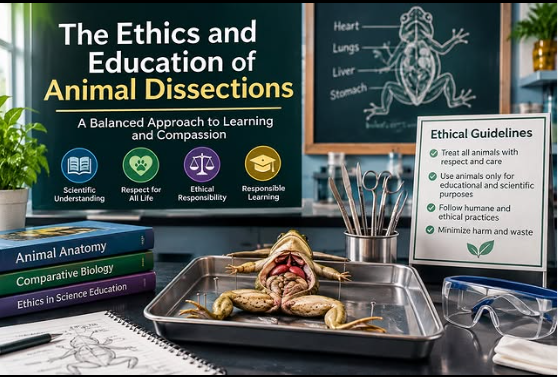
The Ethics and Education of Animal Dissections
Animal dissections have been used in science education for many years as a way to help students understand anatomy, biological structures, and how different body systems work together. By studying organisms directly, students can connect what they read in textbooks with real biological structures. Dissections can make lessons more meaningful by allowing learners to observe organs, tissues, and their relationships in a practical setting.
However, animal dissection is not only a scientific or educational topic; it also raises important ethical questions. Animals are living beings, and their use in education should always be approached with respect, care, and responsibility. Students and teachers should understand why a specimen is being used and ensure that the activity has a genuine educational purpose. Ethical education encourages students to think about both the value of scientific knowledge and the responsibility humans have toward other living organisms.
A responsible approach to dissection includes following appropriate safety and ethical guidelines. Specimens should be obtained through approved and humane sources, handled carefully, and used only when they provide meaningful educational value. Teachers should also explain the purpose of the activity before beginning and create an environment where students can ask questions or express concerns respectfully.
Education is ultimately about developing knowledge as well as character. Learning anatomy through dissection can teach students about the complexity of life, but it can also encourage appreciation for living organisms. When carried out responsibly, the experience can promote scientific curiosity, careful observation, critical thinking, and respect for life.
Modern education can also consider alternatives such as detailed anatomical models, digital simulations, videos, diagrams, and virtual dissection programs. These methods can provide valuable learning experiences while reducing the need for physical specimens in some situations.
Story post NO:17
roll NO:13
Class: Foundation Level
Made by Me
The Ethics and Education of Animal Dissections
Animal dissections have been used in science education for many years as a way to help students understand anatomy, biological structures, and how different body systems work together. By studying organisms directly, students can connect what they read in textbooks with real biological structures. Dissections can make lessons more meaningful by allowing learners to observe organs, tissues, and their relationships in a practical setting.
However, animal dissection is not only a scientific or educational topic; it also raises important ethical questions. Animals are living beings, and their use in education should always be approached with respect, care, and responsibility. Students and teachers should understand why a specimen is being used and ensure that the activity has a genuine educational purpose. Ethical education encourages students to think about both the value of scientific knowledge and the responsibility humans have toward other living organisms.
A responsible approach to dissection includes following appropriate safety and ethical guidelines. Specimens should be obtained through approved and humane sources, handled carefully, and used only when they provide meaningful educational value. Teachers should also explain the purpose of the activity before beginning and create an environment where students can ask questions or express concerns respectfully.
Education is ultimately about developing knowledge as well as character. Learning anatomy through dissection can teach students about the complexity of life, but it can also encourage appreciation for living organisms. When carried out responsibly, the experience can promote scientific curiosity, careful observation, critical thinking, and respect for life.
Modern education can also consider alternatives such as detailed anatomical models, digital simulations, videos, diagrams, and virtual dissection programs. These methods can provide valuable learning experiences while reducing the need for physical specimens in some situations.
Mohsin RS F8 🎓✨
Story post NO:17
roll NO:13
Class: Foundation Level 📚
Made by Me 💻🚀
The Ethics and Education of Animal Dissections
Animal dissections have been used in science education for many years as a way to help students understand anatomy, biological structures, and how different body systems work together. By studying organisms directly, students can connect what they read in textbooks with real biological structures. Dissections can make lessons more meaningful by allowing learners to observe organs, tissues, and their relationships in a practical setting.
However, animal dissection is not only a scientific or educational topic; it also raises important ethical questions. Animals are living beings, and their use in education should always be approached with respect, care, and responsibility. Students and teachers should understand why a specimen is being used and ensure that the activity has a genuine educational purpose. Ethical education encourages students to think about both the value of scientific knowledge and the responsibility humans have toward other living organisms.
A responsible approach to dissection includes following appropriate safety and ethical guidelines. Specimens should be obtained through approved and humane sources, handled carefully, and used only when they provide meaningful educational value. Teachers should also explain the purpose of the activity before beginning and create an environment where students can ask questions or express concerns respectfully.
Education is ultimately about developing knowledge as well as character. Learning anatomy through dissection can teach students about the complexity of life, but it can also encourage appreciation for living organisms. When carried out responsibly, the experience can promote scientific curiosity, careful observation, critical thinking, and respect for life.
Modern education can also consider alternatives such as detailed anatomical models, digital simulations, videos, diagrams, and virtual dissection programs. These methods can provide valuable learning experiences while reducing the need for physical specimens in some situations.
0 Commentarios
0 Acciones
108 Views