


Mohsin RS F8
Story post NO:18
roll NO:13
Class: Foundation Level
Made by Me
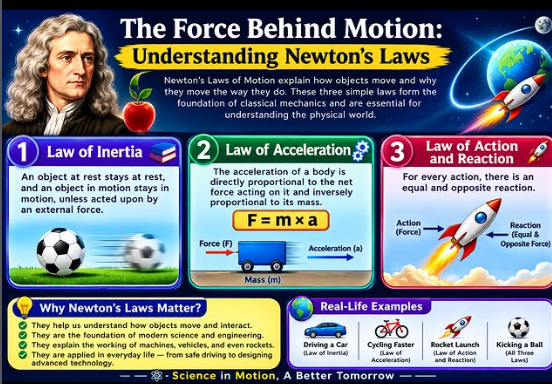
The Force Behind Motion: Understanding Newton’s Laws
Motion is one of the most important ideas in physics. Everything around us is constantly affected by forces, whether we notice them or not. A ball rolling across the ground, a car accelerating on a road, a bicycle slowing down, a person jumping, and a rocket launching into space are all examples of motion caused or changed by forces. To understand these everyday movements, scientists use fundamental principles known as Newton’s Laws of Motion.
Sir Isaac Newton developed his three laws of motion in the 17th century, and they became a foundation of classical physics. These laws help explain the relationship between force, mass, and motion. They allow us to understand not only simple movements around us but also complicated systems involving machines, vehicles, sports, engineering, and space exploration.
The First Law of Motion, often called the Law of Inertia, explains that an object at rest tends to remain at rest, while an object in motion tends to continue moving in the same direction and at the same speed unless an external force acts upon it. In everyday life, we can see this when a football remains still until someone kicks it. Similarly, when a moving car suddenly stops, passengers tend to move forward because their bodies were already in motion. This law teaches us that objects do not naturally change their motion without a force acting on them.
The Second Law of Motion explains how force affects the acceleration of an object. It is commonly represented by the equation F = m × a, meaning that force is equal to mass multiplied by acceleration. This law shows that applying a greater force can produce greater acceleration, while an object with greater mass requires more force to achieve the same acceleration. For example, pushing an empty shopping cart is usually easier than pushing a heavily loaded one. This principle is extremely important in the design of vehicles, machines, sports equipment, and many engineering systems.
The Third Law of Motion states that for every action, there is an equal and opposite
Story post NO:18
roll NO:13
Class: Foundation Level
Made by Me
The Force Behind Motion: Understanding Newton’s Laws
Motion is one of the most important ideas in physics. Everything around us is constantly affected by forces, whether we notice them or not. A ball rolling across the ground, a car accelerating on a road, a bicycle slowing down, a person jumping, and a rocket launching into space are all examples of motion caused or changed by forces. To understand these everyday movements, scientists use fundamental principles known as Newton’s Laws of Motion.
Sir Isaac Newton developed his three laws of motion in the 17th century, and they became a foundation of classical physics. These laws help explain the relationship between force, mass, and motion. They allow us to understand not only simple movements around us but also complicated systems involving machines, vehicles, sports, engineering, and space exploration.
The First Law of Motion, often called the Law of Inertia, explains that an object at rest tends to remain at rest, while an object in motion tends to continue moving in the same direction and at the same speed unless an external force acts upon it. In everyday life, we can see this when a football remains still until someone kicks it. Similarly, when a moving car suddenly stops, passengers tend to move forward because their bodies were already in motion. This law teaches us that objects do not naturally change their motion without a force acting on them.
The Second Law of Motion explains how force affects the acceleration of an object. It is commonly represented by the equation F = m × a, meaning that force is equal to mass multiplied by acceleration. This law shows that applying a greater force can produce greater acceleration, while an object with greater mass requires more force to achieve the same acceleration. For example, pushing an empty shopping cart is usually easier than pushing a heavily loaded one. This principle is extremely important in the design of vehicles, machines, sports equipment, and many engineering systems.
The Third Law of Motion states that for every action, there is an equal and opposite
Mohsin RS F8 🎓✨
Story post NO:18
roll NO:13
Class: Foundation Level 📚
Made by Me 💻🚀
The Force Behind Motion: Understanding Newton’s Laws ⚡🔬🚀
Motion is one of the most important ideas in physics. Everything around us is constantly affected by forces, whether we notice them or not. A ball rolling across the ground, a car accelerating on a road, a bicycle slowing down, a person jumping, and a rocket launching into space are all examples of motion caused or changed by forces. To understand these everyday movements, scientists use fundamental principles known as Newton’s Laws of Motion.
Sir Isaac Newton developed his three laws of motion in the 17th century, and they became a foundation of classical physics. These laws help explain the relationship between force, mass, and motion. They allow us to understand not only simple movements around us but also complicated systems involving machines, vehicles, sports, engineering, and space exploration.
The First Law of Motion, often called the Law of Inertia, explains that an object at rest tends to remain at rest, while an object in motion tends to continue moving in the same direction and at the same speed unless an external force acts upon it. In everyday life, we can see this when a football remains still until someone kicks it. Similarly, when a moving car suddenly stops, passengers tend to move forward because their bodies were already in motion. This law teaches us that objects do not naturally change their motion without a force acting on them.
The Second Law of Motion explains how force affects the acceleration of an object. It is commonly represented by the equation F = m × a, meaning that force is equal to mass multiplied by acceleration. This law shows that applying a greater force can produce greater acceleration, while an object with greater mass requires more force to achieve the same acceleration. For example, pushing an empty shopping cart is usually easier than pushing a heavily loaded one. This principle is extremely important in the design of vehicles, machines, sports equipment, and many engineering systems.
The Third Law of Motion states that for every action, there is an equal and opposite
0 Comentários
0 Compartilhamentos
61 Visualizações