


**Roll No: 2**
**Batch: 14**
**Book: ACCL**
**Task No: 84**
# The Wonders of Geometry: Shapes and Philosophy
Geometry is one of the most fascinating branches of mathematics. It helps us understand the shapes, sizes, positions, and patterns of objects around us. From the circles of the sun and moon to the triangles of mountains and the squares of buildings, geometry is everywhere.
Long ago, ancient civilizations used geometry to measure land, construct buildings, and study the stars. The ancient Egyptians applied geometric knowledge to construction, while Greek thinkers such as **Euclid** developed important principles that helped shape modern mathematics.
Geometry is not only about lines, angles, and shapes; it also encourages us to think logically and explore deeper questions. Philosophers have used geometric ideas to reflect on order, symmetry, beauty, and the structure of the universe. The balance of a butterfly's wings , the symmetry of flowers , and the patterns of snowflakes show how mathematical ideas can appear in nature.
Different shapes have different properties. A triangle has three sides, a square has four equal sides, and a circle has no straight sides or corners. Each shape has its own special characteristics and practical uses. By studying these properties, students develop problem-solving skills, accuracy, and creative thinking.
Geometry also plays an important role in modern life. Architects use it to design buildings, engineers apply it to construct bridges, artists use shapes to create beautiful designs, and scientists rely on geometric models to study space and the physical world. Even computer graphics and video games depend on geometric principles.
The philosophical side of geometry reminds us that simple shapes can reveal remarkable ideas. A straight line may represent direction, a circle can symbolize unity, and symmetry can help us appreciate balance and harmony. These interpretations inspire thought and creativity, even though their meanings can differ across cultures and traditions.
Learning geometry teaches us to observe carefully, question thoughtfully, and solve problems step by step. It connects mathematics with art, science, architecture, and philosophy, showing that knowledge becomes more powerful when different ideas work together.
**Geometry is more than the study of shapes; it is a way of discovering the hidden patterns, logical beauty, and fascinating order of our world. **
**Batch: 14**
**Book: ACCL**
**Task No: 84**
# The Wonders of Geometry: Shapes and Philosophy
Geometry is one of the most fascinating branches of mathematics. It helps us understand the shapes, sizes, positions, and patterns of objects around us. From the circles of the sun and moon to the triangles of mountains and the squares of buildings, geometry is everywhere.
Long ago, ancient civilizations used geometry to measure land, construct buildings, and study the stars. The ancient Egyptians applied geometric knowledge to construction, while Greek thinkers such as **Euclid** developed important principles that helped shape modern mathematics.
Geometry is not only about lines, angles, and shapes; it also encourages us to think logically and explore deeper questions. Philosophers have used geometric ideas to reflect on order, symmetry, beauty, and the structure of the universe. The balance of a butterfly's wings , the symmetry of flowers , and the patterns of snowflakes show how mathematical ideas can appear in nature.
Different shapes have different properties. A triangle has three sides, a square has four equal sides, and a circle has no straight sides or corners. Each shape has its own special characteristics and practical uses. By studying these properties, students develop problem-solving skills, accuracy, and creative thinking.
Geometry also plays an important role in modern life. Architects use it to design buildings, engineers apply it to construct bridges, artists use shapes to create beautiful designs, and scientists rely on geometric models to study space and the physical world. Even computer graphics and video games depend on geometric principles.
The philosophical side of geometry reminds us that simple shapes can reveal remarkable ideas. A straight line may represent direction, a circle can symbolize unity, and symmetry can help us appreciate balance and harmony. These interpretations inspire thought and creativity, even though their meanings can differ across cultures and traditions.
Learning geometry teaches us to observe carefully, question thoughtfully, and solve problems step by step. It connects mathematics with art, science, architecture, and philosophy, showing that knowledge becomes more powerful when different ideas work together.
**Geometry is more than the study of shapes; it is a way of discovering the hidden patterns, logical beauty, and fascinating order of our world. **
**Roll No: 2**
**Batch: 14**
**Book: ACCL**
**Task No: 84**
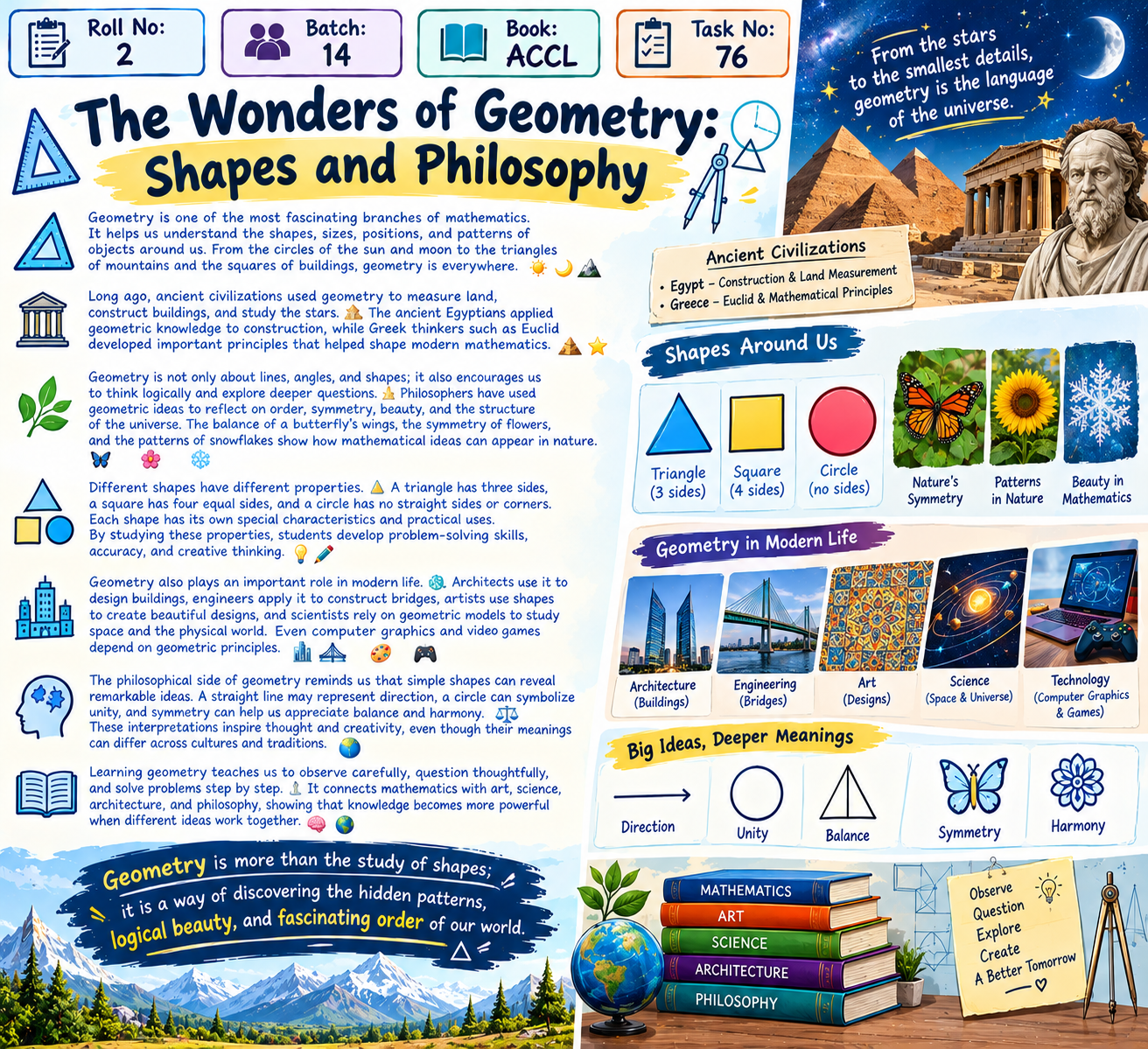
# 📐 The Wonders of Geometry: Shapes and Philosophy 🔺🌍
Geometry is one of the most fascinating branches of mathematics. 📏✨ It helps us understand the shapes, sizes, positions, and patterns of objects around us. From the circles of the sun and moon to the triangles of mountains and the squares of buildings, geometry is everywhere. ☀️🌙🏔️
Long ago, ancient civilizations used geometry to measure land, construct buildings, and study the stars. 🏛️🌌 The ancient Egyptians applied geometric knowledge to construction, while Greek thinkers such as **Euclid** developed important principles that helped shape modern mathematics. 📚🧠
Geometry is not only about lines, angles, and shapes; it also encourages us to think logically and explore deeper questions. 🔍💡 Philosophers have used geometric ideas to reflect on order, symmetry, beauty, and the structure of the universe. The balance of a butterfly's wings 🦋, the symmetry of flowers 🌸, and the patterns of snowflakes ❄️ show how mathematical ideas can appear in nature.
Different shapes have different properties. 🔺 A triangle has three sides, a square has four equal sides, and a circle has no straight sides or corners. Each shape has its own special characteristics and practical uses. 📐📊 By studying these properties, students develop problem-solving skills, accuracy, and creative thinking. 🎓✨
Geometry also plays an important role in modern life. 🏗️ Architects use it to design buildings, engineers apply it to construct bridges, artists use shapes to create beautiful designs, and scientists rely on geometric models to study space and the physical world. 🚀🎨 Even computer graphics and video games depend on geometric principles. 💻🎮
The philosophical side of geometry reminds us that simple shapes can reveal remarkable ideas. A straight line may represent direction, a circle can symbolize unity, and symmetry can help us appreciate balance and harmony. ⚖️🔵 These interpretations inspire thought and creativity, even though their meanings can differ across cultures and traditions.
Learning geometry teaches us to observe carefully, question thoughtfully, and solve problems step by step. 🧠📖 It connects mathematics with art, science, architecture, and philosophy, showing that knowledge becomes more powerful when different ideas work together. 🌍🔬
**Geometry is more than the study of shapes; it is a way of discovering the hidden patterns, logical beauty, and fascinating order of our world. 📐🌟🔺**
0 Yorumlar
0 hisse senetleri
62 Views