


**Roll No: 2**
**Batch: 14**
**Book: ACCL**
**Task No: 104**
# The Blueprint of Existence: Unraveling DNA and the Origins of Life
Life is one of the greatest wonders of our universe. From the tiniest microorganisms to the tallest trees and the human body, every living organism has its own remarkable story. But have you ever wondered how living things grow, develop, and pass their characteristics from one generation to the next? One of the most important clues lies within a special molecule called **DNA**.
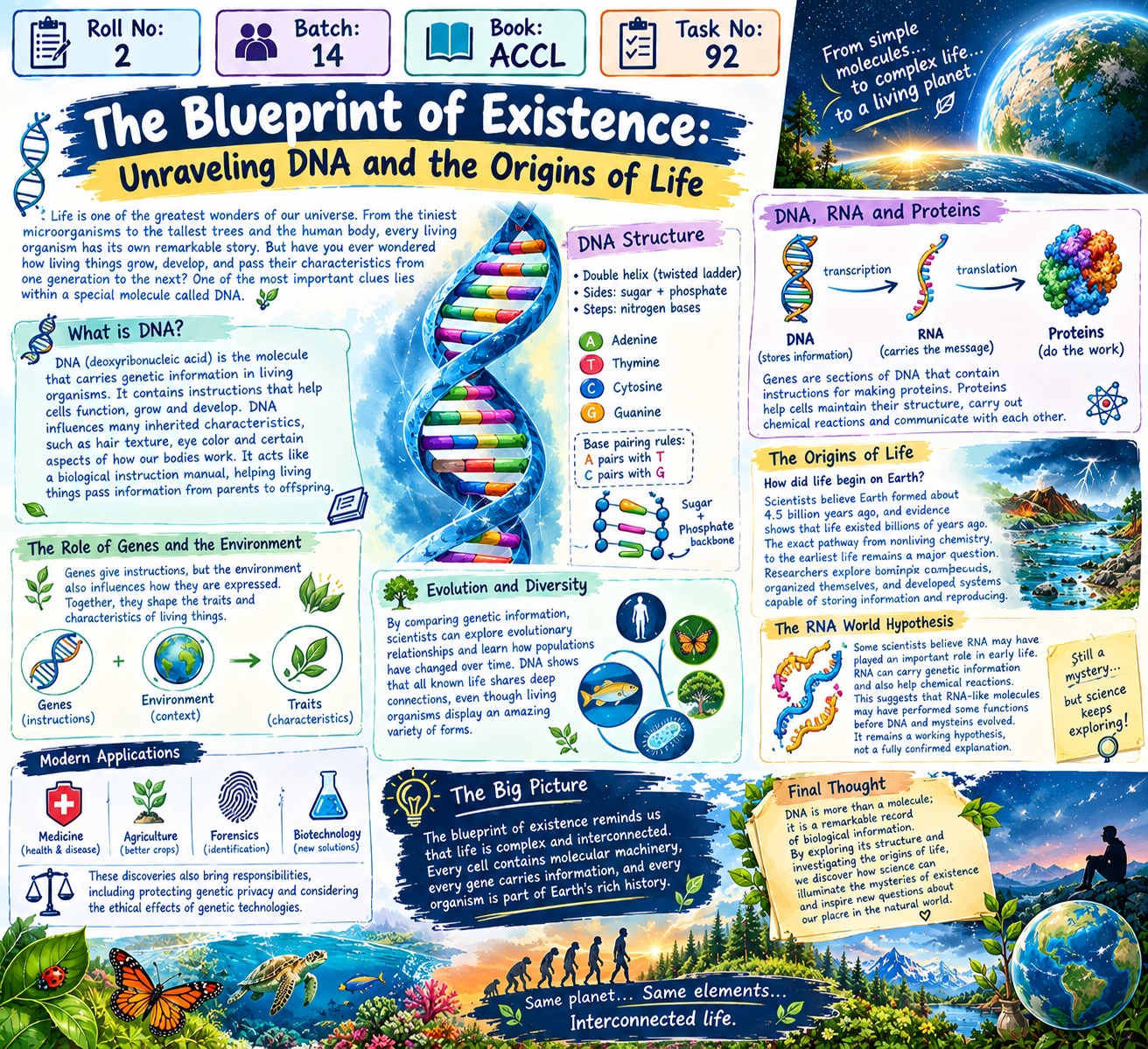
**DNA, or deoxyribonucleic acid, is the molecule that carries genetic information in living organisms.** It contains instructions that help cells function, grow, and develop. DNA influences many inherited characteristics, such as natural hair texture, eye color, and certain aspects of how our bodies work. It acts like a biological instruction manual, helping living things pass information from parents to offspring.
The structure of DNA is fascinating. It resembles a twisted ladder called a **double helix**. Its sides are made of sugar and phosphate molecules, while its steps contain pairs of chemical bases: adenine, thymine, cytosine, and guanine. These bases follow specific pairing rules: adenine pairs with thymine, while cytosine pairs with guanine. The order of these bases stores genetic information in a form that cells can use.
DNA works closely with other molecules inside cells. Sections of DNA called **genes** contain instructions for making functional products, often proteins. Proteins perform countless important jobs, including helping cells maintain their structure, carry out chemical reactions, and communicate with one another. This relationship between DNA, RNA, and proteins is a central part of modern biology.
But how did life begin on Earth? Scientists believe that Earth formed about 4.5 billion years ago, and evidence indicates that life existed billions of years ago. However, the exact pathway through which nonliving chemistry gave rise to the earliest life remains an important scientific question. Researchers investigate how simple molecules might have formed more complex compounds, how these compounds could have organized themselves, and how early systems capable of storing information and reproducing might have developed.
One area of research explores the possibility that **RNA played an important role in early life**. RNA can carry genetic information, and certain RNA molecules can also help chemical reactions occur. This has led to the RNA-world hypothesis, which suggests that RNA-like molecules may have performed some functions before modern DNA-and-protein systems evolved. It remains an active scientific hypothesis, not a fully confirmed explanation of life's origin.
The study of DNA also helps scientists understand the diversity of life. By comparing genetic information from different organisms, researchers can investigate evolutionary relationships and learn how populations have changed over generations. DNA evidence supports the scientific understanding that all known life shares deep connections through evolution, even though living organisms display an extraordinary variety of forms.
Modern DNA research has transformed medicine, agriculture, forensics, and biotechnology. Scientists can study genetic variations, investigate inherited conditions, identify organisms, improve crops, and develop new research methods. These discoveries also bring important responsibilities, including protecting genetic privacy and considering the ethical effects of genetic technologies.
The blueprint of existence reminds us that life is both complex and interconnected. Every cell contains molecular machinery, every gene carries information, and every organism is part of Earth's rich history. Although many questions about the earliest beginnings of life remain unanswered, careful experiments, observations, and discoveries continue to expand our understanding.
**DNA is more than a molecule; it is a remarkable record of biological information. By exploring its structure and investigating the origins of life, we discover how science can illuminate the mysteries of existence and inspire new questions about our place in the natural world. **
\#DNA #OriginsOfLife #Biology #Genetics #Science #Evolution #ACCL #Batch14 #Task92
**Batch: 14**
**Book: ACCL**
**Task No: 104**
# The Blueprint of Existence: Unraveling DNA and the Origins of Life
Life is one of the greatest wonders of our universe. From the tiniest microorganisms to the tallest trees and the human body, every living organism has its own remarkable story. But have you ever wondered how living things grow, develop, and pass their characteristics from one generation to the next? One of the most important clues lies within a special molecule called **DNA**.
**DNA, or deoxyribonucleic acid, is the molecule that carries genetic information in living organisms.** It contains instructions that help cells function, grow, and develop. DNA influences many inherited characteristics, such as natural hair texture, eye color, and certain aspects of how our bodies work. It acts like a biological instruction manual, helping living things pass information from parents to offspring.
The structure of DNA is fascinating. It resembles a twisted ladder called a **double helix**. Its sides are made of sugar and phosphate molecules, while its steps contain pairs of chemical bases: adenine, thymine, cytosine, and guanine. These bases follow specific pairing rules: adenine pairs with thymine, while cytosine pairs with guanine. The order of these bases stores genetic information in a form that cells can use.
DNA works closely with other molecules inside cells. Sections of DNA called **genes** contain instructions for making functional products, often proteins. Proteins perform countless important jobs, including helping cells maintain their structure, carry out chemical reactions, and communicate with one another. This relationship between DNA, RNA, and proteins is a central part of modern biology.
But how did life begin on Earth? Scientists believe that Earth formed about 4.5 billion years ago, and evidence indicates that life existed billions of years ago. However, the exact pathway through which nonliving chemistry gave rise to the earliest life remains an important scientific question. Researchers investigate how simple molecules might have formed more complex compounds, how these compounds could have organized themselves, and how early systems capable of storing information and reproducing might have developed.
One area of research explores the possibility that **RNA played an important role in early life**. RNA can carry genetic information, and certain RNA molecules can also help chemical reactions occur. This has led to the RNA-world hypothesis, which suggests that RNA-like molecules may have performed some functions before modern DNA-and-protein systems evolved. It remains an active scientific hypothesis, not a fully confirmed explanation of life's origin.
The study of DNA also helps scientists understand the diversity of life. By comparing genetic information from different organisms, researchers can investigate evolutionary relationships and learn how populations have changed over generations. DNA evidence supports the scientific understanding that all known life shares deep connections through evolution, even though living organisms display an extraordinary variety of forms.
Modern DNA research has transformed medicine, agriculture, forensics, and biotechnology. Scientists can study genetic variations, investigate inherited conditions, identify organisms, improve crops, and develop new research methods. These discoveries also bring important responsibilities, including protecting genetic privacy and considering the ethical effects of genetic technologies.
The blueprint of existence reminds us that life is both complex and interconnected. Every cell contains molecular machinery, every gene carries information, and every organism is part of Earth's rich history. Although many questions about the earliest beginnings of life remain unanswered, careful experiments, observations, and discoveries continue to expand our understanding.
**DNA is more than a molecule; it is a remarkable record of biological information. By exploring its structure and investigating the origins of life, we discover how science can illuminate the mysteries of existence and inspire new questions about our place in the natural world. **
\#DNA #OriginsOfLife #Biology #Genetics #Science #Evolution #ACCL #Batch14 #Task92
**Roll No: 2**
**Batch: 14**
**Book: ACCL**
**Task No: 104**
# 🧬🌍 The Blueprint of Existence: Unraveling DNA and the Origins of Life 🔬✨
Life is one of the greatest wonders of our universe. From the tiniest microorganisms to the tallest trees and the human body, every living organism has its own remarkable story. 🌱🦠🌳 But have you ever wondered how living things grow, develop, and pass their characteristics from one generation to the next? One of the most important clues lies within a special molecule called **DNA**.
**DNA, or deoxyribonucleic acid, is the molecule that carries genetic information in living organisms.** 🧬 It contains instructions that help cells function, grow, and develop. DNA influences many inherited characteristics, such as natural hair texture, eye color, and certain aspects of how our bodies work. It acts like a biological instruction manual, helping living things pass information from parents to offspring. 📖🔬
The structure of DNA is fascinating. It resembles a twisted ladder called a **double helix**. 🌀 Its sides are made of sugar and phosphate molecules, while its steps contain pairs of chemical bases: adenine, thymine, cytosine, and guanine. These bases follow specific pairing rules: adenine pairs with thymine, while cytosine pairs with guanine. The order of these bases stores genetic information in a form that cells can use.
DNA works closely with other molecules inside cells. 🧪 Sections of DNA called **genes** contain instructions for making functional products, often proteins. Proteins perform countless important jobs, including helping cells maintain their structure, carry out chemical reactions, and communicate with one another. This relationship between DNA, RNA, and proteins is a central part of modern biology. ⚙️🧫
But how did life begin on Earth? 🌎 Scientists believe that Earth formed about 4.5 billion years ago, and evidence indicates that life existed billions of years ago. However, the exact pathway through which nonliving chemistry gave rise to the earliest life remains an important scientific question. Researchers investigate how simple molecules might have formed more complex compounds, how these compounds could have organized themselves, and how early systems capable of storing information and reproducing might have developed. 🔭🧪
One area of research explores the possibility that **RNA played an important role in early life**. RNA can carry genetic information, and certain RNA molecules can also help chemical reactions occur. This has led to the RNA-world hypothesis, which suggests that RNA-like molecules may have performed some functions before modern DNA-and-protein systems evolved. It remains an active scientific hypothesis, not a fully confirmed explanation of life's origin. 🧬💡
The study of DNA also helps scientists understand the diversity of life. 🌿🐦🦋 By comparing genetic information from different organisms, researchers can investigate evolutionary relationships and learn how populations have changed over generations. DNA evidence supports the scientific understanding that all known life shares deep connections through evolution, even though living organisms display an extraordinary variety of forms.
Modern DNA research has transformed medicine, agriculture, forensics, and biotechnology. 🏥🌾 Scientists can study genetic variations, investigate inherited conditions, identify organisms, improve crops, and develop new research methods. These discoveries also bring important responsibilities, including protecting genetic privacy and considering the ethical effects of genetic technologies. ⚖️🔬
The blueprint of existence reminds us that life is both complex and interconnected. Every cell contains molecular machinery, every gene carries information, and every organism is part of Earth's rich history. Although many questions about the earliest beginnings of life remain unanswered, careful experiments, observations, and discoveries continue to expand our understanding. 🌌📚
**DNA is more than a molecule; it is a remarkable record of biological information. By exploring its structure and investigating the origins of life, we discover how science can illuminate the mysteries of existence and inspire new questions about our place in the natural world. 🧬🌍💚**
\#DNA #OriginsOfLife #Biology #Genetics #Science #Evolution #ACCL #Batch14 #Task92 🔬🧬✨
0 Commentaires
0 Parts
151 Vue