


#rsisb
Roll no . 257
Story post . 16
Foundation level
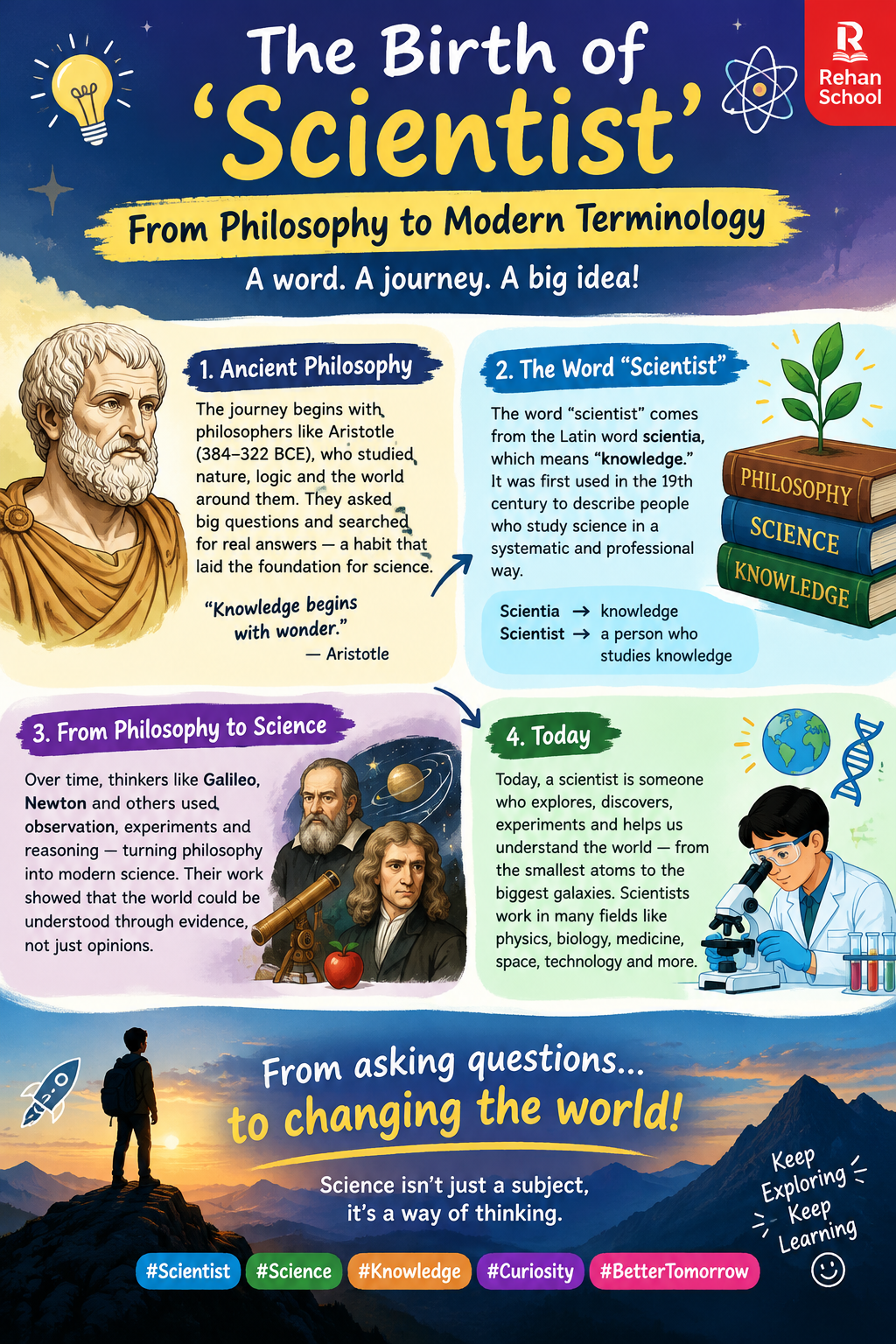
**The Birth of “Scientist”: From Philosophy to Modern Terminology **
**Have you ever wondered where the word “scientist” came from?** The word we use today to describe people who explore the mysteries of the universe, discover new things, and develop amazing inventions has an interesting history!
In ancient times, people who studied nature, the stars, mathematics, medicine, and the world around them were often called **natural philosophers**. They asked important questions about how the world worked and tried to find answers through observation, reasoning, and experiments. Their curiosity helped build the foundations of modern science!
Over time, the study of nature developed into different scientific fields, including physics , chemistry , biology , astronomy , and many others. As scientific research became more specialized, people needed a new word to describe those who dedicated their lives to scientific investigation.
The word **“scientist” was coined by William Whewell in 1833 and publicly introduced in 1834** during discussions about how to describe people who studied science. Before that, terms such as natural philosopher were commonly used. The new word gradually became popular as science developed into a recognized profession.
Today, scientists work in laboratories, universities, hospitals, observatories, research centers, and even in space exploration! They study everything from tiny cells to distant galaxies . Their discoveries help us understand diseases, protect our planet , develop new technologies , and improve our daily lives.
**The biggest lesson from this story is that curiosity can change the world!** Every great discovery begins with a question. Every invention begins with an idea. And every scientist begins with a desire to learn something new!
**Think and Discuss:**
Who were natural philosophers?
Who introduced the word “scientist”?
Why do we need scientists in today's world?
If you could become a scientist, what would you like to discover?
**Share your thoughts in the comments!** What scientific mystery would you love to solve?
Keep asking questions, keep exploring, and never stop learning! Because the journey from curiosity to discovery is what makes science truly amazing!
━━━━━━━━━━━━━━━━━━━━
**HASHTAGS**
#BirthOfScientist #HistoryOfScience #Scientist #ScienceHistory #NaturalPhilosophy #WilliamWhewell #ScienceEducation #LearnSomethingNew #AmazingFacts #DidYouKnow #ScientificDiscoveries #Curiosity #KnowledgeIsPower #Education #ScienceLovers #STEMEducation #Physics #Chemistry #Biology #Astronomy #Innovation #Technology #ExploreTheWorld #LearningJourney #StoryPost #EducationalContent #StudentLife #NeverStopLearning #ScienceForEveryone #KnowledgeSharing
Roll no . 257
Story post . 16
Foundation level
**The Birth of “Scientist”: From Philosophy to Modern Terminology **
**Have you ever wondered where the word “scientist” came from?** The word we use today to describe people who explore the mysteries of the universe, discover new things, and develop amazing inventions has an interesting history!
In ancient times, people who studied nature, the stars, mathematics, medicine, and the world around them were often called **natural philosophers**. They asked important questions about how the world worked and tried to find answers through observation, reasoning, and experiments. Their curiosity helped build the foundations of modern science!
Over time, the study of nature developed into different scientific fields, including physics , chemistry , biology , astronomy , and many others. As scientific research became more specialized, people needed a new word to describe those who dedicated their lives to scientific investigation.
The word **“scientist” was coined by William Whewell in 1833 and publicly introduced in 1834** during discussions about how to describe people who studied science. Before that, terms such as natural philosopher were commonly used. The new word gradually became popular as science developed into a recognized profession.
Today, scientists work in laboratories, universities, hospitals, observatories, research centers, and even in space exploration! They study everything from tiny cells to distant galaxies . Their discoveries help us understand diseases, protect our planet , develop new technologies , and improve our daily lives.
**The biggest lesson from this story is that curiosity can change the world!** Every great discovery begins with a question. Every invention begins with an idea. And every scientist begins with a desire to learn something new!
**Think and Discuss:**
Who were natural philosophers?
Who introduced the word “scientist”?
Why do we need scientists in today's world?
If you could become a scientist, what would you like to discover?
**Share your thoughts in the comments!** What scientific mystery would you love to solve?
Keep asking questions, keep exploring, and never stop learning! Because the journey from curiosity to discovery is what makes science truly amazing!
━━━━━━━━━━━━━━━━━━━━
**HASHTAGS**
#BirthOfScientist #HistoryOfScience #Scientist #ScienceHistory #NaturalPhilosophy #WilliamWhewell #ScienceEducation #LearnSomethingNew #AmazingFacts #DidYouKnow #ScientificDiscoveries #Curiosity #KnowledgeIsPower #Education #ScienceLovers #STEMEducation #Physics #Chemistry #Biology #Astronomy #Innovation #Technology #ExploreTheWorld #LearningJourney #StoryPost #EducationalContent #StudentLife #NeverStopLearning #ScienceForEveryone #KnowledgeSharing
#rsisb
Roll no . 257
Story post . 16
Foundation level
🔬📚 **The Birth of “Scientist”: From Philosophy to Modern Terminology 🧠✨**
🌍💡 **Have you ever wondered where the word “scientist” came from?** 🤔🔍 The word we use today to describe people who explore the mysteries of the universe, discover new things, and develop amazing inventions has an interesting history! 🚀🌟
📖✨ In ancient times, people who studied nature, the stars, mathematics, medicine, and the world around them were often called **natural philosophers**. 🏛️🌌 They asked important questions about how the world worked and tried to find answers through observation, reasoning, and experiments. 🧪🔭 Their curiosity helped build the foundations of modern science!
🌱🧠 Over time, the study of nature developed into different scientific fields, including physics ⚡, chemistry 🧫, biology 🧬, astronomy 🌠, and many others. As scientific research became more specialized, people needed a new word to describe those who dedicated their lives to scientific investigation.
✨📚 The word **“scientist” was coined by William Whewell in 1833 and publicly introduced in 1834** during discussions about how to describe people who studied science. Before that, terms such as natural philosopher were commonly used. The new word gradually became popular as science developed into a recognized profession. 🔬🌍
💡🚀 Today, scientists work in laboratories, universities, hospitals, observatories, research centers, and even in space exploration! 🧑🔬👩🔬 They study everything from tiny cells 🔬 to distant galaxies 🌌. Their discoveries help us understand diseases, protect our planet 🌳, develop new technologies 🤖, and improve our daily lives.
🌟📖 **The biggest lesson from this story is that curiosity can change the world!** Every great discovery begins with a question. 🤔 Every invention begins with an idea. 💡 And every scientist begins with a desire to learn something new! 🌱✨
🎯 **Think and Discuss:**
🔹 Who were natural philosophers?
🔹 Who introduced the word “scientist”?
🔹 Why do we need scientists in today's world?
🔹 If you could become a scientist, what would you like to discover? 🚀🧬
💬 **Share your thoughts in the comments!** What scientific mystery would you love to solve? 🌍🔭
❤️ Keep asking questions, keep exploring, and never stop learning! Because the journey from curiosity to discovery is what makes science truly amazing! 🧠🔬✨
━━━━━━━━━━━━━━━━━━━━
🏷️ **HASHTAGS**
#BirthOfScientist #HistoryOfScience #Scientist #ScienceHistory #NaturalPhilosophy #WilliamWhewell #ScienceEducation #LearnSomethingNew #AmazingFacts #DidYouKnow #ScientificDiscoveries #Curiosity #KnowledgeIsPower #Education #ScienceLovers #STEMEducation #Physics #Chemistry #Biology #Astronomy #Innovation #Technology #ExploreTheWorld #LearningJourney #StoryPost #EducationalContent #StudentLife #NeverStopLearning #ScienceForEveryone #KnowledgeSharing 🔬📚🌍🚀
🚀
0 Comentários
0 Compartilhamentos
58 Visualizações