


**Roll No: 2**
**Batch: 14**
**Book: ACCL**
**Task No: 120**
# Why Frogs? Understanding the Anatomy of Life
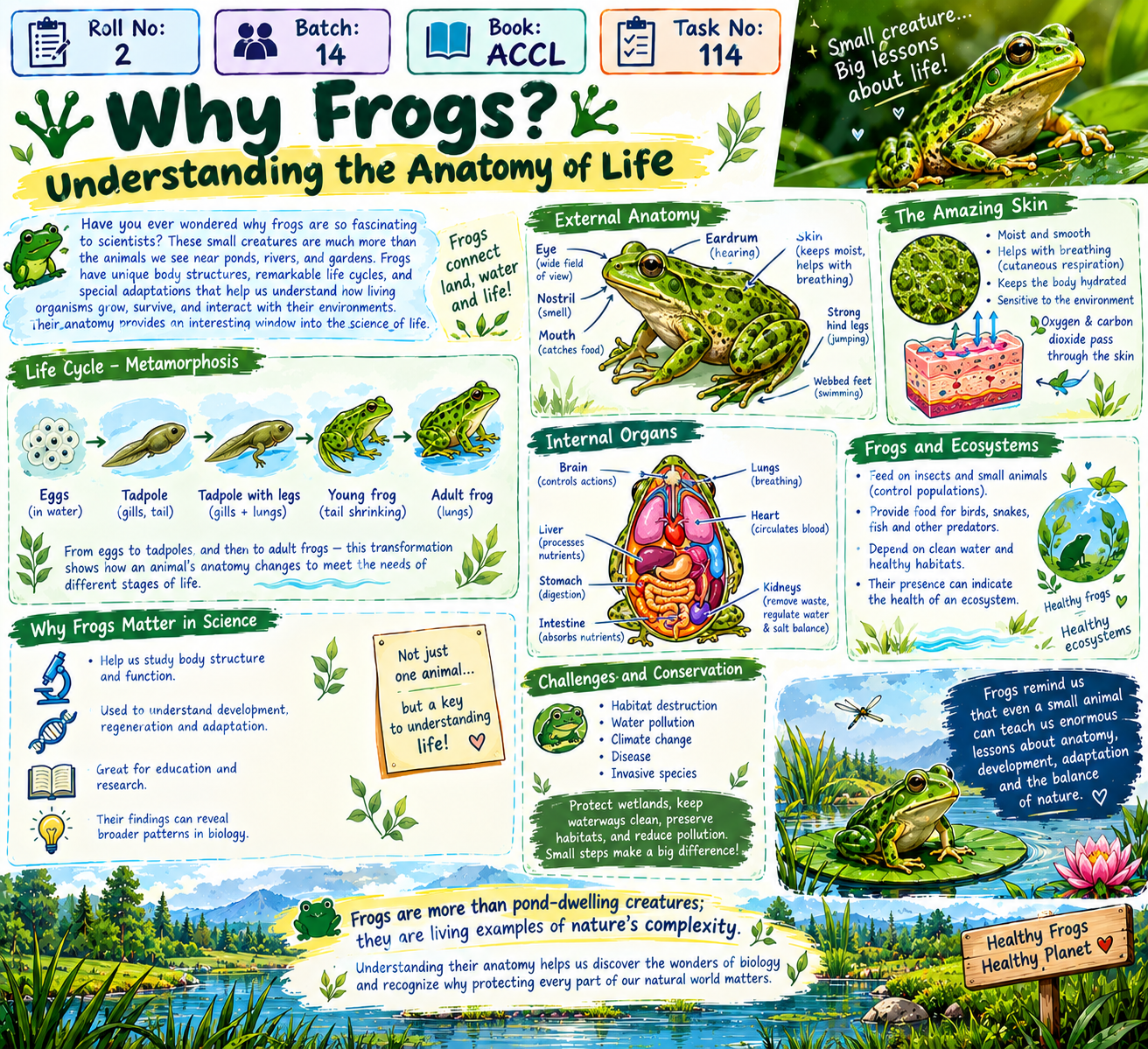
Have you ever wondered why frogs are so fascinating to scientists? These small creatures are much more than the animals we see near ponds, rivers, and gardens. Frogs have unique body structures, remarkable life cycles, and special adaptations that help us understand how living organisms grow, survive, and interact with their environments. Their anatomy provides an interesting window into the science of life.
A frog's body is designed for life both in water and on land. Its body generally has a broad head, a short trunk, strong hind legs, and webbed feet in many species. These features help frogs jump, swim, and move through their habitats. Their eyes are positioned to provide a wide field of view, while their sensitive hearing helps them detect sounds, including the calls of other frogs.
One of the most interesting features of frogs is their skin. Unlike the dry, scaly skin of many reptiles, frog skin is usually moist and plays an important role in their survival. Many frogs can exchange gases through their skin as well as through their lungs. This process, called **cutaneous respiration**, allows oxygen and carbon dioxide to pass across the skin under suitable conditions. Their skin also helps maintain moisture, making a healthy habitat especially important for them.
Frogs have a fascinating life cycle called **metamorphosis**. Many begin life as eggs in water. The eggs hatch into tadpoles, which usually have tails and breathe mainly through gills. As they develop, they grow legs, their lungs develop, and their bodies gradually change into those of adult frogs. The tail is usually absorbed during development. This transformation demonstrates how an animal's anatomy changes to meet the needs of different stages of life.
The internal organs of a frog also reveal important biological principles. Its heart circulates blood through the body, carrying oxygen and nutrients to tissues. The digestive system breaks down food, while the kidneys help remove waste and regulate water and salt balance. The brain and nervous system coordinate movement, senses, and responses to the environment. Each organ works with other systems to keep the animal alive.
Frogs are also valuable to ecosystems. Many feed on insects and other small animals, helping influence populations of these organisms. Frogs themselves provide food for birds, snakes, fish, and other predators. Because many frogs depend on suitable water and land habitats, changes in their populations can provide clues about environmental conditions. Scientists therefore study frogs to learn more about biodiversity, habitat quality, and ecosystem health.
Another reason frogs are important is their role in scientific research and education. Their anatomy helps students explore the structure and function of organs, compare different vertebrates, and understand biological systems. Researchers also study frog development, regeneration in certain species, communication, and adaptation. Such research can reveal broader patterns in biology, although findings from frogs do not always apply directly to humans.
Unfortunately, many frog species face challenges such as habitat destruction, water pollution, climate change, disease, and invasive species. Protecting wetlands, keeping waterways clean, preserving natural habitats, and reducing pollution can help support frog populations and the many other organisms that share their ecosystems. Caring for frogs is one way of caring for the wider web of life.
Frogs remind us that even a small animal can teach us enormous lessons about anatomy, development, adaptation, and the balance of nature. By observing their bodies and studying their life cycles, we gain a deeper appreciation of how living systems work together.
**Frogs are more than pond-dwelling creatures; they are living examples of nature's complexity. Understanding their anatomy helps us discover the wonders of biology and recognize why protecting every part of our natural world matters. **
\#Frogs #AnatomyOfLife #Biology #LifeCycle #AnimalScience #Biodiversity #ACCL #Batch14 #Task114
**Batch: 14**
**Book: ACCL**
**Task No: 120**
# Why Frogs? Understanding the Anatomy of Life
Have you ever wondered why frogs are so fascinating to scientists? These small creatures are much more than the animals we see near ponds, rivers, and gardens. Frogs have unique body structures, remarkable life cycles, and special adaptations that help us understand how living organisms grow, survive, and interact with their environments. Their anatomy provides an interesting window into the science of life.
A frog's body is designed for life both in water and on land. Its body generally has a broad head, a short trunk, strong hind legs, and webbed feet in many species. These features help frogs jump, swim, and move through their habitats. Their eyes are positioned to provide a wide field of view, while their sensitive hearing helps them detect sounds, including the calls of other frogs.
One of the most interesting features of frogs is their skin. Unlike the dry, scaly skin of many reptiles, frog skin is usually moist and plays an important role in their survival. Many frogs can exchange gases through their skin as well as through their lungs. This process, called **cutaneous respiration**, allows oxygen and carbon dioxide to pass across the skin under suitable conditions. Their skin also helps maintain moisture, making a healthy habitat especially important for them.
Frogs have a fascinating life cycle called **metamorphosis**. Many begin life as eggs in water. The eggs hatch into tadpoles, which usually have tails and breathe mainly through gills. As they develop, they grow legs, their lungs develop, and their bodies gradually change into those of adult frogs. The tail is usually absorbed during development. This transformation demonstrates how an animal's anatomy changes to meet the needs of different stages of life.
The internal organs of a frog also reveal important biological principles. Its heart circulates blood through the body, carrying oxygen and nutrients to tissues. The digestive system breaks down food, while the kidneys help remove waste and regulate water and salt balance. The brain and nervous system coordinate movement, senses, and responses to the environment. Each organ works with other systems to keep the animal alive.
Frogs are also valuable to ecosystems. Many feed on insects and other small animals, helping influence populations of these organisms. Frogs themselves provide food for birds, snakes, fish, and other predators. Because many frogs depend on suitable water and land habitats, changes in their populations can provide clues about environmental conditions. Scientists therefore study frogs to learn more about biodiversity, habitat quality, and ecosystem health.
Another reason frogs are important is their role in scientific research and education. Their anatomy helps students explore the structure and function of organs, compare different vertebrates, and understand biological systems. Researchers also study frog development, regeneration in certain species, communication, and adaptation. Such research can reveal broader patterns in biology, although findings from frogs do not always apply directly to humans.
Unfortunately, many frog species face challenges such as habitat destruction, water pollution, climate change, disease, and invasive species. Protecting wetlands, keeping waterways clean, preserving natural habitats, and reducing pollution can help support frog populations and the many other organisms that share their ecosystems. Caring for frogs is one way of caring for the wider web of life.
Frogs remind us that even a small animal can teach us enormous lessons about anatomy, development, adaptation, and the balance of nature. By observing their bodies and studying their life cycles, we gain a deeper appreciation of how living systems work together.
**Frogs are more than pond-dwelling creatures; they are living examples of nature's complexity. Understanding their anatomy helps us discover the wonders of biology and recognize why protecting every part of our natural world matters. **
\#Frogs #AnatomyOfLife #Biology #LifeCycle #AnimalScience #Biodiversity #ACCL #Batch14 #Task114
**Roll No: 2**
**Batch: 14**
**Book: ACCL**
**Task No: 120**
# 🐸🔬 Why Frogs? Understanding the Anatomy of Life 🌿💚
Have you ever wondered why frogs are so fascinating to scientists? 🐸🌎 These small creatures are much more than the animals we see near ponds, rivers, and gardens. Frogs have unique body structures, remarkable life cycles, and special adaptations that help us understand how living organisms grow, survive, and interact with their environments. Their anatomy provides an interesting window into the science of life. 🔬✨
A frog's body is designed for life both in water and on land. 💧🌱 Its body generally has a broad head, a short trunk, strong hind legs, and webbed feet in many species. These features help frogs jump, swim, and move through their habitats. Their eyes are positioned to provide a wide field of view, while their sensitive hearing helps them detect sounds, including the calls of other frogs. 🦵👀
One of the most interesting features of frogs is their skin. Unlike the dry, scaly skin of many reptiles, frog skin is usually moist and plays an important role in their survival. 🐸💦 Many frogs can exchange gases through their skin as well as through their lungs. This process, called **cutaneous respiration**, allows oxygen and carbon dioxide to pass across the skin under suitable conditions. Their skin also helps maintain moisture, making a healthy habitat especially important for them.
Frogs have a fascinating life cycle called **metamorphosis**. 🥚➡️🐟➡️🐸 Many begin life as eggs in water. The eggs hatch into tadpoles, which usually have tails and breathe mainly through gills. As they develop, they grow legs, their lungs develop, and their bodies gradually change into those of adult frogs. The tail is usually absorbed during development. This transformation demonstrates how an animal's anatomy changes to meet the needs of different stages of life. 🌱🔄
The internal organs of a frog also reveal important biological principles. ❤️ Its heart circulates blood through the body, carrying oxygen and nutrients to tissues. The digestive system breaks down food, while the kidneys help remove waste and regulate water and salt balance. The brain and nervous system coordinate movement, senses, and responses to the environment. Each organ works with other systems to keep the animal alive. 🧠🫀
Frogs are also valuable to ecosystems. 🦟🌿 Many feed on insects and other small animals, helping influence populations of these organisms. Frogs themselves provide food for birds, snakes, fish, and other predators. Because many frogs depend on suitable water and land habitats, changes in their populations can provide clues about environmental conditions. Scientists therefore study frogs to learn more about biodiversity, habitat quality, and ecosystem health. 🌍🔎
Another reason frogs are important is their role in scientific research and education. 📚🔬 Their anatomy helps students explore the structure and function of organs, compare different vertebrates, and understand biological systems. Researchers also study frog development, regeneration in certain species, communication, and adaptation. Such research can reveal broader patterns in biology, although findings from frogs do not always apply directly to humans.
Unfortunately, many frog species face challenges such as habitat destruction, water pollution, climate change, disease, and invasive species. 🌧️🏞️ Protecting wetlands, keeping waterways clean, preserving natural habitats, and reducing pollution can help support frog populations and the many other organisms that share their ecosystems. Caring for frogs is one way of caring for the wider web of life. 💚♻️
Frogs remind us that even a small animal can teach us enormous lessons about anatomy, development, adaptation, and the balance of nature. By observing their bodies and studying their life cycles, we gain a deeper appreciation of how living systems work together. 🐸🌎🔬
**Frogs are more than pond-dwelling creatures; they are living examples of nature's complexity. Understanding their anatomy helps us discover the wonders of biology and recognize why protecting every part of our natural world matters. 🐸🧬🌿✨**
\#Frogs #AnatomyOfLife #Biology #LifeCycle #AnimalScience #Biodiversity #ACCL #Batch14 #Task114 🐸🔬🌍
0 Comments
0 Shares
100 Views