


RSIF8
TASK NO:139
ROLLNO:13
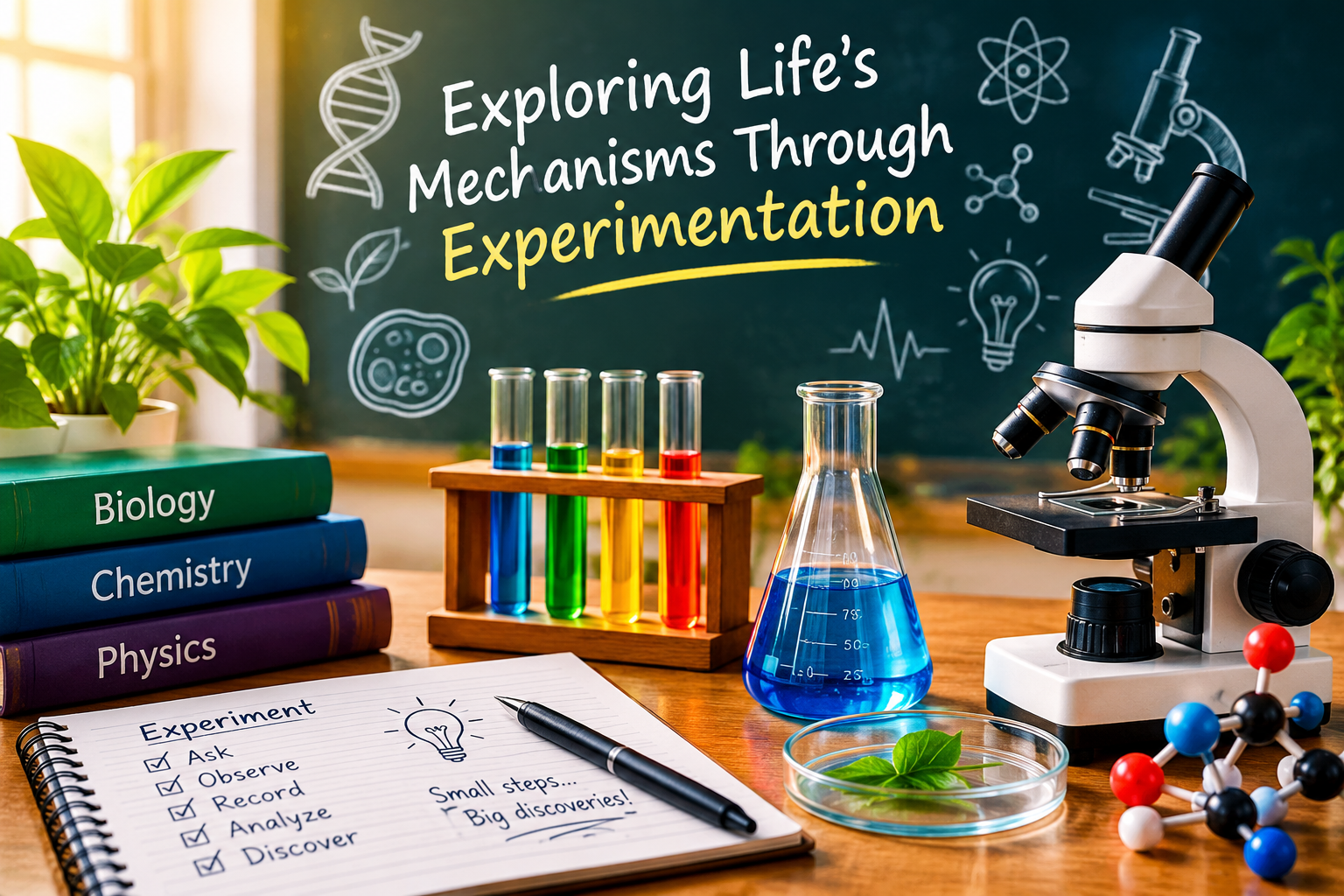
# Exploring Life’s Mechanisms Through Experimentation
Life is full of mysteries, discoveries, and amazing processes that help us understand how living organisms work. **“Exploring Life’s Mechanisms Through Experimentation”** is an exciting topic that highlights the importance of scientific experiments in understanding life, nature, and the world around us. Through observation, investigation, and practical activities, we can explore how living things function and discover the scientific principles behind everyday phenomena.
Experimentation is one of the most important parts of science. It allows us to ask questions, develop ideas, test hypotheses, observe results, and learn from our findings. Instead of simply memorizing facts from books, we can use experiments to understand scientific concepts through practical experience. Every experiment gives us an opportunity to explore something new, improve our knowledge, and develop critical-thinking skills.
Biology helps us understand living organisms, including plants, animals, humans, and microorganisms. By studying cells, we can discover how the basic units of life work together to support living systems. We can investigate how plants grow, how seeds germinate, how leaves respond to sunlight, and how environmental conditions affect living things. These investigations help us appreciate the complexity of life and understand the relationships between organisms and their surroundings.
Chemistry also plays an important role in understanding life. Living organisms depend on chemical reactions to obtain energy, grow, repair cells, and maintain essential functions. Through safe and supervised experiments, students can explore how different substances interact, observe changes in color, and learn about solutions, acids, bases, and chemical reactions. These activities demonstrate that chemistry is not just a subject in a textbook; it is connected to many processes that happen inside our bodies and throughout the natural world.
Microscopes and laboratory equipment make scientific exploration even more interesting. A microscope allows us to observe structures that are too small to see
RSIF8
TASK NO:139
ROLLNO:13
# Exploring Life’s Mechanisms Through Experimentation 🧬🔬🧪
Life is full of mysteries, discoveries, and amazing processes that help us understand how living organisms work. **“Exploring Life’s Mechanisms Through Experimentation”** is an exciting topic that highlights the importance of scientific experiments in understanding life, nature, and the world around us. Through observation, investigation, and practical activities, we can explore how living things function and discover the scientific principles behind everyday phenomena.
Experimentation is one of the most important parts of science. It allows us to ask questions, develop ideas, test hypotheses, observe results, and learn from our findings. Instead of simply memorizing facts from books, we can use experiments to understand scientific concepts through practical experience. Every experiment gives us an opportunity to explore something new, improve our knowledge, and develop critical-thinking skills.
Biology helps us understand living organisms, including plants, animals, humans, and microorganisms. By studying cells, we can discover how the basic units of life work together to support living systems. We can investigate how plants grow, how seeds germinate, how leaves respond to sunlight, and how environmental conditions affect living things. These investigations help us appreciate the complexity of life and understand the relationships between organisms and their surroundings.
Chemistry also plays an important role in understanding life. Living organisms depend on chemical reactions to obtain energy, grow, repair cells, and maintain essential functions. Through safe and supervised experiments, students can explore how different substances interact, observe changes in color, and learn about solutions, acids, bases, and chemical reactions. These activities demonstrate that chemistry is not just a subject in a textbook; it is connected to many processes that happen inside our bodies and throughout the natural world.
Microscopes and laboratory equipment make scientific exploration even more interesting. A microscope allows us to observe structures that are too small to see
0 Commentaires
0 Parts
120 Vue