


Foundation level
Roll no 13
story post
Day 48
Rehan school urdu bazar campas
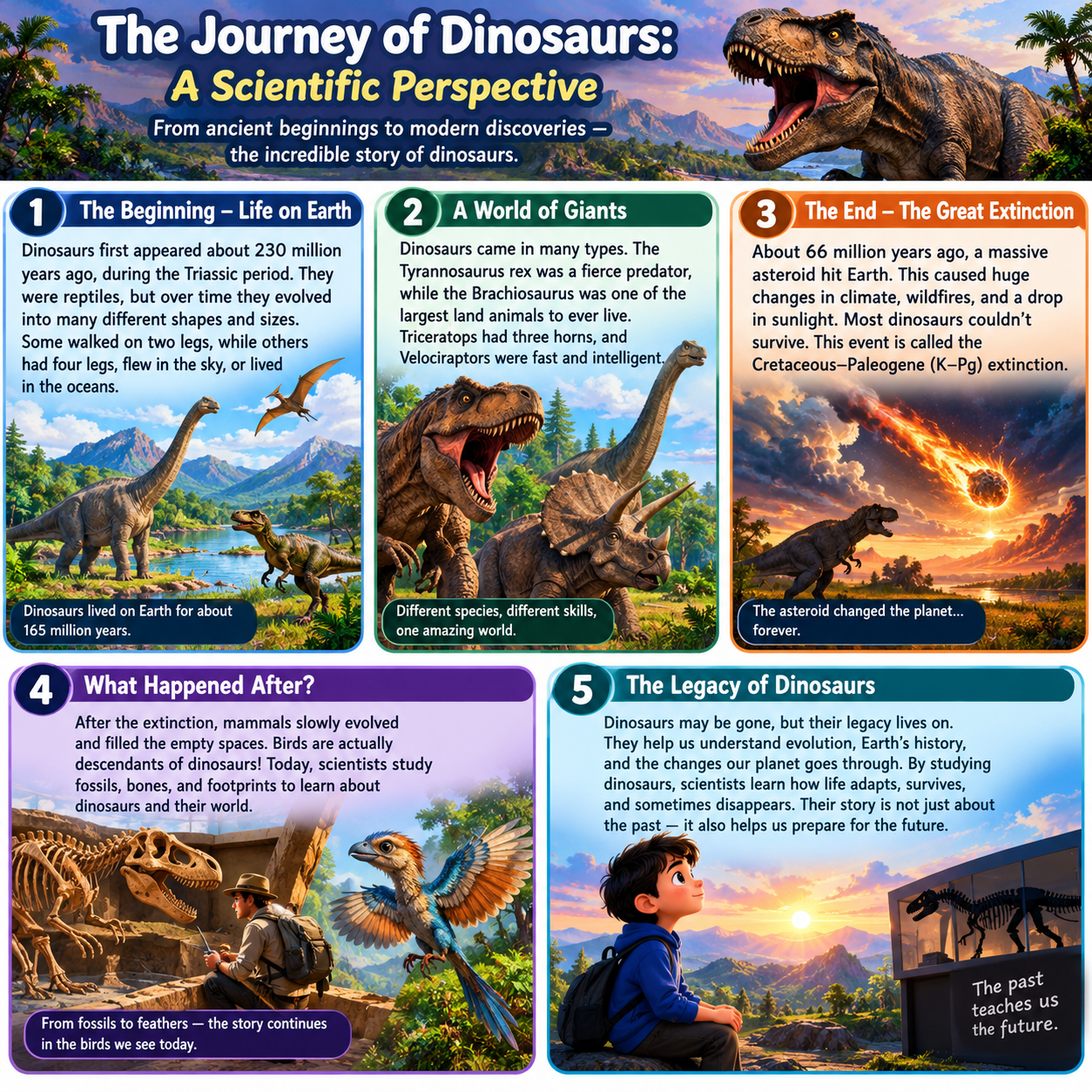
Millions of years ago, long before humans appeared on Earth, dinosaurs lived in a world filled with dense forests, flowing rivers, towering mountains, and vast open lands. Dinosaurs first appeared about 230 million years ago during the Triassic Period. Over millions of years, they evolved into many different shapes and sizes. Some were small and quick, while others grew into enormous creatures that dominated the land. Their fascinating journey became one of the most remarkable chapters in the history of life on Earth.
As time passed, dinosaurs spread across different environments and developed unique ways of surviving. The mighty Tyrannosaurus rex became famous for its powerful jaws and sharp teeth, while the enormous Brachiosaurus used its long neck to reach vegetation high above the ground. The Triceratops had three horns and a large bony shield around its head. Some dinosaurs hunted other animals, while many survived by eating plants. Each species played a different role in its environment, creating a complex and fascinating prehistoric world.
However, approximately 66 million years ago, a massive asteroid struck Earth near what is now Mexico. The impact triggered enormous environmental changes, sending dust and debris into the atmosphere and disrupting ecosystems around the world. Plants struggled to survive, food sources disappeared, and many species became extinct. This event marked the end of the age of non-avian dinosaurs. Yet, not every dinosaur lineage vanished. Some feathered dinosaurs survived through evolution, eventually giving rise to the birds we see in our world today.
Millions of years later, scientists began uncovering the hidden secrets of these ancient creatures through fossils buried deep within the Earth. Paleontologists discovered dinosaur bones, teeth, eggs, and footprints that provided clues about their appearance, behavior, and habitats. Using modern technology, including computer imaging and advanced scientific techniques, researchers can now reconstruct how many dinosaurs may have looked and lived. Every fossil discovery adds another piece to the puzzle, helping u
1m
Foundation level
Roll no 13
story post
Day 48
Rehan school urdu bazar campas
Millions of years ago, long before humans appeared on Earth, dinosaurs lived in a world filled with dense forests, flowing rivers, towering mountains, and vast open lands. Dinosaurs first appeared about 230 million years ago during the Triassic Period. Over millions of years, they evolved into many different shapes and sizes. Some were small and quick, while others grew into enormous creatures that dominated the land. Their fascinating journey became one of the most remarkable chapters in the history of life on Earth.
As time passed, dinosaurs spread across different environments and developed unique ways of surviving. The mighty Tyrannosaurus rex became famous for its powerful jaws and sharp teeth, while the enormous Brachiosaurus used its long neck to reach vegetation high above the ground. The Triceratops had three horns and a large bony shield around its head. Some dinosaurs hunted other animals, while many survived by eating plants. Each species played a different role in its environment, creating a complex and fascinating prehistoric world.
However, approximately 66 million years ago, a massive asteroid struck Earth near what is now Mexico. The impact triggered enormous environmental changes, sending dust and debris into the atmosphere and disrupting ecosystems around the world. Plants struggled to survive, food sources disappeared, and many species became extinct. This event marked the end of the age of non-avian dinosaurs. Yet, not every dinosaur lineage vanished. Some feathered dinosaurs survived through evolution, eventually giving rise to the birds we see in our world today.
Millions of years later, scientists began uncovering the hidden secrets of these ancient creatures through fossils buried deep within the Earth. Paleontologists discovered dinosaur bones, teeth, eggs, and footprints that provided clues about their appearance, behavior, and habitats. Using modern technology, including computer imaging and advanced scientific techniques, researchers can now reconstruct how many dinosaurs may have looked and lived. Every fossil discovery adds another piece to the puzzle, helping u
1m
0 Comments
0 Shares
78 Views