


ACCL TASK
Day:41
Roll No:003
Story post
@Student at Rehan School Urdu bazar campus
# The Mystery of Life: Exploring the World of Cells
Life is one of the most fascinating mysteries of the natural world. From the tallest trees to the smallest insects, every living organism has a unique structure and a special way of surviving. But have you ever wondered what makes life possible? What is the tiny building block that forms every living thing? The answer is **cells**, the fundamental units of life. Although cells are usually too small to be seen without a microscope, they perform countless important functions that allow living organisms to grow, develop, reproduce, and survive.
Cells are often described as the basic building blocks of life because all living organisms are made up of one or more cells. Some organisms, such as bacteria, consist of only a single cell, while humans, animals, and plants are made up of trillions of cells. Each cell has its own structure and responsibilities. Some cells help the body obtain energy, while others carry oxygen, fight infections, or transmit messages throughout the body. In plants, cells help produce food through photosynthesis and provide support to the plant's structure.
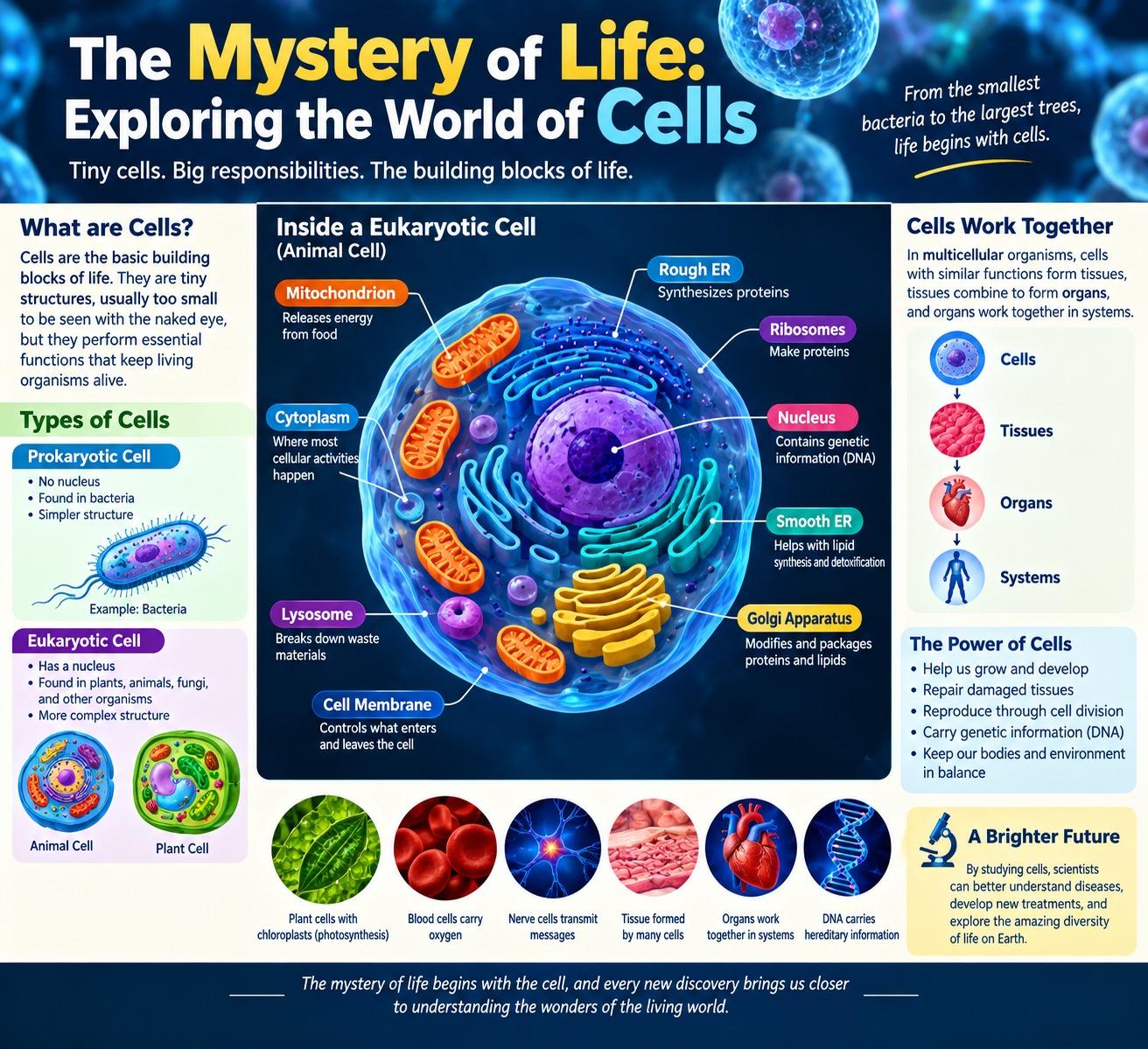
There are two major types of cells: **prokaryotic cells and eukaryotic cells**. Prokaryotic cells, such as bacteria, do not have a nucleus enclosed by a membrane. Eukaryotic cells, which are found in animals, plants, fungi, and many other organisms, contain a nucleus that stores genetic information. These cells also contain specialized structures called organelles, each of which performs a particular function. For example, the nucleus controls many cellular activities, mitochondria release usable energy from food, and the cell membrane regulates what enters and leaves the cell. Plant cells also contain chloroplasts, which help them produce food using sunlight.
One of the most amazing things about cells is how they work together. In multicellular organisms, cells with similar functions form tissues, tissues combine to form organs, and organs work together in systems. In the human body, for example, the heart, lungs, brain, and other organs depend on the coordinated activities of countless cells. This cooperation allows the body to maintain balance, respond to changes, and carry out the activities necessary for life.
Cells also play an essential role in growth, healing, and reproduction. Through a process called cell division, cells produce new cells. This allows organisms to grow, replace old or damaged cells, and repair tissues. Cells contain DNA, the genetic material that carries instructions for the development and functioning of living organisms. of cells. Exploring the world of cells helps us understand how living things function and reveals the extraordinary hidden within even the smallest units of life. The mystery of life begins with the cell, and every new discovery brings us closer to understanding the wonders of the living world.
ACCL TASK
Day:41
Roll No:003
Story post
@Student at Rehan School Urdu bazar campus
# The Mystery of Life: Exploring the World of Cells
Life is one of the most fascinating mysteries of the natural world. From the tallest trees to the smallest insects, every living organism has a unique structure and a special way of surviving. But have you ever wondered what makes life possible? What is the tiny building block that forms every living thing? The answer is **cells**, the fundamental units of life. Although cells are usually too small to be seen without a microscope, they perform countless important functions that allow living organisms to grow, develop, reproduce, and survive.
Cells are often described as the basic building blocks of life because all living organisms are made up of one or more cells. Some organisms, such as bacteria, consist of only a single cell, while humans, animals, and plants are made up of trillions of cells. Each cell has its own structure and responsibilities. Some cells help the body obtain energy, while others carry oxygen, fight infections, or transmit messages throughout the body. In plants, cells help produce food through photosynthesis and provide support to the plant's structure.
There are two major types of cells: **prokaryotic cells and eukaryotic cells**. Prokaryotic cells, such as bacteria, do not have a nucleus enclosed by a membrane. Eukaryotic cells, which are found in animals, plants, fungi, and many other organisms, contain a nucleus that stores genetic information. These cells also contain specialized structures called organelles, each of which performs a particular function. For example, the nucleus controls many cellular activities, mitochondria release usable energy from food, and the cell membrane regulates what enters and leaves the cell. Plant cells also contain chloroplasts, which help them produce food using sunlight.
One of the most amazing things about cells is how they work together. In multicellular organisms, cells with similar functions form tissues, tissues combine to form organs, and organs work together in systems. In the human body, for example, the heart, lungs, brain, and other organs depend on the coordinated activities of countless cells. This cooperation allows the body to maintain balance, respond to changes, and carry out the activities necessary for life.
Cells also play an essential role in growth, healing, and reproduction. Through a process called cell division, cells produce new cells. This allows organisms to grow, replace old or damaged cells, and repair tissues. Cells contain DNA, the genetic material that carries instructions for the development and functioning of living organisms. of cells. Exploring the world of cells helps us understand how living things function and reveals the extraordinary hidden within even the smallest units of life. The mystery of life begins with the cell, and every new discovery brings us closer to understanding the wonders of the living world.
0 Σχόλια
0 Μοιράστηκε
257 Views