


RSIf8
Roll Number: 49
Story post no.45
Story post topic:The Journey of “Cell” – From Monks’ Chambers to Biology Labs
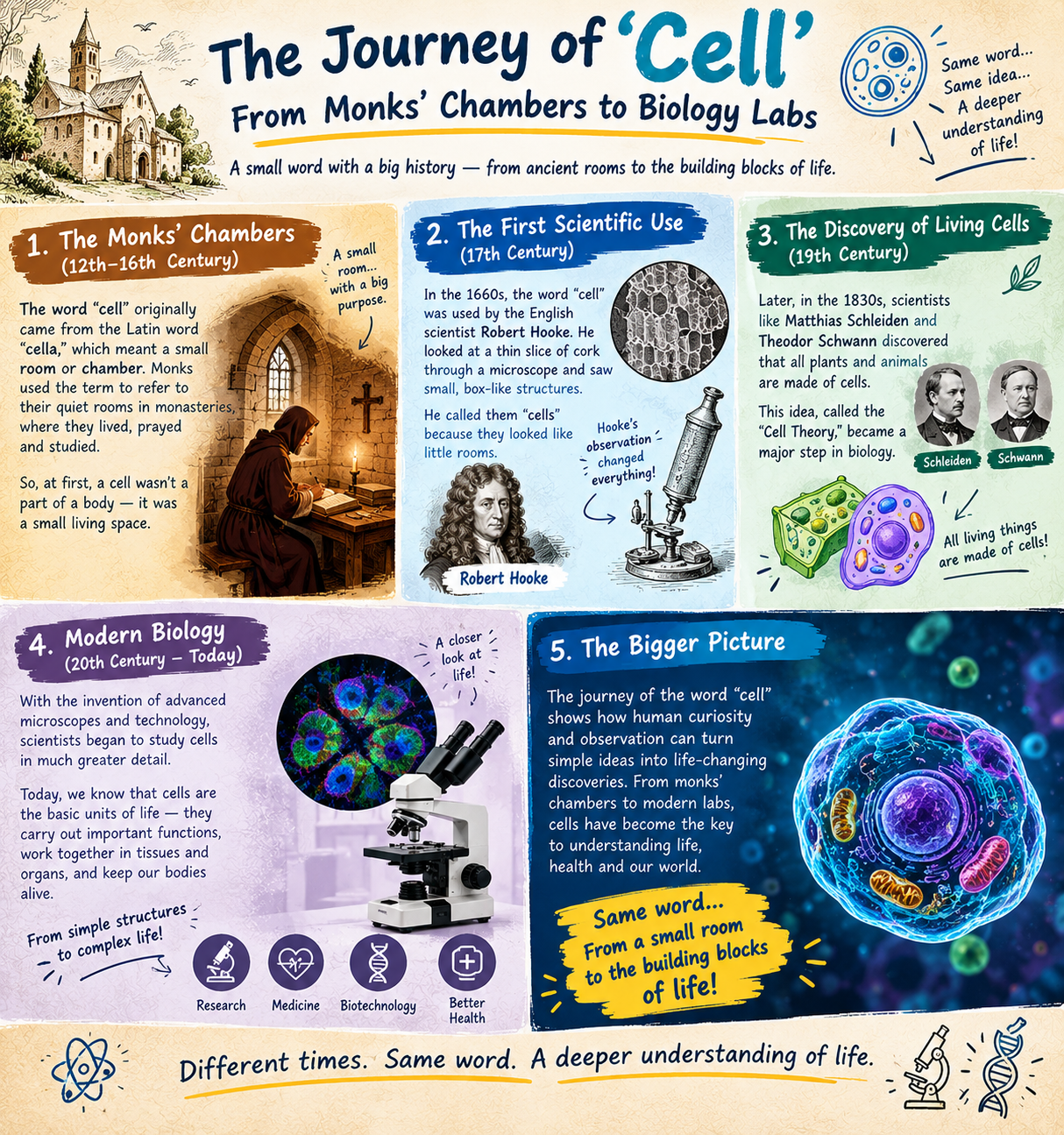
Have you ever wondered how the word “cell” became one of the most important terms in biology? This fascinating story explores the journey of the word from its Latin origin, meaning a small room or chamber, to its modern scientific meaning: the basic building block of life.
In the 17th century, scientist Robert Hooke observed tiny, box-like structures in a thin slice of cork through a microscope and named them “cells.” Later, scientists such as Matthias Schleiden and Theodor Schwann helped develop Cell Theory, which explains the fundamental role of cells in living organisms.
Today, advanced microscopes and modern technology allow scientists to study cells in greater detail, helping us understand human health, diseases, and the mysteries of life.
The key message: A small discovery can lead to a big change in our understanding of the world. Curiosity and scientific exploration help us uncover the secrets of life!
#JourneyOfCell #CellBiology #RobertHooke #CellTheory #Biology #ScientificDiscoveries #HistoryOfScience #LearningThroughStories #ClassFoundation #RSf8
RSIf8
Roll Number: 49
Story post no.45
Story post topic:The Journey of “Cell” – From Monks’ Chambers to Biology Labs
Have you ever wondered how the word “cell” became one of the most important terms in biology? 🤔 This fascinating story explores the journey of the word from its Latin origin, meaning a small room or chamber, to its modern scientific meaning: the basic building block of life.
In the 17th century, scientist Robert Hooke observed tiny, box-like structures in a thin slice of cork through a microscope and named them “cells.” Later, scientists such as Matthias Schleiden and Theodor Schwann helped develop Cell Theory, which explains the fundamental role of cells in living organisms. 🧫🔍
Today, advanced microscopes and modern technology allow scientists to study cells in greater detail, helping us understand human health, diseases, and the mysteries of life. 🌱✨
💡 The key message: A small discovery can lead to a big change in our understanding of the world. Curiosity and scientific exploration help us uncover the secrets of life!
#JourneyOfCell #CellBiology #RobertHooke #CellTheory #Biology #ScientificDiscoveries #HistoryOfScience #LearningThroughStories #ClassFoundation #RSf8
0 Reacties
0 aandelen
46 Views