


**Roll No: 2**
**Batch: 14**
**Book: ACCL**
**Task No: 160**
# The Nature of Light: Exploring Waves and Particles
Have you ever wondered how we see the colorful world around us? From the bright sunshine in the morning to the glowing stars at night, light plays an essential role in our lives. It allows us to see objects, helps plants grow, and makes many modern technologies possible. But what exactly is light? Is it a wave, a particle, or something even more fascinating?
**Light is a form of electromagnetic radiation that carries energy through space.** Unlike sound waves, light does not require air or another material medium to travel. It can move through the vacuum of space, which is how sunlight reaches Earth from the Sun. In a vacuum, light travels at approximately 300,000 kilometres per second, making it one of the fastest phenomena in nature.
## Light as a Wave
For many years, scientists studied light and discovered that it behaves like a wave. Light waves have properties such as wavelength, frequency, reflection, refraction, diffraction, and interference. These properties help explain many everyday optical phenomena.
**Reflection** occurs when light bounces off a surface. A mirror is a familiar example because it reflects light and allows us to see our image. **Refraction** happens when light changes direction as it passes from one transparent material into another, such as from air into water. This is why a straw placed in a glass of water may appear bent.
Light can also spread out through a process called diffraction and produce patterns through interference. These wave properties provide important evidence of the wave nature of light. Scientists use them to understand lenses, microscopes, telescopes, and many other optical instruments.
## Light as a Particle
Light also behaves in ways that can be explained by particles called **photons**. A photon is a small packet, or quantum, of electromagnetic energy. Photons have no rest mass and travel at the speed of light in a vacuum.
One important discovery was the photoelectric effect. Scientists observed that when light of a suitable frequency shines on certain metals, it can cause electrons to be released. Albert Einstein explained this phenomenon by showing that light transfers energy in individual packets called photons. This discovery helped establish the foundation of quantum physics.
The particle model explains how light interacts with matter in processes such as the photoelectric effect and the absorption and emission of energy by atoms.
## Wave-Particle Duality
One of the most fascinating discoveries in physics is that light shows both wave-like and particle-like behaviour. This idea is known as **wave-particle duality**.
Light does not behave like an ordinary water wave or a tiny solid ball. Instead, its behaviour depends on the type of experiment and how it interacts with matter. The wave description helps explain interference and diffraction, while the photon description explains how light transfers energy in individual amounts.
This discovery changed the way scientists understand the universe and became an important part of quantum mechanics.
## The Colours of Light
White light may look simple, but it contains many different colours. When white light passes through a glass prism, it separates into a spectrum of colours: red, orange, yellow, green, blue, indigo, and violet. This process is called **dispersion**.
Each colour has a different wavelength and frequency. Red light has a longer wavelength than violet light, while violet light has a higher frequency. The visible spectrum is only a small part of the electromagnetic spectrum, which also includes radio waves, microwaves, infrared radiation, ultraviolet radiation, X-rays, and gamma rays.
## Light in Modern Technology
The study of light has transformed the modern world. Fibre-optic cables use light to transmit information over long distances, supporting internet communication and global connectivity. Lasers are used in medical equipment, scientific research, manufacturing, and barcode scanners.
Cameras and microscopes use lenses to control light and produce images. Solar panels convert energy from sunlight into electrical energy, while telescopes help scientists observe distant stars and galaxies. These technologies demonstrate how understanding light can improve everyday life and expand human knowledge.
## Light and Life on Earth
Light is essential for many living organisms. Green plants use sunlight during photosynthesis to produce glucose from water and carbon dioxide, releasing oxygen as a by-product. This process supports food chains and helps maintain the balance of gases in Earth's atmosphere.
Light also helps animals and humans understand their surroundings through vision. Many organisms use natural light patterns to regulate daily activities, while sunlight influences environmental conditions and the rhythms of life.
## Learning Through Observation
You can explore the nature of light through simple observations. Notice how a mirror reflects an image, how a pencil appears bent in a glass of water, or how sunlight passing through a prism produces different colours. These examples connect scientific ideas with experiences from everyday life.
By asking questions, making observations, and studying experiments, we can understand how light behaves and why it is so important in science.
**Light is more than something that helps us see; it is a fascinating phenomenon that connects the worlds of waves, particles, energy, and life. By exploring its dual nature, we unlock new ways to understand the universe and discover the science behind the beauty of our world. **
\#NatureOfLight #WavesAndParticles #Physics #QuantumPhysics #ElectromagneticWaves #Science #ACCL #Batch14 #Task154
**Roll No: 2**
**Batch: 14**
**Book: ACCL**
**Task No: 160**
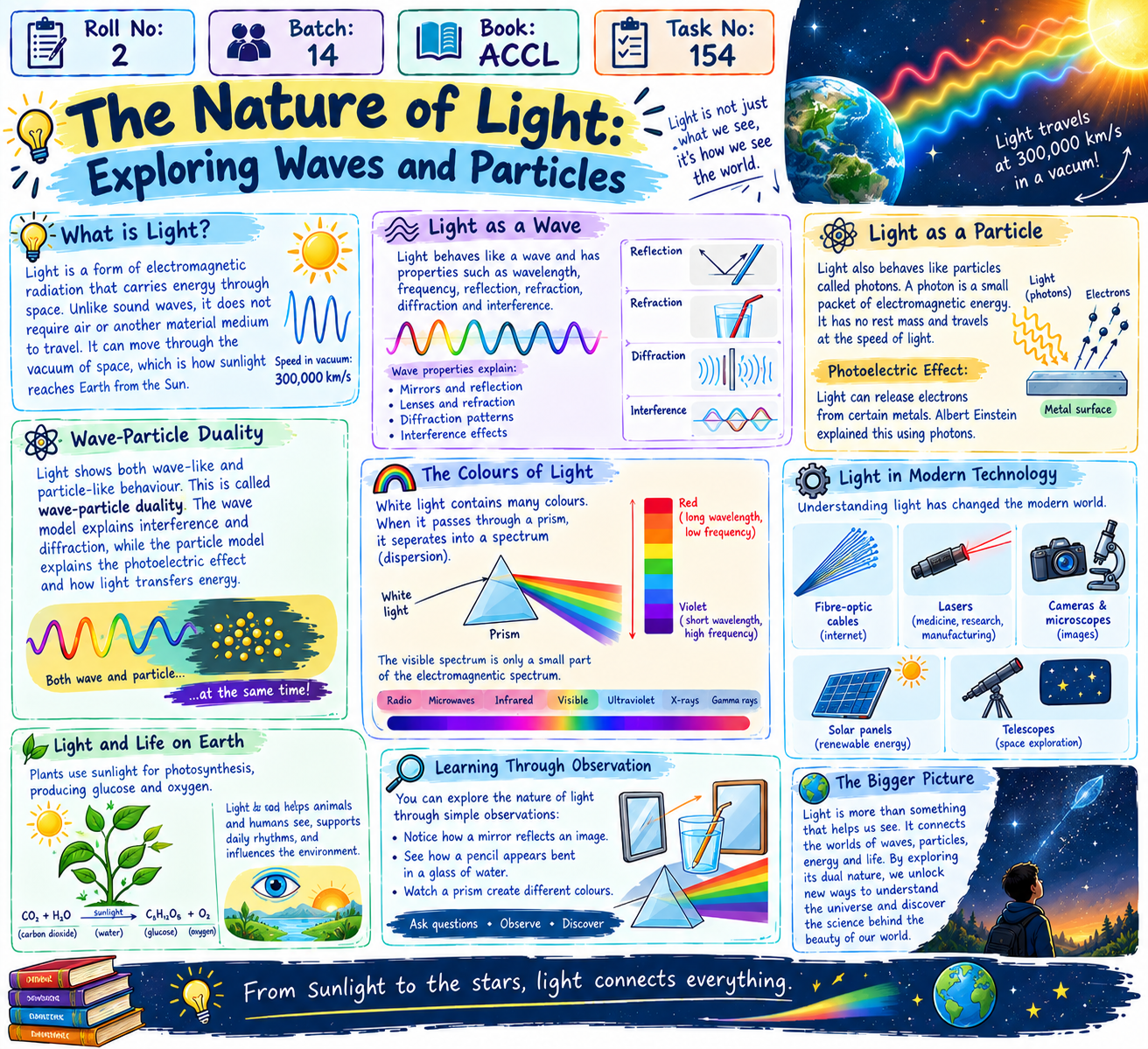
# 🌈💡 The Nature of Light: Exploring Waves and Particles 🔬🌊
Have you ever wondered how we see the colorful world around us? 🌍 From the bright sunshine in the morning to the glowing stars at night, light plays an essential role in our lives. It allows us to see objects, helps plants grow, and makes many modern technologies possible. But what exactly is light? Is it a wave, a particle, or something even more fascinating? ✨
**Light is a form of electromagnetic radiation that carries energy through space.** Unlike sound waves, light does not require air or another material medium to travel. It can move through the vacuum of space, which is how sunlight reaches Earth from the Sun. In a vacuum, light travels at approximately 300,000 kilometres per second, making it one of the fastest phenomena in nature. ☀️🚀
## 🌊 Light as a Wave
For many years, scientists studied light and discovered that it behaves like a wave. Light waves have properties such as wavelength, frequency, reflection, refraction, diffraction, and interference. These properties help explain many everyday optical phenomena. 🌈
**Reflection** occurs when light bounces off a surface. A mirror is a familiar example because it reflects light and allows us to see our image. **Refraction** happens when light changes direction as it passes from one transparent material into another, such as from air into water. This is why a straw placed in a glass of water may appear bent. 🪞💧
Light can also spread out through a process called diffraction and produce patterns through interference. These wave properties provide important evidence of the wave nature of light. Scientists use them to understand lenses, microscopes, telescopes, and many other optical instruments. 🔭🔬
## ⚛️ Light as a Particle
Light also behaves in ways that can be explained by particles called **photons**. A photon is a small packet, or quantum, of electromagnetic energy. Photons have no rest mass and travel at the speed of light in a vacuum. ⚡
One important discovery was the photoelectric effect. Scientists observed that when light of a suitable frequency shines on certain metals, it can cause electrons to be released. Albert Einstein explained this phenomenon by showing that light transfers energy in individual packets called photons. This discovery helped establish the foundation of quantum physics. 🧪
The particle model explains how light interacts with matter in processes such as the photoelectric effect and the absorption and emission of energy by atoms.
## 🔬 Wave-Particle Duality
One of the most fascinating discoveries in physics is that light shows both wave-like and particle-like behaviour. This idea is known as **wave-particle duality**. 🌌
Light does not behave like an ordinary water wave or a tiny solid ball. Instead, its behaviour depends on the type of experiment and how it interacts with matter. The wave description helps explain interference and diffraction, while the photon description explains how light transfers energy in individual amounts.
This discovery changed the way scientists understand the universe and became an important part of quantum mechanics.
## 🌈 The Colours of Light
White light may look simple, but it contains many different colours. When white light passes through a glass prism, it separates into a spectrum of colours: red, orange, yellow, green, blue, indigo, and violet. This process is called **dispersion**. 🌈
Each colour has a different wavelength and frequency. Red light has a longer wavelength than violet light, while violet light has a higher frequency. The visible spectrum is only a small part of the electromagnetic spectrum, which also includes radio waves, microwaves, infrared radiation, ultraviolet radiation, X-rays, and gamma rays.
## 📡 Light in Modern Technology
The study of light has transformed the modern world. Fibre-optic cables use light to transmit information over long distances, supporting internet communication and global connectivity. 💻🌐 Lasers are used in medical equipment, scientific research, manufacturing, and barcode scanners.
Cameras and microscopes use lenses to control light and produce images. Solar panels convert energy from sunlight into electrical energy, while telescopes help scientists observe distant stars and galaxies. These technologies demonstrate how understanding light can improve everyday life and expand human knowledge. 🔭🔋
## 🌱 Light and Life on Earth
Light is essential for many living organisms. Green plants use sunlight during photosynthesis to produce glucose from water and carbon dioxide, releasing oxygen as a by-product. This process supports food chains and helps maintain the balance of gases in Earth's atmosphere. 🌿☀️
Light also helps animals and humans understand their surroundings through vision. Many organisms use natural light patterns to regulate daily activities, while sunlight influences environmental conditions and the rhythms of life.
## 🧠 Learning Through Observation
You can explore the nature of light through simple observations. Notice how a mirror reflects an image, how a pencil appears bent in a glass of water, or how sunlight passing through a prism produces different colours. These examples connect scientific ideas with experiences from everyday life. 🔍📚
By asking questions, making observations, and studying experiments, we can understand how light behaves and why it is so important in science.
**Light is more than something that helps us see; it is a fascinating phenomenon that connects the worlds of waves, particles, energy, and life. By exploring its dual nature, we unlock new ways to understand the universe and discover the science behind the beauty of our world. 🌈💡🌍**
\#NatureOfLight #WavesAndParticles #Physics #QuantumPhysics #ElectromagneticWaves #Science #ACCL #Batch14 #Task154 🌈🔬✨
0 Commentarios
0 Acciones
77 Views