


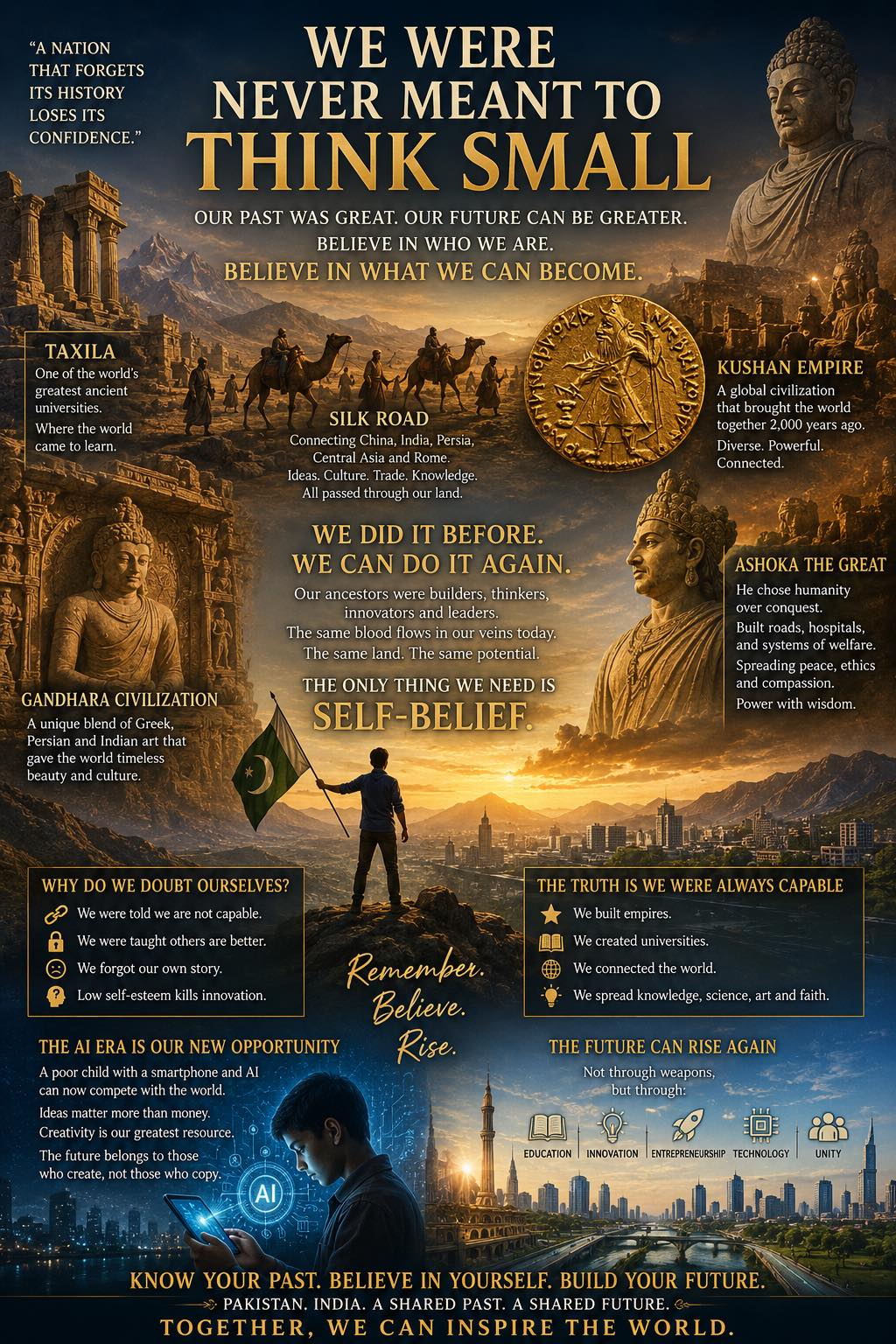
We Were Never Meant to Think Small
When I was growing up, I never heard about the Kushan Empire.
I never learned in school that the lands of modern Pakistan and India were once among the most important centers of civilization on Earth.
I never heard that Taxila was one of the world’s greatest ancient universities.
I never saw documentaries about how this region connected China, Persia, India, Central Asia, and even Rome through the Silk Road.
Instead, like millions of others, I mostly grew up hearing stories that made us feel small.
And maybe that is one of the biggest hidden problems in our region today:
Low self-esteem.
Not just personal self-esteem.
Civilizational self-esteem.
⸻
A Nation That Forgets Its Greatness Begins to Doubt Itself
If a child only grows up hearing:
* your country is poor,
* your people are backward,
* innovation only comes from the West,
* great companies can only be built in America,
* real technology only comes from Europe or China,
then eventually that child stops believing in himself.
He begins to admire others more than he admires his own people.
He begins to think:
“We can use technology… but we cannot create it.”
“We can work for companies… but we cannot build them.”
“We can consume ideas… but not invent them.”
This is not just an economic problem.
It is a psychological problem.
A historical problem.
A storytelling problem.
⸻
But History Tells a Completely Different Story
The truth is:
This region was once one of the beating hearts of the world.
The lands of Pakistan and India were not sitting at the edge of civilization.
They were helping shape civilization itself.
Here existed:
* giant trade networks,
* world-class universities,
* philosophical schools,
* spiritual movements,
* scientific thinking,
* artistic revolutions,
* and powerful empires.
For centuries, knowledge, culture, trade, and ideas flowed through this region.
⸻
Taxila — When the World Came Here to Learn
Today we think “international universities” are a modern invention.
But more than 2,000 years ago, students traveled from distant lands to study at Taxila.
People came to learn:
* medicine,
* philosophy,
* governance,
* mathematics,
* spirituality,
* and political thought.
Imagine that.
At a time when large parts of the world were still deeply undeveloped…
This region was already producing scholars, thinkers, and systems of learning that attracted the world.
⸻
The Kushan Empire — The Civilization That Connected the World
The Kushan Empire was not just another kingdom.
It was one of the world’s great connectors.
Chinese silk,
Indian spices,
Roman gold,
Persian influence,
Central Asian trade—
all passed through this region.
Different religions coexisted.
Different languages were spoken.
Greek, Persian, Indian, and Central Asian cultures blended together.
This was not a closed civilization.
It was a global civilization.
Nearly 2,000 years ago.
⸻
Ashoka — Power Through Humanity
Then came Emperor Ashoka.
A ruler who realized after war that true greatness was not domination…
but humanity.
He built roads.
Planted trees.
Created systems for public welfare.
Spread ethics and philosophy instead of fear.
This happened here.
In this part of the world.
⸻
Why Were We Never Told This Properly?
That is the painful question.
Why did generations grow up learning mostly about invasions, defeats, and colonial narratives…
but so little about the greatness that once existed here?
Why do so many children know more about distant kings than the civilizations that once stood on their own soil?
When a civilization forgets its creative history…
it starts seeing itself only through the eyes of others.
And slowly, it loses confidence.
⸻
Low Self-Esteem Is Destroying Innovation
Today, when somebody in Pakistan or India builds something new…
many people immediately doubt it.
They say:
“It can’t be real.”
“It must be copied.”
“It’s impossible.”
“People here cannot build world-class things.”
Why?
Because deep inside, many of us have been conditioned to believe that greatness only comes from somewhere else.
I have personally built many innovations.
Yet often people did not believe they were truly created here.
Not because the ideas were impossible.
But because their minds had already accepted a hidden belief:
“We are not capable of greatness.”
That belief is more dangerous than poverty.
⸻
But History Says Otherwise
History says:
Your ancestors built empires.
They connected continents.
They created universities.
They spread philosophy.
They influenced religion, trade, and culture across Asia.
They were creators.
Builders.
Thinkers.
Explorers.
This land was once among the centers of the world.
And the blood flowing through us today comes from the same human story.
⸻
The AI Era Changes Everything Again
Today, humanity is entering another great revolution:
Artificial Intelligence.
And for the first time in history, a poor child with:
* a smartphone,
* internet,
* and AI
can potentially compete with the world.
Factories matter less.
Ideas matter more.
Connection matters more.
Creativity matters more.
Knowledge matters more.
And these are areas where our people can rise very quickly.
⸻
We Need to Remember Our Story Again
We must stop teaching our children only about survival.
We must also teach them about possibility.
We must remind them:
* your civilization mattered,
* your ancestors contributed to humanity,
* your region shaped history,
* your people created beauty, knowledge, trade, and ideas.
Because the moment a nation starts believing in itself again…
everything begins to change.
⸻
The Future Can Rise Again
Perhaps Pakistan and India do not need to become copies of the West.
Perhaps they need to rediscover their own confidence.
Because this region was once:
* intellectually powerful,
* economically connected,
* spiritually influential,
* culturally rich,
* and globally important.
And maybe in the AI age…
it can rise again.
Not through conquest.
But through:
* education,
* innovation,
* entrepreneurship,
* technology,
* AI,
* and self-belief.
Maybe the greatest revolution of the next 20 years will not just be technological.
Maybe it will be psychological.
A civilization remembering that it was never meant to think small.
When I was growing up, I never heard about the Kushan Empire.
I never learned in school that the lands of modern Pakistan and India were once among the most important centers of civilization on Earth.
I never heard that Taxila was one of the world’s greatest ancient universities.
I never saw documentaries about how this region connected China, Persia, India, Central Asia, and even Rome through the Silk Road.
Instead, like millions of others, I mostly grew up hearing stories that made us feel small.
And maybe that is one of the biggest hidden problems in our region today:
Low self-esteem.
Not just personal self-esteem.
Civilizational self-esteem.
⸻
A Nation That Forgets Its Greatness Begins to Doubt Itself
If a child only grows up hearing:
* your country is poor,
* your people are backward,
* innovation only comes from the West,
* great companies can only be built in America,
* real technology only comes from Europe or China,
then eventually that child stops believing in himself.
He begins to admire others more than he admires his own people.
He begins to think:
“We can use technology… but we cannot create it.”
“We can work for companies… but we cannot build them.”
“We can consume ideas… but not invent them.”
This is not just an economic problem.
It is a psychological problem.
A historical problem.
A storytelling problem.
⸻
But History Tells a Completely Different Story
The truth is:
This region was once one of the beating hearts of the world.
The lands of Pakistan and India were not sitting at the edge of civilization.
They were helping shape civilization itself.
Here existed:
* giant trade networks,
* world-class universities,
* philosophical schools,
* spiritual movements,
* scientific thinking,
* artistic revolutions,
* and powerful empires.
For centuries, knowledge, culture, trade, and ideas flowed through this region.
⸻
Taxila — When the World Came Here to Learn
Today we think “international universities” are a modern invention.
But more than 2,000 years ago, students traveled from distant lands to study at Taxila.
People came to learn:
* medicine,
* philosophy,
* governance,
* mathematics,
* spirituality,
* and political thought.
Imagine that.
At a time when large parts of the world were still deeply undeveloped…
This region was already producing scholars, thinkers, and systems of learning that attracted the world.
⸻
The Kushan Empire — The Civilization That Connected the World
The Kushan Empire was not just another kingdom.
It was one of the world’s great connectors.
Chinese silk,
Indian spices,
Roman gold,
Persian influence,
Central Asian trade—
all passed through this region.
Different religions coexisted.
Different languages were spoken.
Greek, Persian, Indian, and Central Asian cultures blended together.
This was not a closed civilization.
It was a global civilization.
Nearly 2,000 years ago.
⸻
Ashoka — Power Through Humanity
Then came Emperor Ashoka.
A ruler who realized after war that true greatness was not domination…
but humanity.
He built roads.
Planted trees.
Created systems for public welfare.
Spread ethics and philosophy instead of fear.
This happened here.
In this part of the world.
⸻
Why Were We Never Told This Properly?
That is the painful question.
Why did generations grow up learning mostly about invasions, defeats, and colonial narratives…
but so little about the greatness that once existed here?
Why do so many children know more about distant kings than the civilizations that once stood on their own soil?
When a civilization forgets its creative history…
it starts seeing itself only through the eyes of others.
And slowly, it loses confidence.
⸻
Low Self-Esteem Is Destroying Innovation
Today, when somebody in Pakistan or India builds something new…
many people immediately doubt it.
They say:
“It can’t be real.”
“It must be copied.”
“It’s impossible.”
“People here cannot build world-class things.”
Why?
Because deep inside, many of us have been conditioned to believe that greatness only comes from somewhere else.
I have personally built many innovations.
Yet often people did not believe they were truly created here.
Not because the ideas were impossible.
But because their minds had already accepted a hidden belief:
“We are not capable of greatness.”
That belief is more dangerous than poverty.
⸻
But History Says Otherwise
History says:
Your ancestors built empires.
They connected continents.
They created universities.
They spread philosophy.
They influenced religion, trade, and culture across Asia.
They were creators.
Builders.
Thinkers.
Explorers.
This land was once among the centers of the world.
And the blood flowing through us today comes from the same human story.
⸻
The AI Era Changes Everything Again
Today, humanity is entering another great revolution:
Artificial Intelligence.
And for the first time in history, a poor child with:
* a smartphone,
* internet,
* and AI
can potentially compete with the world.
Factories matter less.
Ideas matter more.
Connection matters more.
Creativity matters more.
Knowledge matters more.
And these are areas where our people can rise very quickly.
⸻
We Need to Remember Our Story Again
We must stop teaching our children only about survival.
We must also teach them about possibility.
We must remind them:
* your civilization mattered,
* your ancestors contributed to humanity,
* your region shaped history,
* your people created beauty, knowledge, trade, and ideas.
Because the moment a nation starts believing in itself again…
everything begins to change.
⸻
The Future Can Rise Again
Perhaps Pakistan and India do not need to become copies of the West.
Perhaps they need to rediscover their own confidence.
Because this region was once:
* intellectually powerful,
* economically connected,
* spiritually influential,
* culturally rich,
* and globally important.
And maybe in the AI age…
it can rise again.
Not through conquest.
But through:
* education,
* innovation,
* entrepreneurship,
* technology,
* AI,
* and self-belief.
Maybe the greatest revolution of the next 20 years will not just be technological.
Maybe it will be psychological.
A civilization remembering that it was never meant to think small.
We Were Never Meant to Think Small
When I was growing up, I never heard about the Kushan Empire.
I never learned in school that the lands of modern Pakistan and India were once among the most important centers of civilization on Earth.
I never heard that Taxila was one of the world’s greatest ancient universities.
I never saw documentaries about how this region connected China, Persia, India, Central Asia, and even Rome through the Silk Road.
Instead, like millions of others, I mostly grew up hearing stories that made us feel small.
And maybe that is one of the biggest hidden problems in our region today:
Low self-esteem.
Not just personal self-esteem.
Civilizational self-esteem.
⸻
A Nation That Forgets Its Greatness Begins to Doubt Itself
If a child only grows up hearing:
* your country is poor,
* your people are backward,
* innovation only comes from the West,
* great companies can only be built in America,
* real technology only comes from Europe or China,
then eventually that child stops believing in himself.
He begins to admire others more than he admires his own people.
He begins to think:
“We can use technology… but we cannot create it.”
“We can work for companies… but we cannot build them.”
“We can consume ideas… but not invent them.”
This is not just an economic problem.
It is a psychological problem.
A historical problem.
A storytelling problem.
⸻
But History Tells a Completely Different Story
The truth is:
This region was once one of the beating hearts of the world.
The lands of Pakistan and India were not sitting at the edge of civilization.
They were helping shape civilization itself.
Here existed:
* giant trade networks,
* world-class universities,
* philosophical schools,
* spiritual movements,
* scientific thinking,
* artistic revolutions,
* and powerful empires.
For centuries, knowledge, culture, trade, and ideas flowed through this region.
⸻
Taxila — When the World Came Here to Learn
Today we think “international universities” are a modern invention.
But more than 2,000 years ago, students traveled from distant lands to study at Taxila.
People came to learn:
* medicine,
* philosophy,
* governance,
* mathematics,
* spirituality,
* and political thought.
Imagine that.
At a time when large parts of the world were still deeply undeveloped…
This region was already producing scholars, thinkers, and systems of learning that attracted the world.
⸻
The Kushan Empire — The Civilization That Connected the World
The Kushan Empire was not just another kingdom.
It was one of the world’s great connectors.
Chinese silk,
Indian spices,
Roman gold,
Persian influence,
Central Asian trade—
all passed through this region.
Different religions coexisted.
Different languages were spoken.
Greek, Persian, Indian, and Central Asian cultures blended together.
This was not a closed civilization.
It was a global civilization.
Nearly 2,000 years ago.
⸻
Ashoka — Power Through Humanity
Then came Emperor Ashoka.
A ruler who realized after war that true greatness was not domination…
but humanity.
He built roads.
Planted trees.
Created systems for public welfare.
Spread ethics and philosophy instead of fear.
This happened here.
In this part of the world.
⸻
Why Were We Never Told This Properly?
That is the painful question.
Why did generations grow up learning mostly about invasions, defeats, and colonial narratives…
but so little about the greatness that once existed here?
Why do so many children know more about distant kings than the civilizations that once stood on their own soil?
When a civilization forgets its creative history…
it starts seeing itself only through the eyes of others.
And slowly, it loses confidence.
⸻
Low Self-Esteem Is Destroying Innovation
Today, when somebody in Pakistan or India builds something new…
many people immediately doubt it.
They say:
“It can’t be real.”
“It must be copied.”
“It’s impossible.”
“People here cannot build world-class things.”
Why?
Because deep inside, many of us have been conditioned to believe that greatness only comes from somewhere else.
I have personally built many innovations.
Yet often people did not believe they were truly created here.
Not because the ideas were impossible.
But because their minds had already accepted a hidden belief:
“We are not capable of greatness.”
That belief is more dangerous than poverty.
⸻
But History Says Otherwise
History says:
Your ancestors built empires.
They connected continents.
They created universities.
They spread philosophy.
They influenced religion, trade, and culture across Asia.
They were creators.
Builders.
Thinkers.
Explorers.
This land was once among the centers of the world.
And the blood flowing through us today comes from the same human story.
⸻
The AI Era Changes Everything Again
Today, humanity is entering another great revolution:
Artificial Intelligence.
And for the first time in history, a poor child with:
* a smartphone,
* internet,
* and AI
can potentially compete with the world.
Factories matter less.
Ideas matter more.
Connection matters more.
Creativity matters more.
Knowledge matters more.
And these are areas where our people can rise very quickly.
⸻
We Need to Remember Our Story Again
We must stop teaching our children only about survival.
We must also teach them about possibility.
We must remind them:
* your civilization mattered,
* your ancestors contributed to humanity,
* your region shaped history,
* your people created beauty, knowledge, trade, and ideas.
Because the moment a nation starts believing in itself again…
everything begins to change.
⸻
The Future Can Rise Again
Perhaps Pakistan and India do not need to become copies of the West.
Perhaps they need to rediscover their own confidence.
Because this region was once:
* intellectually powerful,
* economically connected,
* spiritually influential,
* culturally rich,
* and globally important.
And maybe in the AI age…
it can rise again.
Not through conquest.
But through:
* education,
* innovation,
* entrepreneurship,
* technology,
* AI,
* and self-belief.
Maybe the greatest revolution of the next 20 years will not just be technological.
Maybe it will be psychological.
A civilization remembering that it was never meant to think small.
0 Reacties
0 aandelen
88 Views