


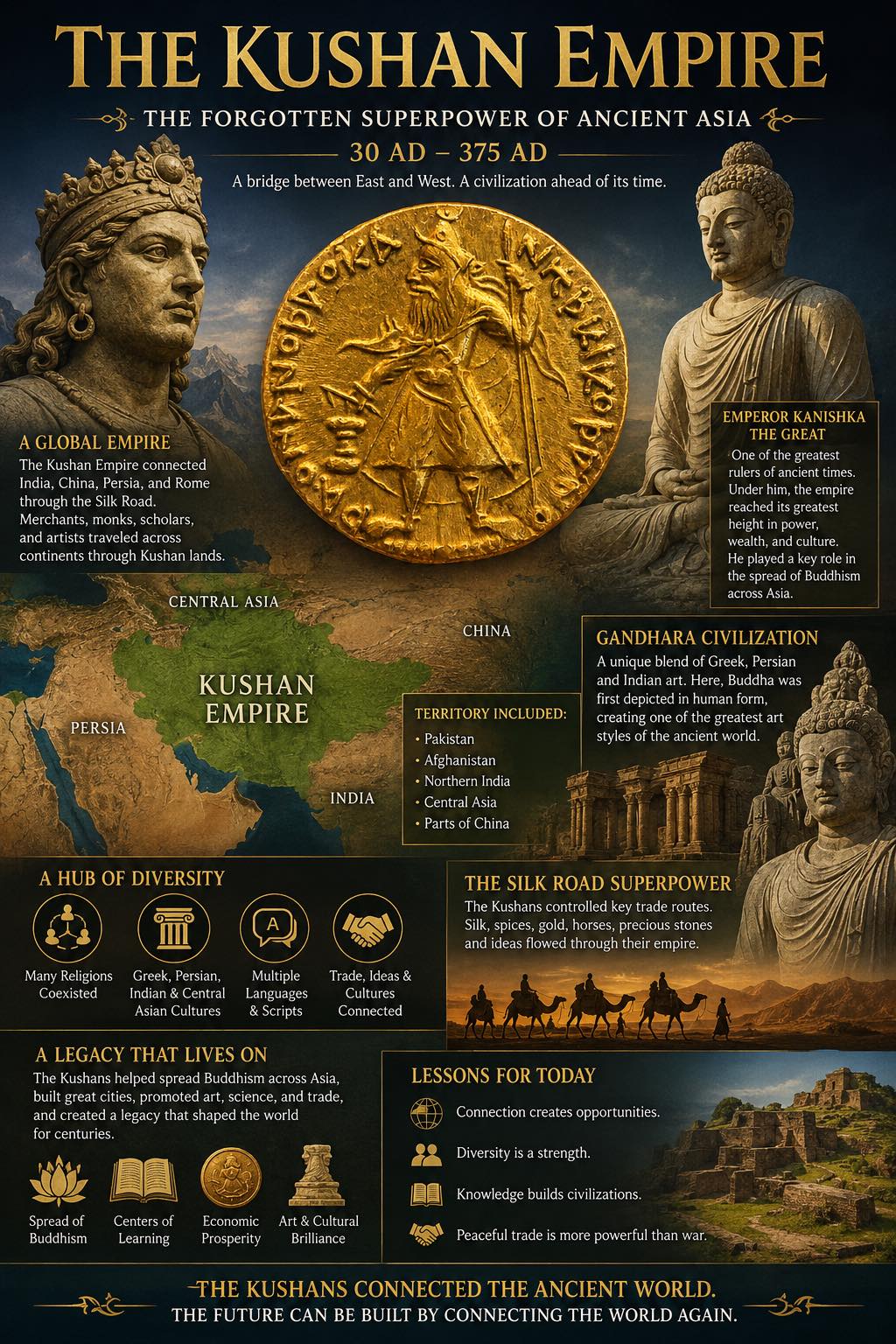
The empire shown in your image is most likely the Kushan Empire — one of the most fascinating yet forgotten superpowers in human history.
The Kushan Empire — The Forgotten Superpower of Ancient Pakistan and Central Asia
When people think about the great empires of history, they often think of Rome, Persia, China, or the Ottomans.
But very few people know that nearly 2,000 years ago, a powerful empire rose from the lands of modern-day Pakistan and Afghanistan that connected East and West, controlled one of the richest trade networks in the world, and helped spread ideas, religion, science, art, and culture across continents.
This empire was called:
The Kushan Empire.
And for a period of time, it became one of the most important civilizations on Earth.
⸻
A Civilization at the Center of the World
The Kushan Empire existed roughly between:
30 AD to 375 AD.
At its peak, the empire covered areas of:
* Pakistan
* Afghanistan
* Northern India
* Tajikistan
* Uzbekistan
* Parts of China
This was not a small kingdom.
This was a giant international superpower sitting directly on the Silk Road — the ancient trade highway connecting China, India, Persia, Arabia, and Europe.
Imagine caravans full of:
* Silk from China
* Spices from India
* Gold from Rome
* Horses from Central Asia
* Precious stones from Afghanistan
All moving through Kushan territory.
The Kushans became rich because they controlled trade between civilizations.
Today, countries fight over oil routes.
Back then, empires fought over trade routes.
And the Kushans controlled one of the most important routes on Earth.
⸻
Who Were the Kushans?
The Kushans originally came from a nomadic tribe called the Yuezhi from Central Asia.
After wars and migrations, they moved south toward Bactria and eventually established a powerful empire.
Instead of destroying local cultures, they absorbed them.
That became their superpower.
The Kushans mixed:
* Greek culture
* Persian culture
* Indian culture
* Central Asian traditions
* Buddhist philosophy
This created one of the most multicultural civilizations of the ancient world.
⸻
The Empire of Many Languages
One of the most amazing things about the Kushan Empire was diversity.
Their coins used:
* Greek letters
* Bactrian language
* Indian symbols
* Persian influences
Their cities contained people from many races and religions.
Merchants from Rome could meet monks from India while traders from China exchanged goods with Persian businessmen.
Nearly 2,000 years ago, the Kushans created something that looked surprisingly modern:
A globalized civilization.
⸻
Emperor Kanishka — The Great Visionary
The greatest ruler of the Kushan Empire was:
Kanishka the Great.
Many historians compare him to:
* Ashoka
* Constantine
* Alexander
* Akbar
Because of his enormous influence on religion and culture.
Under Kanishka:
* The empire became extremely wealthy
* Buddhism spread across Asia
* Trade exploded
* Art and science flourished
Some historians believe Kanishka ruled from areas around modern Pakistan and Afghanistan.
His empire became the bridge between India and China.
Without the Kushans, Buddhism might never have spread deeply into China, Korea, Japan, and much of East Asia.
That means the Kushans helped shape the spiritual future of billions of people.
⸻
The Gandhara Civilization
One of the greatest achievements of the Kushan Empire was the development of:
Gandhara Art.
This art style mixed:
* Greek realism
* Buddhist themes
* Persian elegance
* Indian spirituality
For the first time in history, Buddha statues began appearing in human form with detailed artistic beauty.
Many historians believe Greek artistic influence from Alexander the Great’s era helped shape Buddhist art in Gandhara.
This happened largely in areas of:
* Taxila
* Peshawar
* Swat
* Afghanistan
Modern Pakistan once stood at the center of one of the greatest artistic revolutions in history.
⸻
Ancient Pakistan as a Global Knowledge Hub
Today many people imagine ancient Pakistan as isolated or undeveloped.
Reality was the opposite.
During the Kushan period:
* Taxila was one of the world’s great educational centers
* Traders crossed continents
* Philosophers exchanged ideas
* Religions mixed peacefully
* Wealth flowed through the region
Students traveled from faraway lands to study.
Ideas traveled faster than armies.
Knowledge became power.
⸻
The Silk Road Internet of the Ancient World
Today the internet connects humanity.
Back then, the Silk Road did.
The Kushans sat in the middle of this ancient information network.
Through trade routes, people exchanged:
* Religion
* Mathematics
* Astronomy
* Medicine
* Art
* Technology
* Philosophy
The Kushan Empire became rich not only because of military power…
But because of connection.
That is an important lesson even today.
The future belongs to connected civilizations.
⸻
Religion and Tolerance
The Kushans were remarkably tolerant for their time.
Their coins showed symbols from multiple religions:
* Greek gods
* Persian gods
* Buddhist symbols
* Hindu influences
This tells us something extraordinary.
Instead of forcing one identity, they allowed civilizations to coexist.
That openness helped them grow rapidly.
⸻
Why the Kushan Empire Matters Today
Most Pakistanis grow up learning more about distant empires than the civilizations that once existed in their own region.
But the Kushans prove something powerful:
The lands of Pakistan and Afghanistan were once among the centers of global civilization.
Not the edges.
The center.
Trade.
Knowledge.
Culture.
Innovation.
Art.
Religion.
All flowed through this region.
⸻
Lessons for Modern Pakistan
The Kushan Empire teaches us several important lessons:
1. Connection Creates Wealth
The Kushans became rich by connecting civilizations.
Today Pakistan can do the same through:
* Internet
* AI
* Trade
* Education
* Technology
⸻
2. Diversity Can Become Strength
The Kushans succeeded because they absorbed ideas from many cultures.
Civilizations grow when they learn openly.
⸻
3. Knowledge Is More Powerful Than Borders
Taxila and Gandhara became famous because they attracted thinkers and traders.
The future economy may again belong to countries that become centers of learning and innovation.
⸻
4. Geography Is Destiny
Pakistan still sits near one of the world’s most important trade positions:
* China
* Middle East
* Central Asia
* India
* Arabian Sea
The same geography that made the Kushans powerful still exists today.
⸻
The Fall of the Empire
Like all empires, the Kushans eventually weakened.
Several reasons contributed:
* Internal divisions
* Pressure from Persian empires
* Invasions from Central Asia
* Fragmentation of trade routes
Over time the empire broke apart.
But its influence survived.
Its impact on Buddhism, art, trade, and culture continued for centuries.
⸻
A Forgotten Giant
Today many people have never heard of the Kushan Empire.
Yet its influence shaped Asia.
It connected civilizations.
It spread ideas across continents.
It transformed art and religion.
And it proved that the lands of modern Pakistan and Afghanistan were once among the beating hearts of the ancient world.
Perhaps one day this region can become such a center again.
Not through conquest.
But through:
* Knowledge
* Technology
* AI
* Education
* Connection
* Entrepreneurship
Just like the Kushans once connected the Silk Road…
The next generation may connect the digital road of the future.
The Kushan Empire — The Forgotten Superpower of Ancient Pakistan and Central Asia
When people think about the great empires of history, they often think of Rome, Persia, China, or the Ottomans.
But very few people know that nearly 2,000 years ago, a powerful empire rose from the lands of modern-day Pakistan and Afghanistan that connected East and West, controlled one of the richest trade networks in the world, and helped spread ideas, religion, science, art, and culture across continents.
This empire was called:
The Kushan Empire.
And for a period of time, it became one of the most important civilizations on Earth.
⸻
A Civilization at the Center of the World
The Kushan Empire existed roughly between:
30 AD to 375 AD.
At its peak, the empire covered areas of:
* Pakistan
* Afghanistan
* Northern India
* Tajikistan
* Uzbekistan
* Parts of China
This was not a small kingdom.
This was a giant international superpower sitting directly on the Silk Road — the ancient trade highway connecting China, India, Persia, Arabia, and Europe.
Imagine caravans full of:
* Silk from China
* Spices from India
* Gold from Rome
* Horses from Central Asia
* Precious stones from Afghanistan
All moving through Kushan territory.
The Kushans became rich because they controlled trade between civilizations.
Today, countries fight over oil routes.
Back then, empires fought over trade routes.
And the Kushans controlled one of the most important routes on Earth.
⸻
Who Were the Kushans?
The Kushans originally came from a nomadic tribe called the Yuezhi from Central Asia.
After wars and migrations, they moved south toward Bactria and eventually established a powerful empire.
Instead of destroying local cultures, they absorbed them.
That became their superpower.
The Kushans mixed:
* Greek culture
* Persian culture
* Indian culture
* Central Asian traditions
* Buddhist philosophy
This created one of the most multicultural civilizations of the ancient world.
⸻
The Empire of Many Languages
One of the most amazing things about the Kushan Empire was diversity.
Their coins used:
* Greek letters
* Bactrian language
* Indian symbols
* Persian influences
Their cities contained people from many races and religions.
Merchants from Rome could meet monks from India while traders from China exchanged goods with Persian businessmen.
Nearly 2,000 years ago, the Kushans created something that looked surprisingly modern:
A globalized civilization.
⸻
Emperor Kanishka — The Great Visionary
The greatest ruler of the Kushan Empire was:
Kanishka the Great.
Many historians compare him to:
* Ashoka
* Constantine
* Alexander
* Akbar
Because of his enormous influence on religion and culture.
Under Kanishka:
* The empire became extremely wealthy
* Buddhism spread across Asia
* Trade exploded
* Art and science flourished
Some historians believe Kanishka ruled from areas around modern Pakistan and Afghanistan.
His empire became the bridge between India and China.
Without the Kushans, Buddhism might never have spread deeply into China, Korea, Japan, and much of East Asia.
That means the Kushans helped shape the spiritual future of billions of people.
⸻
The Gandhara Civilization
One of the greatest achievements of the Kushan Empire was the development of:
Gandhara Art.
This art style mixed:
* Greek realism
* Buddhist themes
* Persian elegance
* Indian spirituality
For the first time in history, Buddha statues began appearing in human form with detailed artistic beauty.
Many historians believe Greek artistic influence from Alexander the Great’s era helped shape Buddhist art in Gandhara.
This happened largely in areas of:
* Taxila
* Peshawar
* Swat
* Afghanistan
Modern Pakistan once stood at the center of one of the greatest artistic revolutions in history.
⸻
Ancient Pakistan as a Global Knowledge Hub
Today many people imagine ancient Pakistan as isolated or undeveloped.
Reality was the opposite.
During the Kushan period:
* Taxila was one of the world’s great educational centers
* Traders crossed continents
* Philosophers exchanged ideas
* Religions mixed peacefully
* Wealth flowed through the region
Students traveled from faraway lands to study.
Ideas traveled faster than armies.
Knowledge became power.
⸻
The Silk Road Internet of the Ancient World
Today the internet connects humanity.
Back then, the Silk Road did.
The Kushans sat in the middle of this ancient information network.
Through trade routes, people exchanged:
* Religion
* Mathematics
* Astronomy
* Medicine
* Art
* Technology
* Philosophy
The Kushan Empire became rich not only because of military power…
But because of connection.
That is an important lesson even today.
The future belongs to connected civilizations.
⸻
Religion and Tolerance
The Kushans were remarkably tolerant for their time.
Their coins showed symbols from multiple religions:
* Greek gods
* Persian gods
* Buddhist symbols
* Hindu influences
This tells us something extraordinary.
Instead of forcing one identity, they allowed civilizations to coexist.
That openness helped them grow rapidly.
⸻
Why the Kushan Empire Matters Today
Most Pakistanis grow up learning more about distant empires than the civilizations that once existed in their own region.
But the Kushans prove something powerful:
The lands of Pakistan and Afghanistan were once among the centers of global civilization.
Not the edges.
The center.
Trade.
Knowledge.
Culture.
Innovation.
Art.
Religion.
All flowed through this region.
⸻
Lessons for Modern Pakistan
The Kushan Empire teaches us several important lessons:
1. Connection Creates Wealth
The Kushans became rich by connecting civilizations.
Today Pakistan can do the same through:
* Internet
* AI
* Trade
* Education
* Technology
⸻
2. Diversity Can Become Strength
The Kushans succeeded because they absorbed ideas from many cultures.
Civilizations grow when they learn openly.
⸻
3. Knowledge Is More Powerful Than Borders
Taxila and Gandhara became famous because they attracted thinkers and traders.
The future economy may again belong to countries that become centers of learning and innovation.
⸻
4. Geography Is Destiny
Pakistan still sits near one of the world’s most important trade positions:
* China
* Middle East
* Central Asia
* India
* Arabian Sea
The same geography that made the Kushans powerful still exists today.
⸻
The Fall of the Empire
Like all empires, the Kushans eventually weakened.
Several reasons contributed:
* Internal divisions
* Pressure from Persian empires
* Invasions from Central Asia
* Fragmentation of trade routes
Over time the empire broke apart.
But its influence survived.
Its impact on Buddhism, art, trade, and culture continued for centuries.
⸻
A Forgotten Giant
Today many people have never heard of the Kushan Empire.
Yet its influence shaped Asia.
It connected civilizations.
It spread ideas across continents.
It transformed art and religion.
And it proved that the lands of modern Pakistan and Afghanistan were once among the beating hearts of the ancient world.
Perhaps one day this region can become such a center again.
Not through conquest.
But through:
* Knowledge
* Technology
* AI
* Education
* Connection
* Entrepreneurship
Just like the Kushans once connected the Silk Road…
The next generation may connect the digital road of the future.
The empire shown in your image is most likely the Kushan Empire — one of the most fascinating yet forgotten superpowers in human history.
The Kushan Empire — The Forgotten Superpower of Ancient Pakistan and Central Asia
When people think about the great empires of history, they often think of Rome, Persia, China, or the Ottomans.
But very few people know that nearly 2,000 years ago, a powerful empire rose from the lands of modern-day Pakistan and Afghanistan that connected East and West, controlled one of the richest trade networks in the world, and helped spread ideas, religion, science, art, and culture across continents.
This empire was called:
The Kushan Empire.
And for a period of time, it became one of the most important civilizations on Earth.
⸻
A Civilization at the Center of the World
The Kushan Empire existed roughly between:
30 AD to 375 AD.
At its peak, the empire covered areas of:
* Pakistan
* Afghanistan
* Northern India
* Tajikistan
* Uzbekistan
* Parts of China
This was not a small kingdom.
This was a giant international superpower sitting directly on the Silk Road — the ancient trade highway connecting China, India, Persia, Arabia, and Europe.
Imagine caravans full of:
* Silk from China
* Spices from India
* Gold from Rome
* Horses from Central Asia
* Precious stones from Afghanistan
All moving through Kushan territory.
The Kushans became rich because they controlled trade between civilizations.
Today, countries fight over oil routes.
Back then, empires fought over trade routes.
And the Kushans controlled one of the most important routes on Earth.
⸻
Who Were the Kushans?
The Kushans originally came from a nomadic tribe called the Yuezhi from Central Asia.
After wars and migrations, they moved south toward Bactria and eventually established a powerful empire.
Instead of destroying local cultures, they absorbed them.
That became their superpower.
The Kushans mixed:
* Greek culture
* Persian culture
* Indian culture
* Central Asian traditions
* Buddhist philosophy
This created one of the most multicultural civilizations of the ancient world.
⸻
The Empire of Many Languages
One of the most amazing things about the Kushan Empire was diversity.
Their coins used:
* Greek letters
* Bactrian language
* Indian symbols
* Persian influences
Their cities contained people from many races and religions.
Merchants from Rome could meet monks from India while traders from China exchanged goods with Persian businessmen.
Nearly 2,000 years ago, the Kushans created something that looked surprisingly modern:
A globalized civilization.
⸻
Emperor Kanishka — The Great Visionary
The greatest ruler of the Kushan Empire was:
Kanishka the Great.
Many historians compare him to:
* Ashoka
* Constantine
* Alexander
* Akbar
Because of his enormous influence on religion and culture.
Under Kanishka:
* The empire became extremely wealthy
* Buddhism spread across Asia
* Trade exploded
* Art and science flourished
Some historians believe Kanishka ruled from areas around modern Pakistan and Afghanistan.
His empire became the bridge between India and China.
Without the Kushans, Buddhism might never have spread deeply into China, Korea, Japan, and much of East Asia.
That means the Kushans helped shape the spiritual future of billions of people.
⸻
The Gandhara Civilization
One of the greatest achievements of the Kushan Empire was the development of:
Gandhara Art.
This art style mixed:
* Greek realism
* Buddhist themes
* Persian elegance
* Indian spirituality
For the first time in history, Buddha statues began appearing in human form with detailed artistic beauty.
Many historians believe Greek artistic influence from Alexander the Great’s era helped shape Buddhist art in Gandhara.
This happened largely in areas of:
* Taxila
* Peshawar
* Swat
* Afghanistan
Modern Pakistan once stood at the center of one of the greatest artistic revolutions in history.
⸻
Ancient Pakistan as a Global Knowledge Hub
Today many people imagine ancient Pakistan as isolated or undeveloped.
Reality was the opposite.
During the Kushan period:
* Taxila was one of the world’s great educational centers
* Traders crossed continents
* Philosophers exchanged ideas
* Religions mixed peacefully
* Wealth flowed through the region
Students traveled from faraway lands to study.
Ideas traveled faster than armies.
Knowledge became power.
⸻
The Silk Road Internet of the Ancient World
Today the internet connects humanity.
Back then, the Silk Road did.
The Kushans sat in the middle of this ancient information network.
Through trade routes, people exchanged:
* Religion
* Mathematics
* Astronomy
* Medicine
* Art
* Technology
* Philosophy
The Kushan Empire became rich not only because of military power…
But because of connection.
That is an important lesson even today.
The future belongs to connected civilizations.
⸻
Religion and Tolerance
The Kushans were remarkably tolerant for their time.
Their coins showed symbols from multiple religions:
* Greek gods
* Persian gods
* Buddhist symbols
* Hindu influences
This tells us something extraordinary.
Instead of forcing one identity, they allowed civilizations to coexist.
That openness helped them grow rapidly.
⸻
Why the Kushan Empire Matters Today
Most Pakistanis grow up learning more about distant empires than the civilizations that once existed in their own region.
But the Kushans prove something powerful:
The lands of Pakistan and Afghanistan were once among the centers of global civilization.
Not the edges.
The center.
Trade.
Knowledge.
Culture.
Innovation.
Art.
Religion.
All flowed through this region.
⸻
Lessons for Modern Pakistan
The Kushan Empire teaches us several important lessons:
1. Connection Creates Wealth
The Kushans became rich by connecting civilizations.
Today Pakistan can do the same through:
* Internet
* AI
* Trade
* Education
* Technology
⸻
2. Diversity Can Become Strength
The Kushans succeeded because they absorbed ideas from many cultures.
Civilizations grow when they learn openly.
⸻
3. Knowledge Is More Powerful Than Borders
Taxila and Gandhara became famous because they attracted thinkers and traders.
The future economy may again belong to countries that become centers of learning and innovation.
⸻
4. Geography Is Destiny
Pakistan still sits near one of the world’s most important trade positions:
* China
* Middle East
* Central Asia
* India
* Arabian Sea
The same geography that made the Kushans powerful still exists today.
⸻
The Fall of the Empire
Like all empires, the Kushans eventually weakened.
Several reasons contributed:
* Internal divisions
* Pressure from Persian empires
* Invasions from Central Asia
* Fragmentation of trade routes
Over time the empire broke apart.
But its influence survived.
Its impact on Buddhism, art, trade, and culture continued for centuries.
⸻
A Forgotten Giant
Today many people have never heard of the Kushan Empire.
Yet its influence shaped Asia.
It connected civilizations.
It spread ideas across continents.
It transformed art and religion.
And it proved that the lands of modern Pakistan and Afghanistan were once among the beating hearts of the ancient world.
Perhaps one day this region can become such a center again.
Not through conquest.
But through:
* Knowledge
* Technology
* AI
* Education
* Connection
* Entrepreneurship
Just like the Kushans once connected the Silk Road…
The next generation may connect the digital road of the future.
0 Comentários
0 Compartilhamentos
139 Visualizações