


InnerVoice Band
The Future Device That Turns Silent Thoughts Into Text
For thousands of years, humans have used:
* speaking,
* writing,
* keyboards,
* touchscreens,
to communicate with machines and each other.
But a new era is beginning.
A future is coming where humans may no longer need to:
* type,
* press buttons,
* or even speak aloud.
Instead, computers may understand:
intention itself.
One possible step toward that future is a device called:
InnerVoice Band
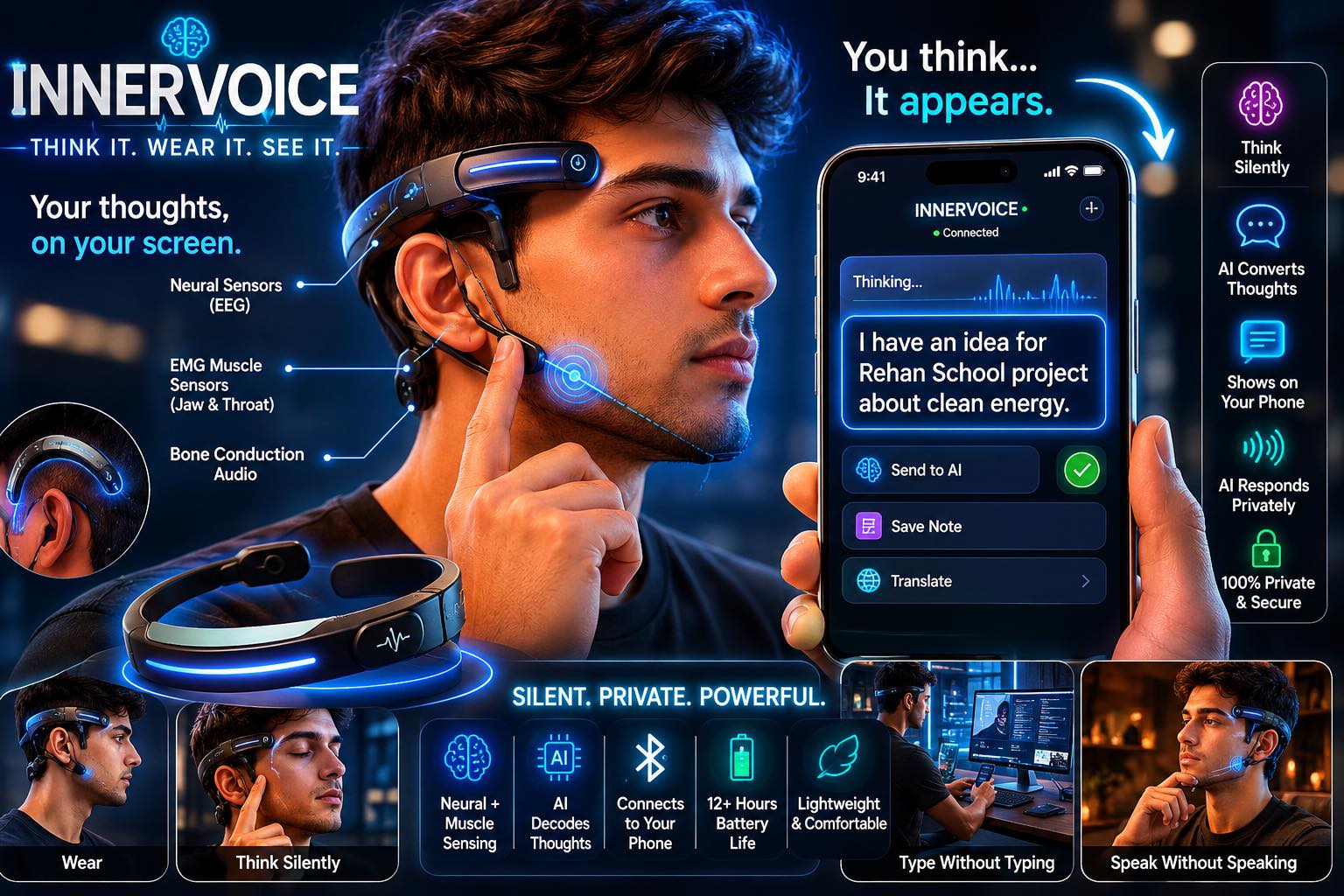
A wearable AI-powered communication device that converts silent inner speech into text on a phone, computer, or TV screen.
⸻
What Is the InnerVoice Band?
The InnerVoice Band is a wearable device placed around:
* the jaw,
* ear,
* neck,
* or glasses frame.
The user silently “speaks” in their mind.
For example:
“Message Abdullah I am coming.”
The device detects tiny muscle and nerve signals generated during internal speech and converts them into:
* text,
* commands,
* notes,
* AI prompts,
displayed instantly on a phone or screen.
The person never speaks aloud.
To an outside observer, it appears almost magical.
⸻
The Science Behind It
The device does not truly “read minds.”
Instead, it reads:
subvocal signals.
When humans silently talk in their head, the brain still sends microscopic electrical signals to:
* jaw muscles,
* throat muscles,
* tongue muscles.
These signals are extremely weak but real.
The technology used to detect them is called:
Electromyography (EMG)
EMG sensors measure tiny electrical activity in muscles.
Even when a person does not visibly move their mouth, the body often prepares speech internally.
The InnerVoice Band captures these hidden signals.
⸻
How the Device Works
Step 1 — Internal Speech
The user silently thinks:
“Open WhatsApp.”
⸻
Step 2 — Signal Detection
EMG sensors detect:
* jaw micro-movements,
* throat activation,
* muscle electrical patterns.
Optional EEG sensors may also detect general neural activity.
⸻
Step 3 — AI Interpretation
An AI model analyzes the signals.
The AI predicts:
* words,
* commands,
* sentences,
using:
* machine learning,
* language prediction,
* personal training data.
This is similar to how ChatGPT predicts sentences from incomplete information.
⸻
Step 4 — Output
The text appears on:
* phone,
* computer,
* AR glasses,
* TV screen.
Example:
“Open WhatsApp.”
Or:
“I have an idea for a solar startup.”
⸻
Hardware Needed
1. EMG Sensors
These detect electrical muscle activity.
Possible components:
* MyoWare EMG sensor,
* ADS1299 bio-signal chips,
* custom dry electrodes.
Cost:
~$5–20 per sensor.
⸻
2. Microcontroller / AI Processor
Possible options:
* ESP32,
* Raspberry Pi Zero,
* Qualcomm AI chip,
* NVIDIA Jetson Nano.
This handles:
* signal collection,
* Bluetooth,
* preprocessing.
⸻
3. Bluetooth Module
Sends data to:
* smartphone,
* computer,
* cloud AI.
Most modern chips already include Bluetooth.
⸻
4. AI Software
The AI system performs:
* signal interpretation,
* noise filtering,
* word prediction,
* personalization.
Possible software stack:
* Python,
* TensorFlow,
* PyTorch,
* OpenAI APIs,
* Whisper-like speech models.
⸻
5. Battery
Small lithium battery:
* 8–12 hour runtime.
Rechargeable through USB-C.
⸻
6. Bone Conduction Speaker (Optional)
The AI can respond privately through skull vibrations.
Only the wearer hears the response.
Like:
* a silent AI whisper assistant.
⸻
Why AI Changed Everything
Ten years ago, this device would have been nearly impossible.
The signals from the body are:
* noisy,
* weak,
* inconsistent.
But modern AI can now:
* predict missing information,
* infer intent,
* autocomplete human language.
This changes the problem completely.
Even imperfect muscle signals can become useful when combined with:
large language models.
⸻
Training the Device
Every human has different muscle patterns.
So the device must learn:
* your speech style,
* your jaw signals,
* your vocabulary.
The user trains it by:
1. silently speaking phrases,
2. confirming correct outputs,
3. allowing AI personalization.
Over time:
accuracy improves dramatically.
Similar to:
* Face ID learning your face,
* keyboard autocorrect learning your typing style.
⸻
Realistic Version 1 Features
Possible Today
Silent note taking
Silent texting
AI assistant control
Smart home commands
Translation
Accessibility communication
Cursor control
AR glasses interaction
⸻
Not Yet Realistic
Reading random thoughts
Reading dreams
Detecting secrets automatically
Perfect emotion reading
Full telepathy
⸻
Best Initial Markets
1. Disabled Communication
People unable to speak could communicate silently.
Massive humanitarian impact.
⸻
2. Professionals
Silent note taking during meetings.
⸻
3. Military & Security
Silent communication without radios.
⸻
4. AR/VR Industry
Future glasses need post-keyboard interfaces.
⸻
5. AI Power Users
Fast interaction with AI assistants.
⸻
Challenges
Noise
Human bodies generate many overlapping signals.
⸻
Accuracy
Different users speak differently internally.
⸻
Privacy
People may fear “mind reading.”
Marketing must emphasize:
“Intentional silent speech only.”
⸻
Comfort
The wearable must become:
* lightweight,
* fashionable,
* all-day wearable.
⸻
Future Possibilities
In the future, devices like InnerVoice Band may merge with:
* smart glasses,
* AI assistants,
* neural wristbands,
* earbuds.
Humans may eventually interact with computers using:
intention instead of typing.
The keyboard may become:
* outdated,
* slow,
* unnecessary.
Just as smartphones replaced many older technologies, silent AI interfaces may replace:
* keyboards,
* mice,
* touchscreens,
over the next few decades.
⸻
Final Thought
Human history is the story of improving communication:
* cave drawings,
* language,
* writing,
* printing,
* telephones,
* internet,
* smartphones,
* AI.
The next step may be:
thought-to-computer communication.
Not magic.
Not telepathy.
But a powerful combination of:
* biology,
* sensors,
* AI,
* and human intention.
And the first generation of that future is already beginning.
The Future Device That Turns Silent Thoughts Into Text
For thousands of years, humans have used:
* speaking,
* writing,
* keyboards,
* touchscreens,
to communicate with machines and each other.
But a new era is beginning.
A future is coming where humans may no longer need to:
* type,
* press buttons,
* or even speak aloud.
Instead, computers may understand:
intention itself.
One possible step toward that future is a device called:
InnerVoice Band
A wearable AI-powered communication device that converts silent inner speech into text on a phone, computer, or TV screen.
⸻
What Is the InnerVoice Band?
The InnerVoice Band is a wearable device placed around:
* the jaw,
* ear,
* neck,
* or glasses frame.
The user silently “speaks” in their mind.
For example:
“Message Abdullah I am coming.”
The device detects tiny muscle and nerve signals generated during internal speech and converts them into:
* text,
* commands,
* notes,
* AI prompts,
displayed instantly on a phone or screen.
The person never speaks aloud.
To an outside observer, it appears almost magical.
⸻
The Science Behind It
The device does not truly “read minds.”
Instead, it reads:
subvocal signals.
When humans silently talk in their head, the brain still sends microscopic electrical signals to:
* jaw muscles,
* throat muscles,
* tongue muscles.
These signals are extremely weak but real.
The technology used to detect them is called:
Electromyography (EMG)
EMG sensors measure tiny electrical activity in muscles.
Even when a person does not visibly move their mouth, the body often prepares speech internally.
The InnerVoice Band captures these hidden signals.
⸻
How the Device Works
Step 1 — Internal Speech
The user silently thinks:
“Open WhatsApp.”
⸻
Step 2 — Signal Detection
EMG sensors detect:
* jaw micro-movements,
* throat activation,
* muscle electrical patterns.
Optional EEG sensors may also detect general neural activity.
⸻
Step 3 — AI Interpretation
An AI model analyzes the signals.
The AI predicts:
* words,
* commands,
* sentences,
using:
* machine learning,
* language prediction,
* personal training data.
This is similar to how ChatGPT predicts sentences from incomplete information.
⸻
Step 4 — Output
The text appears on:
* phone,
* computer,
* AR glasses,
* TV screen.
Example:
“Open WhatsApp.”
Or:
“I have an idea for a solar startup.”
⸻
Hardware Needed
1. EMG Sensors
These detect electrical muscle activity.
Possible components:
* MyoWare EMG sensor,
* ADS1299 bio-signal chips,
* custom dry electrodes.
Cost:
~$5–20 per sensor.
⸻
2. Microcontroller / AI Processor
Possible options:
* ESP32,
* Raspberry Pi Zero,
* Qualcomm AI chip,
* NVIDIA Jetson Nano.
This handles:
* signal collection,
* Bluetooth,
* preprocessing.
⸻
3. Bluetooth Module
Sends data to:
* smartphone,
* computer,
* cloud AI.
Most modern chips already include Bluetooth.
⸻
4. AI Software
The AI system performs:
* signal interpretation,
* noise filtering,
* word prediction,
* personalization.
Possible software stack:
* Python,
* TensorFlow,
* PyTorch,
* OpenAI APIs,
* Whisper-like speech models.
⸻
5. Battery
Small lithium battery:
* 8–12 hour runtime.
Rechargeable through USB-C.
⸻
6. Bone Conduction Speaker (Optional)
The AI can respond privately through skull vibrations.
Only the wearer hears the response.
Like:
* a silent AI whisper assistant.
⸻
Why AI Changed Everything
Ten years ago, this device would have been nearly impossible.
The signals from the body are:
* noisy,
* weak,
* inconsistent.
But modern AI can now:
* predict missing information,
* infer intent,
* autocomplete human language.
This changes the problem completely.
Even imperfect muscle signals can become useful when combined with:
large language models.
⸻
Training the Device
Every human has different muscle patterns.
So the device must learn:
* your speech style,
* your jaw signals,
* your vocabulary.
The user trains it by:
1. silently speaking phrases,
2. confirming correct outputs,
3. allowing AI personalization.
Over time:
accuracy improves dramatically.
Similar to:
* Face ID learning your face,
* keyboard autocorrect learning your typing style.
⸻
Realistic Version 1 Features
Possible Today
Silent note taking
Silent texting
AI assistant control
Smart home commands
Translation
Accessibility communication
Cursor control
AR glasses interaction
⸻
Not Yet Realistic
Reading random thoughts
Reading dreams
Detecting secrets automatically
Perfect emotion reading
Full telepathy
⸻
Best Initial Markets
1. Disabled Communication
People unable to speak could communicate silently.
Massive humanitarian impact.
⸻
2. Professionals
Silent note taking during meetings.
⸻
3. Military & Security
Silent communication without radios.
⸻
4. AR/VR Industry
Future glasses need post-keyboard interfaces.
⸻
5. AI Power Users
Fast interaction with AI assistants.
⸻
Challenges
Noise
Human bodies generate many overlapping signals.
⸻
Accuracy
Different users speak differently internally.
⸻
Privacy
People may fear “mind reading.”
Marketing must emphasize:
“Intentional silent speech only.”
⸻
Comfort
The wearable must become:
* lightweight,
* fashionable,
* all-day wearable.
⸻
Future Possibilities
In the future, devices like InnerVoice Band may merge with:
* smart glasses,
* AI assistants,
* neural wristbands,
* earbuds.
Humans may eventually interact with computers using:
intention instead of typing.
The keyboard may become:
* outdated,
* slow,
* unnecessary.
Just as smartphones replaced many older technologies, silent AI interfaces may replace:
* keyboards,
* mice,
* touchscreens,
over the next few decades.
⸻
Final Thought
Human history is the story of improving communication:
* cave drawings,
* language,
* writing,
* printing,
* telephones,
* internet,
* smartphones,
* AI.
The next step may be:
thought-to-computer communication.
Not magic.
Not telepathy.
But a powerful combination of:
* biology,
* sensors,
* AI,
* and human intention.
And the first generation of that future is already beginning.
InnerVoice Band
The Future Device That Turns Silent Thoughts Into Text
For thousands of years, humans have used:
* speaking,
* writing,
* keyboards,
* touchscreens,
to communicate with machines and each other.
But a new era is beginning.
A future is coming where humans may no longer need to:
* type,
* press buttons,
* or even speak aloud.
Instead, computers may understand:
intention itself.
One possible step toward that future is a device called:
InnerVoice Band
A wearable AI-powered communication device that converts silent inner speech into text on a phone, computer, or TV screen.
⸻
What Is the InnerVoice Band?
The InnerVoice Band is a wearable device placed around:
* the jaw,
* ear,
* neck,
* or glasses frame.
The user silently “speaks” in their mind.
For example:
“Message Abdullah I am coming.”
The device detects tiny muscle and nerve signals generated during internal speech and converts them into:
* text,
* commands,
* notes,
* AI prompts,
displayed instantly on a phone or screen.
The person never speaks aloud.
To an outside observer, it appears almost magical.
⸻
The Science Behind It
The device does not truly “read minds.”
Instead, it reads:
subvocal signals.
When humans silently talk in their head, the brain still sends microscopic electrical signals to:
* jaw muscles,
* throat muscles,
* tongue muscles.
These signals are extremely weak but real.
The technology used to detect them is called:
Electromyography (EMG)
EMG sensors measure tiny electrical activity in muscles.
Even when a person does not visibly move their mouth, the body often prepares speech internally.
The InnerVoice Band captures these hidden signals.
⸻
How the Device Works
Step 1 — Internal Speech
The user silently thinks:
“Open WhatsApp.”
⸻
Step 2 — Signal Detection
EMG sensors detect:
* jaw micro-movements,
* throat activation,
* muscle electrical patterns.
Optional EEG sensors may also detect general neural activity.
⸻
Step 3 — AI Interpretation
An AI model analyzes the signals.
The AI predicts:
* words,
* commands,
* sentences,
using:
* machine learning,
* language prediction,
* personal training data.
This is similar to how ChatGPT predicts sentences from incomplete information.
⸻
Step 4 — Output
The text appears on:
* phone,
* computer,
* AR glasses,
* TV screen.
Example:
“Open WhatsApp.”
Or:
“I have an idea for a solar startup.”
⸻
Hardware Needed
1. EMG Sensors
These detect electrical muscle activity.
Possible components:
* MyoWare EMG sensor,
* ADS1299 bio-signal chips,
* custom dry electrodes.
Cost:
~$5–20 per sensor.
⸻
2. Microcontroller / AI Processor
Possible options:
* ESP32,
* Raspberry Pi Zero,
* Qualcomm AI chip,
* NVIDIA Jetson Nano.
This handles:
* signal collection,
* Bluetooth,
* preprocessing.
⸻
3. Bluetooth Module
Sends data to:
* smartphone,
* computer,
* cloud AI.
Most modern chips already include Bluetooth.
⸻
4. AI Software
The AI system performs:
* signal interpretation,
* noise filtering,
* word prediction,
* personalization.
Possible software stack:
* Python,
* TensorFlow,
* PyTorch,
* OpenAI APIs,
* Whisper-like speech models.
⸻
5. Battery
Small lithium battery:
* 8–12 hour runtime.
Rechargeable through USB-C.
⸻
6. Bone Conduction Speaker (Optional)
The AI can respond privately through skull vibrations.
Only the wearer hears the response.
Like:
* a silent AI whisper assistant.
⸻
Why AI Changed Everything
Ten years ago, this device would have been nearly impossible.
The signals from the body are:
* noisy,
* weak,
* inconsistent.
But modern AI can now:
* predict missing information,
* infer intent,
* autocomplete human language.
This changes the problem completely.
Even imperfect muscle signals can become useful when combined with:
large language models.
⸻
Training the Device
Every human has different muscle patterns.
So the device must learn:
* your speech style,
* your jaw signals,
* your vocabulary.
The user trains it by:
1. silently speaking phrases,
2. confirming correct outputs,
3. allowing AI personalization.
Over time:
accuracy improves dramatically.
Similar to:
* Face ID learning your face,
* keyboard autocorrect learning your typing style.
⸻
Realistic Version 1 Features
Possible Today
✅ Silent note taking
✅ Silent texting
✅ AI assistant control
✅ Smart home commands
✅ Translation
✅ Accessibility communication
✅ Cursor control
✅ AR glasses interaction
⸻
Not Yet Realistic
❌ Reading random thoughts
❌ Reading dreams
❌ Detecting secrets automatically
❌ Perfect emotion reading
❌ Full telepathy
⸻
Best Initial Markets
1. Disabled Communication
People unable to speak could communicate silently.
Massive humanitarian impact.
⸻
2. Professionals
Silent note taking during meetings.
⸻
3. Military & Security
Silent communication without radios.
⸻
4. AR/VR Industry
Future glasses need post-keyboard interfaces.
⸻
5. AI Power Users
Fast interaction with AI assistants.
⸻
Challenges
Noise
Human bodies generate many overlapping signals.
⸻
Accuracy
Different users speak differently internally.
⸻
Privacy
People may fear “mind reading.”
Marketing must emphasize:
“Intentional silent speech only.”
⸻
Comfort
The wearable must become:
* lightweight,
* fashionable,
* all-day wearable.
⸻
Future Possibilities
In the future, devices like InnerVoice Band may merge with:
* smart glasses,
* AI assistants,
* neural wristbands,
* earbuds.
Humans may eventually interact with computers using:
intention instead of typing.
The keyboard may become:
* outdated,
* slow,
* unnecessary.
Just as smartphones replaced many older technologies, silent AI interfaces may replace:
* keyboards,
* mice,
* touchscreens,
over the next few decades.
⸻
Final Thought
Human history is the story of improving communication:
* cave drawings,
* language,
* writing,
* printing,
* telephones,
* internet,
* smartphones,
* AI.
The next step may be:
thought-to-computer communication.
Not magic.
Not telepathy.
But a powerful combination of:
* biology,
* sensors,
* AI,
* and human intention.
And the first generation of that future is already beginning.
0 Σχόλια
0 Μοιράστηκε
231 Views