


In 2026, humanity stands at a strange point in history.
For the first time ever:
* more people have smartphones than books,
* more people can watch than read,
* and more people can talk to AI than talk to experts.
Yet the world still does not truly understand technology.
The World in 2026
Today:
* Humanity speaks about 7,170 languages.
* The global literacy rate is about 87%.
* Around 5.7 billion people use mobile phones.
* More than 70% of humanity has internet access in some form.
But these numbers are misleading.
Owning a smartphone does not mean understanding the digital world.
A farmer may use WhatsApp for 10 years and still never:
* search properly,
* use email correctly,
* create documents,
* use spreadsheets,
* use AI,
* or understand digital business.
Even many educated people with smartphones for a decade still do not use tools like:
* ChatGPT
* Claude
* Gemini
In reality, humanity is entering a new phase:
The Difference Between:
* Phone ownership
and
* Digital civilization
These are two completely different things.
⸻
The Three Languages of the Future
By 2126, humanity will operate using three major language systems simultaneously.
1. Emotional Language
This is the language of:
* family,
* identity,
* poetry,
* religion,
* childhood,
* love,
* culture.
Examples:
* Urdu
* Punjabi
* Pashto
* Slovak
* Tamil
* Yoruba
* Navajo
These languages survive because humans need emotional identity.
A grandmother does not sing lullabies in “global business English.”
Humans need roots.
So thousands of emotional languages will survive.
⸻
2. Business Language
This becomes the language of:
* trade,
* startups,
* science,
* coding,
* AI prompts,
* global collaboration,
* negotiation.
Today, that language is mainly:
English
Not because English is superior.
But because:
* the internet grew around it,
* software grew around it,
* research papers grew around it,
* global business adopted it.
By 2050–2080:
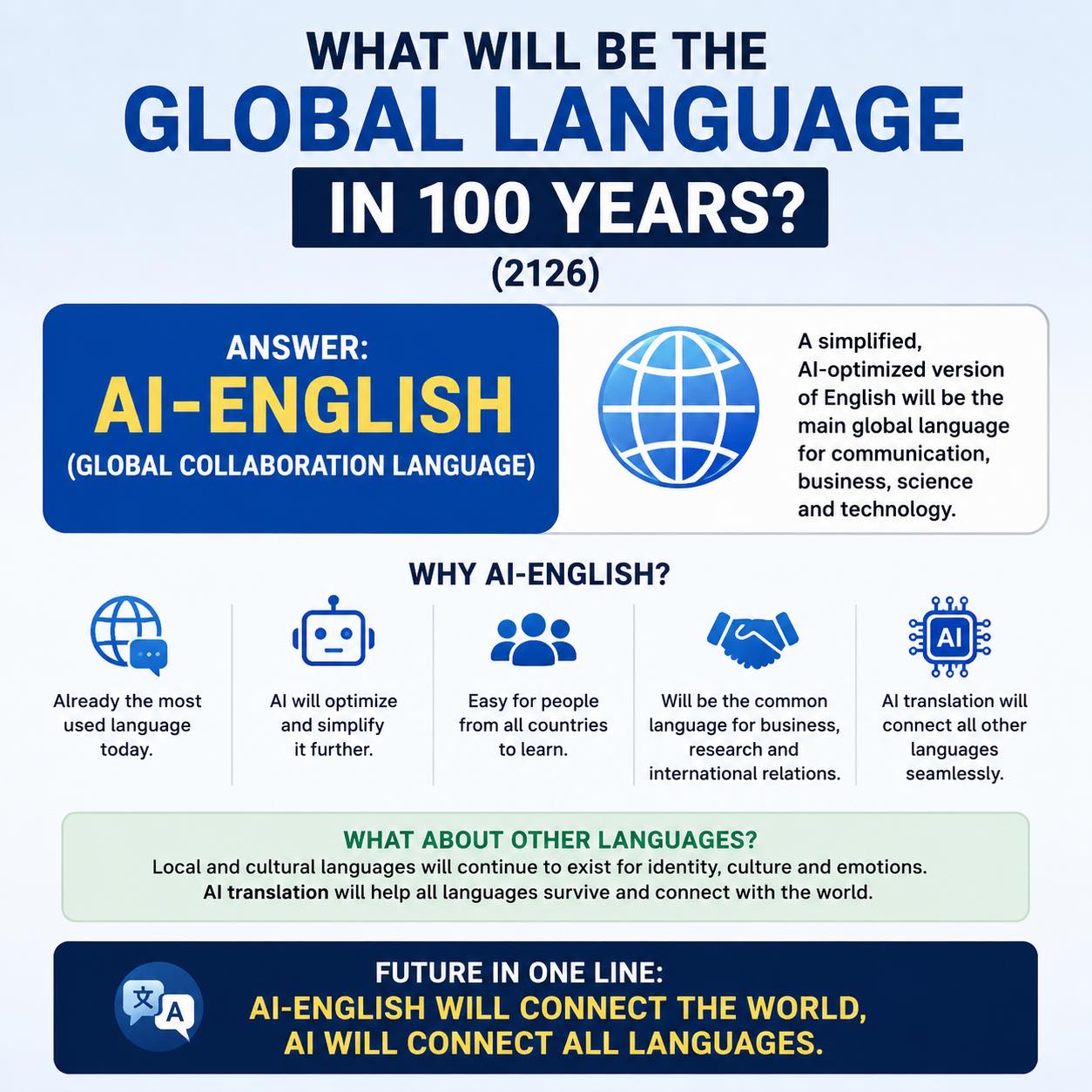
English likely remains the dominant business language of Earth.
But simplified AI-assisted English emerges:
* shorter,
* clearer,
* less grammar-heavy,
* globally optimized.
Like “global airport English.”
At the same time:
* Mandarin grows economically,
* Hindi/Urdu grows demographically,
* Spanish grows culturally,
* Arabic grows regionally,
* African languages grow digitally.
But AI prevents any one language from fully dominating.
⸻
3. AI Language
This is the biggest revolution.
Humans once needed:
* translators,
* dictionaries,
* years of study.
AI changes this.
By 2040:
real-time translation becomes nearly perfect.
You speak Urdu.
The other person hears flawless German.
You write in Pashto.
The other person reads perfect Japanese.
This changes civilization.
For 5,000 years:
language barriers limited human collaboration.
AI begins destroying those walls.
⸻
But Here Is the Hidden Truth
Even with AI, humans still take years to adapt.
Technology adoption is slow.
Example:
Many people today:
* had smartphones for 10 years,
* yet still cannot:
* type properly,
* search properly,
* organize files,
* use cloud storage,
* use AI productively.
Why?
Because:
Tools do not change civilizations.
Habits do.
A smartphone in the hand does not create a digital citizen.
Just like:
* owning books does not create a scholar,
* owning a gym does not create an athlete.
Civilization changes when:
* schools change,
* parenting changes,
* habits change,
* culture changes.
⸻
The Great Divide of 2050
By 2050, humanity splits into two groups.
Group 1:
People who use AI like electricity.
They:
* think with AI,
* work with AI,
* learn with AI,
* negotiate with AI,
* build businesses with AI.
These people become massively productive.
One person with AI may outperform:
* 10 workers,
* 100 workers,
* sometimes entire companies.
⸻
Group 2:
People who only consume technology.
They:
* scroll,
* watch,
* react,
* entertain themselves,
* forward messages.
But they do not create.
This becomes the new global inequality.
Not:
* rich vs poor,
* black vs white,
* East vs West.
But:
AI-augmented humans
versus
non-AI humans.
⸻
What Happens to Languages?
By 2126:
Around 3,000–4,500 languages survive actively.
But survival means different things.
Some survive as:
* home languages,
* village languages,
* cultural languages.
Others become:
* AI-preserved archives,
* museum languages,
* digitally reconstructable languages.
AI may literally revive dead languages.
Children may someday talk to AI avatars in:
* Ancient Egyptian,
* Sanskrit,
* Latin,
* extinct tribal languages.
⸻
Research Language of the Future
Today:
most research is written in English.
By 2100:
research itself changes.
Instead of humans reading 400-page papers:
AI systems summarize, debate, simulate, and test ideas instantly.
The “language of research” becomes:
structured machine-readable knowledge.
Not just human sentences.
AI agents may read:
* 50 million papers,
* compare contradictions,
* simulate outcomes,
* generate discoveries.
Humanity moves from:
reading knowledge
to
collaborating with knowledge systems.
⸻
The Biggest Winners
The nations that win the next 100 years are not necessarily:
* the richest,
* the biggest,
* or the oldest civilizations.
The winners are the countries that teach:
1. English or global communication,
2. AI literacy,
3. digital discipline,
4. problem solving,
5. human confidence,
6. internet-based earning.
Countries that fail to adapt may have smartphones everywhere but productivity nowhere.
⸻
Final Prediction for 2126
Humanity in 2126 likely has:
* one dominant business language (English-based),
* thousands of emotional identity languages,
* universal AI translation,
* AI-generated real-time communication,
* AI-assisted education from childhood,
* and billions of people talking daily with machines.
But the real battle will not be about language.
It will be about:
who learns to think with AI
before the rest of the world does.
For the first time ever:
* more people have smartphones than books,
* more people can watch than read,
* and more people can talk to AI than talk to experts.
Yet the world still does not truly understand technology.
The World in 2026
Today:
* Humanity speaks about 7,170 languages.
* The global literacy rate is about 87%.
* Around 5.7 billion people use mobile phones.
* More than 70% of humanity has internet access in some form.
But these numbers are misleading.
Owning a smartphone does not mean understanding the digital world.
A farmer may use WhatsApp for 10 years and still never:
* search properly,
* use email correctly,
* create documents,
* use spreadsheets,
* use AI,
* or understand digital business.
Even many educated people with smartphones for a decade still do not use tools like:
* ChatGPT
* Claude
* Gemini
In reality, humanity is entering a new phase:
The Difference Between:
* Phone ownership
and
* Digital civilization
These are two completely different things.
⸻
The Three Languages of the Future
By 2126, humanity will operate using three major language systems simultaneously.
1. Emotional Language
This is the language of:
* family,
* identity,
* poetry,
* religion,
* childhood,
* love,
* culture.
Examples:
* Urdu
* Punjabi
* Pashto
* Slovak
* Tamil
* Yoruba
* Navajo
These languages survive because humans need emotional identity.
A grandmother does not sing lullabies in “global business English.”
Humans need roots.
So thousands of emotional languages will survive.
⸻
2. Business Language
This becomes the language of:
* trade,
* startups,
* science,
* coding,
* AI prompts,
* global collaboration,
* negotiation.
Today, that language is mainly:
English
Not because English is superior.
But because:
* the internet grew around it,
* software grew around it,
* research papers grew around it,
* global business adopted it.
By 2050–2080:
English likely remains the dominant business language of Earth.
But simplified AI-assisted English emerges:
* shorter,
* clearer,
* less grammar-heavy,
* globally optimized.
Like “global airport English.”
At the same time:
* Mandarin grows economically,
* Hindi/Urdu grows demographically,
* Spanish grows culturally,
* Arabic grows regionally,
* African languages grow digitally.
But AI prevents any one language from fully dominating.
⸻
3. AI Language
This is the biggest revolution.
Humans once needed:
* translators,
* dictionaries,
* years of study.
AI changes this.
By 2040:
real-time translation becomes nearly perfect.
You speak Urdu.
The other person hears flawless German.
You write in Pashto.
The other person reads perfect Japanese.
This changes civilization.
For 5,000 years:
language barriers limited human collaboration.
AI begins destroying those walls.
⸻
But Here Is the Hidden Truth
Even with AI, humans still take years to adapt.
Technology adoption is slow.
Example:
Many people today:
* had smartphones for 10 years,
* yet still cannot:
* type properly,
* search properly,
* organize files,
* use cloud storage,
* use AI productively.
Why?
Because:
Tools do not change civilizations.
Habits do.
A smartphone in the hand does not create a digital citizen.
Just like:
* owning books does not create a scholar,
* owning a gym does not create an athlete.
Civilization changes when:
* schools change,
* parenting changes,
* habits change,
* culture changes.
⸻
The Great Divide of 2050
By 2050, humanity splits into two groups.
Group 1:
People who use AI like electricity.
They:
* think with AI,
* work with AI,
* learn with AI,
* negotiate with AI,
* build businesses with AI.
These people become massively productive.
One person with AI may outperform:
* 10 workers,
* 100 workers,
* sometimes entire companies.
⸻
Group 2:
People who only consume technology.
They:
* scroll,
* watch,
* react,
* entertain themselves,
* forward messages.
But they do not create.
This becomes the new global inequality.
Not:
* rich vs poor,
* black vs white,
* East vs West.
But:
AI-augmented humans
versus
non-AI humans.
⸻
What Happens to Languages?
By 2126:
Around 3,000–4,500 languages survive actively.
But survival means different things.
Some survive as:
* home languages,
* village languages,
* cultural languages.
Others become:
* AI-preserved archives,
* museum languages,
* digitally reconstructable languages.
AI may literally revive dead languages.
Children may someday talk to AI avatars in:
* Ancient Egyptian,
* Sanskrit,
* Latin,
* extinct tribal languages.
⸻
Research Language of the Future
Today:
most research is written in English.
By 2100:
research itself changes.
Instead of humans reading 400-page papers:
AI systems summarize, debate, simulate, and test ideas instantly.
The “language of research” becomes:
structured machine-readable knowledge.
Not just human sentences.
AI agents may read:
* 50 million papers,
* compare contradictions,
* simulate outcomes,
* generate discoveries.
Humanity moves from:
reading knowledge
to
collaborating with knowledge systems.
⸻
The Biggest Winners
The nations that win the next 100 years are not necessarily:
* the richest,
* the biggest,
* or the oldest civilizations.
The winners are the countries that teach:
1. English or global communication,
2. AI literacy,
3. digital discipline,
4. problem solving,
5. human confidence,
6. internet-based earning.
Countries that fail to adapt may have smartphones everywhere but productivity nowhere.
⸻
Final Prediction for 2126
Humanity in 2126 likely has:
* one dominant business language (English-based),
* thousands of emotional identity languages,
* universal AI translation,
* AI-generated real-time communication,
* AI-assisted education from childhood,
* and billions of people talking daily with machines.
But the real battle will not be about language.
It will be about:
who learns to think with AI
before the rest of the world does.
In 2026, humanity stands at a strange point in history.
For the first time ever:
* more people have smartphones than books,
* more people can watch than read,
* and more people can talk to AI than talk to experts.
Yet the world still does not truly understand technology.
The World in 2026
Today:
* Humanity speaks about 7,170 languages.
* The global literacy rate is about 87%.
* Around 5.7 billion people use mobile phones.
* More than 70% of humanity has internet access in some form.
But these numbers are misleading.
Owning a smartphone does not mean understanding the digital world.
A farmer may use WhatsApp for 10 years and still never:
* search properly,
* use email correctly,
* create documents,
* use spreadsheets,
* use AI,
* or understand digital business.
Even many educated people with smartphones for a decade still do not use tools like:
* ChatGPT
* Claude
* Gemini
In reality, humanity is entering a new phase:
The Difference Between:
* Phone ownership
and
* Digital civilization
These are two completely different things.
⸻
The Three Languages of the Future
By 2126, humanity will operate using three major language systems simultaneously.
1. Emotional Language
This is the language of:
* family,
* identity,
* poetry,
* religion,
* childhood,
* love,
* culture.
Examples:
* Urdu
* Punjabi
* Pashto
* Slovak
* Tamil
* Yoruba
* Navajo
These languages survive because humans need emotional identity.
A grandmother does not sing lullabies in “global business English.”
Humans need roots.
So thousands of emotional languages will survive.
⸻
2. Business Language
This becomes the language of:
* trade,
* startups,
* science,
* coding,
* AI prompts,
* global collaboration,
* negotiation.
Today, that language is mainly:
English
Not because English is superior.
But because:
* the internet grew around it,
* software grew around it,
* research papers grew around it,
* global business adopted it.
By 2050–2080:
English likely remains the dominant business language of Earth.
But simplified AI-assisted English emerges:
* shorter,
* clearer,
* less grammar-heavy,
* globally optimized.
Like “global airport English.”
At the same time:
* Mandarin grows economically,
* Hindi/Urdu grows demographically,
* Spanish grows culturally,
* Arabic grows regionally,
* African languages grow digitally.
But AI prevents any one language from fully dominating.
⸻
3. AI Language
This is the biggest revolution.
Humans once needed:
* translators,
* dictionaries,
* years of study.
AI changes this.
By 2040:
real-time translation becomes nearly perfect.
You speak Urdu.
The other person hears flawless German.
You write in Pashto.
The other person reads perfect Japanese.
This changes civilization.
For 5,000 years:
language barriers limited human collaboration.
AI begins destroying those walls.
⸻
But Here Is the Hidden Truth
Even with AI, humans still take years to adapt.
Technology adoption is slow.
Example:
Many people today:
* had smartphones for 10 years,
* yet still cannot:
* type properly,
* search properly,
* organize files,
* use cloud storage,
* use AI productively.
Why?
Because:
Tools do not change civilizations.
Habits do.
A smartphone in the hand does not create a digital citizen.
Just like:
* owning books does not create a scholar,
* owning a gym does not create an athlete.
Civilization changes when:
* schools change,
* parenting changes,
* habits change,
* culture changes.
⸻
The Great Divide of 2050
By 2050, humanity splits into two groups.
Group 1:
People who use AI like electricity.
They:
* think with AI,
* work with AI,
* learn with AI,
* negotiate with AI,
* build businesses with AI.
These people become massively productive.
One person with AI may outperform:
* 10 workers,
* 100 workers,
* sometimes entire companies.
⸻
Group 2:
People who only consume technology.
They:
* scroll,
* watch,
* react,
* entertain themselves,
* forward messages.
But they do not create.
This becomes the new global inequality.
Not:
* rich vs poor,
* black vs white,
* East vs West.
But:
AI-augmented humans
versus
non-AI humans.
⸻
What Happens to Languages?
By 2126:
Around 3,000–4,500 languages survive actively.
But survival means different things.
Some survive as:
* home languages,
* village languages,
* cultural languages.
Others become:
* AI-preserved archives,
* museum languages,
* digitally reconstructable languages.
AI may literally revive dead languages.
Children may someday talk to AI avatars in:
* Ancient Egyptian,
* Sanskrit,
* Latin,
* extinct tribal languages.
⸻
Research Language of the Future
Today:
most research is written in English.
By 2100:
research itself changes.
Instead of humans reading 400-page papers:
AI systems summarize, debate, simulate, and test ideas instantly.
The “language of research” becomes:
structured machine-readable knowledge.
Not just human sentences.
AI agents may read:
* 50 million papers,
* compare contradictions,
* simulate outcomes,
* generate discoveries.
Humanity moves from:
reading knowledge
to
collaborating with knowledge systems.
⸻
The Biggest Winners
The nations that win the next 100 years are not necessarily:
* the richest,
* the biggest,
* or the oldest civilizations.
The winners are the countries that teach:
1. English or global communication,
2. AI literacy,
3. digital discipline,
4. problem solving,
5. human confidence,
6. internet-based earning.
Countries that fail to adapt may have smartphones everywhere but productivity nowhere.
⸻
Final Prediction for 2126
Humanity in 2126 likely has:
* one dominant business language (English-based),
* thousands of emotional identity languages,
* universal AI translation,
* AI-generated real-time communication,
* AI-assisted education from childhood,
* and billions of people talking daily with machines.
But the real battle will not be about language.
It will be about:
who learns to think with AI
before the rest of the world does.
0 Reacties
0 aandelen
226 Views