


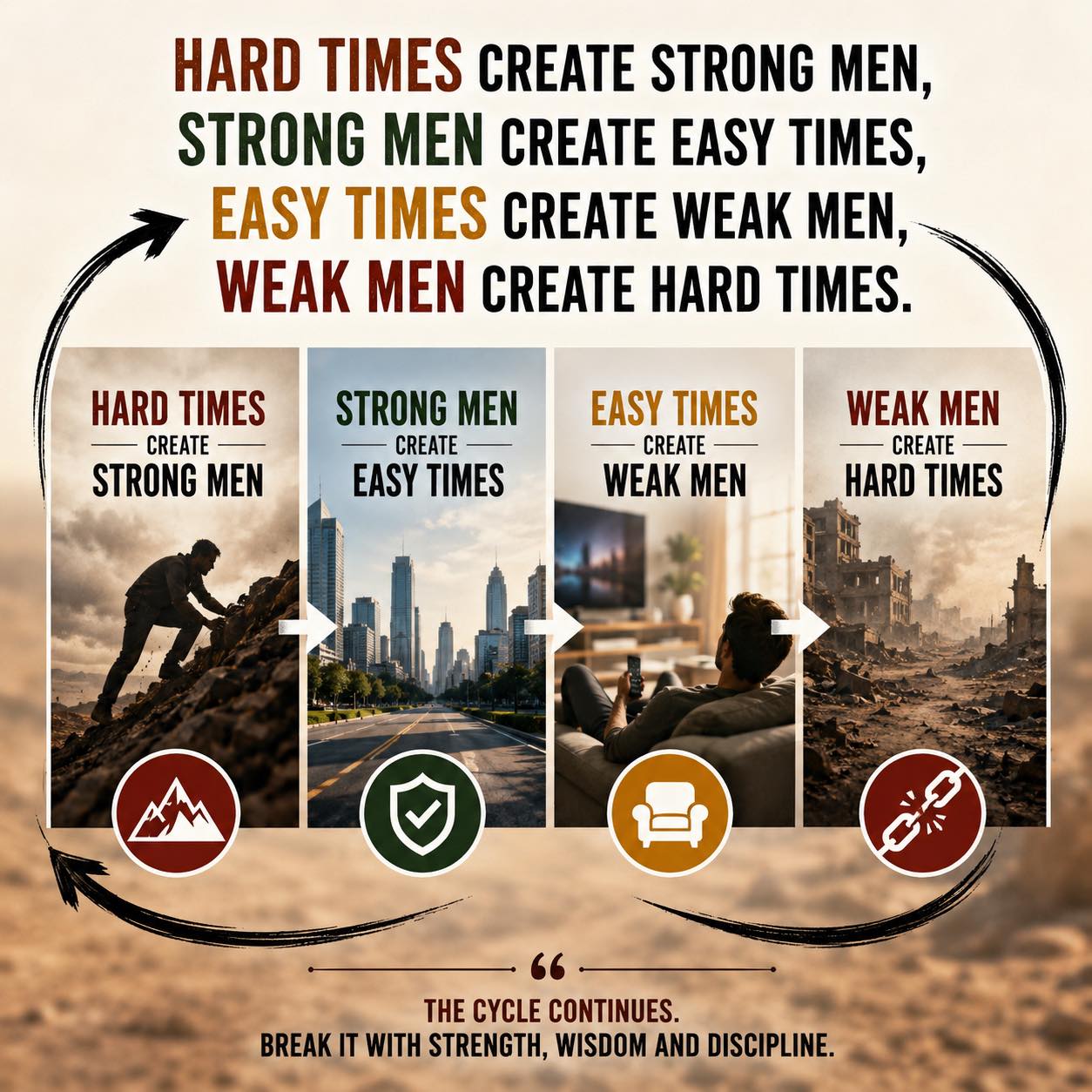
“Hard times create strong men, strong men create easy times, easy times create weak men, and weak men create hard times.”
has become one of the most discussed ideas about civilization, leadership, wealth, and human behavior. Whether completely true or not in every case, history repeatedly shows a similar pattern across families, companies, empires, and nations.
The core idea is simple:
Pain creates discipline.
Discipline creates success.
Success creates comfort.
Comfort creates carelessness.
Carelessness creates collapse.
Then the cycle begins again.
Human beings behave differently depending on the environment around them. A child who grows up in hunger, poverty, war, or struggle often develops survival instincts, resilience, patience, creativity, and toughness. That person learns to value money, time, relationships, and opportunity because they have experienced life without them.
Many of the world’s greatest builders came from hardship.
Steve Jobs was adopted and struggled for years before building Apple.
Elon Musk experienced bullying and isolation before building multiple companies.
Abdul Sattar Edhi lived a life of simplicity and sacrifice before building one of the world’s largest welfare networks.
Hardship forced them to think differently.
Strong people often build systems that make life easier for the next generation:
* better schools,
* safer cities,
* stronger economies,
* advanced technology,
* medical systems,
* transportation,
* wealth,
* peace.
The next generation grows up with comfort their parents never had.
This is where the danger begins.
When people inherit comfort without understanding sacrifice, they may slowly lose:
* discipline,
* gratitude,
* hunger,
* resilience,
* patience,
* emotional strength,
* ability to suffer.
A person who has never faced difficulty may become offended easily, quit quickly, complain constantly, or expect success without effort.
History gives many examples.
The Roman Empire became wealthy and powerful, but over time luxury, political corruption, and internal weakness weakened it from inside.
Many royal families across history lost kingdoms not because enemies were stronger, but because heirs became disconnected from reality.
Even businesses follow this pattern.
A startup begins with desperate founders working day and night. They innovate because survival depends on it. Once the company becomes large and rich, bureaucracy increases, risk-taking decreases, and employees may prioritize comfort over innovation. Eventually, a smaller hungry startup appears and replaces them.
This cycle also happens inside families.
The first generation builds.
The second generation manages.
The third generation often wastes.
This is why many family businesses disappear within three generations.
But the quote does not mean suffering is automatically good, nor that comfort is evil.
The real lesson is this:
A society must preserve discipline even during prosperity.
The challenge of civilization is:
How do you create strong people without forcing them to suffer through disaster?
That is the real educational challenge of the future.
A good education system should not merely create comfortable people. It should create resilient people:
* people who can handle rejection,
* people who can communicate,
* people who can solve problems,
* people who can build under pressure,
* people who can survive uncertainty,
* people who can lead during chaos.
Physical labor, entrepreneurship, public speaking, teamwork, responsibility, discipline, and exposure to real-world problems help build this strength.
If children only consume entertainment and comfort, they may become emotionally fragile even while living in wealthy societies.
Today many countries face this exact contradiction:
They have the highest technology, highest comfort, and highest convenience in human history — yet anxiety, loneliness, depression, and purposelessness are rising.
Why?
Because human beings were not designed only for comfort.
They were designed for meaning, challenge, growth, and contribution.
The strongest societies are not the richest ones alone.
They are the societies that maintain hunger after success.
Japan rebuilt after destruction.
Germany rebuilt after war.
South Korea transformed from poverty into technological power within decades.
Not because life was easy.
But because difficulty forced focus, discipline, and national urgency.
The same principle applies to individuals.
A person who survives failure often becomes wiser.
A person who survives rejection often becomes stronger.
A person who survives hardship often becomes dangerous in a positive way — focused, calm, and capable.
The goal of life should therefore not be to avoid all hardship.
The goal should be:
* to become stronger through hardship,
* wiser through success,
* humble through achievement,
* and disciplined even during comfort.
Because civilizations do not collapse in one day.
They slowly decay when people stop valuing effort, sacrifice, truth, and responsibility.
And civilizations rise when ordinary people decide to become strong again.
has become one of the most discussed ideas about civilization, leadership, wealth, and human behavior. Whether completely true or not in every case, history repeatedly shows a similar pattern across families, companies, empires, and nations.
The core idea is simple:
Pain creates discipline.
Discipline creates success.
Success creates comfort.
Comfort creates carelessness.
Carelessness creates collapse.
Then the cycle begins again.
Human beings behave differently depending on the environment around them. A child who grows up in hunger, poverty, war, or struggle often develops survival instincts, resilience, patience, creativity, and toughness. That person learns to value money, time, relationships, and opportunity because they have experienced life without them.
Many of the world’s greatest builders came from hardship.
Steve Jobs was adopted and struggled for years before building Apple.
Elon Musk experienced bullying and isolation before building multiple companies.
Abdul Sattar Edhi lived a life of simplicity and sacrifice before building one of the world’s largest welfare networks.
Hardship forced them to think differently.
Strong people often build systems that make life easier for the next generation:
* better schools,
* safer cities,
* stronger economies,
* advanced technology,
* medical systems,
* transportation,
* wealth,
* peace.
The next generation grows up with comfort their parents never had.
This is where the danger begins.
When people inherit comfort without understanding sacrifice, they may slowly lose:
* discipline,
* gratitude,
* hunger,
* resilience,
* patience,
* emotional strength,
* ability to suffer.
A person who has never faced difficulty may become offended easily, quit quickly, complain constantly, or expect success without effort.
History gives many examples.
The Roman Empire became wealthy and powerful, but over time luxury, political corruption, and internal weakness weakened it from inside.
Many royal families across history lost kingdoms not because enemies were stronger, but because heirs became disconnected from reality.
Even businesses follow this pattern.
A startup begins with desperate founders working day and night. They innovate because survival depends on it. Once the company becomes large and rich, bureaucracy increases, risk-taking decreases, and employees may prioritize comfort over innovation. Eventually, a smaller hungry startup appears and replaces them.
This cycle also happens inside families.
The first generation builds.
The second generation manages.
The third generation often wastes.
This is why many family businesses disappear within three generations.
But the quote does not mean suffering is automatically good, nor that comfort is evil.
The real lesson is this:
A society must preserve discipline even during prosperity.
The challenge of civilization is:
How do you create strong people without forcing them to suffer through disaster?
That is the real educational challenge of the future.
A good education system should not merely create comfortable people. It should create resilient people:
* people who can handle rejection,
* people who can communicate,
* people who can solve problems,
* people who can build under pressure,
* people who can survive uncertainty,
* people who can lead during chaos.
Physical labor, entrepreneurship, public speaking, teamwork, responsibility, discipline, and exposure to real-world problems help build this strength.
If children only consume entertainment and comfort, they may become emotionally fragile even while living in wealthy societies.
Today many countries face this exact contradiction:
They have the highest technology, highest comfort, and highest convenience in human history — yet anxiety, loneliness, depression, and purposelessness are rising.
Why?
Because human beings were not designed only for comfort.
They were designed for meaning, challenge, growth, and contribution.
The strongest societies are not the richest ones alone.
They are the societies that maintain hunger after success.
Japan rebuilt after destruction.
Germany rebuilt after war.
South Korea transformed from poverty into technological power within decades.
Not because life was easy.
But because difficulty forced focus, discipline, and national urgency.
The same principle applies to individuals.
A person who survives failure often becomes wiser.
A person who survives rejection often becomes stronger.
A person who survives hardship often becomes dangerous in a positive way — focused, calm, and capable.
The goal of life should therefore not be to avoid all hardship.
The goal should be:
* to become stronger through hardship,
* wiser through success,
* humble through achievement,
* and disciplined even during comfort.
Because civilizations do not collapse in one day.
They slowly decay when people stop valuing effort, sacrifice, truth, and responsibility.
And civilizations rise when ordinary people decide to become strong again.
“Hard times create strong men, strong men create easy times, easy times create weak men, and weak men create hard times.”
has become one of the most discussed ideas about civilization, leadership, wealth, and human behavior. Whether completely true or not in every case, history repeatedly shows a similar pattern across families, companies, empires, and nations.
The core idea is simple:
Pain creates discipline.
Discipline creates success.
Success creates comfort.
Comfort creates carelessness.
Carelessness creates collapse.
Then the cycle begins again.
Human beings behave differently depending on the environment around them. A child who grows up in hunger, poverty, war, or struggle often develops survival instincts, resilience, patience, creativity, and toughness. That person learns to value money, time, relationships, and opportunity because they have experienced life without them.
Many of the world’s greatest builders came from hardship.
Steve Jobs was adopted and struggled for years before building Apple.
Elon Musk experienced bullying and isolation before building multiple companies.
Abdul Sattar Edhi lived a life of simplicity and sacrifice before building one of the world’s largest welfare networks.
Hardship forced them to think differently.
Strong people often build systems that make life easier for the next generation:
* better schools,
* safer cities,
* stronger economies,
* advanced technology,
* medical systems,
* transportation,
* wealth,
* peace.
The next generation grows up with comfort their parents never had.
This is where the danger begins.
When people inherit comfort without understanding sacrifice, they may slowly lose:
* discipline,
* gratitude,
* hunger,
* resilience,
* patience,
* emotional strength,
* ability to suffer.
A person who has never faced difficulty may become offended easily, quit quickly, complain constantly, or expect success without effort.
History gives many examples.
The Roman Empire became wealthy and powerful, but over time luxury, political corruption, and internal weakness weakened it from inside.
Many royal families across history lost kingdoms not because enemies were stronger, but because heirs became disconnected from reality.
Even businesses follow this pattern.
A startup begins with desperate founders working day and night. They innovate because survival depends on it. Once the company becomes large and rich, bureaucracy increases, risk-taking decreases, and employees may prioritize comfort over innovation. Eventually, a smaller hungry startup appears and replaces them.
This cycle also happens inside families.
The first generation builds.
The second generation manages.
The third generation often wastes.
This is why many family businesses disappear within three generations.
But the quote does not mean suffering is automatically good, nor that comfort is evil.
The real lesson is this:
A society must preserve discipline even during prosperity.
The challenge of civilization is:
How do you create strong people without forcing them to suffer through disaster?
That is the real educational challenge of the future.
A good education system should not merely create comfortable people. It should create resilient people:
* people who can handle rejection,
* people who can communicate,
* people who can solve problems,
* people who can build under pressure,
* people who can survive uncertainty,
* people who can lead during chaos.
Physical labor, entrepreneurship, public speaking, teamwork, responsibility, discipline, and exposure to real-world problems help build this strength.
If children only consume entertainment and comfort, they may become emotionally fragile even while living in wealthy societies.
Today many countries face this exact contradiction:
They have the highest technology, highest comfort, and highest convenience in human history — yet anxiety, loneliness, depression, and purposelessness are rising.
Why?
Because human beings were not designed only for comfort.
They were designed for meaning, challenge, growth, and contribution.
The strongest societies are not the richest ones alone.
They are the societies that maintain hunger after success.
Japan rebuilt after destruction.
Germany rebuilt after war.
South Korea transformed from poverty into technological power within decades.
Not because life was easy.
But because difficulty forced focus, discipline, and national urgency.
The same principle applies to individuals.
A person who survives failure often becomes wiser.
A person who survives rejection often becomes stronger.
A person who survives hardship often becomes dangerous in a positive way — focused, calm, and capable.
The goal of life should therefore not be to avoid all hardship.
The goal should be:
* to become stronger through hardship,
* wiser through success,
* humble through achievement,
* and disciplined even during comfort.
Because civilizations do not collapse in one day.
They slowly decay when people stop valuing effort, sacrifice, truth, and responsibility.
And civilizations rise when ordinary people decide to become strong again.
0 تبصرے
0 شیئرز
92 ویوز