


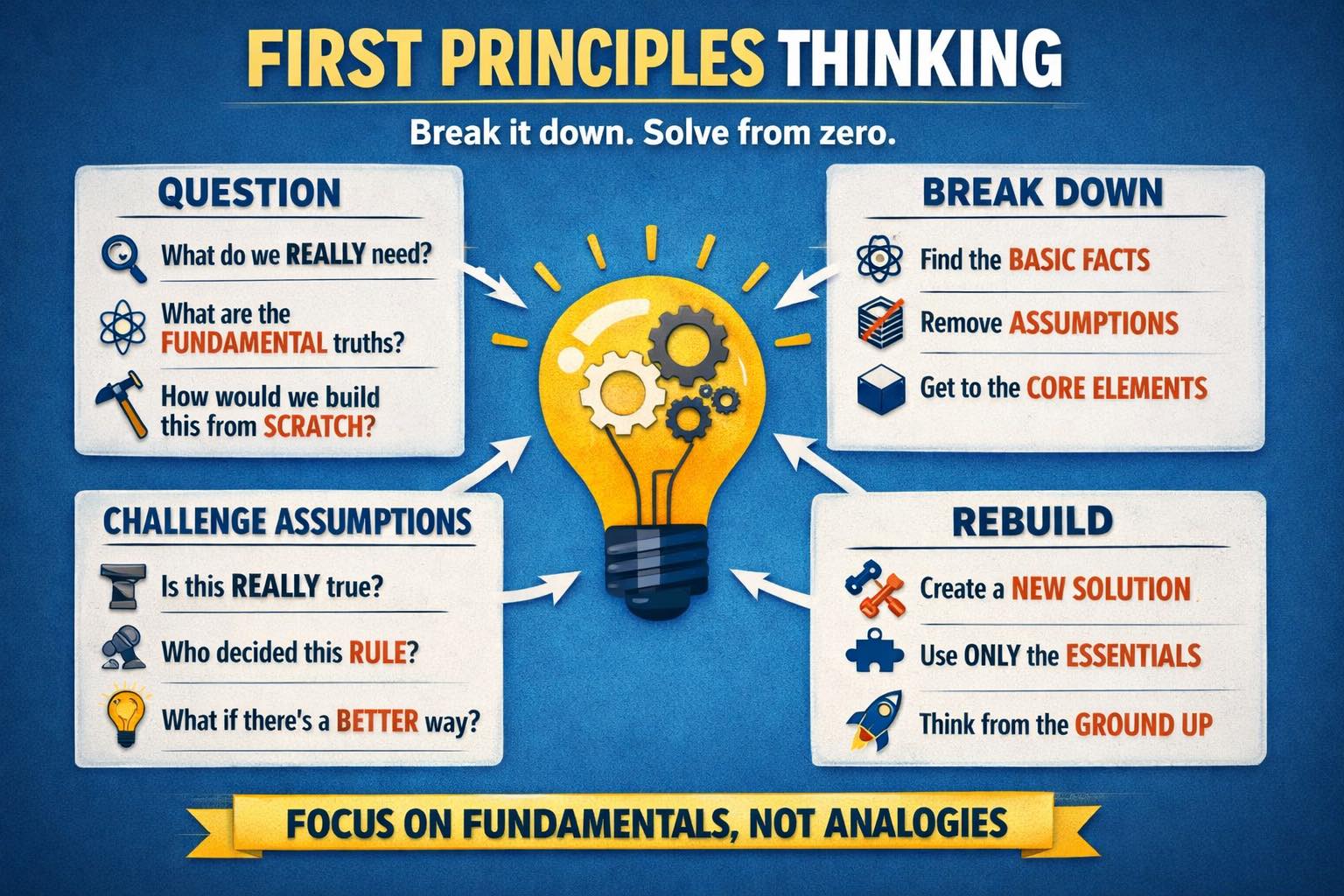
First Principles Thinking
What is First Principles Thinking?
First principles thinking means breaking any problem down to its most basic, undeniable truths, and then rebuilding a solution from scratch, instead of copying what others are doing.
Most people think by analogy:
“This is how it’s always been done.”
“This is how others do it.”
“This is the standard way.”
First principles thinkers ask:
“What is actually true here?”
“What do we really need?”
“If nothing existed, how would I build this from zero?”
This method comes from ancient philosophy, especially Aristotle, but today it is used by the world’s most effective problem-solvers, scientists, and founders.
⸻
Why Normal Thinking Fails
Most systems around us are layers of assumptions:
• Schools assume learning needs classrooms, exams, and degrees
• Jobs assume you must be 22+ to earn
• Businesses assume you need large capital
• Poverty assumes it is permanent
First principles thinking removes assumptions and keeps only facts.
⸻
The First Principles Formula
1. Identify the problem
2. Break it down to facts that cannot be reduced further
3. Remove all assumptions
4. Rebuild a solution using only those facts
⸻
Story 1: The Broken Chair
A school has a broken chair.
Normal thinking (by analogy):
• Buy a new chair
• Chairs cost $50
• We don’t have budget
• Problem stays unsolved
First principles thinking:
• What is a chair?
• Something to sit on
• Must support weight
• Must be stable
• Do we need a chair specifically?
• Or do we need something to sit on?
Solution:
• Stack wooden boxes
• Use a low table
• Repair only the broken leg
Insight:
The problem was never “buy a chair.”
The problem was “support a human body safely.”
⸻
Story 2: The Poor Student Who Couldn’t Learn English
A 12-year-old child in Karachi cannot speak English.
Normal thinking:
• English needs school
• School needs fees
• Fees need money
• Child is poor
• End of story
First principles thinking:
• What is English?
• Sounds
• Words
• Repetition
• Practice
• How do humans learn language?
• Listening
• Copying
• Daily exposure
• Does learning require a school?
• No
• Does it require books?
• No
Solution:
• Phone + YouTube
• Cartoons + subtitles
• Daily speaking practice with AI
• Zero cost
Insight:
English is not a “subject.”
English is a skill learned by exposure and repetition.
⸻
Story 3: The Tea Seller vs the Restaurant Owner
A man wants to start a food business.
Normal thinking:
• Restaurant needs rent
• Furniture
• Staff
• Menu
• Licenses
• Capital required: very high
• He gives up
First principles thinking:
• Why do people buy food?
• Hunger
• Taste
• Convenience
• Do they need a restaurant?
• No
• Do they need branding?
• No
• What’s the minimum?
• One item
• One pot
• One location
• One customer
Solution:
• One chai kettle
• One bench
• One corner
• Start today
Insight:
Business is not “big systems.”
Business is solving one real problem for one real human.
⸻
Why First Principles Thinkers Change the World
They don’t:
• Wait for permission
• Fear tradition
• Respect broken systems
They ask:
• “Why does this exist?”
• “Who decided this rule?”
• “What if this assumption is false?”
This is how:
• New schools are created
• New industries are born
• Poor children become leaders
• Old nations reinvent themselves
⸻
Final Thought
Progress does not come from improving old answers.
Progress comes from questioning old questions.
First principles thinking is not intelligence.
It is courage — the courage to think from zero.
If you teach children to think this way,
you don’t give them jobs —
you give them the ability to create worlds.
What is First Principles Thinking?
First principles thinking means breaking any problem down to its most basic, undeniable truths, and then rebuilding a solution from scratch, instead of copying what others are doing.
Most people think by analogy:
“This is how it’s always been done.”
“This is how others do it.”
“This is the standard way.”
First principles thinkers ask:
“What is actually true here?”
“What do we really need?”
“If nothing existed, how would I build this from zero?”
This method comes from ancient philosophy, especially Aristotle, but today it is used by the world’s most effective problem-solvers, scientists, and founders.
⸻
Why Normal Thinking Fails
Most systems around us are layers of assumptions:
• Schools assume learning needs classrooms, exams, and degrees
• Jobs assume you must be 22+ to earn
• Businesses assume you need large capital
• Poverty assumes it is permanent
First principles thinking removes assumptions and keeps only facts.
⸻
The First Principles Formula
1. Identify the problem
2. Break it down to facts that cannot be reduced further
3. Remove all assumptions
4. Rebuild a solution using only those facts
⸻
Story 1: The Broken Chair
A school has a broken chair.
Normal thinking (by analogy):
• Buy a new chair
• Chairs cost $50
• We don’t have budget
• Problem stays unsolved
First principles thinking:
• What is a chair?
• Something to sit on
• Must support weight
• Must be stable
• Do we need a chair specifically?
• Or do we need something to sit on?
Solution:
• Stack wooden boxes
• Use a low table
• Repair only the broken leg
Insight:
The problem was never “buy a chair.”
The problem was “support a human body safely.”
⸻
Story 2: The Poor Student Who Couldn’t Learn English
A 12-year-old child in Karachi cannot speak English.
Normal thinking:
• English needs school
• School needs fees
• Fees need money
• Child is poor
• End of story
First principles thinking:
• What is English?
• Sounds
• Words
• Repetition
• Practice
• How do humans learn language?
• Listening
• Copying
• Daily exposure
• Does learning require a school?
• No
• Does it require books?
• No
Solution:
• Phone + YouTube
• Cartoons + subtitles
• Daily speaking practice with AI
• Zero cost
Insight:
English is not a “subject.”
English is a skill learned by exposure and repetition.
⸻
Story 3: The Tea Seller vs the Restaurant Owner
A man wants to start a food business.
Normal thinking:
• Restaurant needs rent
• Furniture
• Staff
• Menu
• Licenses
• Capital required: very high
• He gives up
First principles thinking:
• Why do people buy food?
• Hunger
• Taste
• Convenience
• Do they need a restaurant?
• No
• Do they need branding?
• No
• What’s the minimum?
• One item
• One pot
• One location
• One customer
Solution:
• One chai kettle
• One bench
• One corner
• Start today
Insight:
Business is not “big systems.”
Business is solving one real problem for one real human.
⸻
Why First Principles Thinkers Change the World
They don’t:
• Wait for permission
• Fear tradition
• Respect broken systems
They ask:
• “Why does this exist?”
• “Who decided this rule?”
• “What if this assumption is false?”
This is how:
• New schools are created
• New industries are born
• Poor children become leaders
• Old nations reinvent themselves
⸻
Final Thought
Progress does not come from improving old answers.
Progress comes from questioning old questions.
First principles thinking is not intelligence.
It is courage — the courage to think from zero.
If you teach children to think this way,
you don’t give them jobs —
you give them the ability to create worlds.
First Principles Thinking
What is First Principles Thinking?
First principles thinking means breaking any problem down to its most basic, undeniable truths, and then rebuilding a solution from scratch, instead of copying what others are doing.
Most people think by analogy:
“This is how it’s always been done.”
“This is how others do it.”
“This is the standard way.”
First principles thinkers ask:
“What is actually true here?”
“What do we really need?”
“If nothing existed, how would I build this from zero?”
This method comes from ancient philosophy, especially Aristotle, but today it is used by the world’s most effective problem-solvers, scientists, and founders.
⸻
Why Normal Thinking Fails
Most systems around us are layers of assumptions:
• Schools assume learning needs classrooms, exams, and degrees
• Jobs assume you must be 22+ to earn
• Businesses assume you need large capital
• Poverty assumes it is permanent
First principles thinking removes assumptions and keeps only facts.
⸻
The First Principles Formula
1. Identify the problem
2. Break it down to facts that cannot be reduced further
3. Remove all assumptions
4. Rebuild a solution using only those facts
⸻
Story 1: The Broken Chair
A school has a broken chair.
Normal thinking (by analogy):
• Buy a new chair
• Chairs cost $50
• We don’t have budget
• Problem stays unsolved
First principles thinking:
• What is a chair?
• Something to sit on
• Must support weight
• Must be stable
• Do we need a chair specifically?
• Or do we need something to sit on?
Solution:
• Stack wooden boxes
• Use a low table
• Repair only the broken leg
💡 Insight:
The problem was never “buy a chair.”
The problem was “support a human body safely.”
⸻
Story 2: The Poor Student Who Couldn’t Learn English
A 12-year-old child in Karachi cannot speak English.
Normal thinking:
• English needs school
• School needs fees
• Fees need money
• Child is poor
• End of story
First principles thinking:
• What is English?
• Sounds
• Words
• Repetition
• Practice
• How do humans learn language?
• Listening
• Copying
• Daily exposure
• Does learning require a school?
• No
• Does it require books?
• No
Solution:
• Phone + YouTube
• Cartoons + subtitles
• Daily speaking practice with AI
• Zero cost
💡 Insight:
English is not a “subject.”
English is a skill learned by exposure and repetition.
⸻
Story 3: The Tea Seller vs the Restaurant Owner
A man wants to start a food business.
Normal thinking:
• Restaurant needs rent
• Furniture
• Staff
• Menu
• Licenses
• Capital required: very high
• He gives up
First principles thinking:
• Why do people buy food?
• Hunger
• Taste
• Convenience
• Do they need a restaurant?
• No
• Do they need branding?
• No
• What’s the minimum?
• One item
• One pot
• One location
• One customer
Solution:
• One chai kettle
• One bench
• One corner
• Start today
💡 Insight:
Business is not “big systems.”
Business is solving one real problem for one real human.
⸻
Why First Principles Thinkers Change the World
They don’t:
• Wait for permission
• Fear tradition
• Respect broken systems
They ask:
• “Why does this exist?”
• “Who decided this rule?”
• “What if this assumption is false?”
This is how:
• New schools are created
• New industries are born
• Poor children become leaders
• Old nations reinvent themselves
⸻
Final Thought
Progress does not come from improving old answers.
Progress comes from questioning old questions.
First principles thinking is not intelligence.
It is courage — the courage to think from zero.
If you teach children to think this way,
you don’t give them jobs —
you give them the ability to create worlds.
0 Commentaires
0 Parts
538 Vue