


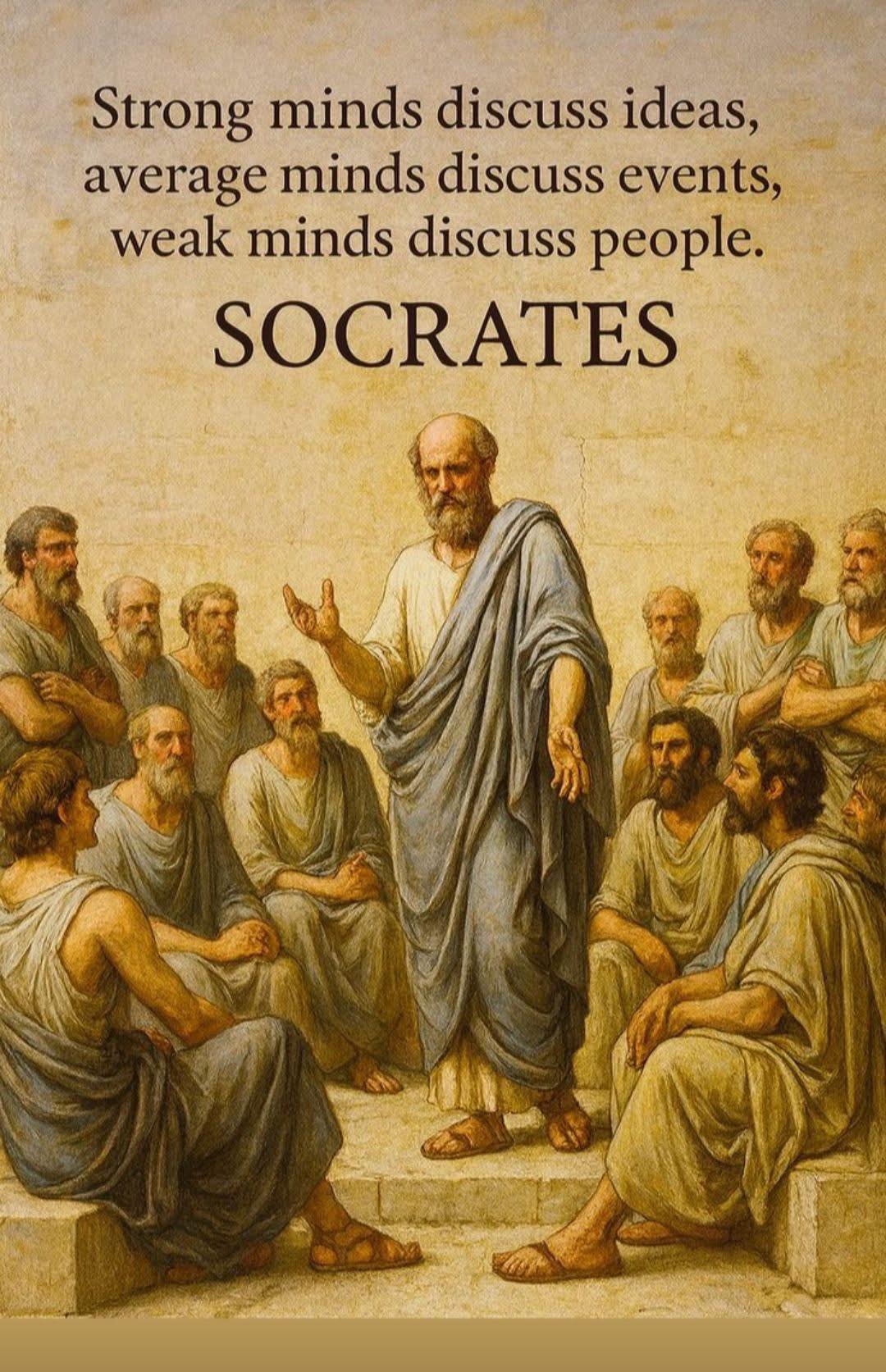
“Strong minds discuss ideas, average minds discuss events, weak minds discuss people.”
This one sentence captures an entire philosophy of how we think and what kind of world we build through our words. It reminds us that the level of our conversation reflects the level of our mind.
A strong mind is not just intelligent—it is curious, creative, and responsible. It doesn’t waste time in gossip or complaints. It looks at patterns, systems, and principles behind things. It asks why and how, not just what. Strong minds discuss ideas—solutions, innovations, models, visions. They talk about how to make education better, how to reduce poverty, how to build a nation ten times stronger. They use every conversation to create new possibilities.
An average mind discusses events. It knows what happened yesterday—the news, the politics, the weather, the stock market—but rarely asks why. It stays informed, but not transformed. Talking about events is not wrong; the problem is when we stop there. A stronger mind takes every event as a clue and asks, “What can we learn from this? What idea can prevent this or improve it next time?”
Nowhere is this difference more visible than in political discussions.
When you walk into a tea shop, you’ll often hear people saying things like:
• “That politician is corrupt.”
• “This leader is useless.”
• “The other party would have done better.”
That is people talk—weak minds focusing on individuals, personalities, and blame. Nothing changes after such a discussion except frustration.
An average-level political conversation sounds like this:
• “There was a rally yesterday.”
• “The government announced a new tax.”
• “The Prime Minister visited another country.”
These are events—factual but shallow. People stay as spectators of politics rather than participants in improving it.
But a strong political conversation sounds very different:
• “What system could make elections cheaper and more transparent?”
• “How can we design a model that ensures politicians focus on performance, not personality?”
• “How can technology make public budgets transparent so corruption becomes impossible?”
Here, the focus is not on politicians but on ideas that fix the system. Such talk leads to progress, innovation, and national growth.
A weak mind discusses people in politics; a strong mind discusses the design of politics.
Weak minds argue who is right; strong minds ask what is right.
Weak minds want to win debates; strong minds want to win the future.
The beauty of this quote is that it’s not an insult—it’s an invitation to grow. Every day we can choose which level to operate on. When we catch ourselves gossiping, we can pause and rise a little higher. When we talk about an event, we can push the conversation deeper: “What idea hides behind this? What can we build or fix because of this?”
The easiest way to lift your thinking is to change your questions. Instead of “Who is to blame?” ask “What system allowed this?” Instead of “What happened?” ask “What does this reveal about human nature or design?” Instead of “Why is he like that?” ask “What experiences shaped him and what can we learn from it?”
If we fill our minds with books, solutions, and ideas, our conversations will automatically become richer. But if we fill them with gossip and noise, that is all we will ever produce. What we discuss daily becomes the raw material of our destiny.
So next time you sit with friends, family, or your team—listen to what you talk about. If you are discussing people, you’re living small. If you are discussing events, you’re living informed. But if you are discussing ideas—you’re living powerful.
Because where your conversation lives, your future lives.
This one sentence captures an entire philosophy of how we think and what kind of world we build through our words. It reminds us that the level of our conversation reflects the level of our mind.
A strong mind is not just intelligent—it is curious, creative, and responsible. It doesn’t waste time in gossip or complaints. It looks at patterns, systems, and principles behind things. It asks why and how, not just what. Strong minds discuss ideas—solutions, innovations, models, visions. They talk about how to make education better, how to reduce poverty, how to build a nation ten times stronger. They use every conversation to create new possibilities.
An average mind discusses events. It knows what happened yesterday—the news, the politics, the weather, the stock market—but rarely asks why. It stays informed, but not transformed. Talking about events is not wrong; the problem is when we stop there. A stronger mind takes every event as a clue and asks, “What can we learn from this? What idea can prevent this or improve it next time?”
Nowhere is this difference more visible than in political discussions.
When you walk into a tea shop, you’ll often hear people saying things like:
• “That politician is corrupt.”
• “This leader is useless.”
• “The other party would have done better.”
That is people talk—weak minds focusing on individuals, personalities, and blame. Nothing changes after such a discussion except frustration.
An average-level political conversation sounds like this:
• “There was a rally yesterday.”
• “The government announced a new tax.”
• “The Prime Minister visited another country.”
These are events—factual but shallow. People stay as spectators of politics rather than participants in improving it.
But a strong political conversation sounds very different:
• “What system could make elections cheaper and more transparent?”
• “How can we design a model that ensures politicians focus on performance, not personality?”
• “How can technology make public budgets transparent so corruption becomes impossible?”
Here, the focus is not on politicians but on ideas that fix the system. Such talk leads to progress, innovation, and national growth.
A weak mind discusses people in politics; a strong mind discusses the design of politics.
Weak minds argue who is right; strong minds ask what is right.
Weak minds want to win debates; strong minds want to win the future.
The beauty of this quote is that it’s not an insult—it’s an invitation to grow. Every day we can choose which level to operate on. When we catch ourselves gossiping, we can pause and rise a little higher. When we talk about an event, we can push the conversation deeper: “What idea hides behind this? What can we build or fix because of this?”
The easiest way to lift your thinking is to change your questions. Instead of “Who is to blame?” ask “What system allowed this?” Instead of “What happened?” ask “What does this reveal about human nature or design?” Instead of “Why is he like that?” ask “What experiences shaped him and what can we learn from it?”
If we fill our minds with books, solutions, and ideas, our conversations will automatically become richer. But if we fill them with gossip and noise, that is all we will ever produce. What we discuss daily becomes the raw material of our destiny.
So next time you sit with friends, family, or your team—listen to what you talk about. If you are discussing people, you’re living small. If you are discussing events, you’re living informed. But if you are discussing ideas—you’re living powerful.
Because where your conversation lives, your future lives.
“Strong minds discuss ideas, average minds discuss events, weak minds discuss people.”
This one sentence captures an entire philosophy of how we think and what kind of world we build through our words. It reminds us that the level of our conversation reflects the level of our mind.
A strong mind is not just intelligent—it is curious, creative, and responsible. It doesn’t waste time in gossip or complaints. It looks at patterns, systems, and principles behind things. It asks why and how, not just what. Strong minds discuss ideas—solutions, innovations, models, visions. They talk about how to make education better, how to reduce poverty, how to build a nation ten times stronger. They use every conversation to create new possibilities.
An average mind discusses events. It knows what happened yesterday—the news, the politics, the weather, the stock market—but rarely asks why. It stays informed, but not transformed. Talking about events is not wrong; the problem is when we stop there. A stronger mind takes every event as a clue and asks, “What can we learn from this? What idea can prevent this or improve it next time?”
Nowhere is this difference more visible than in political discussions.
When you walk into a tea shop, you’ll often hear people saying things like:
• “That politician is corrupt.”
• “This leader is useless.”
• “The other party would have done better.”
That is people talk—weak minds focusing on individuals, personalities, and blame. Nothing changes after such a discussion except frustration.
An average-level political conversation sounds like this:
• “There was a rally yesterday.”
• “The government announced a new tax.”
• “The Prime Minister visited another country.”
These are events—factual but shallow. People stay as spectators of politics rather than participants in improving it.
But a strong political conversation sounds very different:
• “What system could make elections cheaper and more transparent?”
• “How can we design a model that ensures politicians focus on performance, not personality?”
• “How can technology make public budgets transparent so corruption becomes impossible?”
Here, the focus is not on politicians but on ideas that fix the system. Such talk leads to progress, innovation, and national growth.
A weak mind discusses people in politics; a strong mind discusses the design of politics.
Weak minds argue who is right; strong minds ask what is right.
Weak minds want to win debates; strong minds want to win the future.
The beauty of this quote is that it’s not an insult—it’s an invitation to grow. Every day we can choose which level to operate on. When we catch ourselves gossiping, we can pause and rise a little higher. When we talk about an event, we can push the conversation deeper: “What idea hides behind this? What can we build or fix because of this?”
The easiest way to lift your thinking is to change your questions. Instead of “Who is to blame?” ask “What system allowed this?” Instead of “What happened?” ask “What does this reveal about human nature or design?” Instead of “Why is he like that?” ask “What experiences shaped him and what can we learn from it?”
If we fill our minds with books, solutions, and ideas, our conversations will automatically become richer. But if we fill them with gossip and noise, that is all we will ever produce. What we discuss daily becomes the raw material of our destiny.
So next time you sit with friends, family, or your team—listen to what you talk about. If you are discussing people, you’re living small. If you are discussing events, you’re living informed. But if you are discussing ideas—you’re living powerful.
Because where your conversation lives, your future lives.
0 Комментарии
0 Поделились
32 Просмотры