


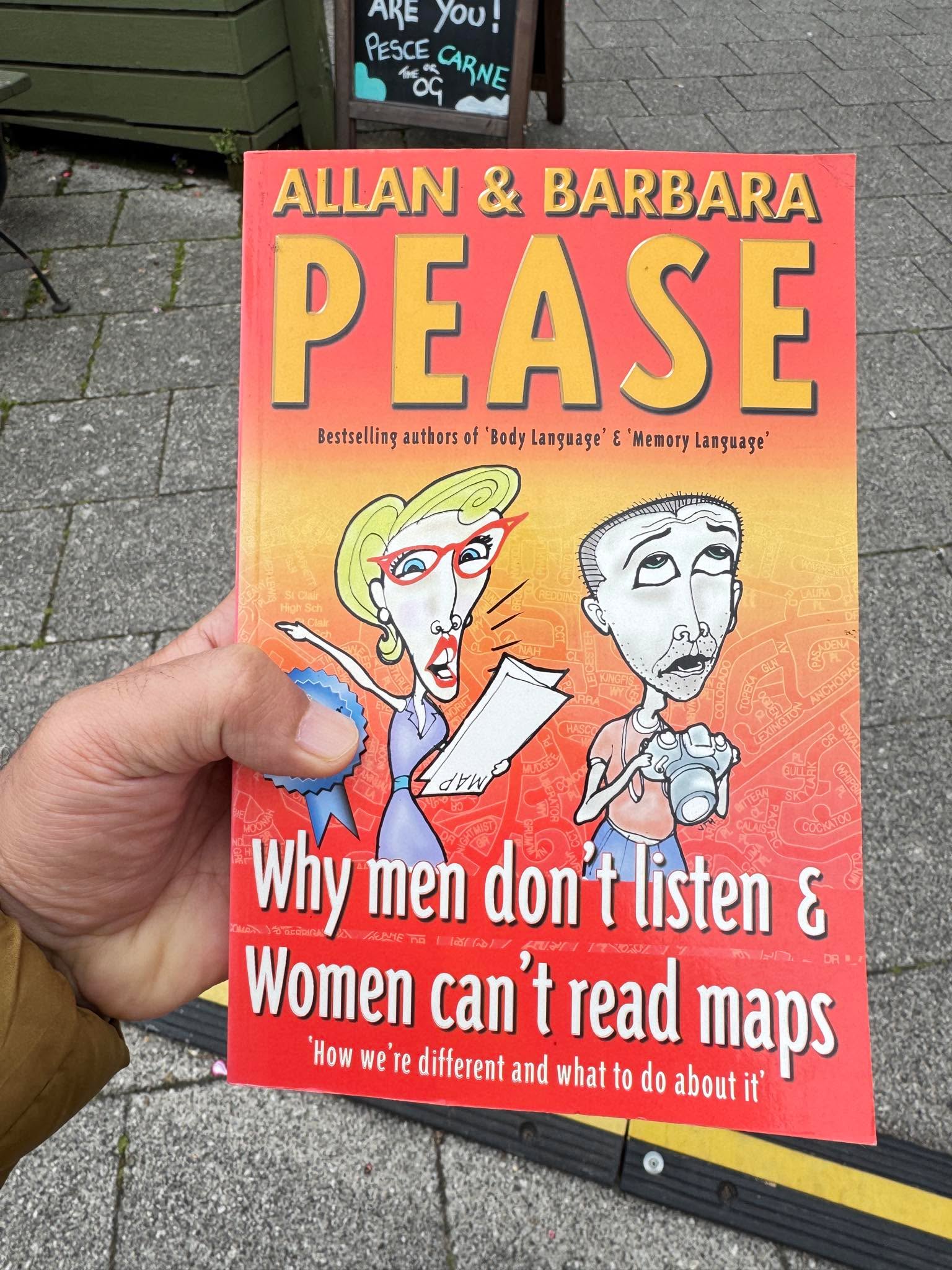
Book Title: Why Men Don’t Listen & Women Can’t Read Maps
Authors: Allan & Barbara Pease
⸻
Overview
This book explores the biological and psychological differences between men and women, particularly in how they communicate, think, behave, and process information. The authors argue that many misunderstandings between genders can be explained by evolutionary roles and brain differences.
⸻
Key Themes
1. Biological & Evolutionary Differences
• Men and women evolved with different survival roles: men as hunters, women as nurturers.
• These roles shaped distinct skills: men developed better spatial awareness, while women became stronger in communication and multitasking.
2. Brain Differences
• Men’s brains are more specialized (left/right hemispheres work more independently).
• Women’s brains have stronger connections between hemispheres, aiding intuition, communication, and multitasking.
3. Communication Styles
• Women use conversation to build relationships and seek empathy.
• Men communicate more directly, often to solve problems rather than to empathize.
4. Behavioral Patterns
• Men are better at reading maps, navigation, and focusing on single tasks.
• Women excel in reading emotions, detecting subtle changes, and multitasking.
5. Relationships & Misunderstandings
• Many conflicts between men and women come from misinterpreting these natural differences.
• Instead of trying to change each other, couples should understand and adapt to these differences.
⸻
Practical Lessons
• Don’t assume the opposite gender “doesn’t care” – they may just think differently.
• Improve relationships by recognizing communication differences.
• Workplaces and teams benefit when they leverage both men’s and women’s strengths.
• Adapt expectations rather than trying to change innate traits.
⸻
Takeaway
The book emphasizes:
Men and women are not better or worse – they are different.
By understanding these differences, we can improve relationships, teamwork, and communication in both personal and professional life.
⸻
Authors: Allan & Barbara Pease
⸻
Overview
This book explores the biological and psychological differences between men and women, particularly in how they communicate, think, behave, and process information. The authors argue that many misunderstandings between genders can be explained by evolutionary roles and brain differences.
⸻
Key Themes
1. Biological & Evolutionary Differences
• Men and women evolved with different survival roles: men as hunters, women as nurturers.
• These roles shaped distinct skills: men developed better spatial awareness, while women became stronger in communication and multitasking.
2. Brain Differences
• Men’s brains are more specialized (left/right hemispheres work more independently).
• Women’s brains have stronger connections between hemispheres, aiding intuition, communication, and multitasking.
3. Communication Styles
• Women use conversation to build relationships and seek empathy.
• Men communicate more directly, often to solve problems rather than to empathize.
4. Behavioral Patterns
• Men are better at reading maps, navigation, and focusing on single tasks.
• Women excel in reading emotions, detecting subtle changes, and multitasking.
5. Relationships & Misunderstandings
• Many conflicts between men and women come from misinterpreting these natural differences.
• Instead of trying to change each other, couples should understand and adapt to these differences.
⸻
Practical Lessons
• Don’t assume the opposite gender “doesn’t care” – they may just think differently.
• Improve relationships by recognizing communication differences.
• Workplaces and teams benefit when they leverage both men’s and women’s strengths.
• Adapt expectations rather than trying to change innate traits.
⸻
Takeaway
The book emphasizes:
Men and women are not better or worse – they are different.
By understanding these differences, we can improve relationships, teamwork, and communication in both personal and professional life.
⸻
Book Title: Why Men Don’t Listen & Women Can’t Read Maps
Authors: Allan & Barbara Pease
⸻
Overview
This book explores the biological and psychological differences between men and women, particularly in how they communicate, think, behave, and process information. The authors argue that many misunderstandings between genders can be explained by evolutionary roles and brain differences.
⸻
Key Themes
1. Biological & Evolutionary Differences
• Men and women evolved with different survival roles: men as hunters, women as nurturers.
• These roles shaped distinct skills: men developed better spatial awareness, while women became stronger in communication and multitasking.
2. Brain Differences
• Men’s brains are more specialized (left/right hemispheres work more independently).
• Women’s brains have stronger connections between hemispheres, aiding intuition, communication, and multitasking.
3. Communication Styles
• Women use conversation to build relationships and seek empathy.
• Men communicate more directly, often to solve problems rather than to empathize.
4. Behavioral Patterns
• Men are better at reading maps, navigation, and focusing on single tasks.
• Women excel in reading emotions, detecting subtle changes, and multitasking.
5. Relationships & Misunderstandings
• Many conflicts between men and women come from misinterpreting these natural differences.
• Instead of trying to change each other, couples should understand and adapt to these differences.
⸻
Practical Lessons
• Don’t assume the opposite gender “doesn’t care” – they may just think differently.
• Improve relationships by recognizing communication differences.
• Workplaces and teams benefit when they leverage both men’s and women’s strengths.
• Adapt expectations rather than trying to change innate traits.
⸻
Takeaway
The book emphasizes:
👉 Men and women are not better or worse – they are different.
👉 By understanding these differences, we can improve relationships, teamwork, and communication in both personal and professional life.
⸻
0 Comentários
0 Compartilhamentos
94 Visualizações