


Why Humans Misunderstand Each Other — and How We Can Fix It
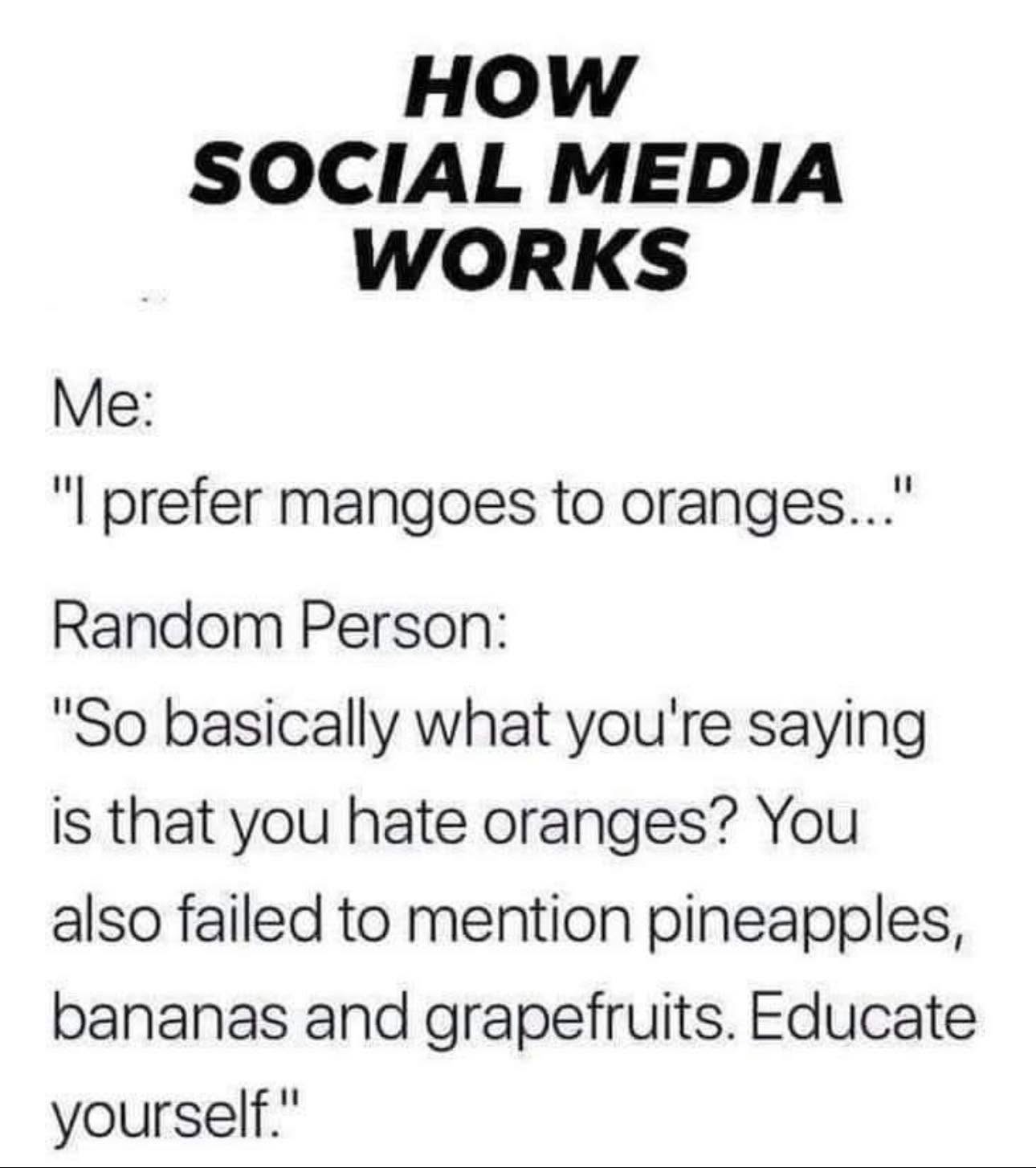
Social media has shown us a mirror: a simple opinion like “I prefer mangoes to oranges” can suddenly turn into an argument about why you hate oranges, ignored bananas, and need to educate yourself. But this isn’t just about fruit. It reflects how human beings think, react, and miscommunicate.
If we want to live in a more harmonious global society, we must understand the science of our minds, why context is lost, and how to re-train ourselves — and the next generation — for better communication and coexistence.
⸻
Why Do Humans Misunderstand Each Other?
1. Our Brain Seeks Shortcuts (Cognitive Biases)
The human brain evolved to make quick decisions for survival. Instead of analyzing carefully, it often jumps to conclusions. Psychologists call this “cognitive bias.” For example:
• Confirmation bias: We only notice things that support our beliefs.
• Negativity bias: We react more strongly to threats or criticism.
• Black-and-white thinking: We see things as “for” or “against,” with no middle ground.
This is why “I like mangoes” is heard as “I hate oranges.”
2. Lack of Context in Communication
In face-to-face conversation, we use tone, facial expressions, and body language to understand intent. On social media or even in rushed conversations, this context disappears. The written word feels harsher, and our brains “fill the gaps” with assumptions.
3. Impulse Before Thought (Fast vs. Slow Thinking)
Neuroscientist Daniel Kahneman explains in Thinking, Fast and Slow that we have two systems of thought:
• System 1: Fast, emotional, instinctive.
• System 2: Slow, logical, reflective.
Most people react with System 1 first — comment, judge, attack — instead of pausing to let System 2 analyze.
4. Social Media Amplifies the Problem
Platforms are designed for speed, not depth. Likes, shares, and comments reward quick reactions. Nuanced thinking doesn’t go viral — outrage does.
⸻
How Can We Fix This?
If we want a harmonious human society, we must re-train our brains and culture. Here are three powerful actions to begin with:
1. Practice the Pause
Before reacting — whether on social media, WhatsApp, or in real life — take 5 seconds to pause. Ask:
• Did I really understand what the other person meant?
• Can there be another interpretation?
This small delay shifts us from emotional System 1 to thoughtful System 2, reducing misunderstanding and conflict.
2. Seek First to Understand, Then to Respond
Instead of attacking or assuming, ask clarifying questions:
• “Oh, you prefer mangoes? Why?”
• “Can you explain what you mean?”
This simple shift builds bridges instead of walls. Imagine if every online argument started with curiosity instead of accusation.
3. Educate the Next Generation in Emotional Intelligence (EQ)
We must teach children — and adults — how to manage emotions, listen empathetically, and communicate clearly. In schools, workplaces, and families, emphasize:
• Critical thinking: Don’t believe or react without checking.
• Empathy training: Learn to feel what the other person may be experiencing.
• Mindful communication: Words can heal or harm — choose them with care.
⸻
The Vision: A Harmonious Human Society
If billions of people across the planet practiced these three actions, we would shift from reactionary to reflective, from conflict-driven to cooperative.
• Instead of fighting online, we’d listen and learn.
• Instead of assuming the worst, we’d seek common ground.
• Instead of teaching children to “win arguments,” we’d teach them to “build understanding.”
This is how we move from a society of endless division to one of harmony — where humans, regardless of culture, religion, or nationality, work together as one global family.
⸻
Final Thought:
The world doesn’t change when others change; it changes when we change. Each pause, each kind question, and each act of empathy is a seed for a better future.
World Safety Alliance
Social media has shown us a mirror: a simple opinion like “I prefer mangoes to oranges” can suddenly turn into an argument about why you hate oranges, ignored bananas, and need to educate yourself. But this isn’t just about fruit. It reflects how human beings think, react, and miscommunicate.
If we want to live in a more harmonious global society, we must understand the science of our minds, why context is lost, and how to re-train ourselves — and the next generation — for better communication and coexistence.
⸻
Why Do Humans Misunderstand Each Other?
1. Our Brain Seeks Shortcuts (Cognitive Biases)
The human brain evolved to make quick decisions for survival. Instead of analyzing carefully, it often jumps to conclusions. Psychologists call this “cognitive bias.” For example:
• Confirmation bias: We only notice things that support our beliefs.
• Negativity bias: We react more strongly to threats or criticism.
• Black-and-white thinking: We see things as “for” or “against,” with no middle ground.
This is why “I like mangoes” is heard as “I hate oranges.”
2. Lack of Context in Communication
In face-to-face conversation, we use tone, facial expressions, and body language to understand intent. On social media or even in rushed conversations, this context disappears. The written word feels harsher, and our brains “fill the gaps” with assumptions.
3. Impulse Before Thought (Fast vs. Slow Thinking)
Neuroscientist Daniel Kahneman explains in Thinking, Fast and Slow that we have two systems of thought:
• System 1: Fast, emotional, instinctive.
• System 2: Slow, logical, reflective.
Most people react with System 1 first — comment, judge, attack — instead of pausing to let System 2 analyze.
4. Social Media Amplifies the Problem
Platforms are designed for speed, not depth. Likes, shares, and comments reward quick reactions. Nuanced thinking doesn’t go viral — outrage does.
⸻
How Can We Fix This?
If we want a harmonious human society, we must re-train our brains and culture. Here are three powerful actions to begin with:
1. Practice the Pause
Before reacting — whether on social media, WhatsApp, or in real life — take 5 seconds to pause. Ask:
• Did I really understand what the other person meant?
• Can there be another interpretation?
This small delay shifts us from emotional System 1 to thoughtful System 2, reducing misunderstanding and conflict.
2. Seek First to Understand, Then to Respond
Instead of attacking or assuming, ask clarifying questions:
• “Oh, you prefer mangoes? Why?”
• “Can you explain what you mean?”
This simple shift builds bridges instead of walls. Imagine if every online argument started with curiosity instead of accusation.
3. Educate the Next Generation in Emotional Intelligence (EQ)
We must teach children — and adults — how to manage emotions, listen empathetically, and communicate clearly. In schools, workplaces, and families, emphasize:
• Critical thinking: Don’t believe or react without checking.
• Empathy training: Learn to feel what the other person may be experiencing.
• Mindful communication: Words can heal or harm — choose them with care.
⸻
The Vision: A Harmonious Human Society
If billions of people across the planet practiced these three actions, we would shift from reactionary to reflective, from conflict-driven to cooperative.
• Instead of fighting online, we’d listen and learn.
• Instead of assuming the worst, we’d seek common ground.
• Instead of teaching children to “win arguments,” we’d teach them to “build understanding.”
This is how we move from a society of endless division to one of harmony — where humans, regardless of culture, religion, or nationality, work together as one global family.
⸻
Final Thought:
The world doesn’t change when others change; it changes when we change. Each pause, each kind question, and each act of empathy is a seed for a better future.
World Safety Alliance
Why Humans Misunderstand Each Other — and How We Can Fix It
Social media has shown us a mirror: a simple opinion like “I prefer mangoes to oranges” can suddenly turn into an argument about why you hate oranges, ignored bananas, and need to educate yourself. But this isn’t just about fruit. It reflects how human beings think, react, and miscommunicate.
If we want to live in a more harmonious global society, we must understand the science of our minds, why context is lost, and how to re-train ourselves — and the next generation — for better communication and coexistence.
⸻
Why Do Humans Misunderstand Each Other?
1. Our Brain Seeks Shortcuts (Cognitive Biases)
The human brain evolved to make quick decisions for survival. Instead of analyzing carefully, it often jumps to conclusions. Psychologists call this “cognitive bias.” For example:
• Confirmation bias: We only notice things that support our beliefs.
• Negativity bias: We react more strongly to threats or criticism.
• Black-and-white thinking: We see things as “for” or “against,” with no middle ground.
This is why “I like mangoes” is heard as “I hate oranges.”
2. Lack of Context in Communication
In face-to-face conversation, we use tone, facial expressions, and body language to understand intent. On social media or even in rushed conversations, this context disappears. The written word feels harsher, and our brains “fill the gaps” with assumptions.
3. Impulse Before Thought (Fast vs. Slow Thinking)
Neuroscientist Daniel Kahneman explains in Thinking, Fast and Slow that we have two systems of thought:
• System 1: Fast, emotional, instinctive.
• System 2: Slow, logical, reflective.
Most people react with System 1 first — comment, judge, attack — instead of pausing to let System 2 analyze.
4. Social Media Amplifies the Problem
Platforms are designed for speed, not depth. Likes, shares, and comments reward quick reactions. Nuanced thinking doesn’t go viral — outrage does.
⸻
How Can We Fix This?
If we want a harmonious human society, we must re-train our brains and culture. Here are three powerful actions to begin with:
1. Practice the Pause 🧘
Before reacting — whether on social media, WhatsApp, or in real life — take 5 seconds to pause. Ask:
• Did I really understand what the other person meant?
• Can there be another interpretation?
This small delay shifts us from emotional System 1 to thoughtful System 2, reducing misunderstanding and conflict.
2. Seek First to Understand, Then to Respond 🎧
Instead of attacking or assuming, ask clarifying questions:
• “Oh, you prefer mangoes? Why?”
• “Can you explain what you mean?”
This simple shift builds bridges instead of walls. Imagine if every online argument started with curiosity instead of accusation.
3. Educate the Next Generation in Emotional Intelligence (EQ) 🌱
We must teach children — and adults — how to manage emotions, listen empathetically, and communicate clearly. In schools, workplaces, and families, emphasize:
• Critical thinking: Don’t believe or react without checking.
• Empathy training: Learn to feel what the other person may be experiencing.
• Mindful communication: Words can heal or harm — choose them with care.
⸻
The Vision: A Harmonious Human Society
If billions of people across the planet practiced these three actions, we would shift from reactionary to reflective, from conflict-driven to cooperative.
• Instead of fighting online, we’d listen and learn.
• Instead of assuming the worst, we’d seek common ground.
• Instead of teaching children to “win arguments,” we’d teach them to “build understanding.”
This is how we move from a society of endless division to one of harmony — where humans, regardless of culture, religion, or nationality, work together as one global family.
⸻
✅ Final Thought:
The world doesn’t change when others change; it changes when we change. Each pause, each kind question, and each act of empathy is a seed for a better future.
World Safety Alliance
0 Yorumlar
0 hisse senetleri
55 Views