


Title: Will AI and E-Books Replace Real Books? A Message for the Heart and the Mind
Many people today feel that Artificial Intelligence (AI) and digital books can never replace the experience of holding a real book in your hands.
They miss the texture of the pages, the scent of old paper, the weight of knowledge bound in a cover.
And yes — that feeling is real, deeply emotional, and beautiful.
But let us pause and ask:
Is the purpose of a book its smell?
Or its ability to change lives?
⸻
1. Books Are More Than Paper – They Are Pathways
A real book may touch the fingers.
But a good idea touches the mind.
And a life-changing insight touches the soul.
Today, millions of people around the world don’t have access to libraries or bookstores.
But thanks to smartphones and the internet, they can now carry an entire library in their pocket.
They can read, learn, question, and grow — not in silence, but in empowerment.
Would we deny them that, simply to preserve nostalgia?
⸻
2. AI Is Not Just Memory — It Is a Mirror of Our Intelligence
Some believe AI cannot be creative.
But AI is already composing poetry, painting artworks, writing novels, and even suggesting medical research ideas.
No, AI does not have a soul.
But it reflects ours — it is trained on human thoughts, hopes, stories, questions, and dreams.
It doesn’t take away creativity — it multiplies it, just like a light bulb didn’t replace fire — it extended what fire began.
⸻
3. The Lost Legacy of Knowledge in Our Societies
There was a time when our communities were the torchbearers of global knowledge — in science, philosophy, medicine, and art.
Today, that light has dimmed — not because we lack intelligence, but because we lack access and opportunity.
AI and digital education can change that.
It can revive curiosity, democratize information, and help the next Ibn Sina, Rumi, or Fatima al-Fihri rise — not from ivory towers, but from modest homes in forgotten neighborhoods.
⸻
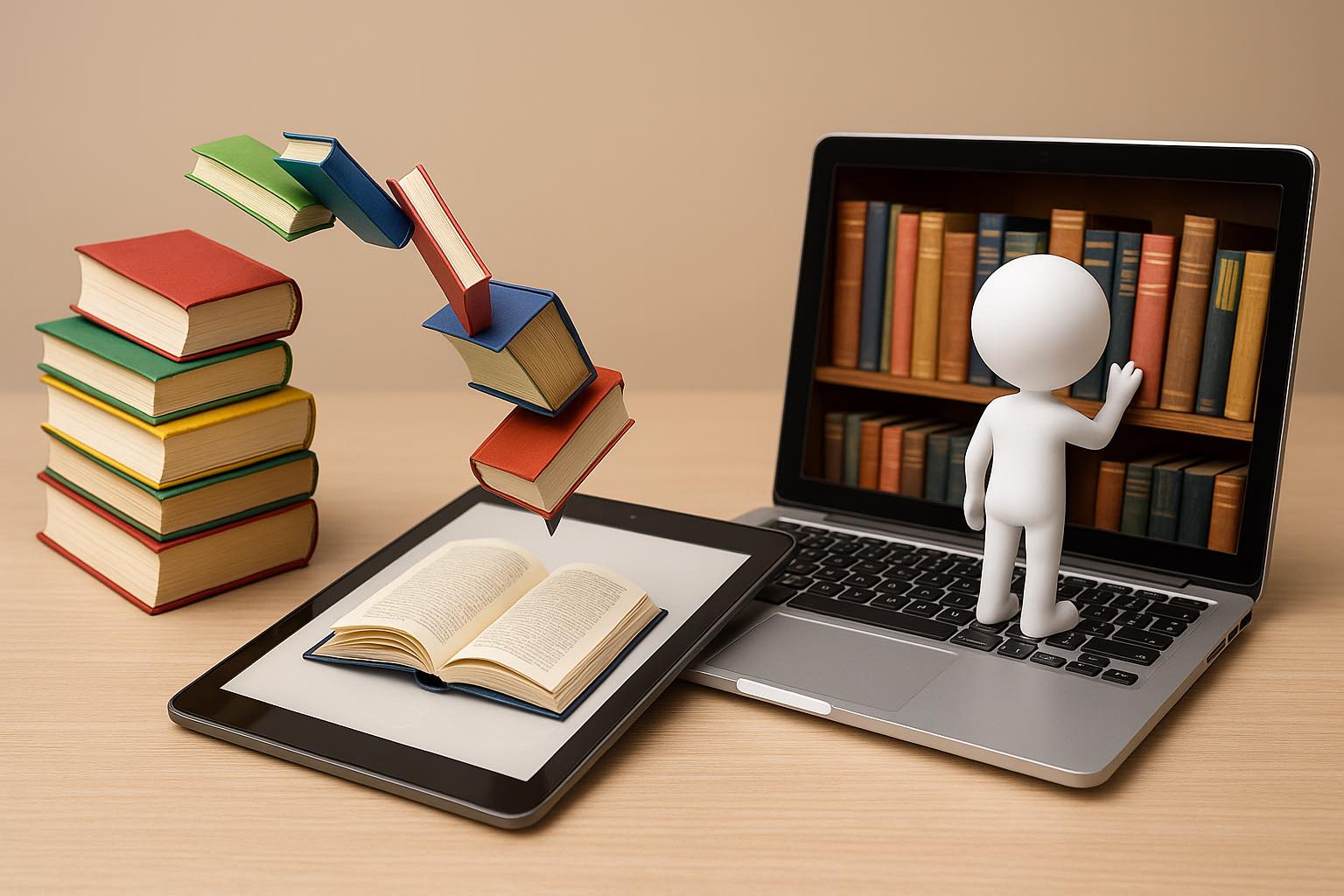
4. The Truth: AI and Books Are Not Enemies
This is not a war between paper and pixels.
• A printed book is beautiful.
• An e-book is accessible.
• AI is powerful.
• And the human mind is still the master.
We need all of them — not one against the other, but side by side, serving different needs.
Let the trees be hugged. Let the paper be honored.
But let us also teach a poor child in a village through AI — if that’s what it takes to unlock their future.
⸻
Final Thought
Books can calm your heart.
AI can ignite your mind.
Together, they can awaken the world.
This is not the end of books.
It is the beginning of new readers.
And if we care about truth, education, and justice —
we must go beyond emotions, and into action.
Many people today feel that Artificial Intelligence (AI) and digital books can never replace the experience of holding a real book in your hands.
They miss the texture of the pages, the scent of old paper, the weight of knowledge bound in a cover.
And yes — that feeling is real, deeply emotional, and beautiful.
But let us pause and ask:
Is the purpose of a book its smell?
Or its ability to change lives?
⸻
1. Books Are More Than Paper – They Are Pathways
A real book may touch the fingers.
But a good idea touches the mind.
And a life-changing insight touches the soul.
Today, millions of people around the world don’t have access to libraries or bookstores.
But thanks to smartphones and the internet, they can now carry an entire library in their pocket.
They can read, learn, question, and grow — not in silence, but in empowerment.
Would we deny them that, simply to preserve nostalgia?
⸻
2. AI Is Not Just Memory — It Is a Mirror of Our Intelligence
Some believe AI cannot be creative.
But AI is already composing poetry, painting artworks, writing novels, and even suggesting medical research ideas.
No, AI does not have a soul.
But it reflects ours — it is trained on human thoughts, hopes, stories, questions, and dreams.
It doesn’t take away creativity — it multiplies it, just like a light bulb didn’t replace fire — it extended what fire began.
⸻
3. The Lost Legacy of Knowledge in Our Societies
There was a time when our communities were the torchbearers of global knowledge — in science, philosophy, medicine, and art.
Today, that light has dimmed — not because we lack intelligence, but because we lack access and opportunity.
AI and digital education can change that.
It can revive curiosity, democratize information, and help the next Ibn Sina, Rumi, or Fatima al-Fihri rise — not from ivory towers, but from modest homes in forgotten neighborhoods.
⸻
4. The Truth: AI and Books Are Not Enemies
This is not a war between paper and pixels.
• A printed book is beautiful.
• An e-book is accessible.
• AI is powerful.
• And the human mind is still the master.
We need all of them — not one against the other, but side by side, serving different needs.
Let the trees be hugged. Let the paper be honored.
But let us also teach a poor child in a village through AI — if that’s what it takes to unlock their future.
⸻
Final Thought
Books can calm your heart.
AI can ignite your mind.
Together, they can awaken the world.
This is not the end of books.
It is the beginning of new readers.
And if we care about truth, education, and justice —
we must go beyond emotions, and into action.
Title: Will AI and E-Books Replace Real Books? A Message for the Heart and the Mind
Many people today feel that Artificial Intelligence (AI) and digital books can never replace the experience of holding a real book in your hands.
They miss the texture of the pages, the scent of old paper, the weight of knowledge bound in a cover.
And yes — that feeling is real, deeply emotional, and beautiful.
But let us pause and ask:
Is the purpose of a book its smell?
Or its ability to change lives?
⸻
1. Books Are More Than Paper – They Are Pathways
A real book may touch the fingers.
But a good idea touches the mind.
And a life-changing insight touches the soul.
Today, millions of people around the world don’t have access to libraries or bookstores.
But thanks to smartphones and the internet, they can now carry an entire library in their pocket.
They can read, learn, question, and grow — not in silence, but in empowerment.
Would we deny them that, simply to preserve nostalgia?
⸻
2. AI Is Not Just Memory — It Is a Mirror of Our Intelligence
Some believe AI cannot be creative.
But AI is already composing poetry, painting artworks, writing novels, and even suggesting medical research ideas.
No, AI does not have a soul.
But it reflects ours — it is trained on human thoughts, hopes, stories, questions, and dreams.
It doesn’t take away creativity — it multiplies it, just like a light bulb didn’t replace fire — it extended what fire began.
⸻
3. The Lost Legacy of Knowledge in Our Societies
There was a time when our communities were the torchbearers of global knowledge — in science, philosophy, medicine, and art.
Today, that light has dimmed — not because we lack intelligence, but because we lack access and opportunity.
AI and digital education can change that.
It can revive curiosity, democratize information, and help the next Ibn Sina, Rumi, or Fatima al-Fihri rise — not from ivory towers, but from modest homes in forgotten neighborhoods.
⸻
4. The Truth: AI and Books Are Not Enemies
This is not a war between paper and pixels.
• A printed book is beautiful.
• An e-book is accessible.
• AI is powerful.
• And the human mind is still the master.
We need all of them — not one against the other, but side by side, serving different needs.
Let the trees be hugged. Let the paper be honored.
But let us also teach a poor child in a village through AI — if that’s what it takes to unlock their future.
⸻
Final Thought
Books can calm your heart.
AI can ignite your mind.
Together, they can awaken the world.
This is not the end of books.
It is the beginning of new readers.
And if we care about truth, education, and justice —
we must go beyond emotions, and into action.
0 Reacties
0 aandelen
139 Views