


“Do You Know What Dakyanusi Actually Means?”
Most of us have heard (or said) the word “Dakyanusi” to describe something old-fashioned, boring, or stuck in the past.
Like:
“Yeh to bilkul dakyanusi soch hai.”
Translation: “This is such an ancient mindset.”
But… have you ever wondered who this mysterious “Daqyanus” was?
Let me take you on a time-travel trip:
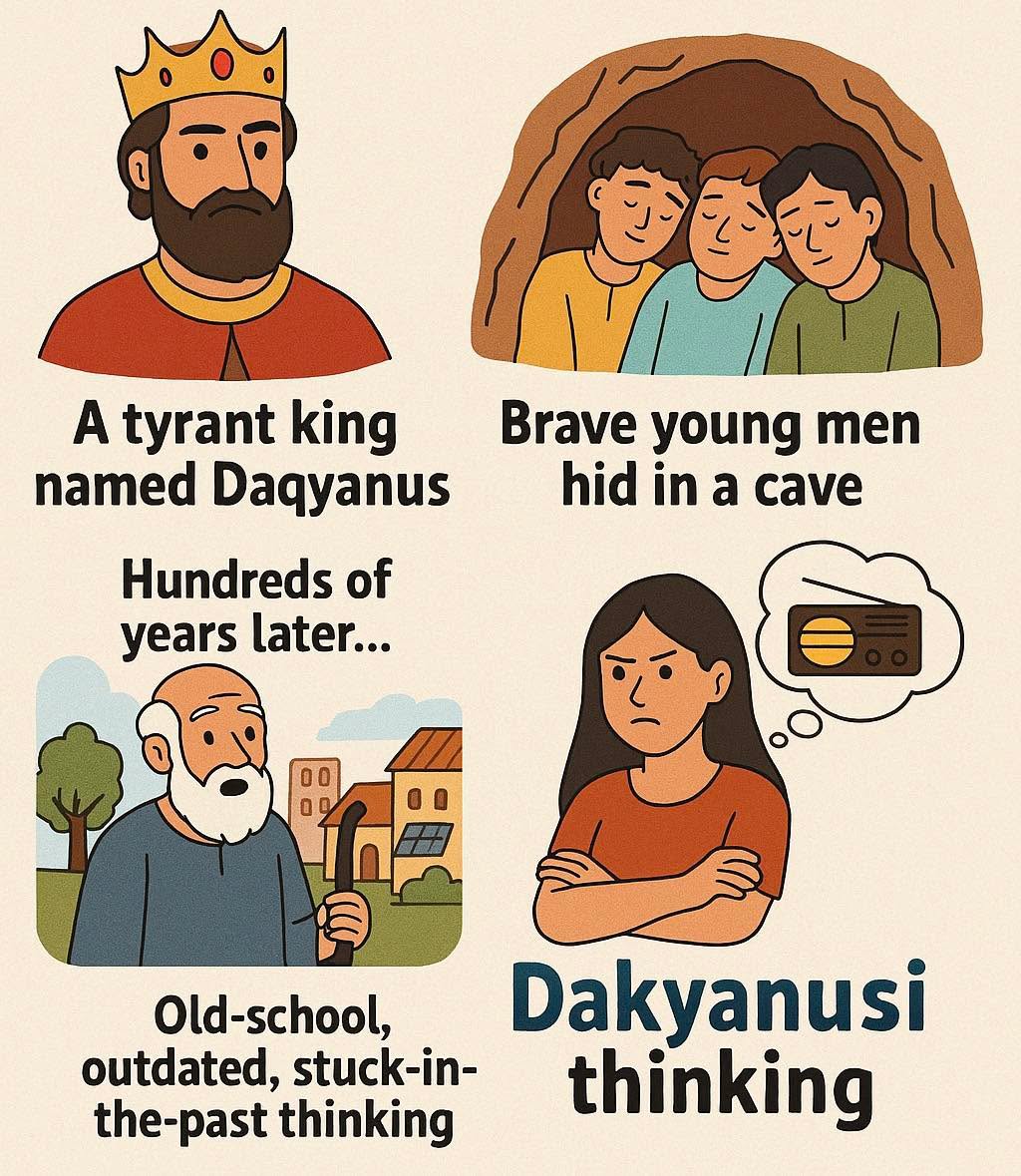
Once upon a time — okay, a loooong time ago — there was a tyrant king named Daqyanus (دقیانوس). He ruled with an iron fist and didn’t let people practice their religion freely. During his time, a group of brave young men ran away to hide in a cave to escape persecution.
They slept there… and when they woke up, it was hundreds of years later!
The world had completely changed — new king, new society, new TikTok trends (okay, maybe not that part).
This miraculous story is mentioned in the Qur’an (Surah Al-Kahf) and is also found in Christian and Jewish traditions as the tale of the “Seven Sleepers of the Cave.”
So over time, the name Daqyanus became associated with someone who belonged to an ancient era, and “Dakyanusi” turned into a powerful adjective to describe:
Old-school, outdated, stuck-in-the-past thinking.
Next time someone says girls shouldn’t use the internet, or books are better than Google, feel free to say:
“Aap to poore Dakyanusi hain!”
Let’s upgrade our thoughts.
Let’s move from Dakyanusi to Fikr-e-Naw (فکر نو) — fresh thinking.
“Do You Know What Dakyanusi Actually Means?”
Most of us have heard (or said) the word “Dakyanusi” to describe something old-fashioned, boring, or stuck in the past.
Like:
“Yeh to bilkul dakyanusi soch hai.”
Translation: “This is such an ancient mindset.”
But… have you ever wondered who this mysterious “Daqyanus” was?
Let me take you on a time-travel trip:
Once upon a time — okay, a loooong time ago — there was a tyrant king named Daqyanus (دقیانوس). He ruled with an iron fist and didn’t let people practice their religion freely. During his time, a group of brave young men ran away to hide in a cave to escape persecution.
They slept there… and when they woke up, it was hundreds of years later!
The world had completely changed — new king, new society, new TikTok trends (okay, maybe not that part).
This miraculous story is mentioned in the Qur’an (Surah Al-Kahf) and is also found in Christian and Jewish traditions as the tale of the “Seven Sleepers of the Cave.”
So over time, the name Daqyanus became associated with someone who belonged to an ancient era, and “Dakyanusi” turned into a powerful adjective to describe:
Old-school, outdated, stuck-in-the-past thinking.
Next time someone says girls shouldn’t use the internet, or books are better than Google, feel free to say:
“Aap to poore Dakyanusi hain!”
Let’s upgrade our thoughts.
Let’s move from Dakyanusi to Fikr-e-Naw (فکر نو) — fresh thinking.
0 تبصرے
0 شیئرز
78 ویوز