


How Much Information Does the Human Brain Process Daily?
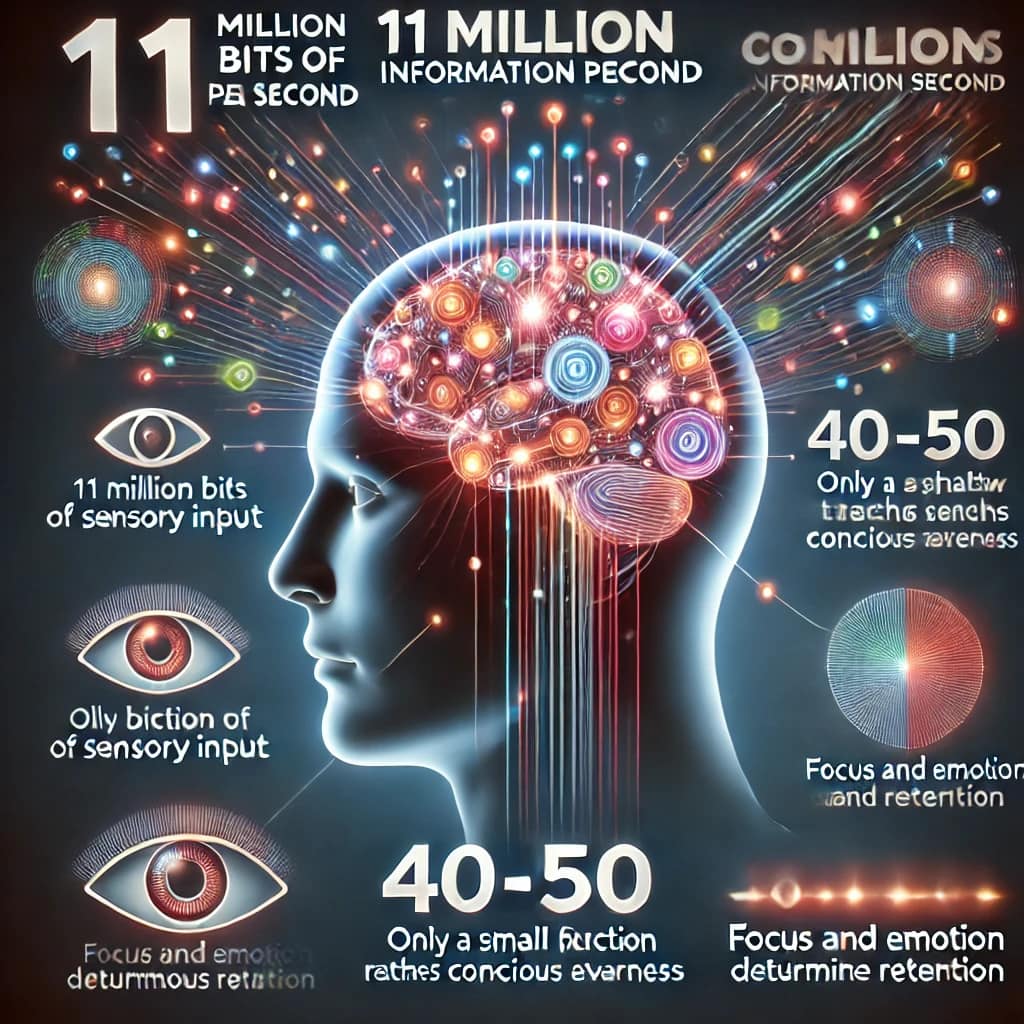
Did you know that our brains process an incredible 11 million bits of information per second through our senses? However, only about 40-50 bits per second make it to our conscious awareness. That’s just 0.00036% to 0.00045% of the total sensory input! The rest is automatically filtered out by our brain to keep us from being overwhelmed.
What Happens to the Rest of the Information?
Our brain’s filtering system prioritizes what we focus on, what’s relevant, and what carries emotional significance. This means we only consciously process a tiny fraction of the sensory input we receive. It’s not about seeing or hearing everything—it’s about focusing on what matters most!
The Digital World’s Impact:
In today’s world of constant notifications, endless scrolling, and media overload, the amount of information we’re exposed to has grown exponentially. But our brain’s natural filters still work to help us focus, even if it doesn’t always feel that way.
Sources:
• Research on sensory input and information filtering by Dr. Timothy J. Smith, University of London.
• “The Magical Number Seven, Plus or Minus Two,” by G.A. Miller (1956).
• Journal of Cognitive Neuroscience: Studies on human information processing.
Takeaway:
Our brain is an extraordinary machine, designed to focus on quality over quantity. So, don’t worry about forgetting most of what you see or hear—it’s your brain doing what it does best: keeping you focused on what truly matters.
What do you think about how much information our brains process? Share your thoughts below!
💡 How Much Information Does the Human Brain Process Daily? 🧠
Did you know that our brains process an incredible 11 million bits of information per second through our senses? However, only about 40-50 bits per second make it to our conscious awareness. That’s just 0.00036% to 0.00045% of the total sensory input! The rest is automatically filtered out by our brain to keep us from being overwhelmed.
🌟 What Happens to the Rest of the Information?
Our brain’s filtering system prioritizes what we focus on, what’s relevant, and what carries emotional significance. This means we only consciously process a tiny fraction of the sensory input we receive. It’s not about seeing or hearing everything—it’s about focusing on what matters most!
🌐 The Digital World’s Impact:
In today’s world of constant notifications, endless scrolling, and media overload, the amount of information we’re exposed to has grown exponentially. But our brain’s natural filters still work to help us focus, even if it doesn’t always feel that way.
🔗 Sources:
• Research on sensory input and information filtering by Dr. Timothy J. Smith, University of London.
• “The Magical Number Seven, Plus or Minus Two,” by G.A. Miller (1956).
• Journal of Cognitive Neuroscience: Studies on human information processing.
💭 Takeaway:
Our brain is an extraordinary machine, designed to focus on quality over quantity. So, don’t worry about forgetting most of what you see or hear—it’s your brain doing what it does best: keeping you focused on what truly matters.
What do you think about how much information our brains process? Share your thoughts below! 👇
0 Comentários
0 Compartilhamentos
152 Visualizações