


The term military-industrial complex (MIC) refers to the intricate relationship between a nation’s military, its government, and the defense industry that supplies arms and military technologies. This concept gained prominence when U.S. President Dwight D. Eisenhower warned of its potential influence in his 1961 farewell address. 
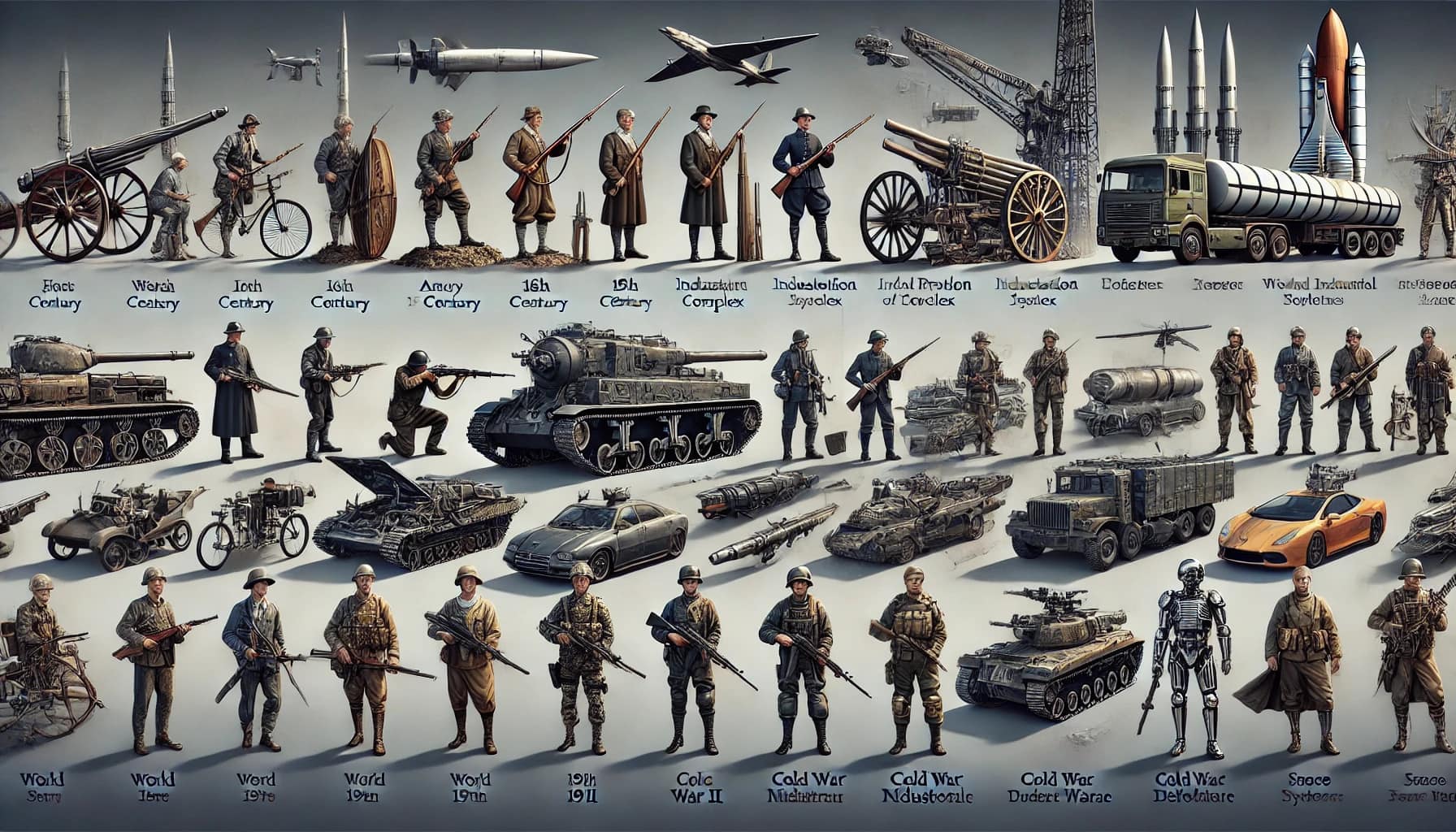
Over the past 500 years, the evolution of the MIC and global military expenditures have been influenced by technological advancements, geopolitical shifts, and economic developments. Here’s an overview:
16th to 18th Centuries: Early Modern Period
• Military-Industrial Relations: During this era, European powers began establishing state-controlled armories and naval shipyards to support expanding empires. The relationship between governments and private arms manufacturers was nascent, with monarchies often commissioning weapons production directly.
• Global Military Spending: Comprehensive data is scarce, but military expenditures were significant, especially for colonial powers like Spain, France, and England, which invested heavily in navies and armies to protect and expand their territories.
19th Century: Industrial Revolution and Militarization
• Military-Industrial Relations: The Industrial Revolution introduced mass production techniques, leading to the rise of private arms manufacturers. Governments increasingly relied on these private entities for weapons, marking the early stages of the MIC.
• Global Military Spending: Military expenditures grew as nations built large standing armies and navies. For instance, by the late 19th century, major powers were spending substantial portions of their national budgets on defense to support imperial ambitions.
Early to Mid-20th Century: World Wars and the Formalization of the MIC
• Military-Industrial Relations: World Wars I and II necessitated unprecedented collaboration between governments and private industry to produce vast quantities of arms. In the U.S., this collaboration was formalized during World War II, with civilian industries shifting to wartime production. 
• Global Military Spending: Military spending surged during the World Wars. For example, U.S. military expenditure during World War II peaked at approximately 40% of GDP. 
Cold War Era (1947–1991): Expansion of the MIC
• Military-Industrial Relations: The Cold War era saw the MIC become deeply entrenched, especially in the U.S. The persistent arms race between NATO and the Warsaw Pact led to sustained high levels of defense spending and the proliferation of defense contractors.
• Global Military Spending: Global military expenditure remained high throughout the Cold War. In the 1980s, during the Reagan administration, U.S. military spending reached about 6% of GDP, contributing to global military expenditures exceeding $1 trillion annually.
Post-Cold War to Early 21st Century: Transformation and Modernization
• Military-Industrial Relations: The end of the Cold War led to a temporary reduction in military spending, known as the “peace dividend.” However, conflicts in the Middle East and the War on Terror reignited defense expenditures. The MIC adapted by focusing on advanced technologies, cybersecurity, and unmanned systems.
• Global Military Spending: After a decline in the 1990s, global military spending began to rise again in the 2000s. By 2010, it reached approximately $1.7 trillion. 
Recent Trends: 2020s and Beyond
• Military-Industrial Relations: The MIC continues to evolve with a focus on emerging technologies such as artificial intelligence, space capabilities, and advanced missile systems. Geopolitical tensions, such as those involving Ukraine, have prompted increased defense budgets and a reevaluation of military-industrial capabilities.
• Global Military Spending: In 2023, global military expenditure reached a record high of $2.44 trillion, reflecting ongoing geopolitical tensions and the modernization of armed forces worldwide. 
Conclusion
Over the past five centuries, the relationship between governments, militaries, and the defense industry has transformed significantly, culminating in the modern military-industrial complex. Global military spending has mirrored this evolution, influenced by technological advancements, geopolitical dynamics, and economic capacities. The MIC remains a pivotal component of national security strategies, with global military expenditures continuing to rise in response to emerging threats and strategic competitions.
The term military-industrial complex (MIC) refers to the intricate relationship between a nation’s military, its government, and the defense industry that supplies arms and military technologies. This concept gained prominence when U.S. President Dwight D. Eisenhower warned of its potential influence in his 1961 farewell address. 
Over the past 500 years, the evolution of the MIC and global military expenditures have been influenced by technological advancements, geopolitical shifts, and economic developments. Here’s an overview:
16th to 18th Centuries: Early Modern Period
• Military-Industrial Relations: During this era, European powers began establishing state-controlled armories and naval shipyards to support expanding empires. The relationship between governments and private arms manufacturers was nascent, with monarchies often commissioning weapons production directly.
• Global Military Spending: Comprehensive data is scarce, but military expenditures were significant, especially for colonial powers like Spain, France, and England, which invested heavily in navies and armies to protect and expand their territories.
19th Century: Industrial Revolution and Militarization
• Military-Industrial Relations: The Industrial Revolution introduced mass production techniques, leading to the rise of private arms manufacturers. Governments increasingly relied on these private entities for weapons, marking the early stages of the MIC.
• Global Military Spending: Military expenditures grew as nations built large standing armies and navies. For instance, by the late 19th century, major powers were spending substantial portions of their national budgets on defense to support imperial ambitions.
Early to Mid-20th Century: World Wars and the Formalization of the MIC
• Military-Industrial Relations: World Wars I and II necessitated unprecedented collaboration between governments and private industry to produce vast quantities of arms. In the U.S., this collaboration was formalized during World War II, with civilian industries shifting to wartime production. 
• Global Military Spending: Military spending surged during the World Wars. For example, U.S. military expenditure during World War II peaked at approximately 40% of GDP. 
Cold War Era (1947–1991): Expansion of the MIC
• Military-Industrial Relations: The Cold War era saw the MIC become deeply entrenched, especially in the U.S. The persistent arms race between NATO and the Warsaw Pact led to sustained high levels of defense spending and the proliferation of defense contractors.
• Global Military Spending: Global military expenditure remained high throughout the Cold War. In the 1980s, during the Reagan administration, U.S. military spending reached about 6% of GDP, contributing to global military expenditures exceeding $1 trillion annually.
Post-Cold War to Early 21st Century: Transformation and Modernization
• Military-Industrial Relations: The end of the Cold War led to a temporary reduction in military spending, known as the “peace dividend.” However, conflicts in the Middle East and the War on Terror reignited defense expenditures. The MIC adapted by focusing on advanced technologies, cybersecurity, and unmanned systems.
• Global Military Spending: After a decline in the 1990s, global military spending began to rise again in the 2000s. By 2010, it reached approximately $1.7 trillion. 
Recent Trends: 2020s and Beyond
• Military-Industrial Relations: The MIC continues to evolve with a focus on emerging technologies such as artificial intelligence, space capabilities, and advanced missile systems. Geopolitical tensions, such as those involving Ukraine, have prompted increased defense budgets and a reevaluation of military-industrial capabilities.
• Global Military Spending: In 2023, global military expenditure reached a record high of $2.44 trillion, reflecting ongoing geopolitical tensions and the modernization of armed forces worldwide. 
Conclusion
Over the past five centuries, the relationship between governments, militaries, and the defense industry has transformed significantly, culminating in the modern military-industrial complex. Global military spending has mirrored this evolution, influenced by technological advancements, geopolitical dynamics, and economic capacities. The MIC remains a pivotal component of national security strategies, with global military expenditures continuing to rise in response to emerging threats and strategic competitions.
0 Yorumlar
0 hisse senetleri
391 Views