


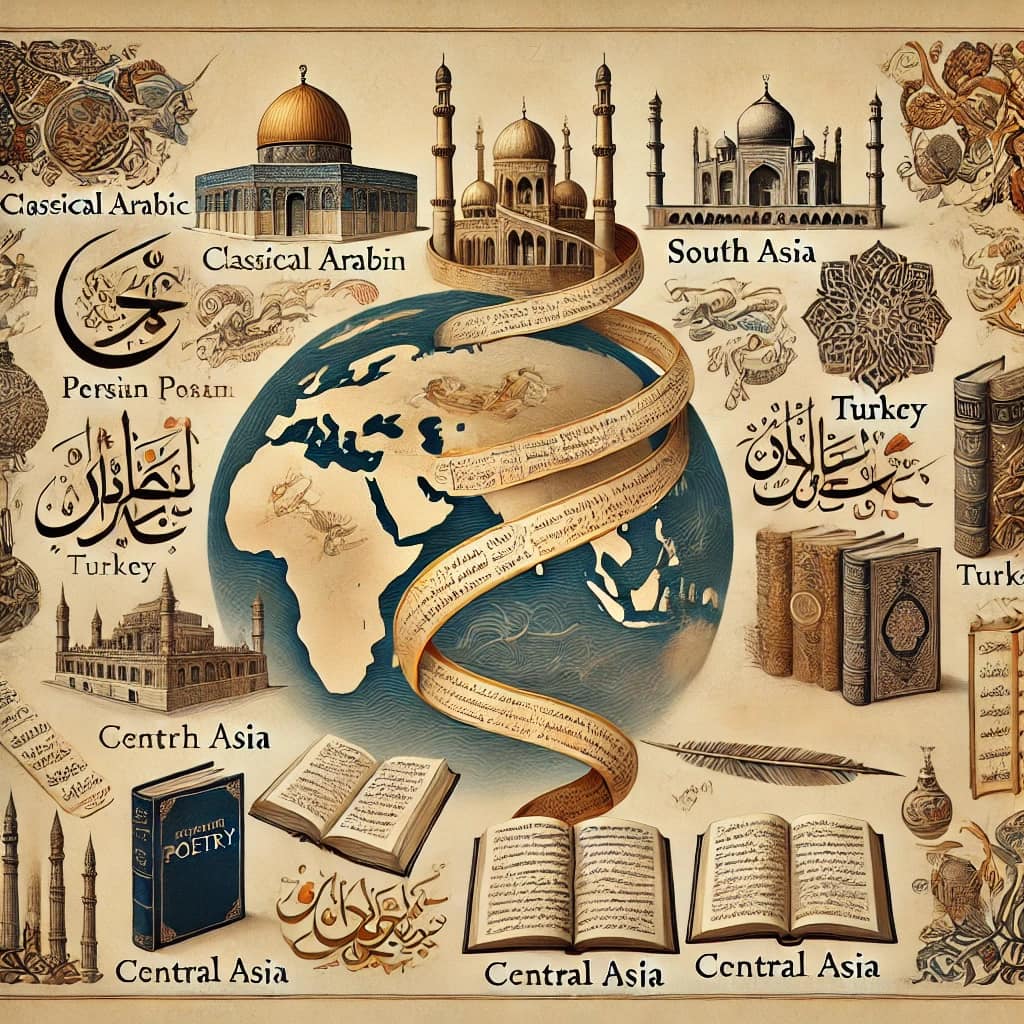
The Ghazal is a poetic form that originated in the Arabian Peninsula and has since spread to many parts of the world, adapting to different languages and cultures. Here are some regions and languages where the Ghazal is a significant part of the literary tradition:
1. Persia (Iran):
• The Ghazal was popularized in Persian literature and reached its classical form there. Persian poets like Hafez, Rumi, and Saadi are considered masters of the Ghazal, blending themes of love, spirituality, and mysticism.
• In Persian, the Ghazal retains its traditional form with a focus on rhyme and meter, and it’s often a medium for Sufi poetry, exploring the relationship between the individual and the divine.
2. South Asia (Hindi/Urdu):
• The Ghazal took deep roots in South Asia, particularly in Urdu and Hindi poetry. Poets like Mirza Ghalib, Faiz Ahmed Faiz, and Mir Taqi Mir have made significant contributions to the Urdu Ghazal tradition.
• It remains a popular form in modern India and Pakistan, with many singers performing Ghazals as a musical genre, blending poetry with melody.
3. Turkey:
• In Ottoman literature, the Ghazal became a popular form known as “Gazel.” Turkish poets like Fuzuli and Nedim were well-known for their Gazels, which retained the classical structure while infusing Turkish cultural elements.
• Turkish Gazels often explore themes of love, beauty, loss, and longing, similar to the Persian and Urdu Ghazals.
4. Arabic World:
• The roots of the Ghazal can be traced back to Arabic poetry, particularly in pre-Islamic and early Islamic Arabia. The early form of the Ghazal developed within the Qasida, a longer form of Arabic poetry, focusing on themes of love and longing.
• Although the Ghazal is less prominent in modern Arabic literature, it laid the groundwork for what became a flourishing tradition in Persia and beyond.
5. Central Asia:
• In Central Asia, particularly in countries like Afghanistan and Tajikistan, the Ghazal has a strong presence in Dari and Tajik poetry. The works of poets like Bedil and Jami are well-regarded for their Ghazals, blending Persian and local influences.
• Ghazals in these regions often retain a mystical or spiritual dimension, similar to Persian traditions.
6. Western World:
• The Ghazal has gained interest among Western poets, particularly in English literature, as poets experiment with its form and themes. Poets like Agha Shahid Ali, an Indian-American poet, have played a significant role in introducing the Ghazal to English poetry.
• English Ghazals maintain the spirit of the traditional form but often adapt the structure to suit modern themes and free verse.
In essence, the Ghazal has a rich and diverse history, evolving as it moved from its Arabic origins to Persian refinement and South Asian cultural integration, while even influencing Western poetic traditions in recent times.
1. Persia (Iran):
• The Ghazal was popularized in Persian literature and reached its classical form there. Persian poets like Hafez, Rumi, and Saadi are considered masters of the Ghazal, blending themes of love, spirituality, and mysticism.
• In Persian, the Ghazal retains its traditional form with a focus on rhyme and meter, and it’s often a medium for Sufi poetry, exploring the relationship between the individual and the divine.
2. South Asia (Hindi/Urdu):
• The Ghazal took deep roots in South Asia, particularly in Urdu and Hindi poetry. Poets like Mirza Ghalib, Faiz Ahmed Faiz, and Mir Taqi Mir have made significant contributions to the Urdu Ghazal tradition.
• It remains a popular form in modern India and Pakistan, with many singers performing Ghazals as a musical genre, blending poetry with melody.
3. Turkey:
• In Ottoman literature, the Ghazal became a popular form known as “Gazel.” Turkish poets like Fuzuli and Nedim were well-known for their Gazels, which retained the classical structure while infusing Turkish cultural elements.
• Turkish Gazels often explore themes of love, beauty, loss, and longing, similar to the Persian and Urdu Ghazals.
4. Arabic World:
• The roots of the Ghazal can be traced back to Arabic poetry, particularly in pre-Islamic and early Islamic Arabia. The early form of the Ghazal developed within the Qasida, a longer form of Arabic poetry, focusing on themes of love and longing.
• Although the Ghazal is less prominent in modern Arabic literature, it laid the groundwork for what became a flourishing tradition in Persia and beyond.
5. Central Asia:
• In Central Asia, particularly in countries like Afghanistan and Tajikistan, the Ghazal has a strong presence in Dari and Tajik poetry. The works of poets like Bedil and Jami are well-regarded for their Ghazals, blending Persian and local influences.
• Ghazals in these regions often retain a mystical or spiritual dimension, similar to Persian traditions.
6. Western World:
• The Ghazal has gained interest among Western poets, particularly in English literature, as poets experiment with its form and themes. Poets like Agha Shahid Ali, an Indian-American poet, have played a significant role in introducing the Ghazal to English poetry.
• English Ghazals maintain the spirit of the traditional form but often adapt the structure to suit modern themes and free verse.
In essence, the Ghazal has a rich and diverse history, evolving as it moved from its Arabic origins to Persian refinement and South Asian cultural integration, while even influencing Western poetic traditions in recent times.
The Ghazal is a poetic form that originated in the Arabian Peninsula and has since spread to many parts of the world, adapting to different languages and cultures. Here are some regions and languages where the Ghazal is a significant part of the literary tradition:
1. Persia (Iran):
• The Ghazal was popularized in Persian literature and reached its classical form there. Persian poets like Hafez, Rumi, and Saadi are considered masters of the Ghazal, blending themes of love, spirituality, and mysticism.
• In Persian, the Ghazal retains its traditional form with a focus on rhyme and meter, and it’s often a medium for Sufi poetry, exploring the relationship between the individual and the divine.
2. South Asia (Hindi/Urdu):
• The Ghazal took deep roots in South Asia, particularly in Urdu and Hindi poetry. Poets like Mirza Ghalib, Faiz Ahmed Faiz, and Mir Taqi Mir have made significant contributions to the Urdu Ghazal tradition.
• It remains a popular form in modern India and Pakistan, with many singers performing Ghazals as a musical genre, blending poetry with melody.
3. Turkey:
• In Ottoman literature, the Ghazal became a popular form known as “Gazel.” Turkish poets like Fuzuli and Nedim were well-known for their Gazels, which retained the classical structure while infusing Turkish cultural elements.
• Turkish Gazels often explore themes of love, beauty, loss, and longing, similar to the Persian and Urdu Ghazals.
4. Arabic World:
• The roots of the Ghazal can be traced back to Arabic poetry, particularly in pre-Islamic and early Islamic Arabia. The early form of the Ghazal developed within the Qasida, a longer form of Arabic poetry, focusing on themes of love and longing.
• Although the Ghazal is less prominent in modern Arabic literature, it laid the groundwork for what became a flourishing tradition in Persia and beyond.
5. Central Asia:
• In Central Asia, particularly in countries like Afghanistan and Tajikistan, the Ghazal has a strong presence in Dari and Tajik poetry. The works of poets like Bedil and Jami are well-regarded for their Ghazals, blending Persian and local influences.
• Ghazals in these regions often retain a mystical or spiritual dimension, similar to Persian traditions.
6. Western World:
• The Ghazal has gained interest among Western poets, particularly in English literature, as poets experiment with its form and themes. Poets like Agha Shahid Ali, an Indian-American poet, have played a significant role in introducing the Ghazal to English poetry.
• English Ghazals maintain the spirit of the traditional form but often adapt the structure to suit modern themes and free verse.
In essence, the Ghazal has a rich and diverse history, evolving as it moved from its Arabic origins to Persian refinement and South Asian cultural integration, while even influencing Western poetic traditions in recent times.
0 Kommentare
0 Anteile
55 Ansichten