


David R. Hawkins was a psychiatrist, consciousness researcher, and author known for his work on the "Map of Consciousness" and his book "Power vs. Force." The Map of Consciousness is a theoretical framework that attempts to categorize and measure levels of human consciousness and awareness. Its a central concept in his teachings and books.
Heres an overview of the Map of Consciousness:
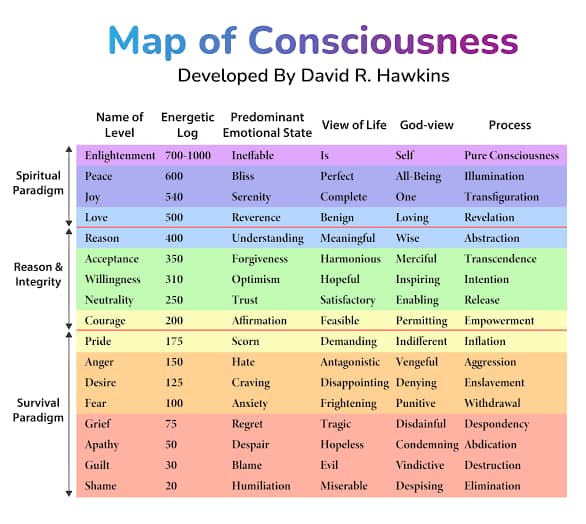
1. **Scale of Consciousness:** The Map of Consciousness is often presented as a scale or hierarchy of consciousness levels, ranging from the lowest levels of awareness to the highest. Its depicted as a logarithmic scale, with each level having a numerical value.
2. **Calibration:** Hawkins claimed that he calibrated these levels using muscle testing or Applied Kinesiology. He assigned numerical values to various emotions, thoughts, and states of being based on the idea that they have a unique vibrational frequency.
3. **Lower Levels:** The lower levels of consciousness are characterized by negative emotions and behaviors, such as shame, guilt, apathy, and anger. These levels are associated with feelings of powerlessness and victimhood.
4. **Middle Levels:** The middle levels include emotions like courage, acceptance, and reason. People at these levels are more empowered and have a greater capacity for positive change and growth.
5. **Higher Levels:** The higher levels represent states of consciousness associated with love, joy, peace, and enlightenment. These levels are considered more spiritually advanced and associated with greater clarity, compassion, and unity with the universe.
6. **Hawkins Work:** David Hawkins wrote extensively about the Map of Consciousness in his books, particularly "Power vs. Force." He claimed that his research showed that higher levels of consciousness could have a positive impact on ones life and the world.
Its important to note that Hawkins work and the Map of Consciousness have been met with both praise and criticism within the scientific and spiritual communities. Some view it as a valuable tool for personal development and self-awareness, while others question the validity of his calibration methods and the scientific rigor of his work.
Ultimately, the Map of Consciousness is a conceptual framework that attempts to provide a way to understand and measure human consciousness and its potential for growth and transformation. Its widely discussed in the fields of spirituality and self-help.
Heres an overview of the Map of Consciousness:
1. **Scale of Consciousness:** The Map of Consciousness is often presented as a scale or hierarchy of consciousness levels, ranging from the lowest levels of awareness to the highest. Its depicted as a logarithmic scale, with each level having a numerical value.
2. **Calibration:** Hawkins claimed that he calibrated these levels using muscle testing or Applied Kinesiology. He assigned numerical values to various emotions, thoughts, and states of being based on the idea that they have a unique vibrational frequency.
3. **Lower Levels:** The lower levels of consciousness are characterized by negative emotions and behaviors, such as shame, guilt, apathy, and anger. These levels are associated with feelings of powerlessness and victimhood.
4. **Middle Levels:** The middle levels include emotions like courage, acceptance, and reason. People at these levels are more empowered and have a greater capacity for positive change and growth.
5. **Higher Levels:** The higher levels represent states of consciousness associated with love, joy, peace, and enlightenment. These levels are considered more spiritually advanced and associated with greater clarity, compassion, and unity with the universe.
6. **Hawkins Work:** David Hawkins wrote extensively about the Map of Consciousness in his books, particularly "Power vs. Force." He claimed that his research showed that higher levels of consciousness could have a positive impact on ones life and the world.
Its important to note that Hawkins work and the Map of Consciousness have been met with both praise and criticism within the scientific and spiritual communities. Some view it as a valuable tool for personal development and self-awareness, while others question the validity of his calibration methods and the scientific rigor of his work.
Ultimately, the Map of Consciousness is a conceptual framework that attempts to provide a way to understand and measure human consciousness and its potential for growth and transformation. Its widely discussed in the fields of spirituality and self-help.
David R. Hawkins was a psychiatrist, consciousness researcher, and author known for his work on the "Map of Consciousness" and his book "Power vs. Force." The Map of Consciousness is a theoretical framework that attempts to categorize and measure levels of human consciousness and awareness. It's a central concept in his teachings and books.
Here's an overview of the Map of Consciousness:
1. **Scale of Consciousness:** The Map of Consciousness is often presented as a scale or hierarchy of consciousness levels, ranging from the lowest levels of awareness to the highest. It's depicted as a logarithmic scale, with each level having a numerical value.
2. **Calibration:** Hawkins claimed that he calibrated these levels using muscle testing or Applied Kinesiology. He assigned numerical values to various emotions, thoughts, and states of being based on the idea that they have a unique vibrational frequency.
3. **Lower Levels:** The lower levels of consciousness are characterized by negative emotions and behaviors, such as shame, guilt, apathy, and anger. These levels are associated with feelings of powerlessness and victimhood.
4. **Middle Levels:** The middle levels include emotions like courage, acceptance, and reason. People at these levels are more empowered and have a greater capacity for positive change and growth.
5. **Higher Levels:** The higher levels represent states of consciousness associated with love, joy, peace, and enlightenment. These levels are considered more spiritually advanced and associated with greater clarity, compassion, and unity with the universe.
6. **Hawkins' Work:** David Hawkins wrote extensively about the Map of Consciousness in his books, particularly "Power vs. Force." He claimed that his research showed that higher levels of consciousness could have a positive impact on one's life and the world.
It's important to note that Hawkins' work and the Map of Consciousness have been met with both praise and criticism within the scientific and spiritual communities. Some view it as a valuable tool for personal development and self-awareness, while others question the validity of his calibration methods and the scientific rigor of his work.
Ultimately, the Map of Consciousness is a conceptual framework that attempts to provide a way to understand and measure human consciousness and its potential for growth and transformation. It's widely discussed in the fields of spirituality and self-help.
0 Comentários
0 Compartilhamentos
123 Visualizações