



Fondation Level Batch No 4
Roll RSLC #42
Task No #146
Day #146
# The Ethics and Education of Animal Dissections
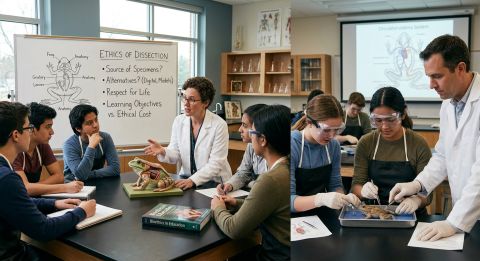
On a bright Monday morning, Sara entered her biology classroom with excitement and curiosity. Her teacher, Ms. Helen, announced that the students would be learning about animal anatomy through a dissection lesson. Sara had always wanted to understand how living bodies worked, but she also wondered whether using animals for education was the right choice. Before beginning, Ms. Helen reminded the class that science was not only about discovering facts?it was also about making responsible and ethical decisions.
During the lesson, Sara carefully observed the specimen and began to understand how different organs worked together. However, Ms. Helen explained that animals should never be treated as ordinary objects. They were living beings and deserved respect. She told the students that every use of an animal in education should have a clear purpose and that unnecessary harm should always be avoided.
One student asked, ?Can we learn anatomy without using real animals?? Ms. Helen explained that modern technology now offers alternatives such as virtual dissections, 3D models, computer simulations, and artificial specimens. These methods can help students understand anatomy while reducing the need for animal use. Sara realized that scientific progress was not only about learning more, but also about finding kinder and more responsible ways to learn.
At the end of the lesson, Sara wrote in her notebook, ?True science seeks knowledge without forgetting kindness.? She understood that education should develop knowledge, compassion, responsibility, and respect. From that day forward, she looked at science differently and realized that the best discoveries are those that help us understand life while also teaching us to value it.
## Moral Lesson
**True education combines knowledge with compassion. Science should seek understanding while respecting life and choosing ethical ways to learn whenever possible.**
#AnimalDissection #EthicsInScience #BiologyEducation #AnimalWelfare #ScienceEducation #EthicalLearning
Roll RSLC #42
Task No #146
Day #146
# The Ethics and Education of Animal Dissections
On a bright Monday morning, Sara entered her biology classroom with excitement and curiosity. Her teacher, Ms. Helen, announced that the students would be learning about animal anatomy through a dissection lesson. Sara had always wanted to understand how living bodies worked, but she also wondered whether using animals for education was the right choice. Before beginning, Ms. Helen reminded the class that science was not only about discovering facts?it was also about making responsible and ethical decisions.
During the lesson, Sara carefully observed the specimen and began to understand how different organs worked together. However, Ms. Helen explained that animals should never be treated as ordinary objects. They were living beings and deserved respect. She told the students that every use of an animal in education should have a clear purpose and that unnecessary harm should always be avoided.
One student asked, ?Can we learn anatomy without using real animals?? Ms. Helen explained that modern technology now offers alternatives such as virtual dissections, 3D models, computer simulations, and artificial specimens. These methods can help students understand anatomy while reducing the need for animal use. Sara realized that scientific progress was not only about learning more, but also about finding kinder and more responsible ways to learn.
At the end of the lesson, Sara wrote in her notebook, ?True science seeks knowledge without forgetting kindness.? She understood that education should develop knowledge, compassion, responsibility, and respect. From that day forward, she looked at science differently and realized that the best discoveries are those that help us understand life while also teaching us to value it.
## Moral Lesson
**True education combines knowledge with compassion. Science should seek understanding while respecting life and choosing ethical ways to learn whenever possible.**
#AnimalDissection #EthicsInScience #BiologyEducation #AnimalWelfare #ScienceEducation #EthicalLearning
Fondation Level Batch No 4
Roll RSLC #42
Task No #146
Day #146
# The Ethics and Education of Animal Dissections
On a bright Monday morning, Sara entered her biology classroom with excitement and curiosity. Her teacher, Ms. Helen, announced that the students would be learning about animal anatomy through a dissection lesson. Sara had always wanted to understand how living bodies worked, but she also wondered whether using animals for education was the right choice. Before beginning, Ms. Helen reminded the class that science was not only about discovering facts?it was also about making responsible and ethical decisions.
During the lesson, Sara carefully observed the specimen and began to understand how different organs worked together. However, Ms. Helen explained that animals should never be treated as ordinary objects. They were living beings and deserved respect. She told the students that every use of an animal in education should have a clear purpose and that unnecessary harm should always be avoided.
One student asked, ?Can we learn anatomy without using real animals?? Ms. Helen explained that modern technology now offers alternatives such as virtual dissections, 3D models, computer simulations, and artificial specimens. These methods can help students understand anatomy while reducing the need for animal use. Sara realized that scientific progress was not only about learning more, but also about finding kinder and more responsible ways to learn.
At the end of the lesson, Sara wrote in her notebook, ?True science seeks knowledge without forgetting kindness.? She understood that education should develop knowledge, compassion, responsibility, and respect. From that day forward, she looked at science differently and realized that the best discoveries are those that help us understand life while also teaching us to value it.
## Moral Lesson
**True education combines knowledge with compassion. Science should seek understanding while respecting life and choosing ethical ways to learn whenever possible.**
#AnimalDissection #EthicsInScience #BiologyEducation #AnimalWelfare #ScienceEducation #EthicalLearning
0 التعليقات
0 المشاركات
139 مشاهدة