Day: -104
Roll No: 006
Level: Foundation
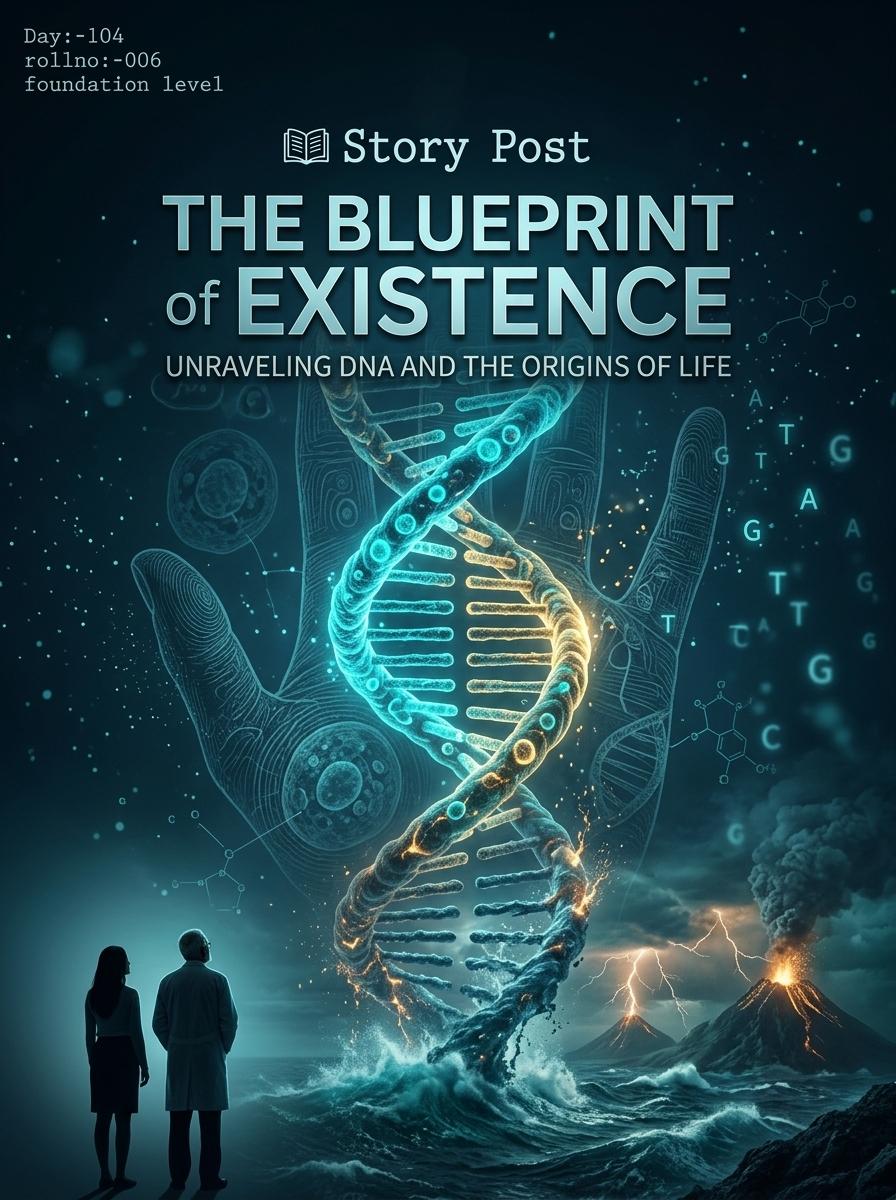
Title: The Blueprint of Existence
The laboratory was quiet, save for the low hum of the sequencing machines and the persistent click of Maya’s pen against her notebook. On the monitor, billions of nitrogenous bases flickered in glowing cyan—A, T, C, G—a silent language written four billion years ago.
For centuries, humanity looked up at the stars to understand where we came from, building telescopes to peer into the void. But as Maya watched the double helix render across her screen, she knew the real ledger of our origins wasn't written in dust and plasma. It was coiled tightly inside every nucleus of every living cell on Earth.
"Still trying to read the first page?"
Maya turned. Dr. Aris stood in the doorway, two mugs of cold coffee in hand. He set one on her desk, his gaze lingering on the digital rendering of RNA strands folding over themselves in a simulated primordial tide pool.
"It’s the transition that gets me," Maya said, tracing the curve of the ribbon on her screen. "RNA was the pioneer—acting as both the blueprint and the engine in the primitive soup. But it was fragile. Volatile. How did life take that impossible leap from chaotic chemistry to the absolute permanence of DNA?"
Aris smiled, pulling up a chair. "By inventing memory. RNA lived in the moment, reacting and replicating in hydrothermal heat. But DNA was built to endure. It dropped an oxygen atom, twisted into a double helix, and locked the master copy in a vault. It stopped just reacting to the world and started remembering it."
They sat in silence for a moment, surrounded by data streams containing the genetic blueprints of thousands of species—from ancient deep-sea archaebacteria to modern human genomes. Every single one used the exact same four-letter alphabet, a continuous, unbroken chain of code passed down through unfathomable millennia, surviving mass extinctions, ice ages, and cosmic bombardments.
"We think of history as monuments, books, and empires," Maya whispered, adjusting her glasses. "But none of those last. Empires crumble to dust. Books burn."
"And yet," Aris added quietly, "a sequence forged in a primordial tide pool fou
Roll No: 006
Level: Foundation
Title: The Blueprint of Existence
The laboratory was quiet, save for the low hum of the sequencing machines and the persistent click of Maya’s pen against her notebook. On the monitor, billions of nitrogenous bases flickered in glowing cyan—A, T, C, G—a silent language written four billion years ago.
For centuries, humanity looked up at the stars to understand where we came from, building telescopes to peer into the void. But as Maya watched the double helix render across her screen, she knew the real ledger of our origins wasn't written in dust and plasma. It was coiled tightly inside every nucleus of every living cell on Earth.
"Still trying to read the first page?"
Maya turned. Dr. Aris stood in the doorway, two mugs of cold coffee in hand. He set one on her desk, his gaze lingering on the digital rendering of RNA strands folding over themselves in a simulated primordial tide pool.
"It’s the transition that gets me," Maya said, tracing the curve of the ribbon on her screen. "RNA was the pioneer—acting as both the blueprint and the engine in the primitive soup. But it was fragile. Volatile. How did life take that impossible leap from chaotic chemistry to the absolute permanence of DNA?"
Aris smiled, pulling up a chair. "By inventing memory. RNA lived in the moment, reacting and replicating in hydrothermal heat. But DNA was built to endure. It dropped an oxygen atom, twisted into a double helix, and locked the master copy in a vault. It stopped just reacting to the world and started remembering it."
They sat in silence for a moment, surrounded by data streams containing the genetic blueprints of thousands of species—from ancient deep-sea archaebacteria to modern human genomes. Every single one used the exact same four-letter alphabet, a continuous, unbroken chain of code passed down through unfathomable millennia, surviving mass extinctions, ice ages, and cosmic bombardments.
"We think of history as monuments, books, and empires," Maya whispered, adjusting her glasses. "But none of those last. Empires crumble to dust. Books burn."
"And yet," Aris added quietly, "a sequence forged in a primordial tide pool fou
Day: -104
Roll No: 006
Level: Foundation
Title: The Blueprint of Existence
The laboratory was quiet, save for the low hum of the sequencing machines and the persistent click of Maya’s pen against her notebook. On the monitor, billions of nitrogenous bases flickered in glowing cyan—A, T, C, G—a silent language written four billion years ago.
For centuries, humanity looked up at the stars to understand where we came from, building telescopes to peer into the void. But as Maya watched the double helix render across her screen, she knew the real ledger of our origins wasn't written in dust and plasma. It was coiled tightly inside every nucleus of every living cell on Earth.
"Still trying to read the first page?"
Maya turned. Dr. Aris stood in the doorway, two mugs of cold coffee in hand. He set one on her desk, his gaze lingering on the digital rendering of RNA strands folding over themselves in a simulated primordial tide pool.
"It’s the transition that gets me," Maya said, tracing the curve of the ribbon on her screen. "RNA was the pioneer—acting as both the blueprint and the engine in the primitive soup. But it was fragile. Volatile. How did life take that impossible leap from chaotic chemistry to the absolute permanence of DNA?"
Aris smiled, pulling up a chair. "By inventing memory. RNA lived in the moment, reacting and replicating in hydrothermal heat. But DNA was built to endure. It dropped an oxygen atom, twisted into a double helix, and locked the master copy in a vault. It stopped just reacting to the world and started remembering it."
They sat in silence for a moment, surrounded by data streams containing the genetic blueprints of thousands of species—from ancient deep-sea archaebacteria to modern human genomes. Every single one used the exact same four-letter alphabet, a continuous, unbroken chain of code passed down through unfathomable millennia, surviving mass extinctions, ice ages, and cosmic bombardments.
"We think of history as monuments, books, and empires," Maya whispered, adjusting her glasses. "But none of those last. Empires crumble to dust. Books burn."
"And yet," Aris added quietly, "a sequence forged in a primordial tide pool fou
0 Commentarii
0 Distribuiri
415 Views