• RSIF8
    Roll no:100
    Task no:10
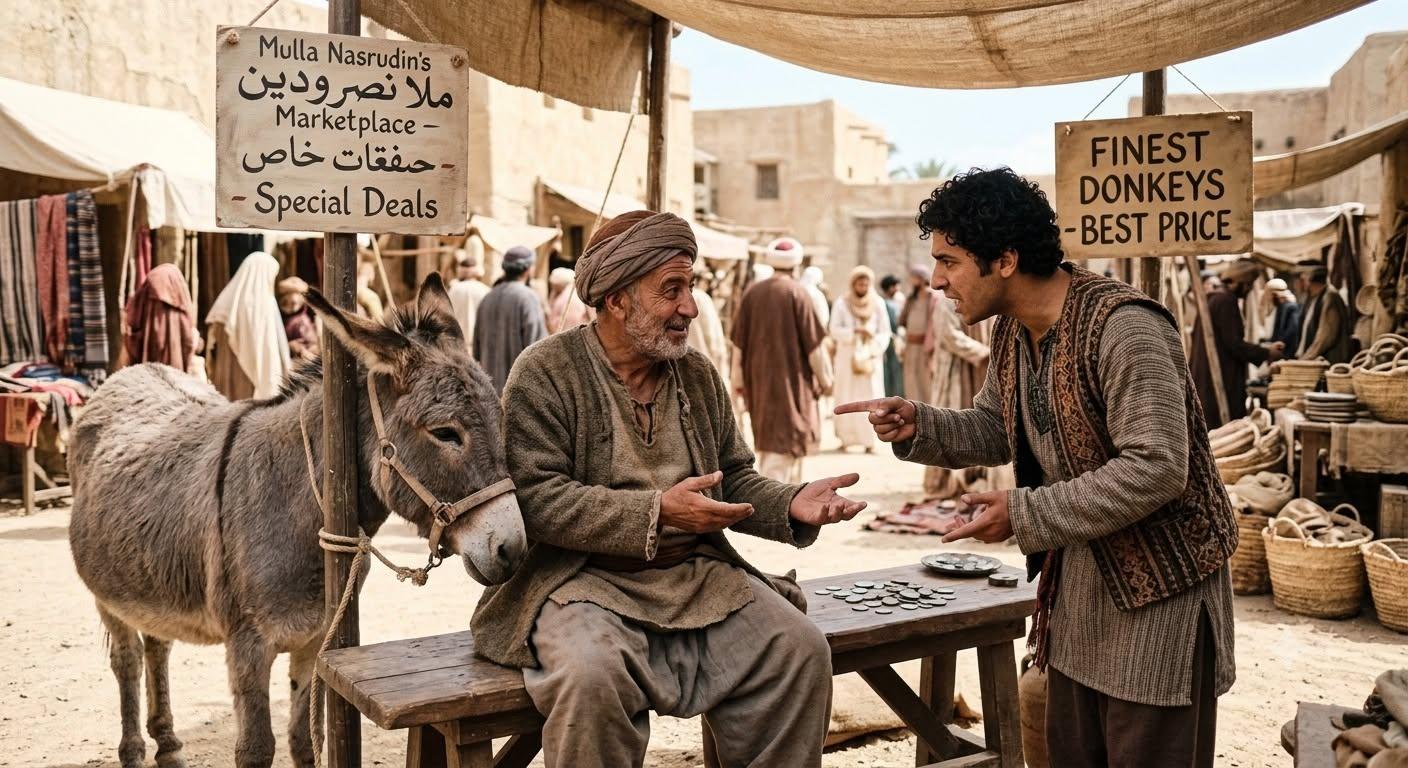
    Task topic:Mulla Nasrudin & the Donkey's Price
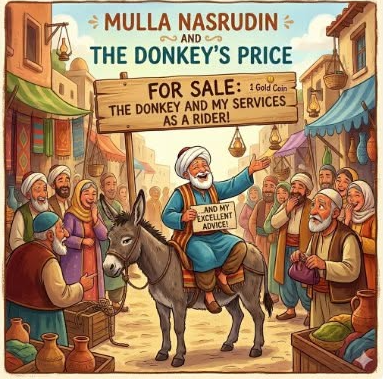
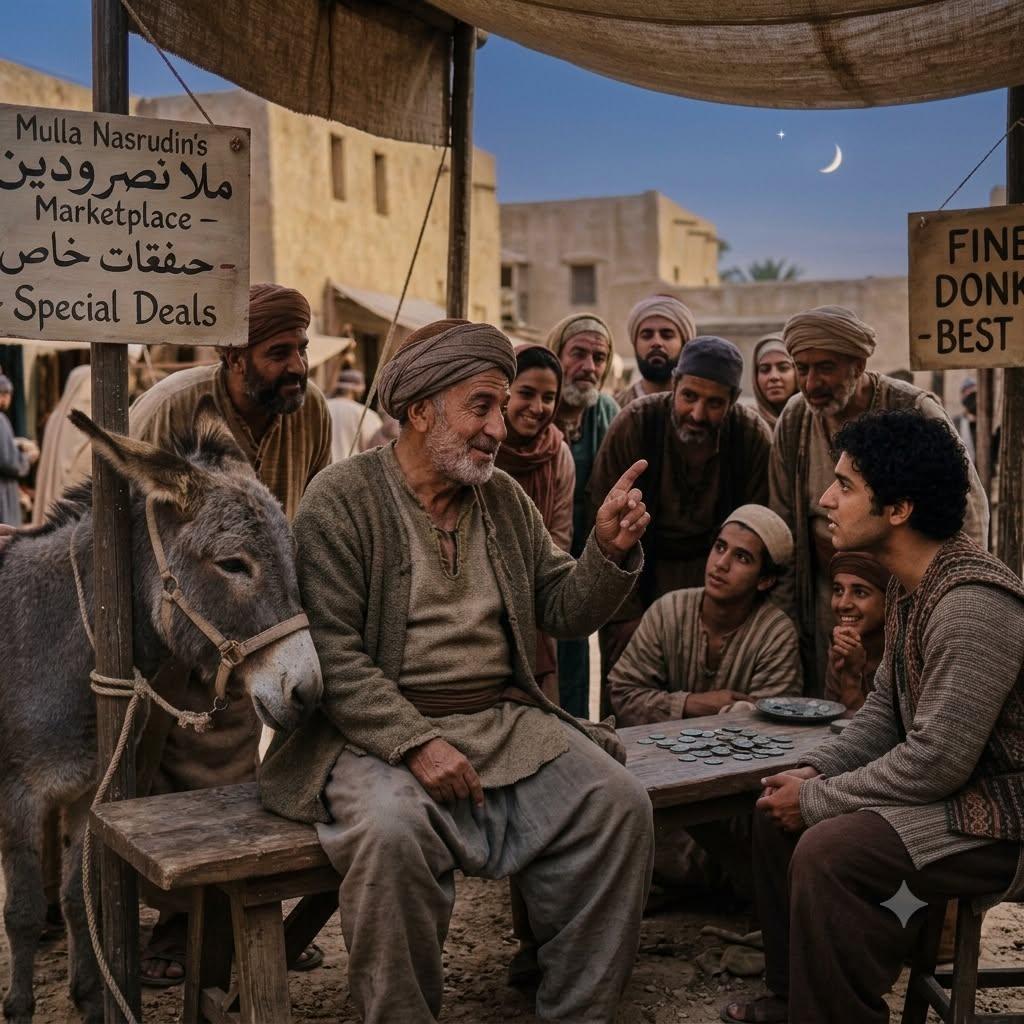
    The marketplace hummed with midday chaos. Mulla Nasrudin sat at his stall under a sign reading **'FINEST DONKEYS - BEST PRICE,'** though his single gray donkey was currently trying to eat its own halter.
    Ahmed, a wealthy and impatient young merchant, marched up and pointed an accusing finger. "Best price? Nasrudin, it looks like a dust mop! What’s your price? Fifty gold coins?"
    Nasrudin spread his hands innocently. "Fifty gold? Far too much!"
    Ahmed slammed two copper coins onto the table. "Don’t play games. Give me a number or I'm leaving!"
    A crowd gathered, sensing a classic Nasrudin lesson. The Mulla looked at the donkey, then at Ahmed. "Young master, the donkey itself is cheap. For you? Just five copper coins! A bargain!"
    Ahmed blinked, completely confused. "Five copper? But your sign says 'Best Price'!"
    "Exactly," Nasrudin nodded sagely. "The donkey is cheap. But I am not just selling the donkey."
    "Then what are you selling?" Ahmed demanded.
    Nasrudin leaned in conspiratorially. "While the donkey is only five coppers, the limited supply of *patience* you need to actually own him? That is very, *very* expensive."
    #MullaNasrudin #Folklore #WiseFool #DonkeyBusiness #Haggling #WittyTales #PatienceIsGold
    RSIF8 Roll no:100 Task no:10 Task topic:Mulla Nasrudin & the Donkey's Price The marketplace hummed with midday chaos. 🐫🏺 Mulla Nasrudin sat at his stall under a sign reading **'FINEST DONKEYS - BEST PRICE,'** though his single gray donkey was currently trying to eat its own halter. 🌾🐴 Ahmed, a wealthy and impatient young merchant, marched up and pointed an accusing finger. 😤 "Best price? Nasrudin, it looks like a dust mop! What’s your price? Fifty gold coins?" 💰🙄 Nasrudin spread his hands innocently. 🤷‍♂️ "Fifty gold? Far too much!" Ahmed slammed two copper coins onto the table. 🪙💥 "Don’t play games. Give me a number or I'm leaving!" A crowd gathered, sensing a classic Nasrudin lesson. 👀 The Mulla looked at the donkey, then at Ahmed. "Young master, the donkey itself is cheap. For you? Just five copper coins! A bargain!" 🤝 Ahmed blinked, completely confused. 😧 "Five copper? But your sign says 'Best Price'!" "Exactly," Nasrudin nodded sagely. ☝️ "The donkey is cheap. But I am not just selling the donkey." "Then what are you selling?" Ahmed demanded. 🗣️ Nasrudin leaned in conspiratorially. 🤫 "While the donkey is only five coppers, the limited supply of *patience* you need to actually own him? That is very, *very* expensive." 💡😂 #MullaNasrudin #Folklore #WiseFool #DonkeyBusiness #Haggling #WittyTales #PatienceIsGold
    0 Kommentare 0 Anteile 413 Ansichten
  • Poetry holds a significant place in cultures worldwide, transcending time, geography, and language. Here’s a summary of its global significance:

    1. Expression of Human Emotions:

    • Poetry captures the full spectrum of human emotions, from love, joy, and hope to sorrow, grief, and longing. It enables people to articulate feelings that might be difficult to express in everyday language.

    2. Cultural Preservation:

    • Poetry plays a crucial role in preserving cultural identity, traditions, and values. It often carries the wisdom, folklore, and collective experiences of a society. Epic poems, like the “Iliad” in Greece or “Mahabharata” in India, are cornerstones of cultural heritage.

    3. Social and Political Commentary:

    • Throughout history, poets have used poetry to critique society, challenge authority, and inspire change. It has been a tool for political expression, activism, and movements, influencing revolutions and social change, like the works of Pablo Neruda or Langston Hughes.

    4. Literary and Artistic Value:

    • Poetry is an art form that focuses on language, rhythm, and aesthetics. It allows for creativity, metaphor, and linguistic play, creating a space for deep reflection and interpretation. The works of poets like William Shakespeare, Rumi, and Emily Dickinson have had a profound impact on literature.

    5. Healing and Therapy:

    • Poetry can serve as a therapeutic tool, providing solace and healing for individuals dealing with trauma, grief, or difficult times. It is often used in therapies to help people process emotions and find comfort.

    6. Global Influence and Connectivity:

    • Poetry connects people across cultures and languages. Translations of poets like Rumi, Rabindranath Tagore, and Hafez have reached global audiences, showing how poetry can transcend borders and bring diverse cultures closer.

    7. Celebration of Language:

    • Poetry is a celebration of language’s beauty, intricacies, and power. It often pushes the boundaries of language, exploring new expressions, forms, and styles, from traditional sonnets to modern free verse.

    In summary, poetry holds a mirror to society, acts as a vessel for cultural memory, and provides a platform for individual and collective voices. Its influence spans centuries, shaping human thought, art, and society, and continues to be a powerful medium in the modern world.
    Poetry holds a significant place in cultures worldwide, transcending time, geography, and language. Here’s a summary of its global significance: 1. Expression of Human Emotions: • Poetry captures the full spectrum of human emotions, from love, joy, and hope to sorrow, grief, and longing. It enables people to articulate feelings that might be difficult to express in everyday language. 2. Cultural Preservation: • Poetry plays a crucial role in preserving cultural identity, traditions, and values. It often carries the wisdom, folklore, and collective experiences of a society. Epic poems, like the “Iliad” in Greece or “Mahabharata” in India, are cornerstones of cultural heritage. 3. Social and Political Commentary: • Throughout history, poets have used poetry to critique society, challenge authority, and inspire change. It has been a tool for political expression, activism, and movements, influencing revolutions and social change, like the works of Pablo Neruda or Langston Hughes. 4. Literary and Artistic Value: • Poetry is an art form that focuses on language, rhythm, and aesthetics. It allows for creativity, metaphor, and linguistic play, creating a space for deep reflection and interpretation. The works of poets like William Shakespeare, Rumi, and Emily Dickinson have had a profound impact on literature. 5. Healing and Therapy: • Poetry can serve as a therapeutic tool, providing solace and healing for individuals dealing with trauma, grief, or difficult times. It is often used in therapies to help people process emotions and find comfort. 6. Global Influence and Connectivity: • Poetry connects people across cultures and languages. Translations of poets like Rumi, Rabindranath Tagore, and Hafez have reached global audiences, showing how poetry can transcend borders and bring diverse cultures closer. 7. Celebration of Language: • Poetry is a celebration of language’s beauty, intricacies, and power. It often pushes the boundaries of language, exploring new expressions, forms, and styles, from traditional sonnets to modern free verse. In summary, poetry holds a mirror to society, acts as a vessel for cultural memory, and provides a platform for individual and collective voices. Its influence spans centuries, shaping human thought, art, and society, and continues to be a powerful medium in the modern world.
    0 Kommentare 0 Anteile 1500 Ansichten
  • The origin of the Pashtun people, also known as Pathans or Afghans, is complex and rooted in ancient history, blending mythology, linguistic analysis, genetic studies, and historical accounts. The Pashtuns are an ethnolinguistic group primarily found in Afghanistan and Pakistan, with smaller populations in India and the Middle East.

    Theories on Pashtun Origins:
    1. Iranian Origin Theory (Most Widely Accepted):
    • Pashtuns are believed to be descendants of ancient Iranian tribes who migrated into the region of modern-day Afghanistan and Pakistan around 1500 BCE.
    • Their language, Pashto, belongs to the Eastern Iranian branch of the Indo-Iranian languages, which connects them linguistically to other Iranian peoples like the Persians, Baloch, and Kurds.
    • This theory is supported by cultural, linguistic, and historical evidence linking Pashtuns to the broader Iranian plateau.
    2. Indo-Aryan Connection:
    • Some scholars suggest Pashtuns are linked to the Indo-Aryan migration that took place around 2000-1500 BCE. This migration brought Indo-Aryan-speaking tribes into the Indian subcontinent and Iranian plateau.
    • Pashtuns might represent a mixture of ancient Indo-Aryans and indigenous peoples of the region.
    3. Semitic/Israelite Theory (Mythological):
    • A popular but unsubstantiated theory within Pashtun folklore claims they are descendants of the lost tribes of Israel (specifically the Tribe of Benjamin).
    • According to this legend, they migrated to the region after being exiled from Israel in 721 BCE by the Assyrian Empire.
    • This theory is largely based on oral traditions and some cultural practices that resemble ancient Israelite customs, but there is no concrete historical or genetic evidence supporting it.
    4. Greco-Bactrian Influence:
    • During the time of Alexander the Great’s conquests (4th century BCE) and the subsequent Greco-Bactrian kingdoms, the region inhabited by Pashtuns experienced significant Hellenistic influence.
    • Some historians suggest that Pashtuns may be partially descended from Greek settlers who intermixed with the local population, though this influence would be minor.
    5. Indigenous Tribal Roots:
    • Pashtuns might be the descendants of the ancient Gandhara and Ariana civilizations that thrived in the region thousands of years ago.
    • Archaeological evidence from the Indus Valley Civilization and surrounding regions shows the long-term human habitation of the areas now inhabited by Pashtuns.

    Cultural and Historical Milestones:
    1. Ancient References:
    • Ancient texts, such as the Rigveda (1500 BCE) and Persian inscriptions, describe the people of the region now occupied by Pashtuns, though the exact identity of Pashtuns is debated.
    2. Pashtunwali:
    • Pashtuns follow a unique code of honor known as Pashtunwali, which emphasizes hospitality, courage, and revenge. It reflects their distinct cultural and social evolution over millennia.
    3. Medieval Era:
    • Pashtuns are first clearly identified as an ethnic group during the Islamic conquests in the 7th-8th centuries CE, where they converted to Islam and began playing key roles in regional politics.
    • They gained prominence during the rule of the Delhi Sultanate and the Mughal Empire, especially under rulers like Sher Shah Suri, a Pashtun emperor.

    Genetic Studies:
    • Modern genetic studies show Pashtuns are closely related to other Iranian peoples but also have significant genetic contributions from South Asia and Central Asia, reflecting the region’s history as a crossroads for migrations and invasions.

    Summary:

    The Pashtuns likely emerged as a distinct group through a mixture of Iranian, Indo-Aryan, and local indigenous elements, with possible influences from Semitic and Greek settlers. They have inhabited the region for millennia, preserving a unique identity shaped by language, culture, and historical interactions.
    The origin of the Pashtun people, also known as Pathans or Afghans, is complex and rooted in ancient history, blending mythology, linguistic analysis, genetic studies, and historical accounts. The Pashtuns are an ethnolinguistic group primarily found in Afghanistan and Pakistan, with smaller populations in India and the Middle East. Theories on Pashtun Origins: 1. Iranian Origin Theory (Most Widely Accepted): • Pashtuns are believed to be descendants of ancient Iranian tribes who migrated into the region of modern-day Afghanistan and Pakistan around 1500 BCE. • Their language, Pashto, belongs to the Eastern Iranian branch of the Indo-Iranian languages, which connects them linguistically to other Iranian peoples like the Persians, Baloch, and Kurds. • This theory is supported by cultural, linguistic, and historical evidence linking Pashtuns to the broader Iranian plateau. 2. Indo-Aryan Connection: • Some scholars suggest Pashtuns are linked to the Indo-Aryan migration that took place around 2000-1500 BCE. This migration brought Indo-Aryan-speaking tribes into the Indian subcontinent and Iranian plateau. • Pashtuns might represent a mixture of ancient Indo-Aryans and indigenous peoples of the region. 3. Semitic/Israelite Theory (Mythological): • A popular but unsubstantiated theory within Pashtun folklore claims they are descendants of the lost tribes of Israel (specifically the Tribe of Benjamin). • According to this legend, they migrated to the region after being exiled from Israel in 721 BCE by the Assyrian Empire. • This theory is largely based on oral traditions and some cultural practices that resemble ancient Israelite customs, but there is no concrete historical or genetic evidence supporting it. 4. Greco-Bactrian Influence: • During the time of Alexander the Great’s conquests (4th century BCE) and the subsequent Greco-Bactrian kingdoms, the region inhabited by Pashtuns experienced significant Hellenistic influence. • Some historians suggest that Pashtuns may be partially descended from Greek settlers who intermixed with the local population, though this influence would be minor. 5. Indigenous Tribal Roots: • Pashtuns might be the descendants of the ancient Gandhara and Ariana civilizations that thrived in the region thousands of years ago. • Archaeological evidence from the Indus Valley Civilization and surrounding regions shows the long-term human habitation of the areas now inhabited by Pashtuns. Cultural and Historical Milestones: 1. Ancient References: • Ancient texts, such as the Rigveda (1500 BCE) and Persian inscriptions, describe the people of the region now occupied by Pashtuns, though the exact identity of Pashtuns is debated. 2. Pashtunwali: • Pashtuns follow a unique code of honor known as Pashtunwali, which emphasizes hospitality, courage, and revenge. It reflects their distinct cultural and social evolution over millennia. 3. Medieval Era: • Pashtuns are first clearly identified as an ethnic group during the Islamic conquests in the 7th-8th centuries CE, where they converted to Islam and began playing key roles in regional politics. • They gained prominence during the rule of the Delhi Sultanate and the Mughal Empire, especially under rulers like Sher Shah Suri, a Pashtun emperor. Genetic Studies: • Modern genetic studies show Pashtuns are closely related to other Iranian peoples but also have significant genetic contributions from South Asia and Central Asia, reflecting the region’s history as a crossroads for migrations and invasions. Summary: The Pashtuns likely emerged as a distinct group through a mixture of Iranian, Indo-Aryan, and local indigenous elements, with possible influences from Semitic and Greek settlers. They have inhabited the region for millennia, preserving a unique identity shaped by language, culture, and historical interactions.
    0 Kommentare 0 Anteile 674 Ansichten
  • Origins of Holi and the Multan Sun Temple Connection

    Mythological Accounts Linking Holi to Multan

    Holi’s origin is rooted in Hindu mythology, particularly the legend of Prahlada and Holika. Prahlada was the devout son of the asura king Hiranyakashipu, who, according to lore, ruled in the ancient city of Multan (known in Sanskrit as Kashyapapura)  . Hiranyakashipu’s sister Holika attempted to kill the boy Prahlada by burning him, but due to divine protection Holika herself was engulfed in the flames. In the Bhagavata Purana and other texts, Holika is ultimately burned to ashes as a result of her evil act . This triumph of good over evil is commemorated as Holika Dahan, the ceremonial bonfire on the eve of Holi. Local tradition in Multan explicitly ties this event to the city – it is said that Holika was burned on the spot that later became a temple site . After Hiranyakashipu’s demise at the hands of Lord Vishnu’s Narasimha avatar, Prahlada is believed to have built a shrine in honor of Narasimha at this very location . The temple was constructed around the pillar from which Narasimha emerged, and “thus, the festival of Holika Dahan commenced” at Multan . In other words, mythological accounts (as preserved in local folklore and later texts) hold that the first Holi bonfire was lit in Multan to celebrate Holika’s defeat and Prahlada’s survival, laying the foundation for the Holi festival.

    Notably, ancient Sanskrit sources do not name Multan outright in the Prahlada story, but they provide clues that align with Multan’s identity. The city’s old Sanskrit name “Kashyapapura” literally means City of Kashyapa, and according to tradition it was founded by Rishi Kashyapa – who in myth is the ancestor (grandfather) of Hiranyakashipu . This gives Multan a direct link to Prahlada’s lineage. Even Greek historians preserved this memory: both Herodotus and Ptolemy mention a city called Kaspeira/Kasyapapura, which scholars identify with Multan . Such ancient references suggest the legend of Multan’s founding by Kashyapa (and by extension its connection to Prahlada’s tale) was well known in antiquity. In summary, while core Hindu scriptures describe Prahlada and Holika’s saga in detail, it’s the later interpretation of those accounts – supported by local folklore and nomenclature – that situates the story in Multan, providing a mythological basis for linking Holi’s origin to the city.

    The Prahladpuri Temple and Holi Tradition

    The focal point of the Holi-Multan connection is the Prahladpuri Temple in Multan. According to legend, Prahlada established this temple to honor Lord Narasimha after the deity’s victory over Hiranyakashipu . The temple’s very inception is intertwined with the Holika episode: oral traditions maintain that it was built around the charred pillar that witnessed Holika’s destruction and Narasimha’s appearance . This temple became the center of an annual celebration marking those events. Historical records from the 19th century note that a yearly festival was held on the temple premises commemorating Narasimha’s appearance (an event directly related to Prahlada’s story) . This celebration corresponds to the essence of Holi – rejoicing at the end of tyranny and the salvation of Prahlada. In effect, Prahladpuri Temple served as a cultural memory site for the Holi legend: local Hindus would gather to re-enact or remember the burning of Holika (Holika Dahan) and the divine deliverance of Prahlada . Even the name “Prahladpuri” itself signifies the temple’s association with Prahlada.

    Historically, Prahladpuri Temple stood within the fort of Multan, adjacent to where the dargah (shrine) of Sufi saint Bahauddin Zakariya is today . Over the centuries, the temple saw cycles of destruction and rebuilding. It was reported to be the only active Hindu shrine in Multan by the mid-1800s, described then as a modest brick building with carved wooden pillars . Despite its modest state, its legacy as “the only place of Hindu worship in Multan” at that time underscores how strongly it was rooted in local religious life . Unfortunately, Prahladpuri Temple did not survive the turmoils of the 20th century; it was damaged during the Partition of India and later razed in 1992 during communal riots, leaving only ruins where it once stood. Yet, the memory of this temple endures because of its legendary status as the birthplace of Holi’s most important rite. Modern historians and writers often cite Prahladpuri when discussing Holi’s origins – for instance, an article in The Friday Times titled “Holi’s home by heritage” highlighted Multan and Prahladpuri’s role in the festival’s history . All told, the Prahladpuri Temple’s lore provides a tangible link (through place-based tradition) between the city of Multan and the celebration of Holi.

    Multan’s Sun Temple in History and Legend

    Apart from Prahladpuri, Multan was famous for another ancient shrine – the Sun Temple of Multan, dedicated to the sun god (Surya, also locally called Aditya or Mul). This Sun Temple was one of the most renowned pilgrimage sites in the subcontinent for millennia. Historical evidence for its prominence is plentiful: the Greek admiral Skylax (515 BCE) mentioned a revered temple in Multan, as did Alexander’s historians, and the Chinese traveler Hiuen Tsang recorded a thriving Aditya (Sun-god) temple when he visited Multan in 641 CE  . The Arab polymath Al-Biruni also described the Multan sun idol in the 11th century, noting its great age and the wealth it attracted from pilgrims  . According to Al-Biruni, local Brahmins claimed the idol dated back to the Krita Yuga (a mythical age over 200,000 years past), underscoring how ancient and sacred the site was believed to be . Multan’s very name is linked to this temple – the Sanskrit Mulasthana (meaning “original place”) and even the word Multan itself are thought to derive from “Mul”, an epithet of the sun god whose idol stood there . Another old name of the city, Kashyapapura, also appears in this context, blending the city’s mythic founding by Kashyapa/Prahlada’s family with its identity as a solar worship center .

    Is there a connection between Holi and the Sun Temple? Indirectly, yes. While the Sun Temple was dedicated to Surya rather than Vishnu, local mythological accounts intertwine the two. One tradition holds that Prahlada himself instituted sun worship in Multan  – suggesting that after Narasimha’s victory, Prahlada honored not only Vishnu but also the sun god at Mulasthana. This legend possibly arose to integrate Prahlada (a Vaishnavite hero) into Multan’s older solar cult. It was also said that Prahlada’s father Hiranyakashipu (being a descendant of the sage Kashyapa) gave Multan its Kashyapapura name, tying the Sun Temple city to Prahlada’s lineage . In essence, Prahlada became a patron figure of all sacred sites in Multan. Thus, later tellings sometimes blur the lines between the Sun Temple and Prahladpuri. For example, some narratives claim Prahlada built the first temple in Multan (by one account, the Sun Temple; by another, the Narasimha temple) – in either case, crediting him with establishing the city’s holiness  . This is why the question of Holi’s origin often invokes the “Sun Temple of Multan” in the same breath as Prahlad: both temples, in different ways, trace back to Prahlada’s legacy. However, it’s important to distinguish that the Holi festival is directly tied to Prahladpuri (Narasimha) Temple and the Holika incident, not to sun worship itself. The Sun Temple’s role is more about underscoring Multan’s antiquity and spiritual significance, which bolsters the plausibility that an ancient festival like Holi could have roots there.

    Archaeological and Scholarly Evidence

    From an archaeological perspective, little remains of these once-great temples today. The Sun Temple of Multan was destroyed by repeated invasions – it survived into the 10th century but was later obliterated (accounts suggest it was finally torn down by the Mughal Aurangzeb in the 17th century)  . Its exact site is uncertain now, though it was located in the old fort area (some ruins near the Suraj Kund reservoir are associated with it) . The Prahladpuri Temple lasted longer, but as noted, it too was reduced to ruins by the late 20th century. What we know of these structures comes from historical descriptions and a few surveys. British administrators like Alexander Burnes and Alexander Cunningham documented Prahladpuri in the 1800s, describing its architecture and noting its annual festivals  . Cunningham in 1854 found the temple roofless yet still revered, standing alongside the “Suraj Kund” (Sun Temple tank), indicating both temples’ sites were known then  . In the 1920s, the Multan District Gazetteer recorded local folklore in detail – confirming the belief that “this was the place where Holika was burnt” and that the temple was built by Bhakta Prahlada himself . This gazetteer (edited by historian Sir Edward Maclagan) treats the Prahlad-Holi connection as an established part of Multan’s heritage .

    Modern scholarship generally views the Multan Holi legend as mythologically and culturally significant, even if not verifiable in a strict historical sense. Researchers note that the Prahlad story is an ancient pan-Indian legend, but Multan’s unique contribution was to localize it. Scholar Anna Suvorova observes that Multan’s multiple names (Kashyapapura, Mulasthana, etc.) reflect layers of mythic history, from the sun cult to Prahlada’s tale  . Historian Syed Muhammad Latif in his Early History of Multan (1891) compiled references from Sanskrit texts and concluded that Kashyapapura (Multan) was indeed associated with Prahlada’s lineage . Likewise, contemporary writers often cite Multan when discussing Holi’s origins – not as the sole origin (since Holi as a spring festival likely has composite roots) but as one of the principal legendary sites of its birth . Importantly, no inscriptions or excavated artifacts directly link Holi to the Sun Temple site – our understanding comes from textual evidence and later documentation. The absence of physical inscriptions is not surprising, given the antiquity of the events (if one follows the legend, it occurred in mythic prehistory) and the destruction of the temples. What does exist is a continuity of cultural memory: from Puranic storytellers to early geographers, from Al-Biruni to British gazetteers, many sources reiterate Multan’s status as an ancient holy city tied to Prahlada’s story  .

    Conclusion: Myth or History?

    In evaluating the connection between Holi’s origin and the Sun Temple of Multan, we find a blend of mythological narrative and historical tradition. Mythologically, the story of Prahlada and Holika provides the foundation of Holi, and Multan’s identity as Kashyapapura/Mulasthana is deeply woven into that story by later interpretations  . Historically, Multan undeniably had a famous Sun Temple and a revered Prahladpuri Temple, which made it a natural locus for celebrating the Prahlada legend. Accounts by travelers and historians over the ages corroborate the importance of these temples and the persistence of the Prahlada-Holika tradition in the region  . While there is no concrete archaeological proof that “Holi started here and nowhere else,” the convergence of evidence – ancient city names, local folklore, scholarly documentation – strongly supports the idea that Multan was considered the cradle of the Holi festival in the eyes of many. In other words, the connection is supported by tradition and texts, if not by strict empirical evidence. As one historian quipped, Multan can be seen as “Holi’s home by heritage” . Today, acknowledging this connection is less about verifying an event in material history and more about recognizing the enduring power of myth and place: the Sun Temple city of Multan has kept alive the legend of Holi’s origin for countless generations, blending its ancient sun-worshipping past with the colorful folklore of Prahlada and Holika that gives Holi its meaning  .

    Sources: Historical and mythological references linking Prahlada’s story and Holi to Multan include local folklore documented in the Multan Gazetteer , research by S. M. Latif and others on Multan’s ancient names , travelogues by Hiuen Tsang and Al-Biruni noting the Sun Temple’s prominence , and modern analyses of these traditions in scholarly and journalistic writing. These collectively indicate that, in the realm of heritage and legend, Holi’s genesis is closely associated with the Sun Temple city of Multan.  

    Origins of Holi and the Multan Sun Temple Connection Mythological Accounts Linking Holi to Multan Holi’s origin is rooted in Hindu mythology, particularly the legend of Prahlada and Holika. Prahlada was the devout son of the asura king Hiranyakashipu, who, according to lore, ruled in the ancient city of Multan (known in Sanskrit as Kashyapapura)  . Hiranyakashipu’s sister Holika attempted to kill the boy Prahlada by burning him, but due to divine protection Holika herself was engulfed in the flames. In the Bhagavata Purana and other texts, Holika is ultimately burned to ashes as a result of her evil act . This triumph of good over evil is commemorated as Holika Dahan, the ceremonial bonfire on the eve of Holi. Local tradition in Multan explicitly ties this event to the city – it is said that Holika was burned on the spot that later became a temple site . After Hiranyakashipu’s demise at the hands of Lord Vishnu’s Narasimha avatar, Prahlada is believed to have built a shrine in honor of Narasimha at this very location . The temple was constructed around the pillar from which Narasimha emerged, and “thus, the festival of Holika Dahan commenced” at Multan . In other words, mythological accounts (as preserved in local folklore and later texts) hold that the first Holi bonfire was lit in Multan to celebrate Holika’s defeat and Prahlada’s survival, laying the foundation for the Holi festival. Notably, ancient Sanskrit sources do not name Multan outright in the Prahlada story, but they provide clues that align with Multan’s identity. The city’s old Sanskrit name “Kashyapapura” literally means City of Kashyapa, and according to tradition it was founded by Rishi Kashyapa – who in myth is the ancestor (grandfather) of Hiranyakashipu . This gives Multan a direct link to Prahlada’s lineage. Even Greek historians preserved this memory: both Herodotus and Ptolemy mention a city called Kaspeira/Kasyapapura, which scholars identify with Multan . Such ancient references suggest the legend of Multan’s founding by Kashyapa (and by extension its connection to Prahlada’s tale) was well known in antiquity. In summary, while core Hindu scriptures describe Prahlada and Holika’s saga in detail, it’s the later interpretation of those accounts – supported by local folklore and nomenclature – that situates the story in Multan, providing a mythological basis for linking Holi’s origin to the city. The Prahladpuri Temple and Holi Tradition The focal point of the Holi-Multan connection is the Prahladpuri Temple in Multan. According to legend, Prahlada established this temple to honor Lord Narasimha after the deity’s victory over Hiranyakashipu . The temple’s very inception is intertwined with the Holika episode: oral traditions maintain that it was built around the charred pillar that witnessed Holika’s destruction and Narasimha’s appearance . This temple became the center of an annual celebration marking those events. Historical records from the 19th century note that a yearly festival was held on the temple premises commemorating Narasimha’s appearance (an event directly related to Prahlada’s story) . This celebration corresponds to the essence of Holi – rejoicing at the end of tyranny and the salvation of Prahlada. In effect, Prahladpuri Temple served as a cultural memory site for the Holi legend: local Hindus would gather to re-enact or remember the burning of Holika (Holika Dahan) and the divine deliverance of Prahlada . Even the name “Prahladpuri” itself signifies the temple’s association with Prahlada. Historically, Prahladpuri Temple stood within the fort of Multan, adjacent to where the dargah (shrine) of Sufi saint Bahauddin Zakariya is today . Over the centuries, the temple saw cycles of destruction and rebuilding. It was reported to be the only active Hindu shrine in Multan by the mid-1800s, described then as a modest brick building with carved wooden pillars . Despite its modest state, its legacy as “the only place of Hindu worship in Multan” at that time underscores how strongly it was rooted in local religious life . Unfortunately, Prahladpuri Temple did not survive the turmoils of the 20th century; it was damaged during the Partition of India and later razed in 1992 during communal riots, leaving only ruins where it once stood. Yet, the memory of this temple endures because of its legendary status as the birthplace of Holi’s most important rite. Modern historians and writers often cite Prahladpuri when discussing Holi’s origins – for instance, an article in The Friday Times titled “Holi’s home by heritage” highlighted Multan and Prahladpuri’s role in the festival’s history . All told, the Prahladpuri Temple’s lore provides a tangible link (through place-based tradition) between the city of Multan and the celebration of Holi. Multan’s Sun Temple in History and Legend Apart from Prahladpuri, Multan was famous for another ancient shrine – the Sun Temple of Multan, dedicated to the sun god (Surya, also locally called Aditya or Mul). This Sun Temple was one of the most renowned pilgrimage sites in the subcontinent for millennia. Historical evidence for its prominence is plentiful: the Greek admiral Skylax (515 BCE) mentioned a revered temple in Multan, as did Alexander’s historians, and the Chinese traveler Hiuen Tsang recorded a thriving Aditya (Sun-god) temple when he visited Multan in 641 CE  . The Arab polymath Al-Biruni also described the Multan sun idol in the 11th century, noting its great age and the wealth it attracted from pilgrims  . According to Al-Biruni, local Brahmins claimed the idol dated back to the Krita Yuga (a mythical age over 200,000 years past), underscoring how ancient and sacred the site was believed to be . Multan’s very name is linked to this temple – the Sanskrit Mulasthana (meaning “original place”) and even the word Multan itself are thought to derive from “Mul”, an epithet of the sun god whose idol stood there . Another old name of the city, Kashyapapura, also appears in this context, blending the city’s mythic founding by Kashyapa/Prahlada’s family with its identity as a solar worship center . Is there a connection between Holi and the Sun Temple? Indirectly, yes. While the Sun Temple was dedicated to Surya rather than Vishnu, local mythological accounts intertwine the two. One tradition holds that Prahlada himself instituted sun worship in Multan  – suggesting that after Narasimha’s victory, Prahlada honored not only Vishnu but also the sun god at Mulasthana. This legend possibly arose to integrate Prahlada (a Vaishnavite hero) into Multan’s older solar cult. It was also said that Prahlada’s father Hiranyakashipu (being a descendant of the sage Kashyapa) gave Multan its Kashyapapura name, tying the Sun Temple city to Prahlada’s lineage . In essence, Prahlada became a patron figure of all sacred sites in Multan. Thus, later tellings sometimes blur the lines between the Sun Temple and Prahladpuri. For example, some narratives claim Prahlada built the first temple in Multan (by one account, the Sun Temple; by another, the Narasimha temple) – in either case, crediting him with establishing the city’s holiness  . This is why the question of Holi’s origin often invokes the “Sun Temple of Multan” in the same breath as Prahlad: both temples, in different ways, trace back to Prahlada’s legacy. However, it’s important to distinguish that the Holi festival is directly tied to Prahladpuri (Narasimha) Temple and the Holika incident, not to sun worship itself. The Sun Temple’s role is more about underscoring Multan’s antiquity and spiritual significance, which bolsters the plausibility that an ancient festival like Holi could have roots there. Archaeological and Scholarly Evidence From an archaeological perspective, little remains of these once-great temples today. The Sun Temple of Multan was destroyed by repeated invasions – it survived into the 10th century but was later obliterated (accounts suggest it was finally torn down by the Mughal Aurangzeb in the 17th century)  . Its exact site is uncertain now, though it was located in the old fort area (some ruins near the Suraj Kund reservoir are associated with it) . The Prahladpuri Temple lasted longer, but as noted, it too was reduced to ruins by the late 20th century. What we know of these structures comes from historical descriptions and a few surveys. British administrators like Alexander Burnes and Alexander Cunningham documented Prahladpuri in the 1800s, describing its architecture and noting its annual festivals  . Cunningham in 1854 found the temple roofless yet still revered, standing alongside the “Suraj Kund” (Sun Temple tank), indicating both temples’ sites were known then  . In the 1920s, the Multan District Gazetteer recorded local folklore in detail – confirming the belief that “this was the place where Holika was burnt” and that the temple was built by Bhakta Prahlada himself . This gazetteer (edited by historian Sir Edward Maclagan) treats the Prahlad-Holi connection as an established part of Multan’s heritage . Modern scholarship generally views the Multan Holi legend as mythologically and culturally significant, even if not verifiable in a strict historical sense. Researchers note that the Prahlad story is an ancient pan-Indian legend, but Multan’s unique contribution was to localize it. Scholar Anna Suvorova observes that Multan’s multiple names (Kashyapapura, Mulasthana, etc.) reflect layers of mythic history, from the sun cult to Prahlada’s tale  . Historian Syed Muhammad Latif in his Early History of Multan (1891) compiled references from Sanskrit texts and concluded that Kashyapapura (Multan) was indeed associated with Prahlada’s lineage . Likewise, contemporary writers often cite Multan when discussing Holi’s origins – not as the sole origin (since Holi as a spring festival likely has composite roots) but as one of the principal legendary sites of its birth . Importantly, no inscriptions or excavated artifacts directly link Holi to the Sun Temple site – our understanding comes from textual evidence and later documentation. The absence of physical inscriptions is not surprising, given the antiquity of the events (if one follows the legend, it occurred in mythic prehistory) and the destruction of the temples. What does exist is a continuity of cultural memory: from Puranic storytellers to early geographers, from Al-Biruni to British gazetteers, many sources reiterate Multan’s status as an ancient holy city tied to Prahlada’s story  . Conclusion: Myth or History? In evaluating the connection between Holi’s origin and the Sun Temple of Multan, we find a blend of mythological narrative and historical tradition. Mythologically, the story of Prahlada and Holika provides the foundation of Holi, and Multan’s identity as Kashyapapura/Mulasthana is deeply woven into that story by later interpretations  . Historically, Multan undeniably had a famous Sun Temple and a revered Prahladpuri Temple, which made it a natural locus for celebrating the Prahlada legend. Accounts by travelers and historians over the ages corroborate the importance of these temples and the persistence of the Prahlada-Holika tradition in the region  . While there is no concrete archaeological proof that “Holi started here and nowhere else,” the convergence of evidence – ancient city names, local folklore, scholarly documentation – strongly supports the idea that Multan was considered the cradle of the Holi festival in the eyes of many. In other words, the connection is supported by tradition and texts, if not by strict empirical evidence. As one historian quipped, Multan can be seen as “Holi’s home by heritage” . Today, acknowledging this connection is less about verifying an event in material history and more about recognizing the enduring power of myth and place: the Sun Temple city of Multan has kept alive the legend of Holi’s origin for countless generations, blending its ancient sun-worshipping past with the colorful folklore of Prahlada and Holika that gives Holi its meaning  . Sources: Historical and mythological references linking Prahlada’s story and Holi to Multan include local folklore documented in the Multan Gazetteer , research by S. M. Latif and others on Multan’s ancient names , travelogues by Hiuen Tsang and Al-Biruni noting the Sun Temple’s prominence , and modern analyses of these traditions in scholarly and journalistic writing. These collectively indicate that, in the realm of heritage and legend, Holi’s genesis is closely associated with the Sun Temple city of Multan.  

    0 Kommentare 0 Anteile 845 Ansichten
  • The belief that cutting nails at home or in public can spread “naisti” (interpreted here as misfortune or negative energy) is rooted in various cultural superstitions rather than Islamic teachings. Across different cultures, practices surrounding nail cutting have been associated with notions of luck, cleanliness, and spiritual well-being.

    Cultural Origins of Nail-Cutting Superstitions:
    1. Historical Practicality:
    • In ancient times, lacking proper lighting and modern nail-cutting tools, trimming nails at night posed risks of injury and made cleanup difficult. This practical concern likely evolved into superstitions discouraging nighttime nail cutting. 
    2. Hindu Cultural Beliefs:
    • In Hindu traditions, cutting nails at night is linked to attracting evil energies and bad luck. It’s believed that such actions can invite misfortune into the household. 
    3. Turkish Superstitions:
    • In Turkish culture, cutting nails at night is thought to shorten one’s lifespan. Additionally, there’s a belief that discarded nail clippings can be used in spells against the individual. 
    4. East Asian Beliefs:
    • In Korean folklore, cutting nails at night carries a unique superstition: it’s believed that if you cut your nails at night, a rat might eat the clippings and transform into a doppelgänger of you. 

    Islamic Perspective:

    Islam emphasizes cleanliness and personal hygiene, encouraging practices like regular nail trimming. However, there are no authentic Islamic teachings that prohibit cutting nails at night or specify particular days for this practice. Such beliefs are considered superstitions without basis in Islamic doctrine.

    Conclusion:

    The apprehension associated with cutting nails at home or in public spaces stems from cultural superstitions aimed at promoting safety and cleanliness in historical contexts. In contemporary times, with advancements in hygiene and safety, these practices are viewed through the lens of cultural tradition rather than necessity. It’s essential to distinguish between cultural beliefs and religious teachings, understanding that while cultural practices shape societal norms, they may not have a foundation in religious doctrine.
    The belief that cutting nails at home or in public can spread “naisti” (interpreted here as misfortune or negative energy) is rooted in various cultural superstitions rather than Islamic teachings. Across different cultures, practices surrounding nail cutting have been associated with notions of luck, cleanliness, and spiritual well-being. Cultural Origins of Nail-Cutting Superstitions: 1. Historical Practicality: • In ancient times, lacking proper lighting and modern nail-cutting tools, trimming nails at night posed risks of injury and made cleanup difficult. This practical concern likely evolved into superstitions discouraging nighttime nail cutting.  2. Hindu Cultural Beliefs: • In Hindu traditions, cutting nails at night is linked to attracting evil energies and bad luck. It’s believed that such actions can invite misfortune into the household.  3. Turkish Superstitions: • In Turkish culture, cutting nails at night is thought to shorten one’s lifespan. Additionally, there’s a belief that discarded nail clippings can be used in spells against the individual.  4. East Asian Beliefs: • In Korean folklore, cutting nails at night carries a unique superstition: it’s believed that if you cut your nails at night, a rat might eat the clippings and transform into a doppelgänger of you.  Islamic Perspective: Islam emphasizes cleanliness and personal hygiene, encouraging practices like regular nail trimming. However, there are no authentic Islamic teachings that prohibit cutting nails at night or specify particular days for this practice. Such beliefs are considered superstitions without basis in Islamic doctrine. Conclusion: The apprehension associated with cutting nails at home or in public spaces stems from cultural superstitions aimed at promoting safety and cleanliness in historical contexts. In contemporary times, with advancements in hygiene and safety, these practices are viewed through the lens of cultural tradition rather than necessity. It’s essential to distinguish between cultural beliefs and religious teachings, understanding that while cultural practices shape societal norms, they may not have a foundation in religious doctrine.
    0 Kommentare 0 Anteile 244 Ansichten
  • Let’s unpack what classical Islamic scholars like Ibn Abbas and Ibn Kathir said about pre-Adamic humanity — the humans (or human-like beings) that may have existed before Prophet Adam (عليه السلام).


    1. Ibn Abbas (رضي الله عنه):

    He was one of the greatest early Qur’anic commentators, a cousin of the Prophet Muhammad ﷺ, and known as “Habr al-Ummah” (the scholar of the ummah).

    What he said:

    Ibn Abbas is reported to have said:

    “Allah created human beings before Adam. They shed blood and caused corruption, so Allah sent angels to destroy them. Then Allah created Adam.”

    This interpretation is often used to explain the following Qur’anic verse:

    Surah Al-Baqarah 2:30
    “When your Lord said to the angels: Indeed, I am placing a successor (khalifah) on Earth.”
    The angels said: “Will You place in it one who causes corruption and sheds blood?”

    The angels’ reaction suggests they had seen this movie before.
    Ibn Abbas explained that these earlier creations were not jinn (because jinn are fire-based) — but beings similar to humans.


    2. Ibn Kathir (رحمه الله):

    In his Tafsir al-Qur’an al-‘Azim, a classical Qur’anic exegesis used widely today, Ibn Kathir comments on the same verse (2:30).

    What he said:

    Ibn Kathir acknowledges narrations that suggest there were jinn or human-like creatures who lived before Adam, and who caused corruption on Earth.

    He explains:

    “It is said that before Adam, the Earth was populated by jinn, and they caused corruption and bloodshed, so Allah sent an army of angels who drove them to the islands.”

    But he also entertains the possibility that there were human-like beings — not just jinn — who resembled us, but weren’t Adam’s descendants.


    3. Al-Tabari (رحمه الله):

    Another heavyweight of tafsir and Islamic history.

    He reports multiple opinions in his tafsir of verse 2:30:

    One opinion says:
    “Before Adam, there were creations similar to humans who ruled the Earth and engaged in warfare, bloodshed, and corruption.”

    Some narrations even use the word “bashar” — same word used for Adam’s kind — but it’s debated whether these were biological humans or something else.


    So… Who Were These Beings?

    The scholars aren’t always clear, but the possibilities include:

    Term Description
    Bashar before Adam Human-like beings, possibly made of clay like Adam
    Nasnas Half-human creatures mentioned in Arab folklore (and even hadith sources)
    Pre-Adamites Beings who had intelligence, societies, and possibly even civilizations
    Ancient Jinn races Possibly confused with physical beings due to lack of clarity in early oral tradition


    What This Suggests
    • Islam doesn’t say Adam was the first “thing” on Earth — just the first of our version of humanity.
    • Other beings may have come and gone — and we might be the 5th or 6th iteration of intelligent life.
    • The angels’ worry in 2:30 makes more sense if they were basing it on past case studies of destruction.


    Final Thought

    Ibn Abbas and Ibn Kathir didn’t say this casually — they carefully left the door open to the idea that:

    We’re not the first intelligent creation — we’re just the latest upgrade.
    Let’s unpack what classical Islamic scholars like Ibn Abbas and Ibn Kathir said about pre-Adamic humanity — the humans (or human-like beings) that may have existed before Prophet Adam (عليه السلام). ⸻ 📜 1. Ibn Abbas (رضي الله عنه): He was one of the greatest early Qur’anic commentators, a cousin of the Prophet Muhammad ﷺ, and known as “Habr al-Ummah” (the scholar of the ummah). 🧠 What he said: Ibn Abbas is reported to have said: “Allah created human beings before Adam. They shed blood and caused corruption, so Allah sent angels to destroy them. Then Allah created Adam.” This interpretation is often used to explain the following Qur’anic verse: Surah Al-Baqarah 2:30 “When your Lord said to the angels: Indeed, I am placing a successor (khalifah) on Earth.” The angels said: “Will You place in it one who causes corruption and sheds blood?” 👀 The angels’ reaction suggests they had seen this movie before. Ibn Abbas explained that these earlier creations were not jinn (because jinn are fire-based) — but beings similar to humans. ⸻ 📚 2. Ibn Kathir (رحمه الله): In his Tafsir al-Qur’an al-‘Azim, a classical Qur’anic exegesis used widely today, Ibn Kathir comments on the same verse (2:30). 🧠 What he said: Ibn Kathir acknowledges narrations that suggest there were jinn or human-like creatures who lived before Adam, and who caused corruption on Earth. He explains: “It is said that before Adam, the Earth was populated by jinn, and they caused corruption and bloodshed, so Allah sent an army of angels who drove them to the islands.” But he also entertains the possibility that there were human-like beings — not just jinn — who resembled us, but weren’t Adam’s descendants. ⸻ 📖 3. Al-Tabari (رحمه الله): Another heavyweight of tafsir and Islamic history. He reports multiple opinions in his tafsir of verse 2:30: One opinion says: “Before Adam, there were creations similar to humans who ruled the Earth and engaged in warfare, bloodshed, and corruption.” Some narrations even use the word “bashar” — same word used for Adam’s kind — but it’s debated whether these were biological humans or something else. ⸻ 🧬 So… Who Were These Beings? The scholars aren’t always clear, but the possibilities include: Term Description Bashar before Adam Human-like beings, possibly made of clay like Adam Nasnas Half-human creatures mentioned in Arab folklore (and even hadith sources) Pre-Adamites Beings who had intelligence, societies, and possibly even civilizations Ancient Jinn races Possibly confused with physical beings due to lack of clarity in early oral tradition ⸻ 🤯 What This Suggests • Islam doesn’t say Adam was the first “thing” on Earth — just the first of our version of humanity. • Other beings may have come and gone — and we might be the 5th or 6th iteration of intelligent life. • The angels’ worry in 2:30 makes more sense if they were basing it on past case studies of destruction. ⸻ 📌 Final Thought Ibn Abbas and Ibn Kathir didn’t say this casually — they carefully left the door open to the idea that: We’re not the first intelligent creation — we’re just the latest upgrade.
    0 Kommentare 0 Anteile 100 Ansichten
  • The History of the Sindhi Language

    Introduction

    Sindhi is one of the oldest languages of the South Asian subcontinent, spoken by over 30–40 million people worldwide, primarily in Sindh (Pakistan), parts of India, and in the Sindhi diaspora across the globe. Known for its rich literature, poetry, and deep-rooted cultural identity, Sindhi is considered a direct descendant of the ancient languages of the Indus Valley Civilization.


    Origins and Age
    1. Indus Valley Civilization (2500–1500 BCE)
    • The Sindhi language is believed to have its earliest links with the Indus script of the Mohenjo-Daro and Harappa civilizations.
    • While the Indus script remains undeciphered, many scholars argue that Sindhi evolved as a continuation of that cultural-linguistic tradition.
    2. Prakrit and Sanskrit Influences (1500 BCE – 600 CE)
    • After the decline of the Indus Valley, Sindhi absorbed influences from Vedic Sanskrit and Prakrits (vernacular languages of ancient India).
    • Sindhi developed as part of the Indo-Aryan family of languages, with strong ties to both Sanskrit and Dravidian substrata.
    3. Arab Conquest and Persian Influence (711 CE onwards)
    • With the Arab conquest of Sindh by Muhammad bin Qasim, Sindhi became the first South Asian language into which the Qur’an was translated.
    • Arabic and Persian vocabulary entered Sindhi during this period, enriching its literary and religious dimensions.
    4. Medieval Development (1000–1800 CE)
    • Sindhi literature blossomed with Sufi poets such as Shah Abdul Latif Bhittai, Sachal Sarmast, and Sami, who used Sindhi to spread messages of love, tolerance, and mysticism.
    • Persian remained the language of administration, but Sindhi thrived as the language of poetry, folklore, and oral traditions.


    Modern Era
    • British Colonial Period (1843–1947):
    • The British introduced printing presses and promoted the Perso-Arabic script for Sindhi (though Devanagari was also in use).
    • They standardized Sindhi grammar and produced dictionaries, making it one of the earliest regional languages in India with a structured system.
    • Post-Partition (1947–Present):
    • In Pakistan, Sindhi was recognized as a provincial language of Sindh and became the medium of instruction in schools.
    • In India, Sindhi was recognized as one of the 22 scheduled languages of the Indian Constitution in 1967, despite Sindhis not having a distinct state.


    🖋 Script of Sindhi
    • Perso-Arabic Script (Pakistan): Written in a modified Arabic script with 52 letters to capture Sindhi’s rich phonetics.
    • Devanagari Script (India): Used by Hindu Sindhis, especially in India and diaspora communities.


    Literature and Cultural Significance

    Sindhi literature is vast and deeply spiritual:
    • Sufi poetry by Shah Latif, Sachal Sarmast, and Sami.
    • Folk tales like Sassi-Punhu and Umar-Marvi.
    • Prose and modern writings on history, politics, and philosophy.

    Sindhi is considered a bridge language, connecting ancient civilizations with modern South Asia, and embodying cultural resilience despite migration and diaspora challenges.


    Conclusion

    Sindhi is at least 2,500–3,000 years old, with cultural roots possibly stretching back to the Indus Valley Civilization. It has survived invasions, colonization, and displacement while retaining its poetic richness and cultural identity.

    More than just a language, Sindhi is a heritage of civilization, symbolizing the resilience of the Sindhi people and their contributions to South Asian history.
    📖 The History of the Sindhi Language 🌍 Introduction Sindhi is one of the oldest languages of the South Asian subcontinent, spoken by over 30–40 million people worldwide, primarily in Sindh (Pakistan), parts of India, and in the Sindhi diaspora across the globe. Known for its rich literature, poetry, and deep-rooted cultural identity, Sindhi is considered a direct descendant of the ancient languages of the Indus Valley Civilization. ⸻ 🏺 Origins and Age 1. Indus Valley Civilization (2500–1500 BCE) • The Sindhi language is believed to have its earliest links with the Indus script of the Mohenjo-Daro and Harappa civilizations. • While the Indus script remains undeciphered, many scholars argue that Sindhi evolved as a continuation of that cultural-linguistic tradition. 2. Prakrit and Sanskrit Influences (1500 BCE – 600 CE) • After the decline of the Indus Valley, Sindhi absorbed influences from Vedic Sanskrit and Prakrits (vernacular languages of ancient India). • Sindhi developed as part of the Indo-Aryan family of languages, with strong ties to both Sanskrit and Dravidian substrata. 3. Arab Conquest and Persian Influence (711 CE onwards) • With the Arab conquest of Sindh by Muhammad bin Qasim, Sindhi became the first South Asian language into which the Qur’an was translated. • Arabic and Persian vocabulary entered Sindhi during this period, enriching its literary and religious dimensions. 4. Medieval Development (1000–1800 CE) • Sindhi literature blossomed with Sufi poets such as Shah Abdul Latif Bhittai, Sachal Sarmast, and Sami, who used Sindhi to spread messages of love, tolerance, and mysticism. • Persian remained the language of administration, but Sindhi thrived as the language of poetry, folklore, and oral traditions. ⸻ 📜 Modern Era • British Colonial Period (1843–1947): • The British introduced printing presses and promoted the Perso-Arabic script for Sindhi (though Devanagari was also in use). • They standardized Sindhi grammar and produced dictionaries, making it one of the earliest regional languages in India with a structured system. • Post-Partition (1947–Present): • In Pakistan, Sindhi was recognized as a provincial language of Sindh and became the medium of instruction in schools. • In India, Sindhi was recognized as one of the 22 scheduled languages of the Indian Constitution in 1967, despite Sindhis not having a distinct state. ⸻ 🖋 Script of Sindhi • Perso-Arabic Script (Pakistan): Written in a modified Arabic script with 52 letters to capture Sindhi’s rich phonetics. • Devanagari Script (India): Used by Hindu Sindhis, especially in India and diaspora communities. ⸻ 📚 Literature and Cultural Significance Sindhi literature is vast and deeply spiritual: • Sufi poetry by Shah Latif, Sachal Sarmast, and Sami. • Folk tales like Sassi-Punhu and Umar-Marvi. • Prose and modern writings on history, politics, and philosophy. Sindhi is considered a bridge language, connecting ancient civilizations with modern South Asia, and embodying cultural resilience despite migration and diaspora challenges. ⸻ 🌟 Conclusion Sindhi is at least 2,500–3,000 years old, with cultural roots possibly stretching back to the Indus Valley Civilization. It has survived invasions, colonization, and displacement while retaining its poetic richness and cultural identity. More than just a language, Sindhi is a heritage of civilization, symbolizing the resilience of the Sindhi people and their contributions to South Asian history.
    0 Kommentare 0 Anteile 383 Ansichten
  • Mullah Nasruddins tales, known for their wit and wisdom, have parallels in various cultures, featuring characters who use humor and cleverness to highlight truths or critique societal norms. Here are a few similar figures and their stories:

    1. **Juha (Middle Eastern Folklore)**: Juha, like Nasruddin, is a character in Middle Eastern folklore known for his wit. In one popular tale, Juha carries his door on his back after his house is robbed. When asked why, he explains that since the thieves have already taken everything inside, hes afraid they might come back for the door.

    2. **Hodja (Turkish Folklore)**: Hodja stories are very similar to those of Nasruddin. One famous story involves Hodja riding his donkey backwards. When asked why, he explains that this way, either he or the donkey can see where theyre going.

    3. **Brer Rabbit (African-American Folklore)**: Brer Rabbit is a trickster figure who often outsmarts larger animals. In the famous "Brer Rabbit and the Tar Baby" story, he cleverly tricks Brer Fox who tries to capture him using a tar doll.

    4. **Eulenspiegel (German Folklore)**: Till Eulenspiegel was a jester and trickster. In one story, hes asked to ride a horse to its new owner but instead rides it to his home, arguing that he was only told to ride it, not to deliver it.

    5. **Panchatantra Tales (Indian Folklore)**: These are ancient Indian fables featuring animals in human-like situations. The stories, such as "The Monkey and the Crocodile", often carry moral lessons and reflect on human nature and society.

    6. **Anansi (West African and Caribbean Folklore)**: Anansi is a spider who often takes the form of a man. In one story, Anansi, the king of all stories, gains the right to tell stories by completing a series of impossible tasks set by the Sky God.

    These stories, like those of Nasruddin, use humor and cleverness to make larger points about human nature and society, and have been passed down through generations in various cultures.
    Mullah Nasruddin's tales, known for their wit and wisdom, have parallels in various cultures, featuring characters who use humor and cleverness to highlight truths or critique societal norms. Here are a few similar figures and their stories: 1. **Juha (Middle Eastern Folklore)**: Juha, like Nasruddin, is a character in Middle Eastern folklore known for his wit. In one popular tale, Juha carries his door on his back after his house is robbed. When asked why, he explains that since the thieves have already taken everything inside, he's afraid they might come back for the door. 2. **Hodja (Turkish Folklore)**: Hodja stories are very similar to those of Nasruddin. One famous story involves Hodja riding his donkey backwards. When asked why, he explains that this way, either he or the donkey can see where they're going. 3. **Br'er Rabbit (African-American Folklore)**: Br'er Rabbit is a trickster figure who often outsmarts larger animals. In the famous "Br'er Rabbit and the Tar Baby" story, he cleverly tricks Br'er Fox who tries to capture him using a tar doll. 4. **Eulenspiegel (German Folklore)**: Till Eulenspiegel was a jester and trickster. In one story, he's asked to ride a horse to its new owner but instead rides it to his home, arguing that he was only told to ride it, not to deliver it. 5. **Panchatantra Tales (Indian Folklore)**: These are ancient Indian fables featuring animals in human-like situations. The stories, such as "The Monkey and the Crocodile", often carry moral lessons and reflect on human nature and society. 6. **Anansi (West African and Caribbean Folklore)**: Anansi is a spider who often takes the form of a man. In one story, Anansi, the king of all stories, gains the right to tell stories by completing a series of impossible tasks set by the Sky God. These stories, like those of Nasruddin, use humor and cleverness to make larger points about human nature and society, and have been passed down through generations in various cultures.
    0 Kommentare 0 Anteile 342 Ansichten