• #rsisb
    Roll no.239
    Story Post no.21
    Foundation Level

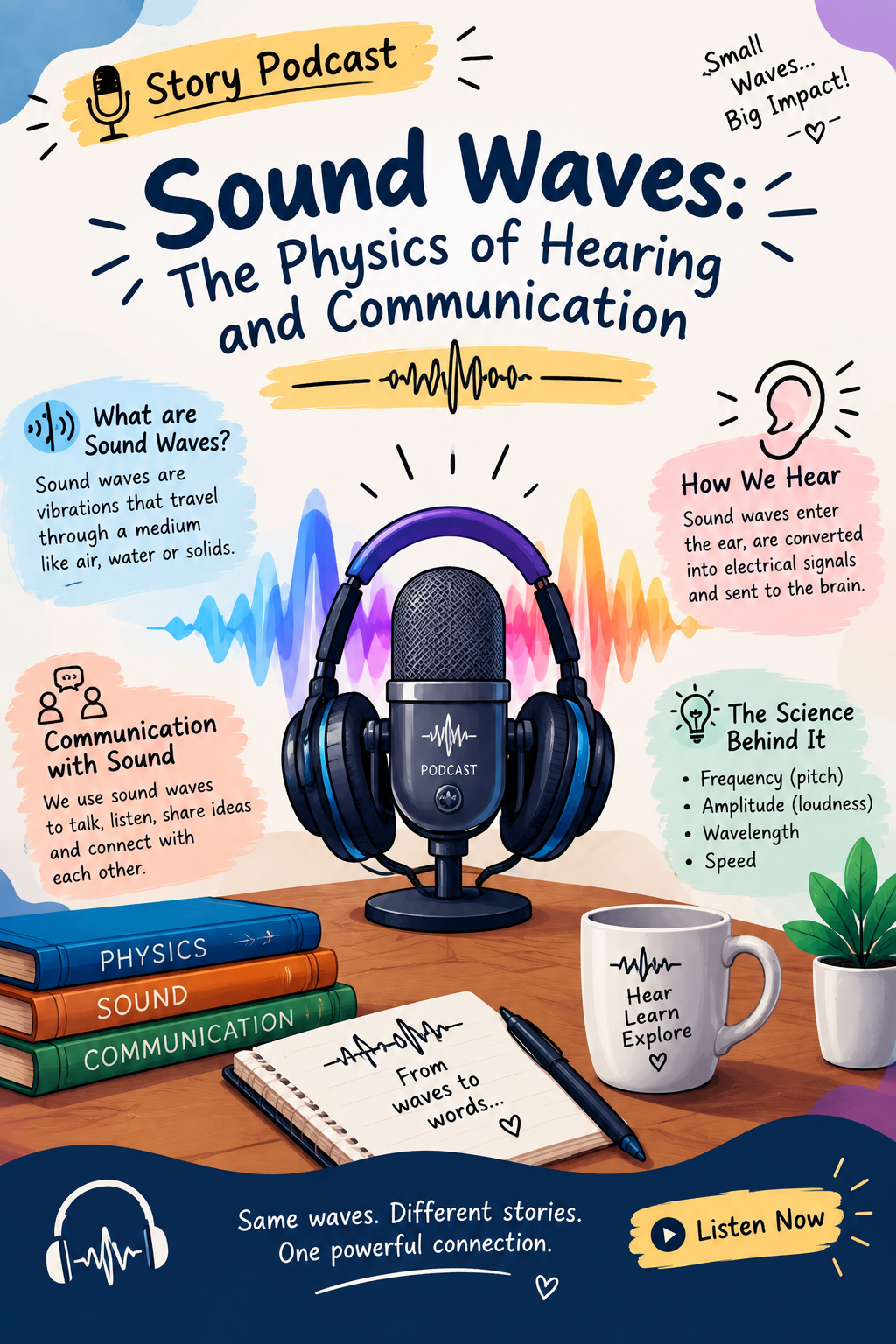
    Sound is all around us! From the voices we hear to the music we enjoy , sound waves play an important role in our daily lives. But have you ever wondered how sound travels and how our ears help us hear?

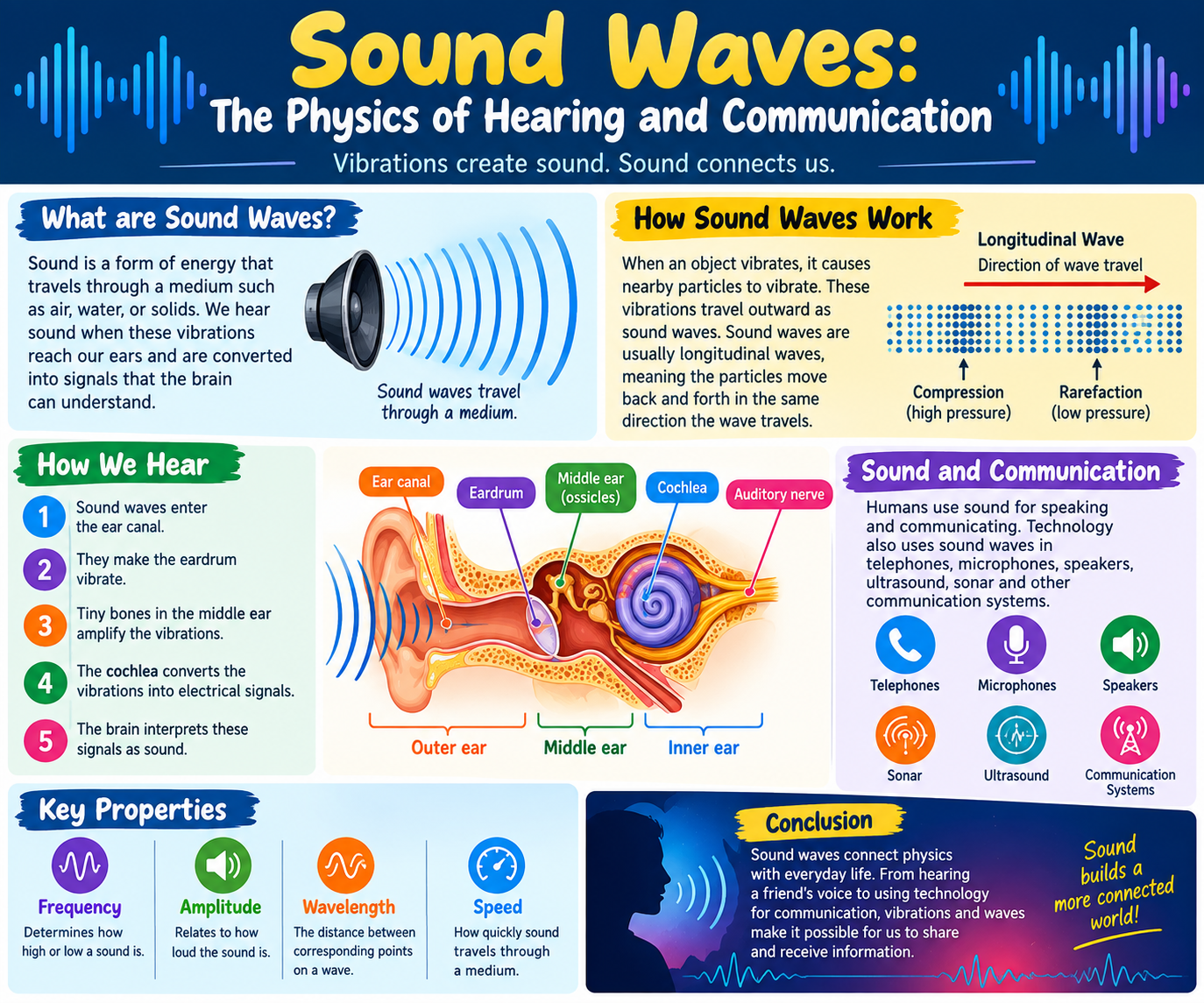
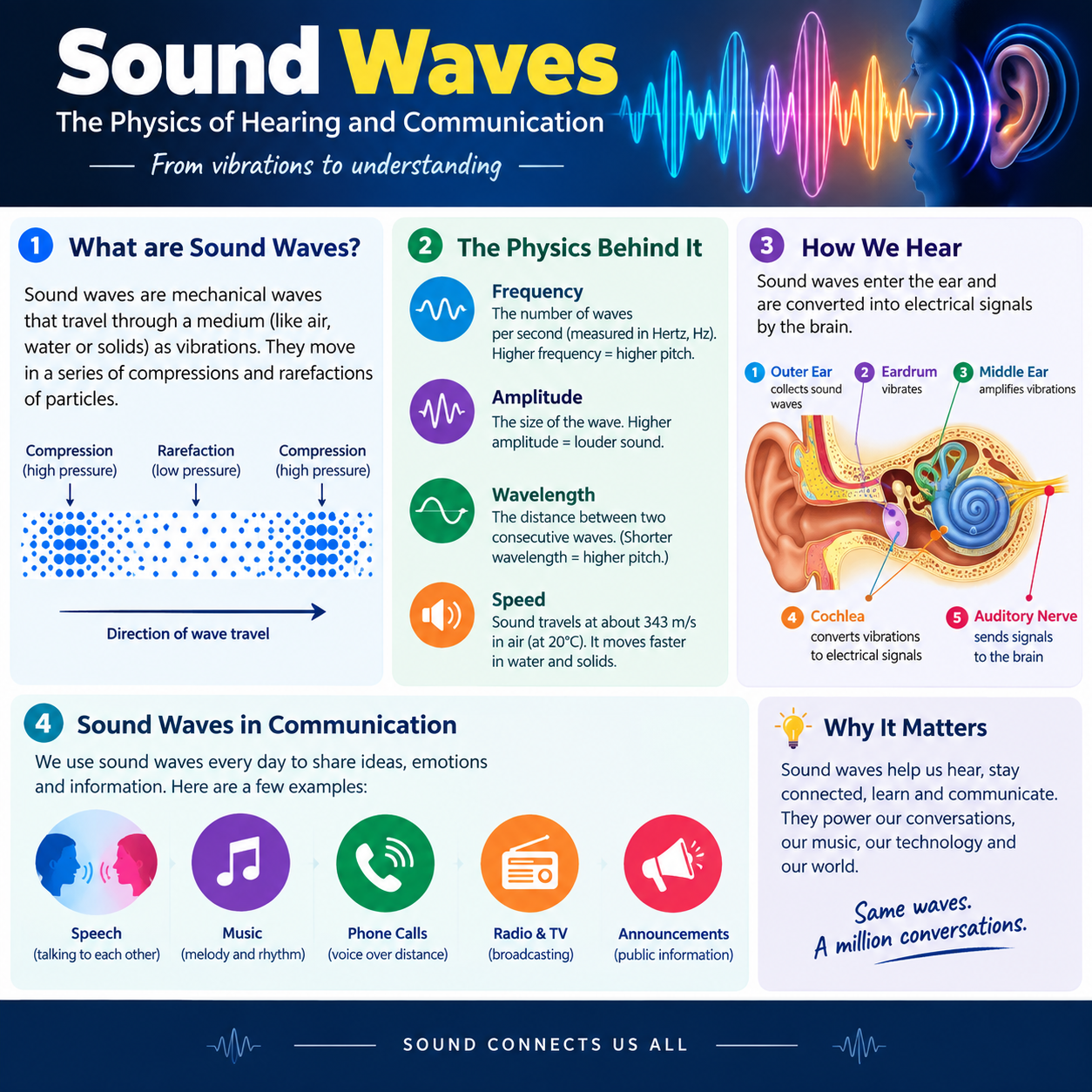
    Sound is produced when an object vibrates. These vibrations travel through a medium such as air, water, or solids in the form of **sound waves** . Our ears receive these waves and send signals to the brain, allowing us to recognize voices, music, and many other sounds.

    The physics of sound helps us understand important concepts such as **frequency, amplitude, wavelength, pitch, and loudness** . Sound is not only a fascinating scientific phenomenon—it is also essential for **hearing, communication, technology, music, and human connection**

    Let's explore the amazing world of sound and discover how invisible waves help us communicate with the world around us!

    #SoundWaves #Physics #PhysicsOfSound #Science #Hearing #Communication #Acoustics #SoundScience #Frequency #Amplitude #Wavelength #Vibrations #Pitch #Loudness #HumanEar #HowWeHear #ScienceEducation #LearnScience #LearnPhysics #EducationalContent #ScienceFacts #Knowledge #Technology #Audio #Music #WavePhysics #ExploreScience #StudentLife #EducationMatters #DiscoverMore
    #rsisb Roll no.239 Story Post no.21 Foundation Level Sound is all around us! From the voices we hear 🗣️ to the music we enjoy 🎶, sound waves play an important role in our daily lives. But have you ever wondered how sound travels and how our ears help us hear? 🤔🔬 Sound is produced when an object vibrates. These vibrations travel through a medium such as air, water, or solids in the form of **sound waves** 🌊. Our ears receive these waves and send signals to the brain, allowing us to recognize voices, music, and many other sounds. 👂🧠✨ The physics of sound helps us understand important concepts such as **frequency, amplitude, wavelength, pitch, and loudness** 📊🔊. Sound is not only a fascinating scientific phenomenon—it is also essential for **hearing, communication, technology, music, and human connection** 🌍❤️🎵 Let's explore the amazing world of sound and discover how invisible waves help us communicate with the world around us! 🚀🔬🌊 #SoundWaves 🔊 #Physics 🌊 #PhysicsOfSound 🎓 #Science 🔬 #Hearing 👂 #Communication 🗣️ #Acoustics 🎧 #SoundScience 📚 #Frequency 📈 #Amplitude 📊 #Wavelength 🌐 #Vibrations ⚡ #Pitch 🎵 #Loudness 🔊 #HumanEar 👂 #HowWeHear 🧠 #ScienceEducation 🎓 #LearnScience 📖 #LearnPhysics 💡 #EducationalContent 📚 #ScienceFacts 🔍 #Knowledge ✨ #Technology 💻 #Audio 🎶 #Music 🎵 #WavePhysics 🌊 #ExploreScience 🚀 #StudentLife 🧑‍🎓 #EducationMatters 🌟 #DiscoverMore 🔭
    0 التعليقات 0 المشاركات 371 مشاهدة
  • #rsisb
    Roll No.240
    Story No.14
    Foundation Level

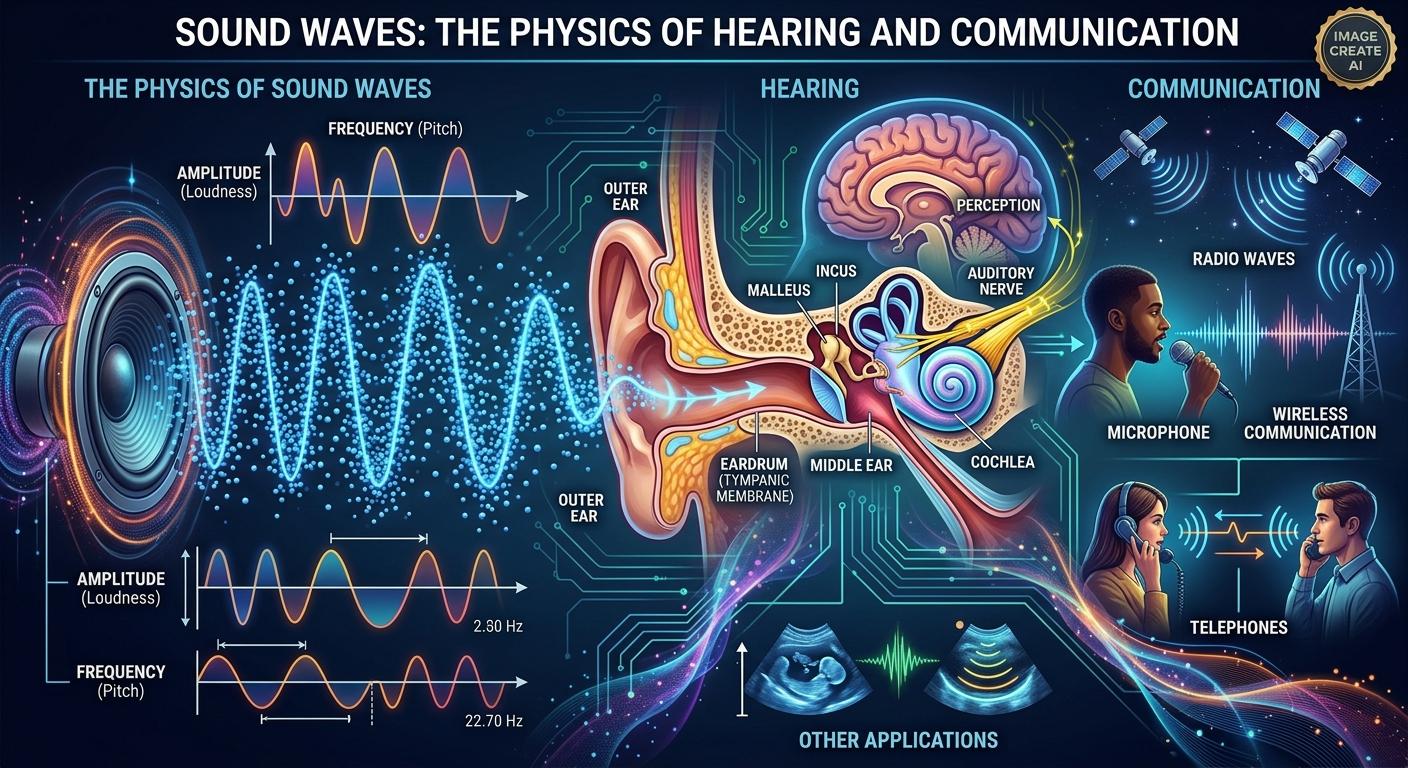
    **Sound Waves: The Physics of Hearing and Communication**

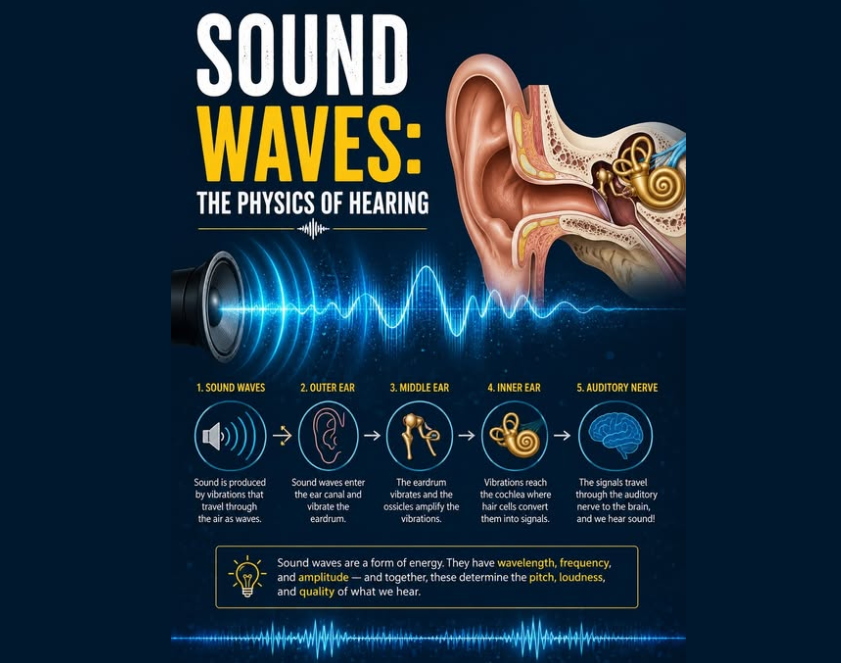
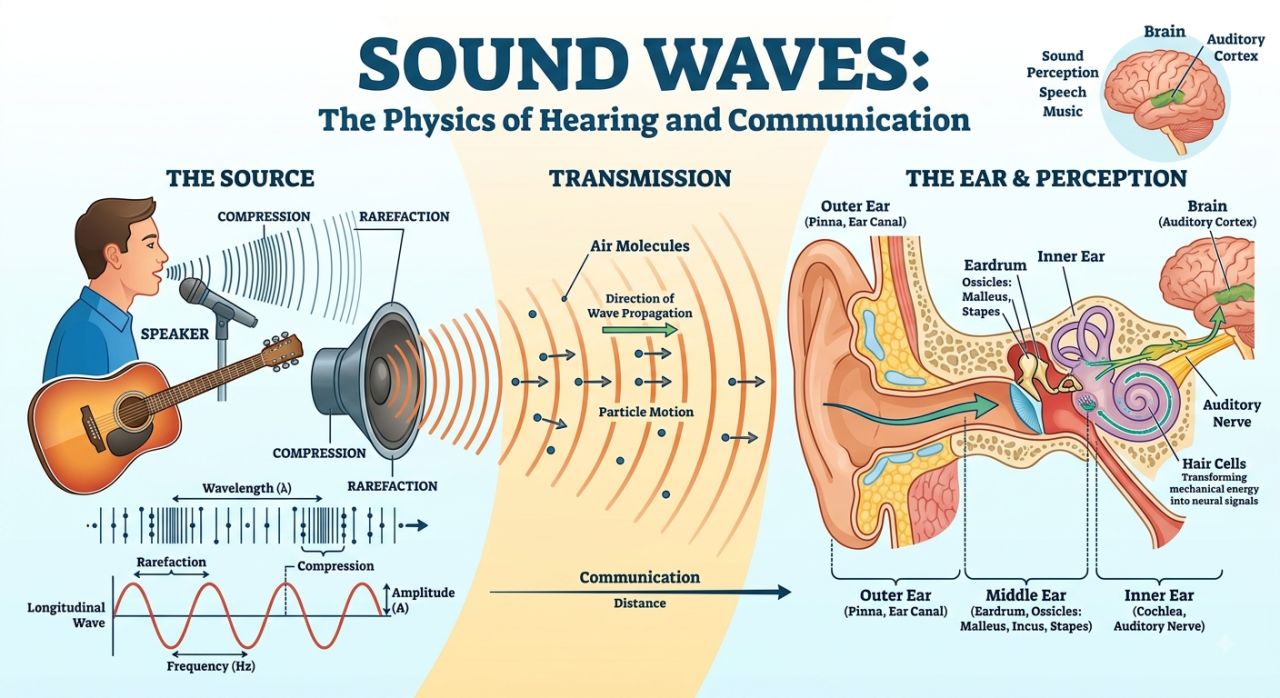
    Sound waves are invisible vibrations that travel through air, water, and solids, allowing us to hear and communicate with the world around us. Every sound begins when an object vibrates, creating waves that move through a medium until they reach our ears. These waves carry energy, not matter, and their frequency determines the pitch while their amplitude controls the loudness of the sound.

    Inside the human ear, sound waves follow an incredible journey. They enter through the outer ear, vibrate the eardrum, and pass through three tiny bones called the ossicles. These vibrations then reach the cochlea, where thousands of tiny hair cells convert them into electrical signals. The auditory nerve carries these signals to the brain, which interprets them as speech, music, or other familiar sounds.

    Sound plays a vital role in communication, education, entertainment, medicine, and technology. From conversations and musical performances to ultrasound imaging, sonar systems, and hearing aids, the science of sound has transformed countless aspects of modern life. Understanding how sound waves travel and interact with different materials helps scientists and engineers develop better communication systems and innovative technologies.

    The study of sound waves demonstrates the fascinating connection between physics and everyday life. By exploring concepts such as vibration, frequency, wavelength, amplitude, and wave speed, we gain a deeper appreciation of how hearing works and how sound enables people to connect, learn, and share ideas across the world.

    Rehan School Islamabad Campus
    Asma Shaheen EducationWali
    Irum Asim
    Saima Happinesswali
    #rsisb Roll No.240 Story No.14 Foundation Level **Sound Waves: The Physics of Hearing and Communication** Sound waves are invisible vibrations that travel through air, water, and solids, allowing us to hear and communicate with the world around us. Every sound begins when an object vibrates, creating waves that move through a medium until they reach our ears. These waves carry energy, not matter, and their frequency determines the pitch while their amplitude controls the loudness of the sound. Inside the human ear, sound waves follow an incredible journey. They enter through the outer ear, vibrate the eardrum, and pass through three tiny bones called the ossicles. These vibrations then reach the cochlea, where thousands of tiny hair cells convert them into electrical signals. The auditory nerve carries these signals to the brain, which interprets them as speech, music, or other familiar sounds. Sound plays a vital role in communication, education, entertainment, medicine, and technology. From conversations and musical performances to ultrasound imaging, sonar systems, and hearing aids, the science of sound has transformed countless aspects of modern life. Understanding how sound waves travel and interact with different materials helps scientists and engineers develop better communication systems and innovative technologies. The study of sound waves demonstrates the fascinating connection between physics and everyday life. By exploring concepts such as vibration, frequency, wavelength, amplitude, and wave speed, we gain a deeper appreciation of how hearing works and how sound enables people to connect, learn, and share ideas across the world. Rehan School Islamabad Campus Asma Shaheen EducationWali Irum Asim Saima Happinesswali
    0 التعليقات 0 المشاركات 3230 مشاهدة
  • When you start living differently from the masses, it makes everyone uncomfortable. The fact that you no longer play the same game of fear and drama like you were conditioned to, makes everyone aware of their own limitations.

    When you operate on an absolute authentic frequency, people dont even know how to approach you anymore because you outgrow their energy. When you are different, people dont know where to fit you anymore, your existence transcends their preconceived ideas.

    You wont be able to meet peoples expectations anymore because youre not the same person anymore and you no longer operate on the same frequencies. Embrace your growth.

    - Dope Soul | The Higher Self

    Via Marina Lazaris
    When you start living differently from the masses, it makes everyone uncomfortable. The fact that you no longer play the same game of fear and drama like you were conditioned to, makes everyone aware of their own limitations. When you operate on an absolute authentic frequency, people don't even know how to approach you anymore because you outgrow their energy. When you are different, people don't know where to fit you anymore, your existence transcends their preconceived ideas. You won't be able to meet people's expectations anymore because you're not the same person anymore and you no longer operate on the same frequencies. Embrace your growth. - Dope Soul | The Higher Self Via Marina Lazaris
    0 التعليقات 0 المشاركات 150 مشاهدة
  • One of the most attractive thing of a human is their mindset and frequency of their soul !
    One of the most attractive thing of a human is their mindset and frequency of their soul !
    0 التعليقات 0 المشاركات 130 مشاهدة
  • The astral plane is a conceptual realm that is believed to exist beyond the physical world. It is often described in various spiritual, esoteric, and mystical traditions as a layer of reality that is accessible through altered states of consciousness, such as during astral projection, meditation, or dreams. Here are some key aspects of the astral plane:

    1. **Non-Physical Realm**:
    - The astral plane is considered a non-physical dimension where consciousness can travel independently of the physical body.

    2. **Levels and Layers**:
    - Some traditions describe the astral plane as having multiple levels or layers, each with varying degrees of density and frequency. These levels may range from lower, more chaotic realms to higher, more refined spiritual realms.

    3. **Entities and Beings**:
    - The astral plane is often populated with various entities and beings, including spirit guides, deceased loved ones, and other non-physical entities. Encounters with these beings are a common aspect of astral travel experiences.

    4. **Thought-Responsive Environment**:
    - In the astral plane, thoughts and intentions can manifest instantly. This means that what you think about can quickly become your experience in the astral realm.

    5. **Symbolism and Archetypes**:
    - The astral plane is rich with symbolism and archetypal imagery. Travelers may encounter scenarios or symbols that hold personal or universal significance.

    6. **Exploration and Learning**:
    - The astral plane is often seen as a place for spiritual exploration, learning, and growth. It is believed that travelers can gain insights, receive guidance, and access knowledge that is not readily available in the physical world.

    7. **Connection to Other Realms**:
    - The astral plane is sometimes viewed as a bridge between the physical world and higher spiritual realms, making it a key area of exploration for those seeking to understand the nature of reality and consciousness.

    While the concept of the astral plane is widely discussed in spiritual and esoteric literature, it remains a theoretical construct with no empirical evidence to support its existence. Nonetheless, many individuals report experiences that they interpret as journeys through this realm, contributing to its rich and varied mythology.
    The astral plane is a conceptual realm that is believed to exist beyond the physical world. It is often described in various spiritual, esoteric, and mystical traditions as a layer of reality that is accessible through altered states of consciousness, such as during astral projection, meditation, or dreams. Here are some key aspects of the astral plane: 1. **Non-Physical Realm**: - The astral plane is considered a non-physical dimension where consciousness can travel independently of the physical body. 2. **Levels and Layers**: - Some traditions describe the astral plane as having multiple levels or layers, each with varying degrees of density and frequency. These levels may range from lower, more chaotic realms to higher, more refined spiritual realms. 3. **Entities and Beings**: - The astral plane is often populated with various entities and beings, including spirit guides, deceased loved ones, and other non-physical entities. Encounters with these beings are a common aspect of astral travel experiences. 4. **Thought-Responsive Environment**: - In the astral plane, thoughts and intentions can manifest instantly. This means that what you think about can quickly become your experience in the astral realm. 5. **Symbolism and Archetypes**: - The astral plane is rich with symbolism and archetypal imagery. Travelers may encounter scenarios or symbols that hold personal or universal significance. 6. **Exploration and Learning**: - The astral plane is often seen as a place for spiritual exploration, learning, and growth. It is believed that travelers can gain insights, receive guidance, and access knowledge that is not readily available in the physical world. 7. **Connection to Other Realms**: - The astral plane is sometimes viewed as a bridge between the physical world and higher spiritual realms, making it a key area of exploration for those seeking to understand the nature of reality and consciousness. While the concept of the astral plane is widely discussed in spiritual and esoteric literature, it remains a theoretical construct with no empirical evidence to support its existence. Nonetheless, many individuals report experiences that they interpret as journeys through this realm, contributing to its rich and varied mythology.
    0 التعليقات 0 المشاركات 115 مشاهدة
  • **Nikola Tesla** was one of the most brilliant and enigmatic inventors in history. His pioneering work in electricity, electromagnetism, and wireless communication laid the foundation for much of modern technology, but despite his immense contributions, he died in relative obscurity and poverty. Heres the story of Tesla, his life, his inventions, and his legacy:

    ### Early Life:
    - Nikola Tesla was born on **July 10, 1856**, in the village of **Smiljan**, in what was then the Austrian Empire (modern-day Croatia). His father was a Serbian Orthodox priest, and his mother, although not formally educated, was highly inventive and made household appliances. Tesla inherited much of his creativity from her.
    - As a child, Tesla showed extraordinary intellectual abilities, particularly in mathematics and engineering. He was fascinated by electricity from an early age and was known for his photographic memory and ability to visualize inventions in his mind without needing to draw them.

    ### Education and Early Career:
    - Tesla attended the **Austrian Polytechnic** in Graz, Austria, where he studied electrical engineering. Although he excelled academically, Tesla did not complete his degree due to financial and personal issues.
    - In **1881**, he moved to **Budapest**, Hungary, where he worked at the **Budapest Telephone Exchange**. It was there that he first conceived the idea of a **rotating magnetic field**, a principle that would become key to his later work on alternating current (AC) motors.

    ### Move to the United States and Work with Edison:
    - In **1884**, Tesla moved to the United States, arriving in **New York City** with just a few cents and a letter of introduction to **Thomas Edison**, the famous American inventor and businessman.
    - Edison hired Tesla to work on improving his **direct current (DC)** power systems, which were being used to supply electricity to much of New York City at the time. However, Tesla’s relationship with Edison quickly soured due to their differing views on electrical power. While Edison was a staunch advocate of DC, Tesla believed in the superiority of **alternating current (AC)**, which could transmit electricity over much longer distances and with greater efficiency.
    - Tesla left Edison’s company after a dispute over money and recognition, marking the beginning of one of the most famous rivalries in the history of science: the **"War of the Currents"**.

    ### The War of the Currents:
    - After leaving Edison, Tesla teamed up with entrepreneur **George Westinghouse**, who recognized the potential of Tesla’s AC system. Westinghouse provided Tesla with funding and support, and together they launched a campaign to promote **alternating current** as the future of electricity distribution.

    - The battle between Tesla’s AC system and Edison’s DC system became known as the **War of the Currents**. Edison tried to discredit AC by highlighting its dangers, going as far as publicly electrocuting animals to demonstrate the risks. Despite these efforts, Tesla’s AC system ultimately prevailed due to its technical advantages in power transmission.

    - In **1893**, the **World’s Columbian Exposition** in Chicago was powered entirely by Tesla’s AC system, and shortly afterward, the **Niagara Falls Power Plant**, one of the first large-scale hydroelectric power plants, began delivering electricity using Tesla’s AC system. This victory solidified Tesla’s place in the history of electricity and cemented **alternating current** as the standard for electrical power distribution worldwide.

    ### Teslas Key Inventions and Discoveries:
    1. **Alternating Current (AC) System**: Teslas work on alternating current forms the backbone of modern electrical grids. His AC motor and transformer allowed electricity to be transmitted over long distances without significant loss of power, which was crucial for the widespread adoption of electricity.

    2. **Tesla Coil**: Invented in **1891**, the **Tesla Coil** is a high-voltage transformer that can produce high-frequency AC electricity. It became a key component in early radio technology and is still used in modern electronics. The coil is also famous for its dramatic visual displays, often seen in demonstrations of electrical arcs.

    3. **Radio and Wireless Communication**: Although **Guglielmo Marconi** is often credited with inventing the radio, Tesla’s work on wireless communication predated Marconi’s, and Tesla filed patents for key radio components in the **1890s**. In fact, the **U.S. Supreme Court** eventually ruled in **1943** (after Tesla’s death) that some of Marconi’s patents infringed on Tesla’s earlier work, recognizing Tesla’s contributions to the invention of radio.

    4. **Wireless Power Transmission**: Tesla envisioned a world where electricity could be transmitted wirelessly over vast distances. He believed that using the Earth’s atmosphere as a conductor, it would be possible to provide free energy to everyone. Tesla’s **Wardenclyffe Tower**, built in **1901** on Long Island, New York, was intended to be a prototype for this technology, but it was never fully operational due to a lack of funding.

    5. **The Induction Motor**: Teslas **AC induction motor**, patented in **1888**, was revolutionary because it eliminated the need for a commutator (a device used in traditional motors) and allowed for more efficient and reliable electric motors. This motor is still widely used in modern appliances, from industrial machinery to household devices.

    ### Later Years and Decline:
    - Despite his early successes, Tesla struggled financially in his later years. His grand ideas, like wireless power transmission and free energy, were ahead of their time, and many investors, including his key backer **J.P. Morgan**, withdrew support when they saw no immediate financial return on his projects.

    - Tesla became more eccentric over time, with some of his ideas becoming increasingly speculative and unworkable. He also suffered from several mental health issues, including obsessive-compulsive behaviors and phobias. His **Wardenclyffe Tower** was eventually dismantled, and Tesla’s dreams of wireless power transmission remained unfulfilled.

    - In his later years, Tesla lived alone in a hotel in New York City, surviving on the goodwill of friends and admirers. Though he continued to make small-scale inventions, he was largely forgotten by the public.

    ### Death and Legacy:
    - Nikola Tesla died on **January 7, 1943**, in his room at the **New Yorker Hotel** at the age of 86. He was found alone, and much of his work had been forgotten or overshadowed by the success of contemporaries like **Thomas Edison** and **Guglielmo Marconi**.

    - However, after his death, Tesla’s contributions to science and technology began to be recognized more fully. Today, Tesla is celebrated as one of the most important inventors in history. His work in electricity, electromagnetism, and wireless communication laid the groundwork for many modern technologies, including radio, radar, X-rays, and the AC power systems that power homes and industries worldwide.

    ### The Tesla Renaissance:
    - In the late 20th and early 21st centuries, interest in Tesla’s work and life story saw a resurgence. He became a cult figure, with renewed admiration for his forward-thinking ideas and inventions.

    - The modern electric car company **Tesla, Inc.**, founded by **Elon Musk** in **2003**, is named after Nikola Tesla in honor of his contributions to electrical engineering. The company’s electric vehicles and renewable energy technologies are often seen as carrying forward Tesla’s legacy of innovation and his vision for a future powered by electricity.

    ### Conclusion:
    Nikola Tesla’s story is one of genius, vision, and tragedy. Though he faced significant setbacks and died in obscurity, Tesla’s inventions changed the world in profound ways. From alternating current to radio and wireless communication, his work continues to influence modern technology. Teslas life serves as a reminder of the challenges faced by visionaries who are ahead of their time, but also of the lasting impact that one brilliant mind can have on the course of human history.
    **Nikola Tesla** was one of the most brilliant and enigmatic inventors in history. His pioneering work in electricity, electromagnetism, and wireless communication laid the foundation for much of modern technology, but despite his immense contributions, he died in relative obscurity and poverty. Here's the story of Tesla, his life, his inventions, and his legacy: ### Early Life: - Nikola Tesla was born on **July 10, 1856**, in the village of **Smiljan**, in what was then the Austrian Empire (modern-day Croatia). His father was a Serbian Orthodox priest, and his mother, although not formally educated, was highly inventive and made household appliances. Tesla inherited much of his creativity from her. - As a child, Tesla showed extraordinary intellectual abilities, particularly in mathematics and engineering. He was fascinated by electricity from an early age and was known for his photographic memory and ability to visualize inventions in his mind without needing to draw them. ### Education and Early Career: - Tesla attended the **Austrian Polytechnic** in Graz, Austria, where he studied electrical engineering. Although he excelled academically, Tesla did not complete his degree due to financial and personal issues. - In **1881**, he moved to **Budapest**, Hungary, where he worked at the **Budapest Telephone Exchange**. It was there that he first conceived the idea of a **rotating magnetic field**, a principle that would become key to his later work on alternating current (AC) motors. ### Move to the United States and Work with Edison: - In **1884**, Tesla moved to the United States, arriving in **New York City** with just a few cents and a letter of introduction to **Thomas Edison**, the famous American inventor and businessman. - Edison hired Tesla to work on improving his **direct current (DC)** power systems, which were being used to supply electricity to much of New York City at the time. However, Tesla’s relationship with Edison quickly soured due to their differing views on electrical power. While Edison was a staunch advocate of DC, Tesla believed in the superiority of **alternating current (AC)**, which could transmit electricity over much longer distances and with greater efficiency. - Tesla left Edison’s company after a dispute over money and recognition, marking the beginning of one of the most famous rivalries in the history of science: the **"War of the Currents"**. ### The War of the Currents: - After leaving Edison, Tesla teamed up with entrepreneur **George Westinghouse**, who recognized the potential of Tesla’s AC system. Westinghouse provided Tesla with funding and support, and together they launched a campaign to promote **alternating current** as the future of electricity distribution. - The battle between Tesla’s AC system and Edison’s DC system became known as the **War of the Currents**. Edison tried to discredit AC by highlighting its dangers, going as far as publicly electrocuting animals to demonstrate the risks. Despite these efforts, Tesla’s AC system ultimately prevailed due to its technical advantages in power transmission. - In **1893**, the **World’s Columbian Exposition** in Chicago was powered entirely by Tesla’s AC system, and shortly afterward, the **Niagara Falls Power Plant**, one of the first large-scale hydroelectric power plants, began delivering electricity using Tesla’s AC system. This victory solidified Tesla’s place in the history of electricity and cemented **alternating current** as the standard for electrical power distribution worldwide. ### Tesla's Key Inventions and Discoveries: 1. **Alternating Current (AC) System**: Tesla's work on alternating current forms the backbone of modern electrical grids. His AC motor and transformer allowed electricity to be transmitted over long distances without significant loss of power, which was crucial for the widespread adoption of electricity. 2. **Tesla Coil**: Invented in **1891**, the **Tesla Coil** is a high-voltage transformer that can produce high-frequency AC electricity. It became a key component in early radio technology and is still used in modern electronics. The coil is also famous for its dramatic visual displays, often seen in demonstrations of electrical arcs. 3. **Radio and Wireless Communication**: Although **Guglielmo Marconi** is often credited with inventing the radio, Tesla’s work on wireless communication predated Marconi’s, and Tesla filed patents for key radio components in the **1890s**. In fact, the **U.S. Supreme Court** eventually ruled in **1943** (after Tesla’s death) that some of Marconi’s patents infringed on Tesla’s earlier work, recognizing Tesla’s contributions to the invention of radio. 4. **Wireless Power Transmission**: Tesla envisioned a world where electricity could be transmitted wirelessly over vast distances. He believed that using the Earth’s atmosphere as a conductor, it would be possible to provide free energy to everyone. Tesla’s **Wardenclyffe Tower**, built in **1901** on Long Island, New York, was intended to be a prototype for this technology, but it was never fully operational due to a lack of funding. 5. **The Induction Motor**: Tesla's **AC induction motor**, patented in **1888**, was revolutionary because it eliminated the need for a commutator (a device used in traditional motors) and allowed for more efficient and reliable electric motors. This motor is still widely used in modern appliances, from industrial machinery to household devices. ### Later Years and Decline: - Despite his early successes, Tesla struggled financially in his later years. His grand ideas, like wireless power transmission and free energy, were ahead of their time, and many investors, including his key backer **J.P. Morgan**, withdrew support when they saw no immediate financial return on his projects. - Tesla became more eccentric over time, with some of his ideas becoming increasingly speculative and unworkable. He also suffered from several mental health issues, including obsessive-compulsive behaviors and phobias. His **Wardenclyffe Tower** was eventually dismantled, and Tesla’s dreams of wireless power transmission remained unfulfilled. - In his later years, Tesla lived alone in a hotel in New York City, surviving on the goodwill of friends and admirers. Though he continued to make small-scale inventions, he was largely forgotten by the public. ### Death and Legacy: - Nikola Tesla died on **January 7, 1943**, in his room at the **New Yorker Hotel** at the age of 86. He was found alone, and much of his work had been forgotten or overshadowed by the success of contemporaries like **Thomas Edison** and **Guglielmo Marconi**. - However, after his death, Tesla’s contributions to science and technology began to be recognized more fully. Today, Tesla is celebrated as one of the most important inventors in history. His work in electricity, electromagnetism, and wireless communication laid the groundwork for many modern technologies, including radio, radar, X-rays, and the AC power systems that power homes and industries worldwide. ### The Tesla Renaissance: - In the late 20th and early 21st centuries, interest in Tesla’s work and life story saw a resurgence. He became a cult figure, with renewed admiration for his forward-thinking ideas and inventions. - The modern electric car company **Tesla, Inc.**, founded by **Elon Musk** in **2003**, is named after Nikola Tesla in honor of his contributions to electrical engineering. The company’s electric vehicles and renewable energy technologies are often seen as carrying forward Tesla’s legacy of innovation and his vision for a future powered by electricity. ### Conclusion: Nikola Tesla’s story is one of genius, vision, and tragedy. Though he faced significant setbacks and died in obscurity, Tesla’s inventions changed the world in profound ways. From alternating current to radio and wireless communication, his work continues to influence modern technology. Tesla's life serves as a reminder of the challenges faced by visionaries who are ahead of their time, but also of the lasting impact that one brilliant mind can have on the course of human history.
    0 التعليقات 0 المشاركات 1173 مشاهدة
  • Raising your vibration refers to elevating your emotional, mental, and spiritual state to experience more joy, clarity, and harmony in your life. Here are some effective ways to raise your vibration:

    1. Practice Gratitude

    Gratitude is one of the simplest and most powerful ways to raise your vibration. By focusing on what you’re thankful for, you shift your attention away from negativity and create a positive mental and emotional state. Try keeping a gratitude journal and write down three things you’re thankful for each day.

    2. Meditation and Mindfulness

    Meditation helps you center yourself, quiet the mind, and connect with the present moment, which can elevate your overall energy. Regular meditation practice promotes calmness, reduces stress, and increases self-awareness, allowing your vibration to rise naturally.

    3. Nourish Your Body with Healthy Food

    The food you eat also carries its own vibration. Fresh, whole, and nutrient-rich foods like fruits, vegetables, and clean water are high-vibrational. Avoid processed and unhealthy foods, as they may lower your energy. Listening to your body and nourishing it with what feels good can have a profound effect on your overall vibration.

    4. Spend Time in Nature

    Being in nature helps ground and balance your energy. Spending time outdoors, walking barefoot on the earth (known as earthing), sitting by the ocean, or walking through the forest can naturally raise your vibrational frequency by connecting you with the Earth’s energy.

    5. Positive Thinking and Affirmations

    Your thoughts influence your emotional and energetic state. Engaging in positive thinking and reciting affirmations can shift your mental patterns away from limiting beliefs or negativity. Replace negative self-talk with positive affirmations like, “I am worthy,” or “I am surrounded by love and abundance.”

    6. Engage in Creative Expression

    Creative activities like painting, writing, dancing, or playing music can tap into your inner joy and raise your vibration. Creativity is a form of self-expression that connects you with your higher self and often puts you in a state of flow, which elevates your energy.

    7. Practice Acts of Kindness and Compassion

    Acts of kindness, whether towards others or yourself, generate positive emotions, which automatically raise your vibrational frequency. Small gestures of kindness can create a ripple effect of positivity, uplifting not only yourself but those around you.

    8. Healing Practices (Reiki, Energy Healing, Yoga)

    Energy healing practices like Reiki, acupuncture, and yoga work to balance your body’s energy systems, releasing blockages and raising your overall vibrational state. Yoga, in particular, aligns the body, mind, and spirit, promoting harmony and inner peace.

    9. Let Go of Low-Vibrational Influences

    Certain behaviors, relationships, or environments can drain your energy. Identify what in your life is contributing to a lower vibration, such as toxic relationships, negative self-talk, or unhealthy habits, and take steps to release or transform them. Surround yourself with positive, uplifting people and environments.

    10. Connect with Your Purpose

    Living in alignment with your life’s purpose naturally raises your vibration. When you are passionate about what you do, you feel energized and fulfilled, which lifts your spirits. Explore what brings you joy, meaning, and fulfillment, and make time for it regularly.

    11. Sound Therapy (Music, Singing Bowls)

    Music and sound have a direct effect on your energy. Listening to high-frequency music, chanting mantras, or using singing bowls can help shift your energy into a higher state. Many people find healing vibrations through sound therapy sessions, which can release energy blockages and raise your overall frequency.

    12. Breathe Deeply

    Deep breathing is one of the quickest ways to shift your energy. When you’re stressed or anxious, your breath becomes shallow. Conscious deep breathing helps calm the mind, increase oxygen flow to the brain, and raise your vibration instantly.

    By consistently incorporating these practices into your life, you can maintain a high vibrational frequency, which can improve your well-being, relationships, and overall experience of life.
    Raising your vibration refers to elevating your emotional, mental, and spiritual state to experience more joy, clarity, and harmony in your life. Here are some effective ways to raise your vibration: 1. Practice Gratitude Gratitude is one of the simplest and most powerful ways to raise your vibration. By focusing on what you’re thankful for, you shift your attention away from negativity and create a positive mental and emotional state. Try keeping a gratitude journal and write down three things you’re thankful for each day. 2. Meditation and Mindfulness Meditation helps you center yourself, quiet the mind, and connect with the present moment, which can elevate your overall energy. Regular meditation practice promotes calmness, reduces stress, and increases self-awareness, allowing your vibration to rise naturally. 3. Nourish Your Body with Healthy Food The food you eat also carries its own vibration. Fresh, whole, and nutrient-rich foods like fruits, vegetables, and clean water are high-vibrational. Avoid processed and unhealthy foods, as they may lower your energy. Listening to your body and nourishing it with what feels good can have a profound effect on your overall vibration. 4. Spend Time in Nature Being in nature helps ground and balance your energy. Spending time outdoors, walking barefoot on the earth (known as earthing), sitting by the ocean, or walking through the forest can naturally raise your vibrational frequency by connecting you with the Earth’s energy. 5. Positive Thinking and Affirmations Your thoughts influence your emotional and energetic state. Engaging in positive thinking and reciting affirmations can shift your mental patterns away from limiting beliefs or negativity. Replace negative self-talk with positive affirmations like, “I am worthy,” or “I am surrounded by love and abundance.” 6. Engage in Creative Expression Creative activities like painting, writing, dancing, or playing music can tap into your inner joy and raise your vibration. Creativity is a form of self-expression that connects you with your higher self and often puts you in a state of flow, which elevates your energy. 7. Practice Acts of Kindness and Compassion Acts of kindness, whether towards others or yourself, generate positive emotions, which automatically raise your vibrational frequency. Small gestures of kindness can create a ripple effect of positivity, uplifting not only yourself but those around you. 8. Healing Practices (Reiki, Energy Healing, Yoga) Energy healing practices like Reiki, acupuncture, and yoga work to balance your body’s energy systems, releasing blockages and raising your overall vibrational state. Yoga, in particular, aligns the body, mind, and spirit, promoting harmony and inner peace. 9. Let Go of Low-Vibrational Influences Certain behaviors, relationships, or environments can drain your energy. Identify what in your life is contributing to a lower vibration, such as toxic relationships, negative self-talk, or unhealthy habits, and take steps to release or transform them. Surround yourself with positive, uplifting people and environments. 10. Connect with Your Purpose Living in alignment with your life’s purpose naturally raises your vibration. When you are passionate about what you do, you feel energized and fulfilled, which lifts your spirits. Explore what brings you joy, meaning, and fulfillment, and make time for it regularly. 11. Sound Therapy (Music, Singing Bowls) Music and sound have a direct effect on your energy. Listening to high-frequency music, chanting mantras, or using singing bowls can help shift your energy into a higher state. Many people find healing vibrations through sound therapy sessions, which can release energy blockages and raise your overall frequency. 12. Breathe Deeply Deep breathing is one of the quickest ways to shift your energy. When you’re stressed or anxious, your breath becomes shallow. Conscious deep breathing helps calm the mind, increase oxygen flow to the brain, and raise your vibration instantly. By consistently incorporating these practices into your life, you can maintain a high vibrational frequency, which can improve your well-being, relationships, and overall experience of life.
    0 التعليقات 0 المشاركات 775 مشاهدة
  • 10 LAWS TO RAISE YOUR FREQUENCY

    1. Learn to remain silent in moments of greatest turbulence: Mental Peace and Patience are your best allies during crises. Conquering these attributes is part of your spiritual evolution.

    2. Avoid judging other people: Your perception of the outside world is part of your inner world. When you speak ill of others, you are speaking ill of yourself. You hurt them and you hurt yourself. Therefore, love them and love yourself.

    3. Focus your attention on the things you like the most: What you resist, persists. If you focus on the negative, you will make it grow. If you focus on the positive, you will also make it grow. So what do you choose?

    4. Stay still, not that it is bad to fight, but remember that it is only a test: You are paying old debts for old actions. Therefore, accept it and let it flow. The more you remain standing, calm and accepting, the more you will have cleared your karma.

    5. Have hope, what seems real is just a bad thought from your imagination. Change it!: Thoughts are things. Reality is created by your thought and the collective thought. Change your mind and you will change your reality.

    6. Forgive, let go, and release: It may be difficult, but it is necessary. These negative feelings are what sustain the cycle of karma. Someone has to break it, start doing it yourself!

    7. Always speak positive: Words also form reality, both yours and that of others. Be careful with what you say, be positive affirmative and choose each word very well.

    8. Meditate at least twice a day (5 minutes would be a very good start): It is the best way to calm the mind and get in touch with your spiritual being.

    9. Visualize pleasant situations for you and all your loved ones: What exists in your mind will manifest in your reality. Create that reality for yourself and your loved ones, you will be creating happiness and adding dharma.

    10. Give Love no matter what you receive: Love builds. Love heals. Love restores. Love is a choice, not a reaction. Give Love, you will be happier doing it and you will gain in Dharma.

    Author -Unknown
    Gratitude to the unknown artist
    10 LAWS TO RAISE YOUR FREQUENCY 1. Learn to remain silent in moments of greatest turbulence: Mental Peace and Patience are your best allies during crises. Conquering these attributes is part of your spiritual evolution. 2. Avoid judging other people: Your perception of the outside world is part of your inner world. When you speak ill of others, you are speaking ill of yourself. You hurt them and you hurt yourself. Therefore, love them and love yourself. 3. Focus your attention on the things you like the most: What you resist, persists. If you focus on the negative, you will make it grow. If you focus on the positive, you will also make it grow. So what do you choose? 4. Stay still, not that it is bad to fight, but remember that it is only a test: You are paying old debts for old actions. Therefore, accept it and let it flow. The more you remain standing, calm and accepting, the more you will have cleared your karma. 5. Have hope, what seems real is just a bad thought from your imagination. Change it!: Thoughts are things. Reality is created by your thought and the collective thought. Change your mind and you will change your reality. 6. Forgive, let go, and release: It may be difficult, but it is necessary. These negative feelings are what sustain the cycle of karma. Someone has to break it, start doing it yourself! 7. Always speak positive: Words also form reality, both yours and that of others. Be careful with what you say, be positive affirmative and choose each word very well. 8. Meditate at least twice a day (5 minutes would be a very good start): It is the best way to calm the mind and get in touch with your spiritual being. 9. Visualize pleasant situations for you and all your loved ones: What exists in your mind will manifest in your reality. Create that reality for yourself and your loved ones, you will be creating happiness and adding dharma. 10. Give Love no matter what you receive: Love builds. Love heals. Love restores. Love is a choice, not a reaction. Give Love, you will be happier doing it and you will gain in Dharma. Author -Unknown 🎨Gratitude to the unknown artist
    0 التعليقات 0 المشاركات 266 مشاهدة
  • Why Do We Feel Up or Down After Meeting People?

    Understanding the Science of Human Vibes

    Have you ever walked away from a conversation feeling like you just drank three cups of espresso without touching a drop—or like someone unplugged your soul and drained your battery? You’re not alone. The energy we feel when meeting others isn’t just “in our head” or emotional poetry—it’s deeply rooted in biology, chemistry, and even subtle electromagnetic signals in our bodies. Let’s explore why meeting some people lifts us up, while others leave us feeling down.


    Chemical & Hormonal Reactions in the Body

    When you interact with someone, your body doesn’t wait for your opinion—it automatically reacts by releasing different chemicals and hormones based on how it perceives the person.
    • Oxytocin is often released when we feel connected or safe. It’s nicknamed the “love hormone” and is key to feelings of trust and bonding. A kind smile or warm voice can trigger a burst of oxytocin, making us feel uplifted.
    • Dopamine kicks in when something feels rewarding. If someone is interesting, funny, or aligns with your values, dopamine brings a feeling of pleasure and motivation.
    • On the flip side, cortisol, the stress hormone, spikes when we feel uncomfortable, judged, or unsafe. This can instantly make your mood drop, heart race, and stomach turn.
    • Adrenaline may also be triggered—if the person feels intense or confrontational, your body gears up to deal with them, even if it’s just emotionally.
    • And when things don’t go well socially, serotonin—the mood stabilizer—can dip, leaving you with a vague sense of deflation or sadness.

    So yes, meeting people is a bit like a hormone cocktail shaker. The mix depends on the person—and how your nervous system interprets them.


    Your Brain is Always Scanning for Safety

    This process is called neuroception—your nervous system scans every person you meet to assess: “Am I safe? Can I relax? Can I trust this person?” And it does this without asking you first.

    If someone feels authentic, open, or kind, your nervous system gives a green light. Energy flows. You feel expansive. But if someone’s body language is tense, fake, or threatening, your system hits the brakes—emotionally and physically.

    It’s a primal survival mechanism. Your ancestors didn’t have time to analyze intentions—they had to sense danger instantly. You still do.


    The Mirror Effect

    We humans are natural mimics. Known as mirror neurons, our brain reflects the emotions and body language of others. If someone’s excited, your energy may rise to match theirs. If they’re anxious, sad, or negative—you might suddenly feel drained without knowing why.

    It’s emotional Wi-Fi. And you’re always connected.


    The Frequency of People

    There’s another layer too: personal resonance. Some people just “vibe” with you. Their beliefs, values, humor, or goals match yours. The interaction flows effortlessly—and both parties leave the conversation feeling lighter, brighter, and more alive.

    Other people may be completely fine—but not “tuned” to your frequency. That mismatch can feel flat, awkward, or draining, even if nothing negative is said.


    The Science of Real Energy

    Beyond chemistry, your body actually emits electromagnetic fields—especially the heart and brain. Research has shown that:
    • Our heart rate variability (HRV) changes when we feel emotionally connected.
    • Our brainwaves can synchronize with others during deep conversations.

    While this isn’t the kind of energy you measure with a plug or battery, it is a form of energetic exchange. Human-to-human Bluetooth, if you will.


    How to Notice the Shift

    Pay attention after interactions. Ask:
    • Do I feel more alive or more tired?
    • Did I feel seen, heard, respected?
    • Did I feel tense, guarded, or free?

    Your body knows. Listen.


    In Summary

    We feel up or down after meeting people because:
    • Our hormones and chemicals respond instantly to perceived emotions and safety.
    • Our nervous system scans people for trust and threat.
    • We mirror others’ energy—consciously or not.
    • We resonate (or don’t) based on values, beliefs, and emotional tone.
    • And, possibly, our hearts and minds physically sync when real connection occurs.

    So next time you meet someone and feel like you just caught a second wind—or like your battery hit 1%—remember: It’s not magic. It’s science.
    Your vibes don’t lie. Your body is simply trying to tell you the truth.
    Why Do We Feel Up or Down After Meeting People? Understanding the Science of Human Vibes Have you ever walked away from a conversation feeling like you just drank three cups of espresso without touching a drop—or like someone unplugged your soul and drained your battery? You’re not alone. The energy we feel when meeting others isn’t just “in our head” or emotional poetry—it’s deeply rooted in biology, chemistry, and even subtle electromagnetic signals in our bodies. Let’s explore why meeting some people lifts us up, while others leave us feeling down. ⸻ ⚗️ Chemical & Hormonal Reactions in the Body When you interact with someone, your body doesn’t wait for your opinion—it automatically reacts by releasing different chemicals and hormones based on how it perceives the person. • Oxytocin is often released when we feel connected or safe. It’s nicknamed the “love hormone” and is key to feelings of trust and bonding. A kind smile or warm voice can trigger a burst of oxytocin, making us feel uplifted. • Dopamine kicks in when something feels rewarding. If someone is interesting, funny, or aligns with your values, dopamine brings a feeling of pleasure and motivation. • On the flip side, cortisol, the stress hormone, spikes when we feel uncomfortable, judged, or unsafe. This can instantly make your mood drop, heart race, and stomach turn. • Adrenaline may also be triggered—if the person feels intense or confrontational, your body gears up to deal with them, even if it’s just emotionally. • And when things don’t go well socially, serotonin—the mood stabilizer—can dip, leaving you with a vague sense of deflation or sadness. So yes, meeting people is a bit like a hormone cocktail shaker. The mix depends on the person—and how your nervous system interprets them. ⸻ 🧠 Your Brain is Always Scanning for Safety This process is called neuroception—your nervous system scans every person you meet to assess: “Am I safe? Can I relax? Can I trust this person?” And it does this without asking you first. If someone feels authentic, open, or kind, your nervous system gives a green light. Energy flows. You feel expansive. But if someone’s body language is tense, fake, or threatening, your system hits the brakes—emotionally and physically. It’s a primal survival mechanism. Your ancestors didn’t have time to analyze intentions—they had to sense danger instantly. You still do. ⸻ 🪞 The Mirror Effect We humans are natural mimics. Known as mirror neurons, our brain reflects the emotions and body language of others. If someone’s excited, your energy may rise to match theirs. If they’re anxious, sad, or negative—you might suddenly feel drained without knowing why. It’s emotional Wi-Fi. And you’re always connected. ⸻ 🧲 The Frequency of People There’s another layer too: personal resonance. Some people just “vibe” with you. Their beliefs, values, humor, or goals match yours. The interaction flows effortlessly—and both parties leave the conversation feeling lighter, brighter, and more alive. Other people may be completely fine—but not “tuned” to your frequency. That mismatch can feel flat, awkward, or draining, even if nothing negative is said. ⸻ 💓 The Science of Real Energy Beyond chemistry, your body actually emits electromagnetic fields—especially the heart and brain. Research has shown that: • Our heart rate variability (HRV) changes when we feel emotionally connected. • Our brainwaves can synchronize with others during deep conversations. While this isn’t the kind of energy you measure with a plug or battery, it is a form of energetic exchange. Human-to-human Bluetooth, if you will. ⸻ 🚦 How to Notice the Shift Pay attention after interactions. Ask: • Do I feel more alive or more tired? • Did I feel seen, heard, respected? • Did I feel tense, guarded, or free? Your body knows. Listen. ⸻ ✅ In Summary We feel up or down after meeting people because: • Our hormones and chemicals respond instantly to perceived emotions and safety. • Our nervous system scans people for trust and threat. • We mirror others’ energy—consciously or not. • We resonate (or don’t) based on values, beliefs, and emotional tone. • And, possibly, our hearts and minds physically sync when real connection occurs. So next time you meet someone and feel like you just caught a second wind—or like your battery hit 1%—remember: It’s not magic. It’s science. Your vibes don’t lie. Your body is simply trying to tell you the truth.
    0 التعليقات 0 المشاركات 1081 مشاهدة
  • Why Do We Feel Up or Down After Meeting People?

    Understanding the Science of Human Vibes

    Have you ever walked away from a conversation feeling like you just drank three cups of espresso without touching a drop—or like someone unplugged your soul and drained your battery? You’re not alone. The energy we feel when meeting others isn’t just “in our head” or emotional poetry—it’s deeply rooted in biology, chemistry, and even subtle electromagnetic signals in our bodies. Let’s explore why meeting some people lifts us up, while others leave us feeling down.


    Chemical & Hormonal Reactions in the Body

    When you interact with someone, your body doesn’t wait for your opinion—it automatically reacts by releasing different chemicals and hormones based on how it perceives the person.
    • Oxytocin is often released when we feel connected or safe. It’s nicknamed the “love hormone” and is key to feelings of trust and bonding. A kind smile or warm voice can trigger a burst of oxytocin, making us feel uplifted.
    • Dopamine kicks in when something feels rewarding. If someone is interesting, funny, or aligns with your values, dopamine brings a feeling of pleasure and motivation.
    • On the flip side, cortisol, the stress hormone, spikes when we feel uncomfortable, judged, or unsafe. This can instantly make your mood drop, heart race, and stomach turn.
    • Adrenaline may also be triggered—if the person feels intense or confrontational, your body gears up to deal with them, even if it’s just emotionally.
    • And when things don’t go well socially, serotonin—the mood stabilizer—can dip, leaving you with a vague sense of deflation or sadness.

    So yes, meeting people is a bit like a hormone cocktail shaker. The mix depends on the person—and how your nervous system interprets them.


    Your Brain is Always Scanning for Safety

    This process is called neuroception—your nervous system scans every person you meet to assess: “Am I safe? Can I relax? Can I trust this person?” And it does this without asking you first.

    If someone feels authentic, open, or kind, your nervous system gives a green light. Energy flows. You feel expansive. But if someone’s body language is tense, fake, or threatening, your system hits the brakes—emotionally and physically.

    It’s a primal survival mechanism. Your ancestors didn’t have time to analyze intentions—they had to sense danger instantly. You still do.


    The Mirror Effect

    We humans are natural mimics. Known as mirror neurons, our brain reflects the emotions and body language of others. If someone’s excited, your energy may rise to match theirs. If they’re anxious, sad, or negative—you might suddenly feel drained without knowing why.

    It’s emotional Wi-Fi. And you’re always connected.


    The Frequency of People

    There’s another layer too: personal resonance. Some people just “vibe” with you. Their beliefs, values, humor, or goals match yours. The interaction flows effortlessly—and both parties leave the conversation feeling lighter, brighter, and more alive.

    Other people may be completely fine—but not “tuned” to your frequency. That mismatch can feel flat, awkward, or draining, even if nothing negative is said.


    The Science of Real Energy

    Beyond chemistry, your body actually emits electromagnetic fields—especially the heart and brain. Research has shown that:
    • Our heart rate variability (HRV) changes when we feel emotionally connected.
    • Our brainwaves can synchronize with others during deep conversations.

    While this isn’t the kind of energy you measure with a plug or battery, it is a form of energetic exchange. Human-to-human Bluetooth, if you will.


    How to Notice the Shift

    Pay attention after interactions. Ask:
    • Do I feel more alive or more tired?
    • Did I feel seen, heard, respected?
    • Did I feel tense, guarded, or free?

    Your body knows. Listen.


    In Summary

    We feel up or down after meeting people because:
    • Our hormones and chemicals respond instantly to perceived emotions and safety.
    • Our nervous system scans people for trust and threat.
    • We mirror others’ energy—consciously or not.
    • We resonate (or don’t) based on values, beliefs, and emotional tone.
    • And, possibly, our hearts and minds physically sync when real connection occurs.

    So next time you meet someone and feel like you just caught a second wind—or like your battery hit 1%—remember: It’s not magic. It’s science.
    Your vibes don’t lie. Your body is simply trying to tell you the truth.
    Why Do We Feel Up or Down After Meeting People? Understanding the Science of Human Vibes Have you ever walked away from a conversation feeling like you just drank three cups of espresso without touching a drop—or like someone unplugged your soul and drained your battery? You’re not alone. The energy we feel when meeting others isn’t just “in our head” or emotional poetry—it’s deeply rooted in biology, chemistry, and even subtle electromagnetic signals in our bodies. Let’s explore why meeting some people lifts us up, while others leave us feeling down. ⸻ ⚗️ Chemical & Hormonal Reactions in the Body When you interact with someone, your body doesn’t wait for your opinion—it automatically reacts by releasing different chemicals and hormones based on how it perceives the person. • Oxytocin is often released when we feel connected or safe. It’s nicknamed the “love hormone” and is key to feelings of trust and bonding. A kind smile or warm voice can trigger a burst of oxytocin, making us feel uplifted. • Dopamine kicks in when something feels rewarding. If someone is interesting, funny, or aligns with your values, dopamine brings a feeling of pleasure and motivation. • On the flip side, cortisol, the stress hormone, spikes when we feel uncomfortable, judged, or unsafe. This can instantly make your mood drop, heart race, and stomach turn. • Adrenaline may also be triggered—if the person feels intense or confrontational, your body gears up to deal with them, even if it’s just emotionally. • And when things don’t go well socially, serotonin—the mood stabilizer—can dip, leaving you with a vague sense of deflation or sadness. So yes, meeting people is a bit like a hormone cocktail shaker. The mix depends on the person—and how your nervous system interprets them. ⸻ 🧠 Your Brain is Always Scanning for Safety This process is called neuroception—your nervous system scans every person you meet to assess: “Am I safe? Can I relax? Can I trust this person?” And it does this without asking you first. If someone feels authentic, open, or kind, your nervous system gives a green light. Energy flows. You feel expansive. But if someone’s body language is tense, fake, or threatening, your system hits the brakes—emotionally and physically. It’s a primal survival mechanism. Your ancestors didn’t have time to analyze intentions—they had to sense danger instantly. You still do. ⸻ 🪞 The Mirror Effect We humans are natural mimics. Known as mirror neurons, our brain reflects the emotions and body language of others. If someone’s excited, your energy may rise to match theirs. If they’re anxious, sad, or negative—you might suddenly feel drained without knowing why. It’s emotional Wi-Fi. And you’re always connected. ⸻ 🧲 The Frequency of People There’s another layer too: personal resonance. Some people just “vibe” with you. Their beliefs, values, humor, or goals match yours. The interaction flows effortlessly—and both parties leave the conversation feeling lighter, brighter, and more alive. Other people may be completely fine—but not “tuned” to your frequency. That mismatch can feel flat, awkward, or draining, even if nothing negative is said. ⸻ 💓 The Science of Real Energy Beyond chemistry, your body actually emits electromagnetic fields—especially the heart and brain. Research has shown that: • Our heart rate variability (HRV) changes when we feel emotionally connected. • Our brainwaves can synchronize with others during deep conversations. While this isn’t the kind of energy you measure with a plug or battery, it is a form of energetic exchange. Human-to-human Bluetooth, if you will. ⸻ 🚦 How to Notice the Shift Pay attention after interactions. Ask: • Do I feel more alive or more tired? • Did I feel seen, heard, respected? • Did I feel tense, guarded, or free? Your body knows. Listen. ⸻ ✅ In Summary We feel up or down after meeting people because: • Our hormones and chemicals respond instantly to perceived emotions and safety. • Our nervous system scans people for trust and threat. • We mirror others’ energy—consciously or not. • We resonate (or don’t) based on values, beliefs, and emotional tone. • And, possibly, our hearts and minds physically sync when real connection occurs. So next time you meet someone and feel like you just caught a second wind—or like your battery hit 1%—remember: It’s not magic. It’s science. Your vibes don’t lie. Your body is simply trying to tell you the truth.
    0 التعليقات 0 المشاركات 1049 مشاهدة
الصفحات المعززة