• #rsisb
    Roll No.240
    Story No.19
    Foundation Level

    # The Blueprint of Existence: Unraveling DNA and the Origins of Life

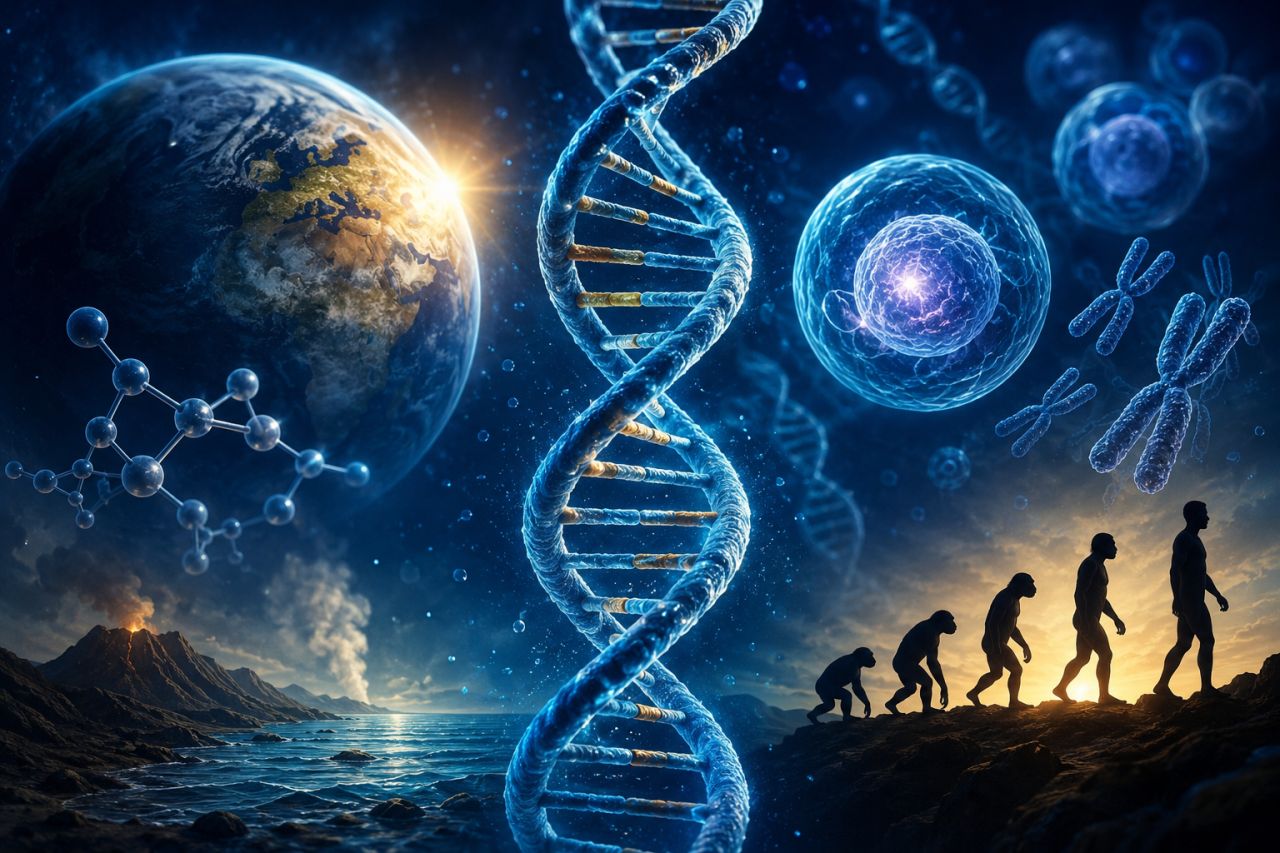
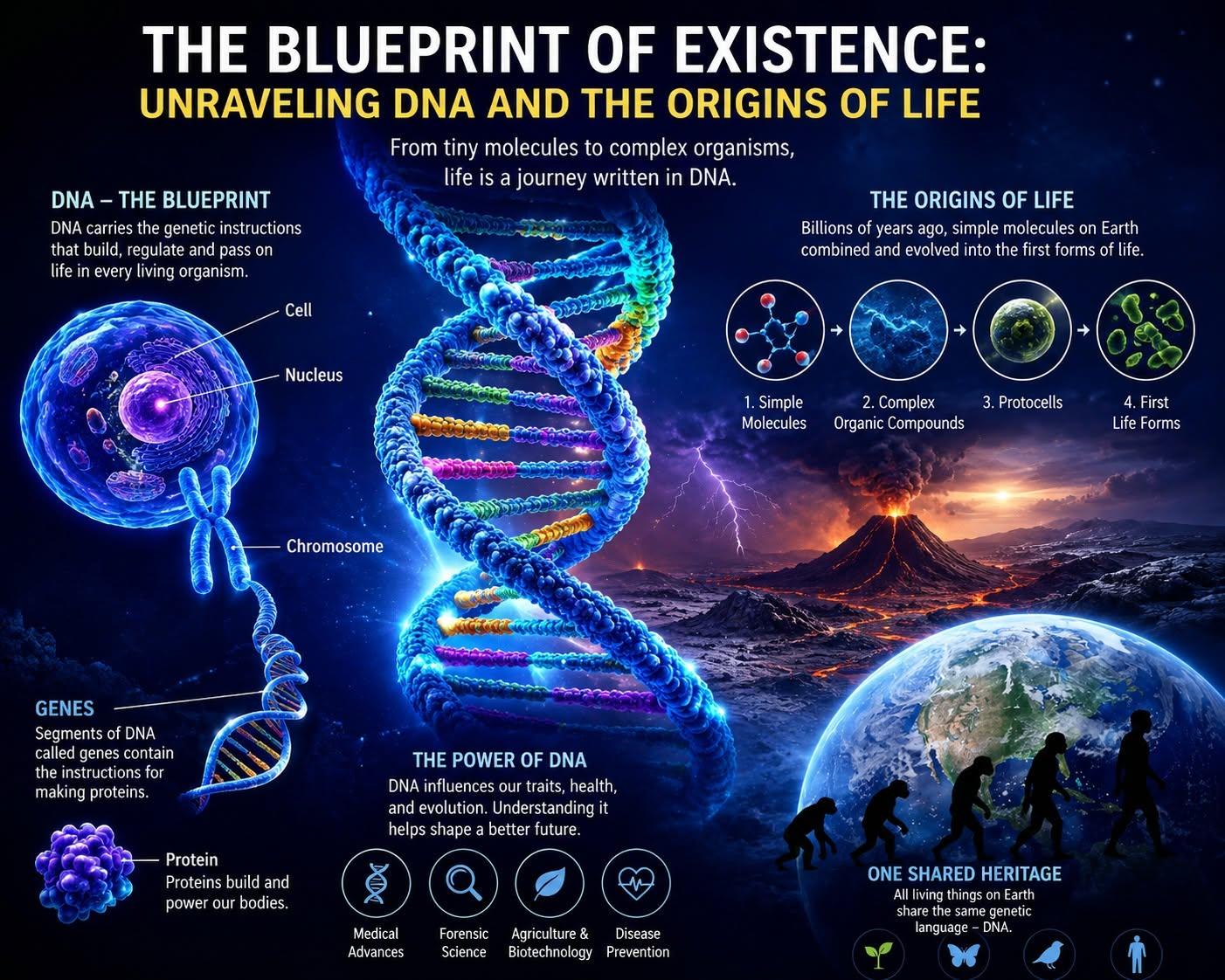
    DNA, or **Deoxyribonucleic Acid**, is often called the **blueprint of life** because it contains the genetic instructions that guide the growth, development, and functioning of every living organism. From the tiniest bacteria to the largest mammals, DNA carries the information that determines how living things are built, how they reproduce, and how traits are passed from one generation to the next. Understanding DNA has revolutionized biology, medicine, agriculture, and forensic science, helping scientists unlock the mysteries of life itself.

    The origins of life remain one of science's greatest questions. Researchers believe that billions of years ago, simple molecules on the early Earth gradually combined through natural chemical processes to form more complex compounds. Over immense periods of time, these molecules eventually developed the ability to replicate and evolve, leading to the first primitive forms of life. While many details are still being explored, scientific evidence suggests that DNA became the primary storage system for genetic information as life evolved.

    Every cell in the human body contains DNA organized into chromosomes, with thousands of genes carrying instructions for producing proteins. These proteins perform countless essential functions, from building tissues and organs to regulating metabolism and supporting the immune system. Even small changes in DNA can influence physical characteristics, health, and susceptibility to certain diseases, making genetics one of the most important fields in modern science.

    The study of DNA has transformed healthcare through genetic testing, personalized medicine, gene therapy, and disease prevention. It has also helped solve criminal investigations through DNA fingerprinting, improved crop production through genetic engineering, and deepened our understanding of evolution by revealing the shared ancestry of all living organisms.

    As scientists continue exploring genetics and the origins of life, new discoveries are reshaping our understanding of biology and opening exciting possibilities for the future. By unraveling the secrets hidden within DNA, humanity moves closer to understanding not only where life came from but also how we can improve health, protect biodiversity, and advance scientific knowledge for generations to come.

    **#DNA #Genetics #Biology #Science #OriginOfLife #MolecularBiology #Evolution #GeneticResearch #LifeSciences #STEM #Education #ScientificDiscovery #Innovation #Learning #FutureOfScience**

    Rehan School Islamabad Campus
    Asma Shaheen EducationWali
    Irum Asim
    Saima Happinesswali
    #rsisb Roll No.240 Story No.19 Foundation Level # ๐Ÿงฌ The Blueprint of Existence: Unraveling DNA and the Origins of Life DNA, or **Deoxyribonucleic Acid**, is often called the **blueprint of life** because it contains the genetic instructions that guide the growth, development, and functioning of every living organism. From the tiniest bacteria to the largest mammals, DNA carries the information that determines how living things are built, how they reproduce, and how traits are passed from one generation to the next. Understanding DNA has revolutionized biology, medicine, agriculture, and forensic science, helping scientists unlock the mysteries of life itself. The origins of life remain one of science's greatest questions. Researchers believe that billions of years ago, simple molecules on the early Earth gradually combined through natural chemical processes to form more complex compounds. Over immense periods of time, these molecules eventually developed the ability to replicate and evolve, leading to the first primitive forms of life. While many details are still being explored, scientific evidence suggests that DNA became the primary storage system for genetic information as life evolved. Every cell in the human body contains DNA organized into chromosomes, with thousands of genes carrying instructions for producing proteins. These proteins perform countless essential functions, from building tissues and organs to regulating metabolism and supporting the immune system. Even small changes in DNA can influence physical characteristics, health, and susceptibility to certain diseases, making genetics one of the most important fields in modern science. The study of DNA has transformed healthcare through genetic testing, personalized medicine, gene therapy, and disease prevention. It has also helped solve criminal investigations through DNA fingerprinting, improved crop production through genetic engineering, and deepened our understanding of evolution by revealing the shared ancestry of all living organisms. As scientists continue exploring genetics and the origins of life, new discoveries are reshaping our understanding of biology and opening exciting possibilities for the future. By unraveling the secrets hidden within DNA, humanity moves closer to understanding not only where life came from but also how we can improve health, protect biodiversity, and advance scientific knowledge for generations to come. **#DNA #Genetics #Biology #Science #OriginOfLife #MolecularBiology #Evolution #GeneticResearch #LifeSciences #STEM #Education #ScientificDiscovery #Innovation #Learning #FutureOfScience** ๐Ÿงฌ๐Ÿ”ฌ๐ŸŒ๐Ÿ“šโœจ Rehan School Islamabad Campus Asma Shaheen EducationWali Irum Asim Saima Happinesswali
    0 Reacties 0 aandelen 455 Views
  • #rsisb
    Roll No.190
    Canva Post No.49
    Foundation Level

    Exploring Lifes Mechanisms Through Experimentation

    Life is one of the greatest mysteries in the universe. From the smallest microscopic cell to the most complex living organisms, every form of life operates through intricate biological mechanisms that enable growth, reproduction, adaptation, and survival. Understanding these mechanisms is at the heart of biological science, and experimentation serves as one of the most powerful tools for uncovering the secrets of life.

    Experimentation allows scientists, researchers, and students to move beyond observation and actively investigate how living systems function. Through carefully designed experiments, we can test hypotheses, collect evidence, and draw conclusions about the natural processes that govern life. Whether studying the structure of cells, the role of DNA, the functions of organs, or the interactions between organisms and their environments, experimentation transforms curiosity into meaningful scientific knowledge.

    Every scientific breakthrough begins with a question. How do cells communicate with one another? What causes certain traits to be inherited? How do organisms adapt to changing environments? Experiments provide a systematic way to explore these questions and discover reliable answers. By manipulating variables, recording observations, and analyzing results, scientists can identify patterns and mechanisms that would otherwise remain hidden.

    Laboratory investigations have played a crucial role in advancing our understanding of biology. Through experiments, researchers have uncovered the structure of DNA, developed life-saving medicines, improved agricultural practices, and gained insights into diseases that affect millions of people worldwide. These discoveries have transformed healthcare, enhanced food production, and contributed to a better understanding of the natural world.

    Experimentation also helps us understand the interconnectedness of life. Ecosystems consist of countless interactions among plants, animals, microorganisms, and their environments. By studying these relationships through experiments, scientists can develop strategies to protect biodiversity, conserve natural resources, and address environmental challenges such as climate change and habitat loss.

    For students, experimentation is more than a learning activity—it is an opportunity to think critically, solve problems, and develop scientific skills. Conducting experiments encourages observation, analysis, creativity, and logical reasoning. It helps learners understand that science is not just a collection of facts but a dynamic process of discovery and exploration.

    Through experimentation, we gain a deeper appreciation for the complexity and beauty of life. Every cell, tissue, organ, and organism contributes to a vast network of biological processes that sustain living systems. Exploring these mechanisms allows us to answer important questions, improve human well-being, and inspire future generations of scientists and innovators.

    The journey of scientific discovery never ends. As technology advances and new questions arise, experimentation will continue to reveal the remarkable mechanisms that drive life itself. By embracing curiosity and investigation, we unlock new possibilities for understanding our world and shaping a better future.

    Science begins with a question, grows through experimentation, and flourishes through discovery. Every experiment is a step closer to understanding the incredible mechanisms that make life possible.

    #ExploringLife #LifeMechanisms #Experimentation #Biology #ScienceEducation #STEM #ScientificDiscovery #Research #LaboratoryLife #FutureScientists #Innovation #Learning #Curiosity #LifeSciences #Knowledge #ScienceMatters #DiscoveryJourney #BiologicalResearch #ExploreAndLearn #EducationForAll #ScienceInAction #FutureOfScience #ThinkLikeAScientist #AcademicExcellence #ResearchAndDiscovery #InspiringMinds #ScienceCommunity #UnlockingLif
    #rsisb Roll No.190 Canva Post No.49 Foundation Level ๐Ÿงฌ๐Ÿ”ฌ Exploring Life's Mechanisms Through Experimentation ๐Ÿ”ฌ๐Ÿงฌ Life is one of the greatest mysteries in the universe. From the smallest microscopic cell to the most complex living organisms, every form of life operates through intricate biological mechanisms that enable growth, reproduction, adaptation, and survival. Understanding these mechanisms is at the heart of biological science, and experimentation serves as one of the most powerful tools for uncovering the secrets of life. ๐ŸŒฑ Experimentation allows scientists, researchers, and students to move beyond observation and actively investigate how living systems function. Through carefully designed experiments, we can test hypotheses, collect evidence, and draw conclusions about the natural processes that govern life. Whether studying the structure of cells, the role of DNA, the functions of organs, or the interactions between organisms and their environments, experimentation transforms curiosity into meaningful scientific knowledge. ๐Ÿ”ฌ Every scientific breakthrough begins with a question. How do cells communicate with one another? What causes certain traits to be inherited? How do organisms adapt to changing environments? Experiments provide a systematic way to explore these questions and discover reliable answers. By manipulating variables, recording observations, and analyzing results, scientists can identify patterns and mechanisms that would otherwise remain hidden. ๐Ÿงช Laboratory investigations have played a crucial role in advancing our understanding of biology. Through experiments, researchers have uncovered the structure of DNA, developed life-saving medicines, improved agricultural practices, and gained insights into diseases that affect millions of people worldwide. These discoveries have transformed healthcare, enhanced food production, and contributed to a better understanding of the natural world. ๐ŸŒ Experimentation also helps us understand the interconnectedness of life. Ecosystems consist of countless interactions among plants, animals, microorganisms, and their environments. By studying these relationships through experiments, scientists can develop strategies to protect biodiversity, conserve natural resources, and address environmental challenges such as climate change and habitat loss. ๐Ÿ’ก For students, experimentation is more than a learning activity—it is an opportunity to think critically, solve problems, and develop scientific skills. Conducting experiments encourages observation, analysis, creativity, and logical reasoning. It helps learners understand that science is not just a collection of facts but a dynamic process of discovery and exploration. ๐Ÿงฌ Through experimentation, we gain a deeper appreciation for the complexity and beauty of life. Every cell, tissue, organ, and organism contributes to a vast network of biological processes that sustain living systems. Exploring these mechanisms allows us to answer important questions, improve human well-being, and inspire future generations of scientists and innovators. ๐Ÿš€ The journey of scientific discovery never ends. As technology advances and new questions arise, experimentation will continue to reveal the remarkable mechanisms that drive life itself. By embracing curiosity and investigation, we unlock new possibilities for understanding our world and shaping a better future. โœจ Science begins with a question, grows through experimentation, and flourishes through discovery. Every experiment is a step closer to understanding the incredible mechanisms that make life possible. #ExploringLife ๐Ÿ”ฌ #LifeMechanisms ๐Ÿงฌ #Experimentation ๐Ÿงช #Biology ๐ŸŒฑ #ScienceEducation ๐Ÿ“š #STEM ๐Ÿš€ #ScientificDiscovery ๐Ÿ” #Research ๐Ÿงซ #LaboratoryLife ๐Ÿ‘ฉ‍๐Ÿ”ฌ #FutureScientists ๐ŸŒŸ #Innovation ๐Ÿ’ก #Learning ๐ŸŽ“ #Curiosity โœจ #LifeSciences ๐Ÿงฌ #Knowledge ๐Ÿ“– #ScienceMatters ๐ŸŒ #DiscoveryJourney ๐Ÿš€ #BiologicalResearch ๐Ÿ”ฌ #ExploreAndLearn ๐ŸŒฑ #EducationForAll ๐Ÿ“š #ScienceInAction ๐Ÿงช #FutureOfScience ๐ŸŒŸ #ThinkLikeAScientist ๐Ÿ’ก #AcademicExcellence ๐ŸŽ“ #ResearchAndDiscovery ๐Ÿ” #InspiringMinds โœจ #ScienceCommunity ๐Ÿงฌ #UnlockingLif
    0 Reacties 0 aandelen 14051 Views