• #rsisb
    Roll No 253
    Foundation Level
    Story Post 24

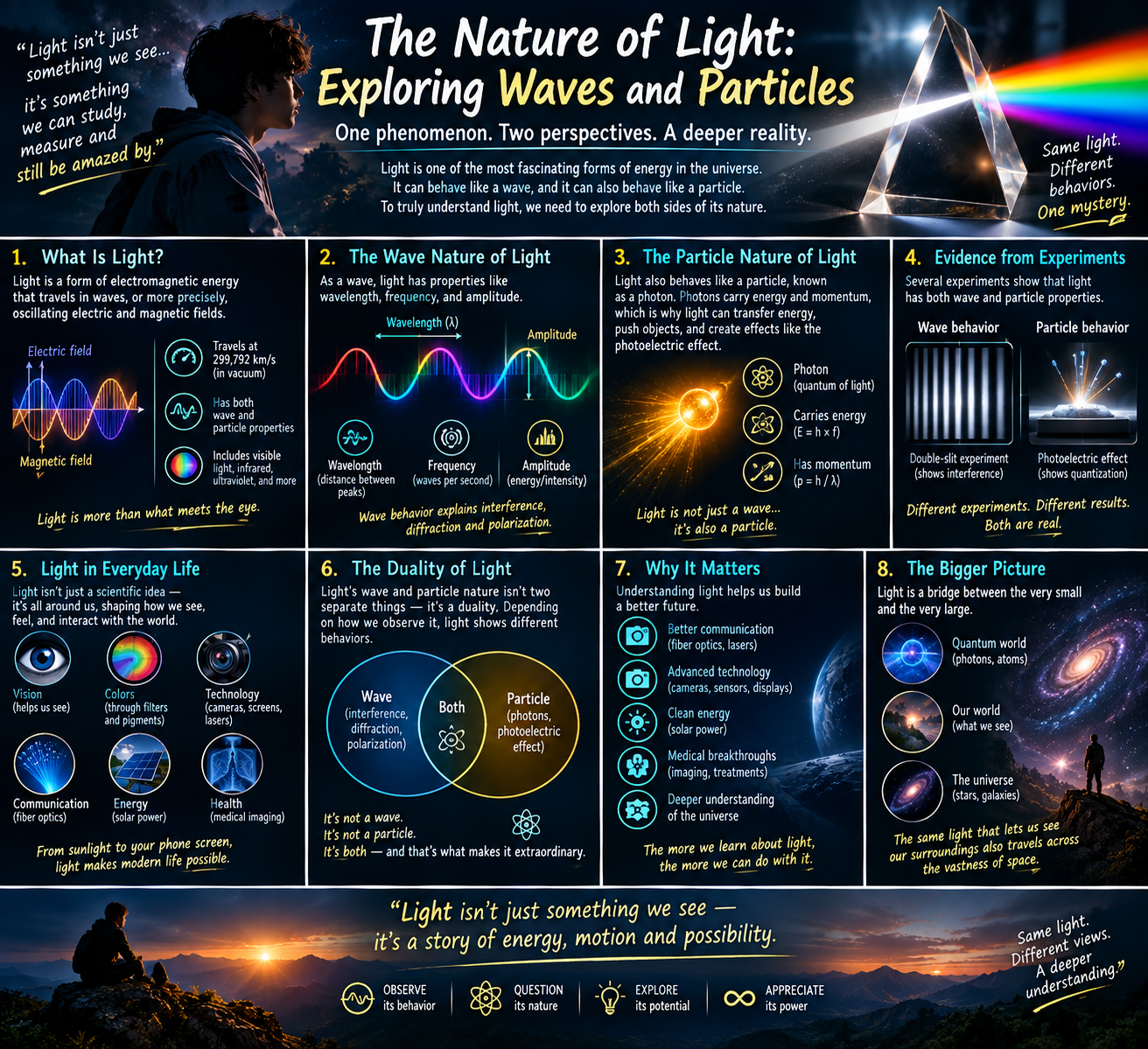
    # The Nature of Light: Exploring Waves and Particles

    Imagine standing beneath a night sky filled with stars.

    Every photon reaching your eyes has traveled across space carrying information from distant worlds. Light allows us to see, measure, communicate, explore, and understand the universe itself.

    But light is far stranger than it first appears.

    Sometimes it behaves like a **wave** .

    Sometimes it behaves like a **particle** .

    And understanding this strange dual nature changed our picture of reality forever.

    ---

    # 1. What Is Light?

    Light is a form of **electromagnetic radiation**—energy carried through oscillating electric and magnetic fields.

    In empty space, electromagnetic waves travel at approximately:

    ### **299,792 kilometers per second**

    That's the speed of light in vacuum.

    Visible light is only a small part of the electromagnetic spectrum.

    Beyond what our eyes can see are:

    Radio waves
    Microwaves
    Infrared
    Visible light
    Ultraviolet
    🩻 X-rays
    Gamma rays

    So light isn't simply what we see.

    ### **It's an enormous family of electromagnetic phenomena.**

    ---

    # 2. The Wave Nature of Light

    When light behaves as a wave, we can describe it using several important properties:

    **Wavelength** — the distance between successive wave peaks
    **Frequency** — how many oscillations occur each second
    **Amplitude** — related to the wave's intensity

    These properties help explain many familiar phenomena.

    **Interference** occurs when waves combine.
    **Diffraction** occurs when waves spread around openings or obstacles.
    **Polarization** describes the orientation of electromagnetic oscillations.

    The wave model explains behaviors that are difficult to understand if we imagine light only as tiny particles.

    ---

    # 3. The Particle Nature of Light

    But the story doesn't end there.

    Light can also behave as if it arrives in discrete packets of energy called **photons**.

    A photon is a quantum of electromagnetic radiation.

    Its energy is related to frequency:

    ### **E = h × f**

    And its momentum is related to its wavelength:

    ### **p = h / λ**

    This particle-like behavior helps explain phenomena such as the **photoelectric effect**, where light can transfer energy to electrons.

    So light isn't simply a smooth continuous wave.

    At the quantum level, energy can be exchanged in discrete amounts.

    ### **Light has another side—and it's quantum.**

    ---

    # 4. Evidence From Experiments

    The strange nature of light isn't merely philosophical.

    Experiments demonstrate it.

    ### Double-Slit Experiment

    When light passes through two narrow openings, an **interference pattern** can appear—strong evidence of wave-like behavior.

    ### Photoelectric Effect

    When light strikes certain materials, it can eject electrons. This behavior is explained using photons and quantized energy.

    Different experiments reveal different aspects of light.

    And that's one of the most fascinating things about physics:

    ### **The same phenomenon can reveal different behaviors depending on how we investigate it.**

    ---

    # 5. Light in Everyday Life

    Light isn't something that exists only inside physics laboratories.

    It's everywhere.

    **Vision** — allows us to see the world
    **Colors** — arise from how different wavelengths interact with matter
    **Cameras** — convert light into images
    **Screens** — produce controlled patterns of light
    **Fiber optics** — carry information using light
    **Solar panels** — convert light energy into electrical energy
    🩻 **Medical imaging** — uses electromagnetic radiation to see inside the body

    From sunrise to smartphone screens…

    ### **Modern civilization depends heavily on our ability to control light.**

    ---

    # 6. The Duality of Light

    Here lies the great mystery.

    Light can display **wave-like behavior**

    and

    **particle-like behavior** .

    This is known as **wave-particle duality**.

    It's important to understand that this doesn't mean light is literally switching between being a classical wave and a classical particle like two separate objects.

    Instead, quantum physics gives us a deeper framework in which classical wave and particle descriptions each capture different aspects of light's behavior.

    ### **Two perspectives. One quantum reality.**

    ---

    # 7. Why Understanding Light Matters

    Learning how light behaves has transformed technology.

    **Communication** — fiber-optic networks
    **Science** — spectroscopy and microscopy
    **Imaging** — cameras and sensors
    **Energy** — solar technology
    **Medicine** — lasers and diagnostic imaging
    **Astronomy** — studying distant stars and galaxies

    When astronomers observe light from a distant star, they aren't simply seeing brightness.

    They can analyze the light's wavelengths and learn about the star's:

    Temperature
    Chemical composition
    Motion
    Environment

    ### **Light carries information across space.**

    ---

    # 8. The Bigger Picture

    Light connects the microscopic and the cosmic.

    At the quantum scale, photons interact with atoms and electrons.

    At human scales, light allows us to see and communicate.

    Across astronomical distances, light travels from stars and galaxies to our telescopes.

    In many ways, light is our messenger from the universe.

    When we look at a distant galaxy, we are receiving photons that may have traveled for millions or billions of years before reaching Earth.

    ### **Looking at the universe means looking at ancient light.**

    ---

    # The Final Thought

    Light is more than something that illuminates a room.

    It is energy.
    It is information.
    It is electromagnetic radiation.
    It has quantum behavior.
    And it is one of the most important tools we have for exploring reality.

    From a photon interacting with an electron…

    to sunlight crossing space…

    to the glow of a distant galaxy…

    ### **Light connects the smallest scales of nature with the largest.**

    So the next time you see sunlight streaming through a window , a rainbow , or stars shining overhead , remember:

    **You aren't simply seeing light.**

    You're witnessing one of the universe's most fascinating mysteries—a phenomenon that behaves in ways far stranger and more beautiful than our everyday experience suggests.

    # **Light isn't just something we see—it's a story of energy, motion, information, and possibility.** ∞


    Asma Shaheen EducationWali
    Saima Empowerment Wali
    Mishaal TrainingWali
    #rsisb Roll No 253 Foundation Level Story Post 24 # 🌈⚡ The Nature of Light: Exploring Waves and Particles Imagine standing beneath a night sky filled with stars. 🌌✨ Every photon reaching your eyes has traveled across space carrying information from distant worlds. Light allows us to see, measure, communicate, explore, and understand the universe itself. 🔭👁️📡 But light is far stranger than it first appears. Sometimes it behaves like a **wave** 🌊. Sometimes it behaves like a **particle** ⚛️. And understanding this strange dual nature changed our picture of reality forever. 🧠🌌 --- # 💡🌌 1. What Is Light? Light is a form of **electromagnetic radiation**—energy carried through oscillating electric and magnetic fields. ⚡🧲 In empty space, electromagnetic waves travel at approximately: ### 🚀 **299,792 kilometers per second** That's the speed of light in vacuum. Visible light 👁️🌈 is only a small part of the electromagnetic spectrum. Beyond what our eyes can see are: 📻 Radio waves 📡 Microwaves 🔥 Infrared 🌈 Visible light ☀️ Ultraviolet 🩻 X-rays ☢️ Gamma rays So light isn't simply what we see. ### **It's an enormous family of electromagnetic phenomena.** 🌌⚡ --- # 🌊🔬 2. The Wave Nature of Light When light behaves as a wave, we can describe it using several important properties: 〰️ **Wavelength** — the distance between successive wave peaks ⚡ **Frequency** — how many oscillations occur each second 📈 **Amplitude** — related to the wave's intensity These properties help explain many familiar phenomena. 🌈 **Interference** occurs when waves combine. 🔍 **Diffraction** occurs when waves spread around openings or obstacles. 🕶️ **Polarization** describes the orientation of electromagnetic oscillations. The wave model explains behaviors that are difficult to understand if we imagine light only as tiny particles. --- # ⚛️✨ 3. The Particle Nature of Light But the story doesn't end there. Light can also behave as if it arrives in discrete packets of energy called **photons**. ⚛️💡 A photon is a quantum of electromagnetic radiation. Its energy is related to frequency: ### **E = h × f** ⚡ And its momentum is related to its wavelength: ### **p = h / λ** 🌊⚛️ This particle-like behavior helps explain phenomena such as the **photoelectric effect**, where light can transfer energy to electrons. So light isn't simply a smooth continuous wave. At the quantum level, energy can be exchanged in discrete amounts. ### **Light has another side—and it's quantum.** 🌌⚛️ --- # 🧪🔍 4. Evidence From Experiments The strange nature of light isn't merely philosophical. Experiments demonstrate it. ### 🌊 Double-Slit Experiment When light passes through two narrow openings, an **interference pattern** can appear—strong evidence of wave-like behavior. 🌊〰️ ### ⚡ Photoelectric Effect When light strikes certain materials, it can eject electrons. This behavior is explained using photons and quantized energy. ⚛️🔋 Different experiments reveal different aspects of light. And that's one of the most fascinating things about physics: ### **The same phenomenon can reveal different behaviors depending on how we investigate it.** 🔬✨ --- # 👁️🌈 5. Light in Everyday Life Light isn't something that exists only inside physics laboratories. It's everywhere. 🌍☀️ 👁️ **Vision** — allows us to see the world 🌈 **Colors** — arise from how different wavelengths interact with matter 📷 **Cameras** — convert light into images 📱 **Screens** — produce controlled patterns of light 🌐 **Fiber optics** — carry information using light ☀️ **Solar panels** — convert light energy into electrical energy 🩻 **Medical imaging** — uses electromagnetic radiation to see inside the body From sunrise to smartphone screens… ### **Modern civilization depends heavily on our ability to control light.** 💡🌍 --- # 🌊⚛️ 6. The Duality of Light Here lies the great mystery. Light can display **wave-like behavior** 🌊 and **particle-like behavior** ⚛️. This is known as **wave-particle duality**. It's important to understand that this doesn't mean light is literally switching between being a classical wave and a classical particle like two separate objects. Instead, quantum physics gives us a deeper framework in which classical wave and particle descriptions each capture different aspects of light's behavior. ### **Two perspectives. One quantum reality.** 🌌✨ --- # 🚀🔬 7. Why Understanding Light Matters Learning how light behaves has transformed technology. 📡 **Communication** — fiber-optic networks 🔬 **Science** — spectroscopy and microscopy 📷 **Imaging** — cameras and sensors ☀️ **Energy** — solar technology 🩺 **Medicine** — lasers and diagnostic imaging 🚀 **Astronomy** — studying distant stars and galaxies When astronomers observe light from a distant star, they aren't simply seeing brightness. They can analyze the light's wavelengths and learn about the star's: 🌡️ Temperature 🧪 Chemical composition 💨 Motion 🌌 Environment ### **Light carries information across space.** --- # 🌌🔭 8. The Bigger Picture Light connects the microscopic and the cosmic. At the quantum scale, photons interact with atoms and electrons. ⚛️🔬 At human scales, light allows us to see and communicate. 👁️📱 Across astronomical distances, light travels from stars and galaxies to our telescopes. 🌟🔭 In many ways, light is our messenger from the universe. When we look at a distant galaxy, we are receiving photons that may have traveled for millions or billions of years before reaching Earth. 🌌⏳ ### **Looking at the universe means looking at ancient light.** ✨ --- # 🌅💡 The Final Thought Light is more than something that illuminates a room. It is energy. ⚡ It is information. 📡 It is electromagnetic radiation. 🌊 It has quantum behavior. ⚛️ And it is one of the most important tools we have for exploring reality. 🔭 From a photon interacting with an electron… to sunlight crossing space… to the glow of a distant galaxy… ### **Light connects the smallest scales of nature with the largest.** 🌌⚛️ So the next time you see sunlight streaming through a window ☀️, a rainbow 🌈, or stars shining overhead ⭐, remember: **You aren't simply seeing light.** You're witnessing one of the universe's most fascinating mysteries—a phenomenon that behaves in ways far stranger and more beautiful than our everyday experience suggests. 🌊⚛️✨ # 🌈🌌 **Light isn't just something we see—it's a story of energy, motion, information, and possibility.** ⚡🔬∞ Asma Shaheen EducationWali Saima Empowerment Wali Mishaal TrainingWali
    0 التعليقات 0 المشاركات 242 مشاهدة
  • #rsisb
    Roll No 253
    Foundation Level
    Story Post 23

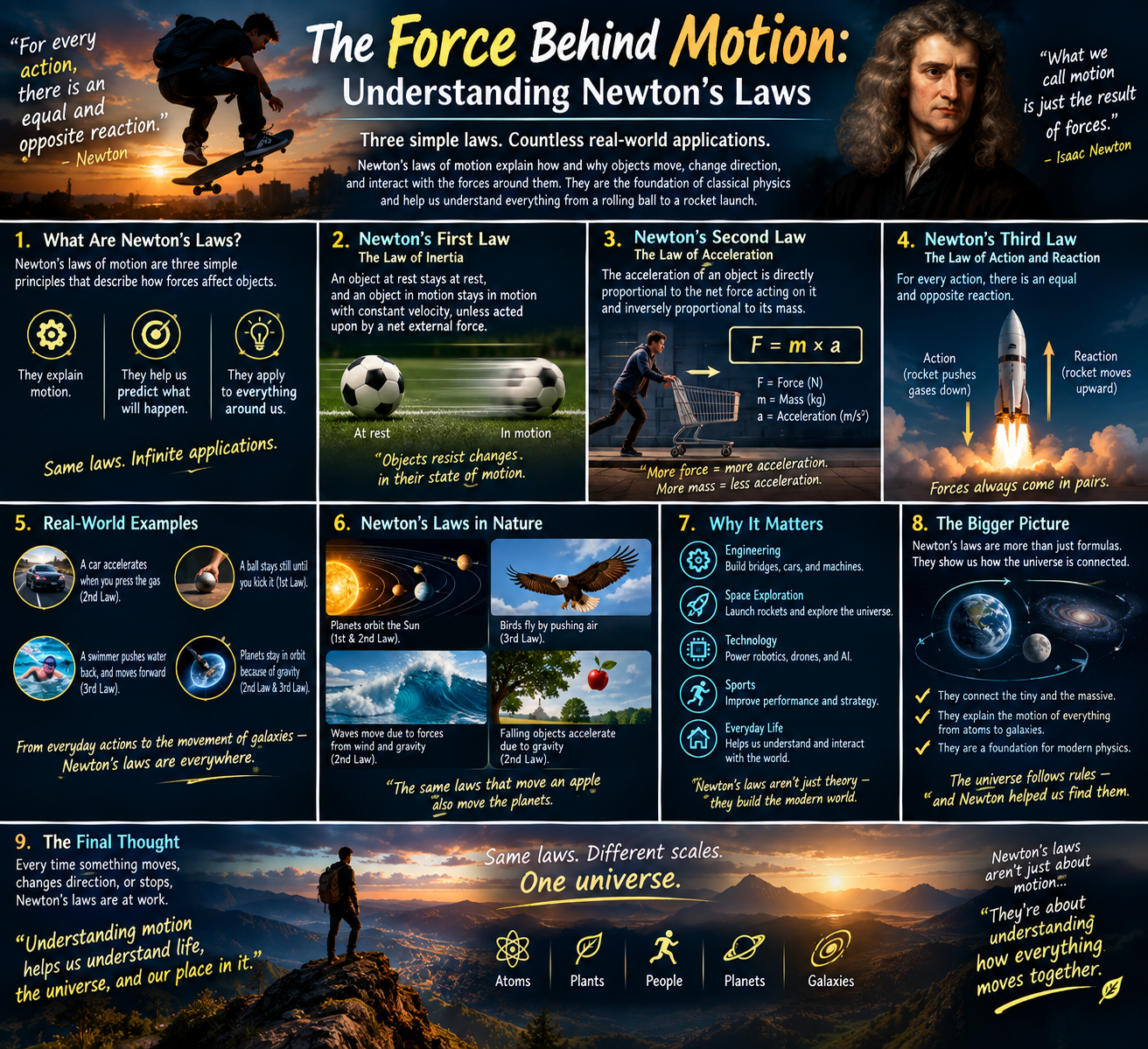
    # The Force Behind Motion: Understanding Newton’s Laws

    Imagine watching a football fly through the air , a car accelerate down a road , a rocket launch into space , or planets orbiting a star .

    These events may appear completely different—but beneath them is the same fundamental idea:

    ## **Forces control motion.**

    More than three centuries ago, **Isaac Newton** developed three laws that transformed our understanding of how objects move and interact. These laws became the foundation of classical mechanics and remain essential to physics, engineering, astronomy, and countless technologies today.

    ---

    # 1. What Are Newton's Laws?

    Newton's three laws describe the relationship between:

    **Force**
    **Mass**
    **Acceleration**
    **Motion**

    Together, they help us explain why objects remain still, why they accelerate, and how forces interact.

    From a rolling ball to a spacecraft , the same fundamental principles apply.

    ### **Three simple laws. Infinite applications.**

    ---

    # 2. Newton's First Law — The Law of Inertia

    Newton's First Law states that an object at rest remains at rest, while an object in motion continues moving at constant velocity unless acted upon by a net external force.

    This property is called **inertia**.

    Imagine a football sitting on the ground.

    It stays there until you kick it.

    Once moving, it won't naturally change its motion unless another force acts on it—such as friction, air resistance, or another object.

    A car requires braking to stop.
    A ball slows because of friction.
    Objects in space can continue moving with very little resistance.

    ### **Objects resist changes in their state of motion.**

    ---

    # 3. Newton's Second Law — The Law of Acceleration

    The second law explains how force changes motion.

    Its famous equation is:

    # **F = m × a**

    Where:

    **F** = Force
    **m** = Mass
    **a** = Acceleration

    This means that increasing the net force on an object generally increases its acceleration, while increasing the object's mass makes the same force produce less acceleration.

    Imagine pushing an empty shopping cart .

    It accelerates easily.

    Now fill it with heavy objects.

    The same push produces less acceleration.

    ### **More net force → more acceleration.**

    ### **More mass → less acceleration for the same force.**

    This simple relationship powers everything from vehicle design to rocket engineering .

    ---

    # 4. Newton's Third Law — Action and Reaction

    Newton's Third Law states:

    ### **For every action, there is an equal and opposite reaction.**

    Forces always occur through interactions between objects.

    Consider a rocket.

    The engine pushes hot gases downward and backward.

    The gases exert an equal and opposite force on the rocket, pushing it upward.

    The same principle appears everywhere:

    A swimmer pushes water backward → the water pushes the swimmer forward.
    A bird pushes air downward → the air helps push the bird upward.
    You push the ground backward → the ground pushes you forward.

    ### **Forces come in pairs.**

    ---

    # 5. Newton's Laws in Everyday Life

    You don't need a laboratory to see Newton's laws.

    They are happening around you constantly.

    **Cars:** Engine force changes speed and direction.
    **Sports:** Kicking a ball changes its motion.
    **Swimming:** Pushing water creates forward motion.
    **Cycling:** Pedaling produces forces that accelerate the bicycle.
    **Falling objects:** Gravity changes their motion.
    **Skateboards:** Pushing against the ground creates movement.

    Everyday motion is essentially a continuous interaction between forces.

    ---

    # 6. Newton's Laws in Nature

    Newton's laws don't stop at Earth.

    They also help describe motion throughout the universe.

    Planets orbit stars.
    Moons orbit planets.
    Comets travel through space.
    Waves respond to forces.
    Birds generate lift through interactions with air.
    Objects accelerate under gravity.

    The same physics that explains a falling apple can help describe the motion of enormous celestial bodies.

    ### **From apples to planets, the same laws operate across nature.**

    ---

    # 7. Why Newton's Laws Matter

    Newton's laws are more than equations in a textbook.

    They are essential tools for understanding and designing the physical world.

    **Engineering** — bridges, buildings, vehicles, and machines
    **Space exploration** — rockets, spacecraft, and orbital motion
    **Technology** — robots, drones, and automated systems
    **Sports science** — movement, speed, and performance
    **Transportation** — cars, aircraft, and trains

    Modern technology depends heavily on our ability to predict how forces produce motion.

    ---

    # 8. The Bigger Picture

    Newton's laws reveal something remarkable:

    The universe is not simply a collection of random movements.

    Objects interact through measurable forces.

    From microscopic particles to massive planets and galaxies , physics provides mathematical relationships that help us understand motion.

    The scale may change.

    The objects may change.

    But the underlying principles remain incredibly powerful.

    ### **Tiny or massive. Fast or slow. Earth or space. Motion follows physical laws.**

    ---

    # 9. The Final Thought

    Every time something moves…

    Every time something accelerates…

    Every time something changes direction…

    **Newton's laws are there.**

    A skateboard rolling down a street
    A bird taking flight
    A rocket leaving Earth
    A planet orbiting the Sun

    Different events.

    Different scales.

    One underlying framework.

    ## **Same laws. Different scales. One universe.**

    Understanding motion isn't just about solving equations.

    It's about understanding **how the physical world moves, interacts, and holds together.**

    ### **Once you understand the forces behind motion, the world around you begins to move in a whole new way.**


    Asma Shaheen EducationWali
    Saima Empowerment Wali
    Mishaal TrainingWali
    #rsisb Roll No 253 Foundation Level Story Post 23 # ⚡🌌 The Force Behind Motion: Understanding Newton’s Laws Imagine watching a football fly through the air ⚽, a car accelerate down a road 🚗💨, a rocket launch into space 🚀, or planets orbiting a star 🪐✨. These events may appear completely different—but beneath them is the same fundamental idea: ## **Forces control motion.** ⚡🧲 More than three centuries ago, **Isaac Newton** developed three laws that transformed our understanding of how objects move and interact. These laws became the foundation of classical mechanics and remain essential to physics, engineering, astronomy, and countless technologies today. 🔬⚙️🌍 --- # 🧠⚡ 1. What Are Newton's Laws? Newton's three laws describe the relationship between: ⚡ **Force** 🧱 **Mass** 💨 **Acceleration** 🏃 **Motion** Together, they help us explain why objects remain still, why they accelerate, and how forces interact. From a rolling ball 🎾 to a spacecraft 🚀, the same fundamental principles apply. ### **Three simple laws. Infinite applications.** 🌌 --- # 🛑➡️ 2. Newton's First Law — The Law of Inertia Newton's First Law states that an object at rest remains at rest, while an object in motion continues moving at constant velocity unless acted upon by a net external force. This property is called **inertia**. 🧱⚡ Imagine a football sitting on the ground. ⚽ It stays there until you kick it. Once moving, it won't naturally change its motion unless another force acts on it—such as friction, air resistance, or another object. 🚗 A car requires braking to stop. ⚽ A ball slows because of friction. 🛰️ Objects in space can continue moving with very little resistance. ### **Objects resist changes in their state of motion.** --- # 💨⚙️ 3. Newton's Second Law — The Law of Acceleration The second law explains how force changes motion. Its famous equation is: # **F = m × a** ⚡ Where: **F** = Force 🧲 **m** = Mass ⚖️ **a** = Acceleration 💨 This means that increasing the net force on an object generally increases its acceleration, while increasing the object's mass makes the same force produce less acceleration. Imagine pushing an empty shopping cart 🛒. It accelerates easily. Now fill it with heavy objects. The same push produces less acceleration. ### **More net force → more acceleration.** ### **More mass → less acceleration for the same force.** This simple relationship powers everything from vehicle design 🚗 to rocket engineering 🚀. --- # 🚀🔥 4. Newton's Third Law — Action and Reaction Newton's Third Law states: ### **For every action, there is an equal and opposite reaction.** ⚡ Forces always occur through interactions between objects. Consider a rocket. 🚀 The engine pushes hot gases downward and backward. The gases exert an equal and opposite force on the rocket, pushing it upward. ⬆️🔥 The same principle appears everywhere: 🏊 A swimmer pushes water backward → the water pushes the swimmer forward. 🦅 A bird pushes air downward → the air helps push the bird upward. 🚶 You push the ground backward → the ground pushes you forward. ### **Forces come in pairs.** 🔗⚡ --- # 🌍⚽ 5. Newton's Laws in Everyday Life You don't need a laboratory to see Newton's laws. They are happening around you constantly. 🚗 **Cars:** Engine force changes speed and direction. ⚽ **Sports:** Kicking a ball changes its motion. 🏊 **Swimming:** Pushing water creates forward motion. 🚲 **Cycling:** Pedaling produces forces that accelerate the bicycle. 🍎 **Falling objects:** Gravity changes their motion. 🛹 **Skateboards:** Pushing against the ground creates movement. Everyday motion is essentially a continuous interaction between forces. --- # 🌌🪐 6. Newton's Laws in Nature Newton's laws don't stop at Earth. They also help describe motion throughout the universe. 🌌 🪐 Planets orbit stars. 🌙 Moons orbit planets. ☄️ Comets travel through space. 🌊 Waves respond to forces. 🦅 Birds generate lift through interactions with air. 🍎 Objects accelerate under gravity. The same physics that explains a falling apple can help describe the motion of enormous celestial bodies. ### **From apples to planets, the same laws operate across nature.** 🍎➡️🪐 --- # ⚙️🚀 7. Why Newton's Laws Matter Newton's laws are more than equations in a textbook. They are essential tools for understanding and designing the physical world. 🏗️ **Engineering** — bridges, buildings, vehicles, and machines 🚀 **Space exploration** — rockets, spacecraft, and orbital motion 🤖 **Technology** — robots, drones, and automated systems 🏃 **Sports science** — movement, speed, and performance 🚗 **Transportation** — cars, aircraft, and trains Modern technology depends heavily on our ability to predict how forces produce motion. --- # 🌌🔭 8. The Bigger Picture Newton's laws reveal something remarkable: The universe is not simply a collection of random movements. Objects interact through measurable forces. ⚛️🧲 From microscopic particles 🔬 to massive planets 🪐 and galaxies 🌌, physics provides mathematical relationships that help us understand motion. The scale may change. The objects may change. But the underlying principles remain incredibly powerful. ### **Tiny or massive. Fast or slow. Earth or space. Motion follows physical laws.** ⚡🌍🌌 --- # 🌅⚡ 9. The Final Thought Every time something moves… Every time something accelerates… Every time something changes direction… **Newton's laws are there.** 🧠⚡ A skateboard rolling down a street 🛹 A bird taking flight 🦅 A rocket leaving Earth 🚀 A planet orbiting the Sun ☀️🪐 Different events. Different scales. One underlying framework. ## 🌌 **Same laws. Different scales. One universe.** Understanding motion isn't just about solving equations. It's about understanding **how the physical world moves, interacts, and holds together.** ⚛️🌍✨ ### **Once you understand the forces behind motion, the world around you begins to move in a whole new way.** ⚡🔬🌌 Asma Shaheen EducationWali Saima Empowerment Wali Mishaal TrainingWali
    0 التعليقات 0 المشاركات 358 مشاهدة
  • RSIF 8

    Roll no 93

    Story post no 34

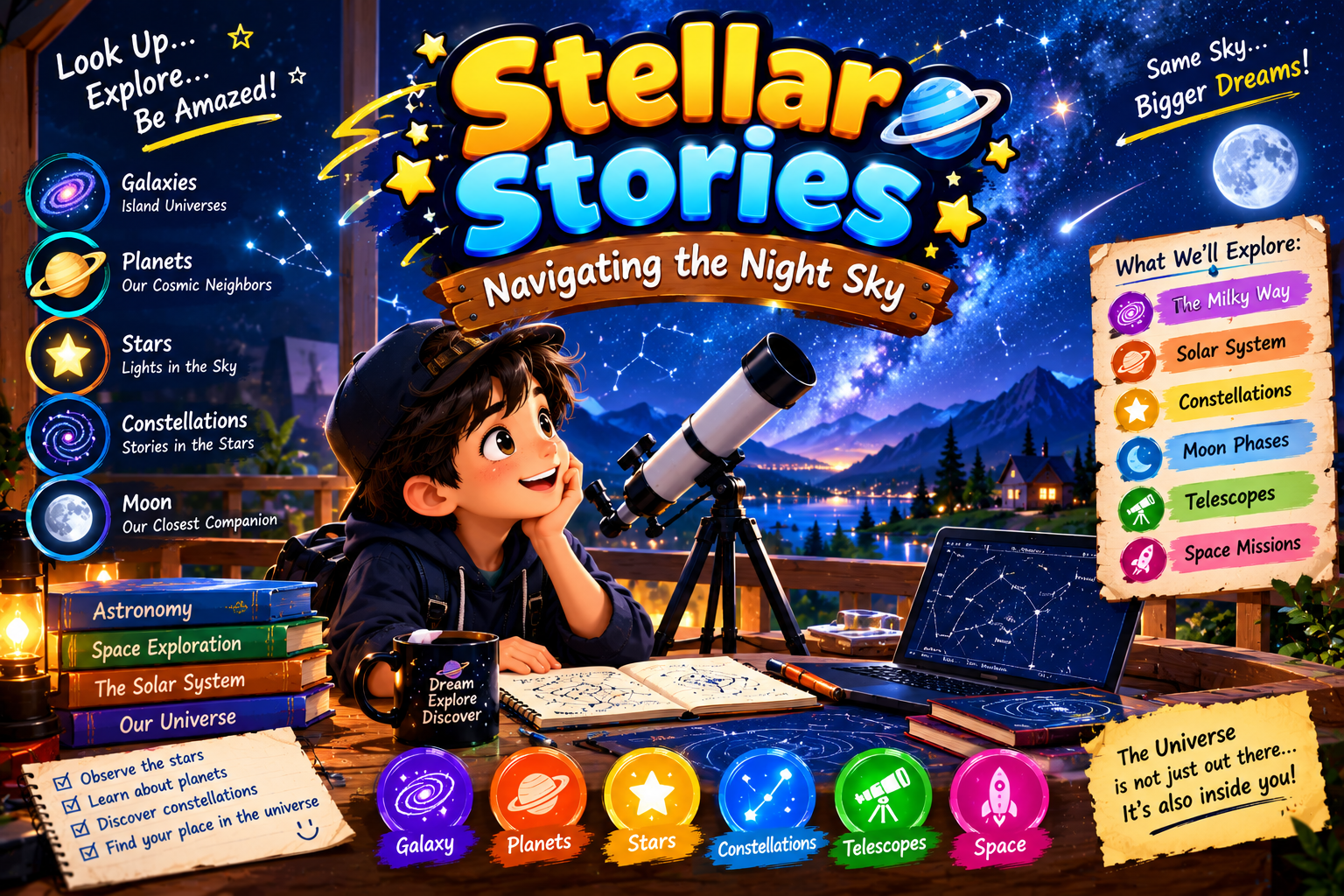
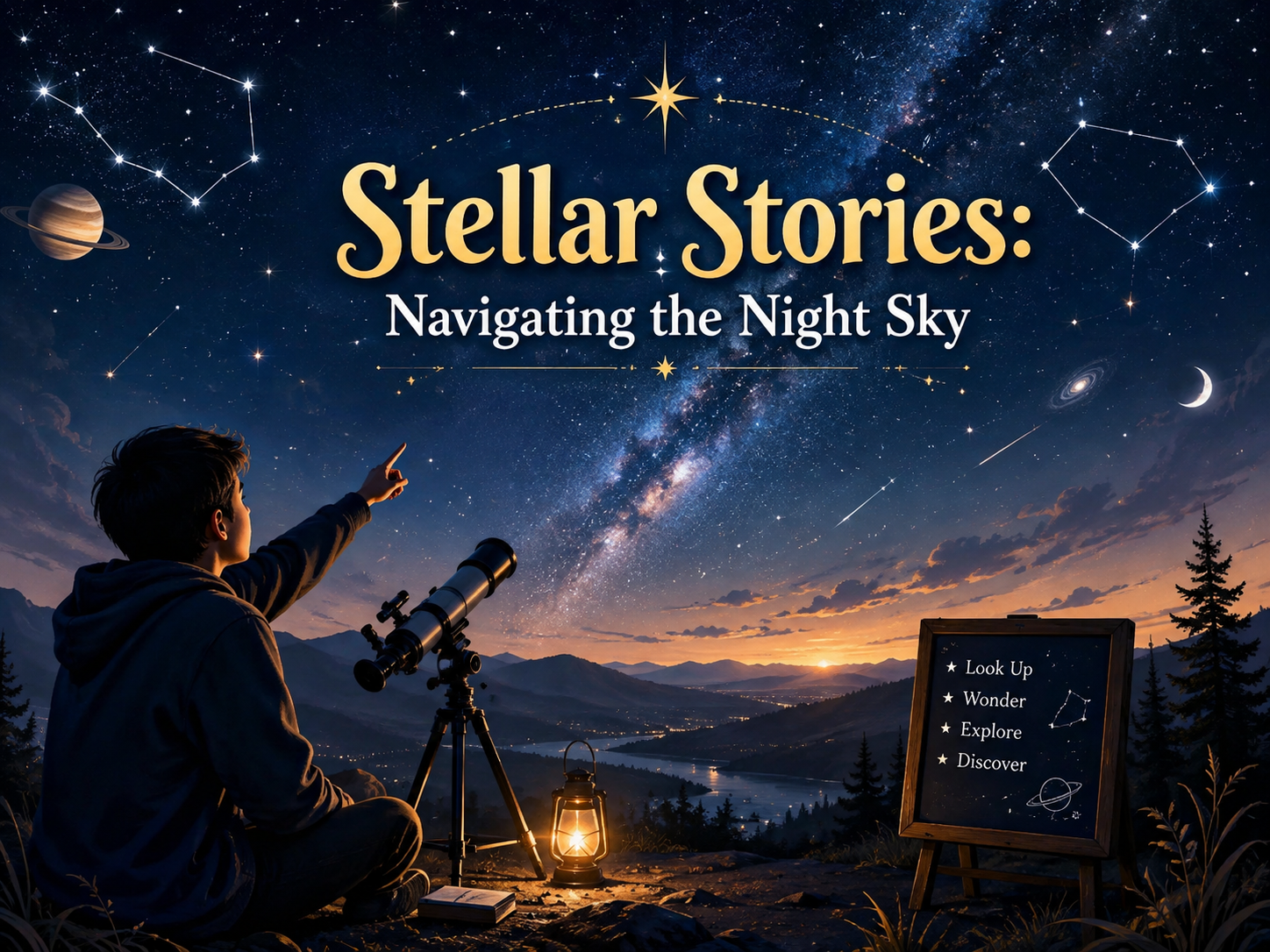
    Task topic: "Stellar Stories: Navigating the Night Sky".Bilkul Yeh **“Stellar Stories: Navigating the Night Sky”** ke liye long description hai:


    **Stellar Stories: Navigating the Night Sky**


    Look up at the night sky and you will see much more than twinkling lights. Above us is a vast universe filled with stars, planets, galaxies, constellations, meteors, and countless mysteries waiting to be explored.


    For thousands of years, humans have looked toward the stars for **direction, knowledge, inspiration, and answers**. Ancient travelers used the night sky to navigate, while astronomers today use powerful telescopes and advanced technology to study objects billions of light-years away.


    **Stars** are enormous glowing objects that produce their own light and energy.


    **Planets** orbit stars and come in many different sizes and types.


    **Meteors** are streaks of light created when space rocks enter Earth's atmosphere and heat up.


    **Constellations** are patterns of stars that people have recognized and named throughout history.


    **Galaxies** are enormous collections of stars, gas, dust, and other matter. Our home galaxy is the **Milky Way**.


    One familiar pattern in the sky is the **Big Dipper**, which is part of the larger constellation Ursa Major. It has helped people recognize directions and identify other stars in the night sky.


    The night sky connects us with both the past and the future. Ancient civilizations created stories about the stars, while modern scientists continue searching for new worlds and learning more about our universe.


    **So, the next time you look up, remember:**

    There is a whole universe waiting to be explored.


    **Look up. Stay curious. Keep discovering.**


    #StellarStories #NightSky #Astronomy #Space #Universe #Stars #Planets #Galaxies #MilkyWay #Constellations #BigDipper #Meteor #Science #ScienceEducation #AstronomyLovers #SpaceExploration #STEM #Learning #DiscoverTheUniverse #ExploreSpace #EducationalPost

    RSIF 8 Roll no 93 Story post no 34 Task topic: "Stellar Stories: Navigating the Night Sky".Bilkul 👍 Yeh **“Stellar Stories: Navigating the Night Sky”** ke liye long description hai: 🌌⭐ **Stellar Stories: Navigating the Night Sky** 🔭 Look up at the night sky and you will see much more than twinkling lights. Above us is a vast universe filled with stars, planets, galaxies, constellations, meteors, and countless mysteries waiting to be explored. For thousands of years, humans have looked toward the stars for **direction, knowledge, inspiration, and answers**. Ancient travelers used the night sky to navigate, while astronomers today use powerful telescopes and advanced technology to study objects billions of light-years away. ⭐ **Stars** are enormous glowing objects that produce their own light and energy. 🪐 **Planets** orbit stars and come in many different sizes and types. ☄️ **Meteors** are streaks of light created when space rocks enter Earth's atmosphere and heat up. ✨ **Constellations** are patterns of stars that people have recognized and named throughout history. 🌌 **Galaxies** are enormous collections of stars, gas, dust, and other matter. Our home galaxy is the **Milky Way**. One familiar pattern in the sky is the **Big Dipper**, which is part of the larger constellation Ursa Major. It has helped people recognize directions and identify other stars in the night sky. The night sky connects us with both the past and the future. Ancient civilizations created stories about the stars, while modern scientists continue searching for new worlds and learning more about our universe. 🔭 **So, the next time you look up, remember:** There is a whole universe waiting to be explored. 🌟 **Look up. Stay curious. Keep discovering.** #StellarStories #NightSky #Astronomy #Space #Universe #Stars #Planets #Galaxies #MilkyWay #Constellations #BigDipper #Meteor #Science #ScienceEducation #AstronomyLovers #SpaceExploration #STEM #Learning #DiscoverTheUniverse #ExploreSpace #EducationalPost
    0 التعليقات 0 المشاركات 434 مشاهدة
  • #rsisb
    Roll NO:232
    Foundation level student.
    Story post:11

    **Stellar Stories: Navigating the Night Sky**

    Get ready for an amazing journey beyond our planet and into the mysterious beauty of the **night sky!** Join us as we explore shining stars , fascinating constellations , planets , the Moon , and other incredible objects across the universe.

    In this exciting educational adventure, we’ll learn how people have used the stars to **navigate, tell stories, understand seasons, and explore the universe** throughout history. We’ll discover how constellations form recognizable patterns and how astronomers use powerful telescopes to study objects that are millions or even billions of light-years away.

    From the sparkling stars above us to distant galaxies , the night sky reminds us that the universe is vast, beautiful, and full of mysteries waiting to be discovered.

    **Look Up • Explore the Stars • Discover the Universe • Keep Wondering!**

    Join us on this stellar adventure and let your curiosity take you beyond Earth and into the incredible world of astronomy!

    #StellarStories #NightSky #Astronomy #Stars #Space #Universe #Constellations #Planets #Moon #Galaxy #SpaceExploration #AstronomyForKids #Science #ScienceEducation #STEM #Learning #EducationalVideo #FunLearning #ExploreSpace #DiscoverTheUniverse #StarGazing #YoungAstronomers #Cosmos
    #rsisb Roll NO:232 Foundation level student. Story post:11 🌌✨ **Stellar Stories: Navigating the Night Sky** 🔭⭐ Get ready for an amazing journey beyond our planet and into the mysterious beauty of the **night sky!** 🚀🌠 Join us as we explore shining stars ⭐, fascinating constellations 🌌, planets 🪐, the Moon 🌙, and other incredible objects across the universe. In this exciting educational adventure, we’ll learn how people have used the stars to **navigate, tell stories, understand seasons, and explore the universe** throughout history. 🧭📚🌍 We’ll discover how constellations form recognizable patterns and how astronomers use powerful telescopes 🔭 to study objects that are millions or even billions of light-years away. From the sparkling stars above us ✨ to distant galaxies 🌌, the night sky reminds us that the universe is vast, beautiful, and full of mysteries waiting to be discovered. 🌠🪐 🌟 **Look Up • Explore the Stars • Discover the Universe • Keep Wondering!** 🔭🚀 Join us on this stellar adventure and let your curiosity take you beyond Earth and into the incredible world of astronomy! 🌍➡️🌌💫 #StellarStories #NightSky #Astronomy #Stars #Space #Universe #Constellations #Planets #Moon #Galaxy #SpaceExploration #AstronomyForKids #Science #ScienceEducation #STEM #Learning #EducationalVideo #FunLearning #ExploreSpace #DiscoverTheUniverse #StarGazing #YoungAstronomers #Cosmos 🌌🔭⭐🪐🌙🌠🚀🧭✨🌍📚🔬💫
    0 التعليقات 0 المشاركات 339 مشاهدة
  • #rsisb
    Roll no.239
    Story post no.29
    Foundation Level

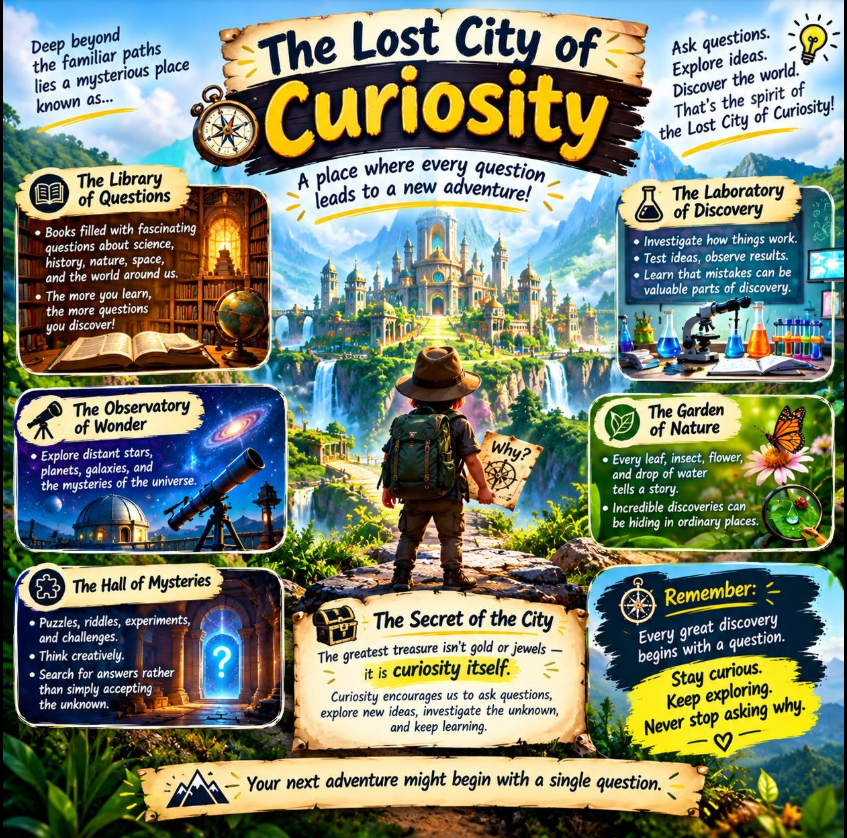
    Deep beyond the familiar paths lies a mysterious place known as **The Lost City of Curiosity**—a city where every doorway leads to a question, every discovery creates another mystery, and every explorer is encouraged to ask, **“Why?”**

    **The Library of Questions**
    Its enormous library contains books filled with fascinating questions about science, history, nature, space, and the world around us. The more you learn, the more questions you discover!

    **The Laboratory of Discovery**
    Here, explorers investigate how things work, test ideas, observe results, and learn that mistakes can be valuable parts of discovery.

    **The Observatory of Wonder**
    Look through the giant telescopes and explore distant stars, planets, galaxies, and the mysteries of the universe.

    **The Garden of Nature**
    Every leaf, insect, flower, and drop of water tells a story. The garden reminds visitors that incredible discoveries can be hiding in ordinary places.

    **The Hall of Mysteries**
    Puzzles, riddles, experiments, and challenges encourage explorers to think creatively and search for answers rather than simply accepting the unknown.

    **The Secret of the City**
    The greatest treasure isn't gold or jewels—it is **curiosity itself**. Curiosity encourages us to ask questions, explore new ideas, investigate the unknown, and keep learning.

    **Remember:**
    Every great discovery begins with a question. **Stay curious. Keep exploring. Never stop asking why.**

    **Your next adventure might begin with a single question.**

    #TheLostCityOfCuriosity #Curiosity #Science #Learning #Discovery #Education #Explore #Wonder #STEM #Knowledge #Imagination #ScienceEducation #LearningAdventure #DidYouKnow #KeepExploring
    #rsisb Roll no.239 Story post no.29 Foundation Level Deep beyond the familiar paths lies a mysterious place known as **The Lost City of Curiosity**—a city where every doorway leads to a question, every discovery creates another mystery, and every explorer is encouraged to ask, **“Why?”** 🤔 📚 **The Library of Questions** Its enormous library contains books filled with fascinating questions about science, history, nature, space, and the world around us. The more you learn, the more questions you discover! 🔬 **The Laboratory of Discovery** Here, explorers investigate how things work, test ideas, observe results, and learn that mistakes can be valuable parts of discovery. 🌌 **The Observatory of Wonder** Look through the giant telescopes and explore distant stars, planets, galaxies, and the mysteries of the universe. 🌠 🌿 **The Garden of Nature** Every leaf, insect, flower, and drop of water tells a story. The garden reminds visitors that incredible discoveries can be hiding in ordinary places. 🧩 **The Hall of Mysteries** Puzzles, riddles, experiments, and challenges encourage explorers to think creatively and search for answers rather than simply accepting the unknown. 💡 **The Secret of the City** The greatest treasure isn't gold or jewels—it is **curiosity itself**. Curiosity encourages us to ask questions, explore new ideas, investigate the unknown, and keep learning. 🌟 **Remember:** Every great discovery begins with a question. **Stay curious. Keep exploring. Never stop asking why.** 🗺️ **Your next adventure might begin with a single question.** #TheLostCityOfCuriosity #Curiosity #Science #Learning #Discovery #Education #Explore #Wonder #STEM #Knowledge #Imagination #ScienceEducation #LearningAdventure #DidYouKnow #KeepExploring
    0 التعليقات 0 المشاركات 614 مشاهدة
  • RSIF8
    ROLL NO 68
    Task no 117
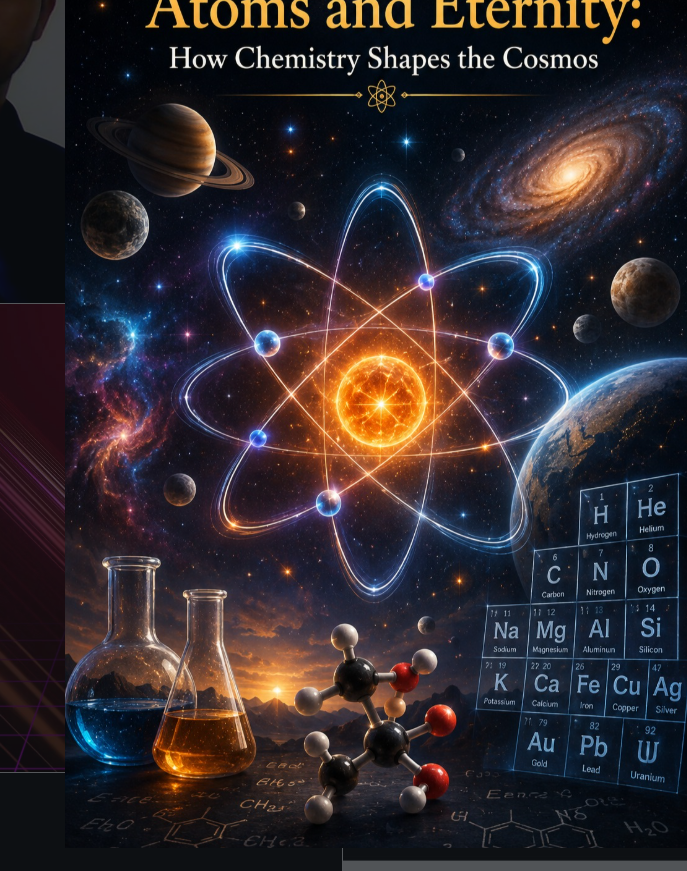
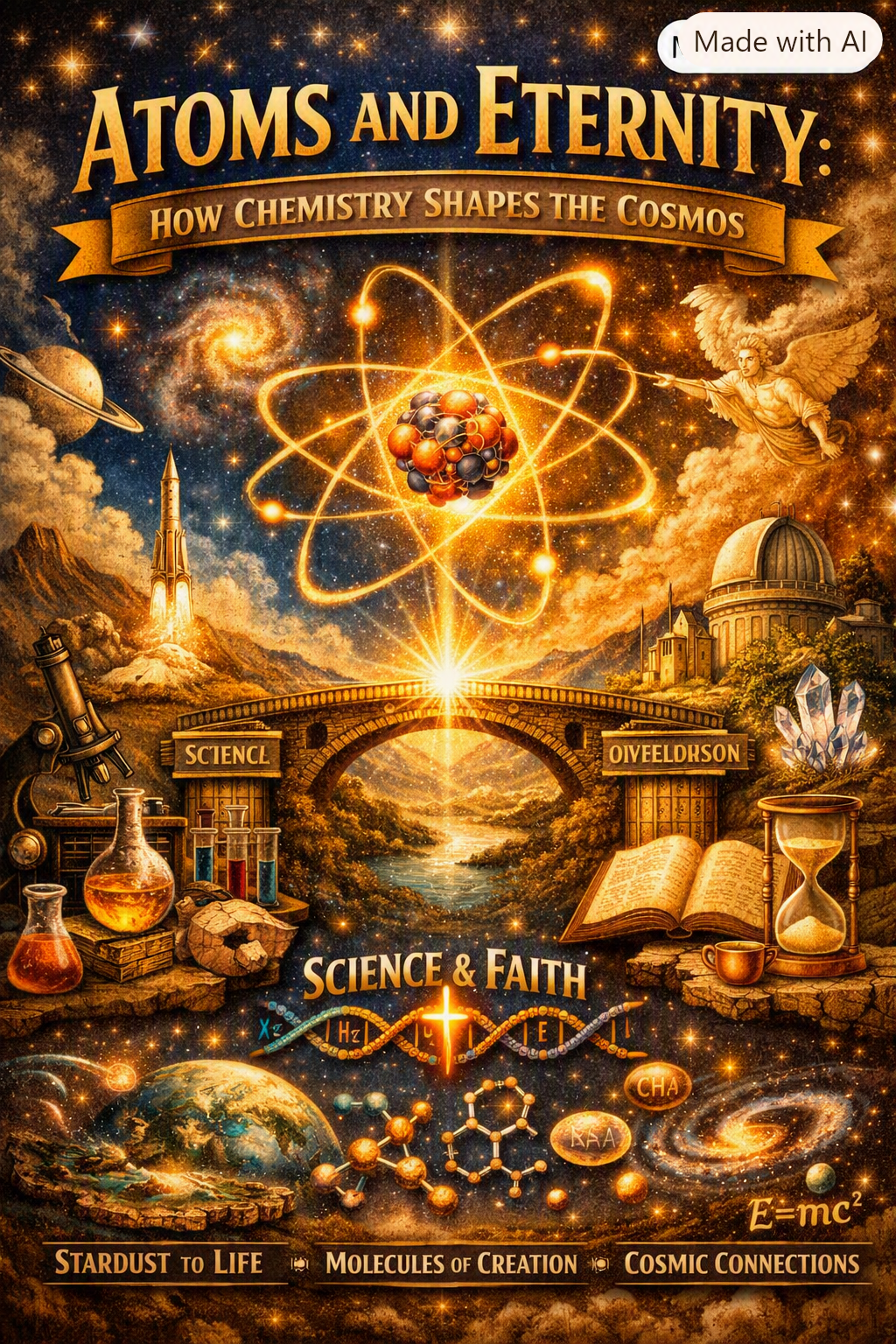
    Task topic; Atoms and Eternity: How Chemistry Shapes the Cosmos

    From the smallest atoms to the largest galaxies, chemistry is woven into the story of the universe. Explore how elements, molecules, and chemical reactions shape stars, planets, life, and the world around us.
    RSIF8 ROLL NO 68 Task no 117 Task topic; Atoms and Eternity: How Chemistry Shapes the Cosmos ⚛️✨ From the smallest atoms to the largest galaxies, chemistry is woven into the story of the universe. Explore how elements, molecules, and chemical reactions shape stars, planets, life, and the world around us. 🌍🔬
    0 التعليقات 0 المشاركات 901 مشاهدة
  • #rsisb
    Roll No.240
    Story Post No.24
    Foundation Level

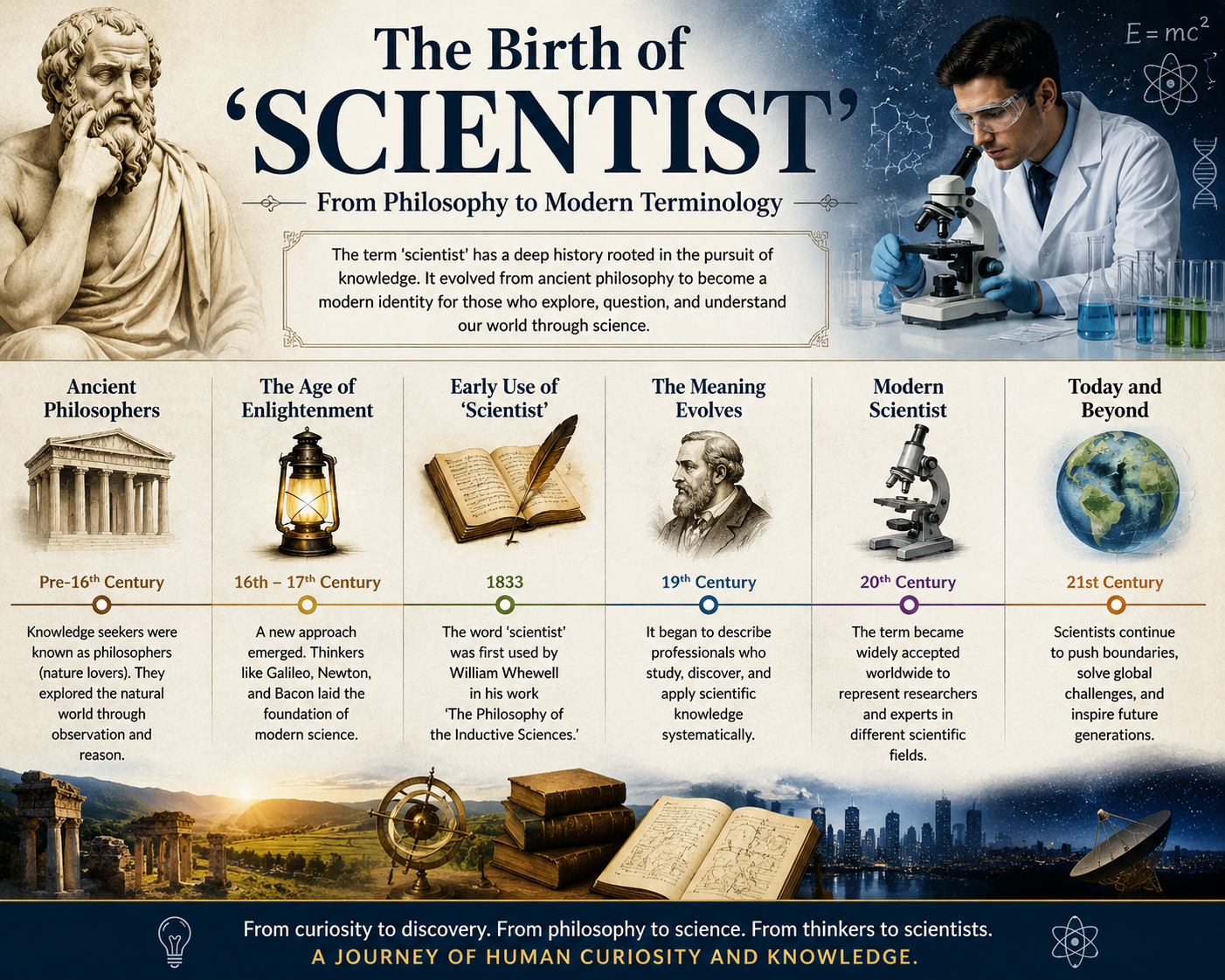
    The word “scientist” may sound like a modern term, but the journey behind it is connected to centuries of human curiosity, philosophy, observation, experimentation, and the search for knowledge.

    Long before the word “scientist” became common, people who studied the natural world were often known as philosophers, scholars, natural philosophers, mathematicians, and thinkers. They asked important questions about nature, the universe, life, matter, motion, and the world around them.

    From the thinkers of the ancient world to the scholars of the Renaissance and the Scientific Revolution, humans continued developing new ways to understand nature. Observation became more important, experiments became more systematic, and evidence gradually became a central part of scientific inquiry.

    During the 18th and 19th centuries, many different branches of knowledge began becoming more specialized. Physics, chemistry, biology, astronomy, geology, and other fields developed their own methods, discoveries, and communities of researchers.

    A major moment in terminology came in the 19th century, when the word “scientist” was introduced as a useful name for people engaged in scientific study. The term is widely associated with William Whewell, who used it in 1833. This helped provide a new, unified word for researchers working across different areas of science.

    The evolution of this word reflects something bigger than language. It represents the changing way humanity organized knowledge and recognized scientific work. The transition from “natural philosopher” to “scientist” shows how science gradually became a distinct and organized field of study.

    Today, scientists work in laboratories, universities, hospitals, observatories, research centers, engineering facilities, and many other places around the world. They investigate everything from tiny cells and molecules to distant galaxies and the origins of the universe.

    Modern science continues to grow through curiosity, evidence, teamwork, technology, and a willingness to ask difficult questions. Every discovery begins with someone wondering, “Why?”, “How?”, or “What if?”

    The story of the word “scientist” reminds us that human knowledge is always evolving. What began with simple curiosity and philosophical questioning gradually developed into the powerful and diverse scientific world we know today.

    From thinkers to researchers. From philosophy to science. From questions to discoveries.

    Science is not only about finding answers—it is also about continuing to ask better questions.

    A journey from curiosity to discovery, and from philosophy to modern science.

    #TheBirthOfScientist #Scientist #HistoryOfScience #ScienceHistory #ScientificRevolution #Philosophy #NaturalPhilosophy #WilliamWhewell #1833 #ModernScience #ScienceEducation #ScientificTerminology #Science #Scientists #Research #Discovery #Curiosity #Knowledge #Learning #Education #STEM #Physics #Chemistry #Biology #Astronomy #Geology #Innovation #Experimentation #ScientificThinking #CriticalThinking #HumanKnowledge #HistoryOfKnowledge #ScienceJourney #FromPhilosophyToScience #ScienceFacts #EducationalContent #LearningJourney #ExploreScience #DiscoverScience

    Rehan School Islamabad Campus
    Asma Shaheen EducationWali
    Irum Asim
    Saima Happinesswali

    #rsisb Roll No.240 Story Post No.24 Foundation Level The word “scientist” may sound like a modern term, but the journey behind it is connected to centuries of human curiosity, philosophy, observation, experimentation, and the search for knowledge. 🧠🔎 Long before the word “scientist” became common, people who studied the natural world were often known as philosophers, scholars, natural philosophers, mathematicians, and thinkers. 🏛️📜 They asked important questions about nature, the universe, life, matter, motion, and the world around them. From the thinkers of the ancient world to the scholars of the Renaissance and the Scientific Revolution, humans continued developing new ways to understand nature. 🌌🌍📖 Observation became more important, experiments became more systematic, and evidence gradually became a central part of scientific inquiry. 🔬🧪✨ During the 18th and 19th centuries, many different branches of knowledge began becoming more specialized. Physics, chemistry, biology, astronomy, geology, and other fields developed their own methods, discoveries, and communities of researchers. 🧬⚗️🌠 A major moment in terminology came in the 19th century, when the word “scientist” was introduced as a useful name for people engaged in scientific study. The term is widely associated with William Whewell, who used it in 1833. 📜🔬 This helped provide a new, unified word for researchers working across different areas of science. The evolution of this word reflects something bigger than language. It represents the changing way humanity organized knowledge and recognized scientific work. 🌟📚 The transition from “natural philosopher” to “scientist” shows how science gradually became a distinct and organized field of study. Today, scientists work in laboratories, universities, hospitals, observatories, research centers, engineering facilities, and many other places around the world. 🌍🧪🔭 They investigate everything from tiny cells and molecules to distant galaxies and the origins of the universe. 🧬🦠🌌 Modern science continues to grow through curiosity, evidence, teamwork, technology, and a willingness to ask difficult questions. 💡🤝🚀 Every discovery begins with someone wondering, “Why?”, “How?”, or “What if?” The story of the word “scientist” reminds us that human knowledge is always evolving. What began with simple curiosity and philosophical questioning gradually developed into the powerful and diverse scientific world we know today. 🌱➡️🔬➡️🌍 ✨ From thinkers to researchers. From philosophy to science. From questions to discoveries. ✨ Science is not only about finding answers—it is also about continuing to ask better questions. 🔎💡 🌟 A journey from curiosity to discovery, and from philosophy to modern science. 🌟 #TheBirthOfScientist #Scientist #HistoryOfScience #ScienceHistory #ScientificRevolution #Philosophy #NaturalPhilosophy #WilliamWhewell #1833 #ModernScience #ScienceEducation #ScientificTerminology #Science #Scientists #Research #Discovery #Curiosity #Knowledge #Learning #Education #STEM #Physics #Chemistry #Biology #Astronomy #Geology #Innovation #Experimentation #ScientificThinking #CriticalThinking #HumanKnowledge #HistoryOfKnowledge #ScienceJourney #FromPhilosophyToScience #ScienceFacts #EducationalContent #LearningJourney #ExploreScience #DiscoverScience 🔬📚🧠🌍✨🔭🧪🚀💡🌟 Rehan School Islamabad Campus Asma Shaheen EducationWali Irum Asim Saima Happinesswali
    0 التعليقات 0 المشاركات 6926 مشاهدة
  • #rsisb
    Roll No.190
    Call Anni.No.46
    Foundation Level


    1. *My First Conversation With AI! *

    Start a video by introducing AI and asking simple questions like: “What are you?”*, *“How do you answer questions?”*, and *“What can you help me with?” Then move into more interesting questions about school, technology, hobbies, and the future. Finish by asking AI what advice it would give to someone who wants to learn new things.

    2. *Can AI Answer 20 Questions? *

    Create a fun challenge where you ask AI 20 completely different questions. Start with easy questions and slowly make them more difficult. Ask about science, space, computers, animals, history, and everyday life. The goal is to see how interesting and useful AI's answers can be.

    3. *AI and the Future of Technology *

    Talk with AI about how technology might change in the future. Ask about smart homes, robots, self-driving cars, virtual reality, and future computers. You can also ask, “What might technology look like 20 years from now?” This can make an exciting educational conversation.

    4. *AI Becomes My Teacher! ‍*

    Pretend that AI is your personal teacher for one day. Ask it to explain mathematics, science, English, and computer topics in very simple language. You can then ask follow-up questions whenever something is difficult.

    5. *Ask AI About Our Amazing Planet *

    Have a conversation about Earth and nature. Ask AI about oceans, mountains, forests, weather, animals, and interesting natural phenomena. You can make each question more surprising than the previous one.

    ‍ 6. *Talking to AI About Space! *

    Take your audience on a virtual journey through space. Ask AI about planets, stars, galaxies, black holes, astronauts, and space exploration. End with an imaginative question such as, “What could humans discover in space in the future?”

    7. *AI and Video Games *

    Discuss how AI is used in modern games. Ask about computer-controlled characters, game worlds, racing games, and how AI can make games more challenging. You can also ask AI to invent an idea for a brand-new game.

    8. *My Dream Smart Home With AI *

    Ask AI to imagine a futuristic smart home. Talk about automatic lights, smart security, helpful robots, voice commands, smart appliances, and energy-saving technology. Then ask AI to design your perfect futuristic room.

    ‍ 9. *AI Helps Me Learn Coding! *

    Make a beginner-friendly coding conversation. Ask AI what coding is, why people learn it, and how simple programs work. You can ask it to explain concepts like variables, loops, and functions using easy examples.

    10. *Can AI Solve My Brain Challenges? *

    Give AI fun puzzles, riddles, logic questions, and math challenges. Don't reveal the answers immediately—let your audience think first! Then compare your answer with AI's explanation.

    11. *Improve My English With AI! *

    Have a daily English conversation with AI. Talk about school, hobbies, food, sports, technology, and your daily routine. Ask AI to correct your grammar and teach you new vocabulary in a simple way.

    12. *AI Predicts the Future! *

    Ask AI questions about the future of computers, phones, robots, transportation, education, and space exploration. Make it clear that these are **ideas or predictions, not guaranteed facts**.

    13. *Can AI Help Save the Planet? *

    Talk about pollution, recycling, renewable energy, forests, oceans, and wildlife. Ask AI how technology could help people protect the environment. This gives your video an educational and positive message.

    14. *Funny Questions for AI! *

    Ask AI unusual but harmless questions such as “If you could have a favorite hobby, what would it be?” or “What would a robot's perfect vacation look like?” Turn the answers into a fun conversation with reactions and jokes.

    15. *A Full Day With My AI Assistant! *

    Create a story where AI helps you throughout an imaginary day. Start with planning your morning, then studying, learning something new, organizing tasks, solving a puzzle, and finishing the day with a fun conversation. It can become a complete *“Day With AI”* episode.
    #rsisb Roll No.190 Call Anni.No.46 Foundation Level 🤖 1. *My First Conversation With AI! 🌟* Start a video by introducing AI and asking simple questions like: “What are you?”*, *“How do you answer questions?”*, and *“What can you help me with?” Then move into more interesting questions about school, technology, hobbies, and the future. Finish by asking AI what advice it would give to someone who wants to learn new things. 📚✨ 🧠 2. *Can AI Answer 20 Questions? 🎯* Create a fun challenge where you ask AI 20 completely different questions. Start with easy questions and slowly make them more difficult. Ask about science, space, computers, animals, history, and everyday life. The goal is to see how interesting and useful AI's answers can be. 🚀🌍 💻 3. *AI and the Future of Technology 🚀* Talk with AI about how technology might change in the future. Ask about smart homes, robots, self-driving cars, virtual reality, and future computers. You can also ask, “What might technology look like 20 years from now?” This can make an exciting educational conversation. 🤖🏠🚗 📚 4. *AI Becomes My Teacher! 👨‍🏫🤖* Pretend that AI is your personal teacher for one day. Ask it to explain mathematics, science, English, and computer topics in very simple language. You can then ask follow-up questions whenever something is difficult. 📖✏️ 🌎 5. *Ask AI About Our Amazing Planet 🌍* Have a conversation about Earth and nature. Ask AI about oceans, mountains, forests, weather, animals, and interesting natural phenomena. You can make each question more surprising than the previous one. 🌊🏔️🦁 👨‍🚀 6. *Talking to AI About Space! 🌌🚀* Take your audience on a virtual journey through space. Ask AI about planets, stars, galaxies, black holes, astronauts, and space exploration. End with an imaginative question such as, “What could humans discover in space in the future?” 🌙⭐ 🎮 7. *AI and Video Games 🎮🤖* Discuss how AI is used in modern games. Ask about computer-controlled characters, game worlds, racing games, and how AI can make games more challenging. You can also ask AI to invent an idea for a brand-new game. 🏎️🎯 🏠 8. *My Dream Smart Home With AI 🏡✨* Ask AI to imagine a futuristic smart home. Talk about automatic lights, smart security, helpful robots, voice commands, smart appliances, and energy-saving technology. Then ask AI to design your perfect futuristic room. 💡🤖🏠 🧑‍💻 9. *AI Helps Me Learn Coding! 💻🔥* Make a beginner-friendly coding conversation. Ask AI what coding is, why people learn it, and how simple programs work. You can ask it to explain concepts like variables, loops, and functions using easy examples. 🖥️⌨️ 🧩 10. *Can AI Solve My Brain Challenges? 🧠🏆* Give AI fun puzzles, riddles, logic questions, and math challenges. Don't reveal the answers immediately—let your audience think first! Then compare your answer with AI's explanation. 🤔💡 🗣️ 11. *Improve My English With AI! 🇬🇧🤖* Have a daily English conversation with AI. Talk about school, hobbies, food, sports, technology, and your daily routine. Ask AI to correct your grammar and teach you new vocabulary in a simple way. 📚🗣️✨ 🔮 12. *AI Predicts the Future! 🚀🔮* Ask AI questions about the future of computers, phones, robots, transportation, education, and space exploration. Make it clear that these are **ideas or predictions, not guaranteed facts**. 🌍🤖 🌱 13. *Can AI Help Save the Planet? 🌳🌎* Talk about pollution, recycling, renewable energy, forests, oceans, and wildlife. Ask AI how technology could help people protect the environment. This gives your video an educational and positive message. ♻️🌳🐼 😂 14. *Funny Questions for AI! 🤣🤖* Ask AI unusual but harmless questions such as “If you could have a favorite hobby, what would it be?” or “What would a robot's perfect vacation look like?” Turn the answers into a fun conversation with reactions and jokes. 😄🎉 🌟 15. *A Full Day With My AI Assistant! 🤖☀️🌙* Create a story where AI helps you throughout an imaginary day. Start with planning your morning, then studying, learning something new, organizing tasks, solving a puzzle, and finishing the day with a fun conversation. It can become a complete *“Day With AI”* episode. 🚀📚🎮🌙
    0 التعليقات 0 المشاركات 4734 مشاهدة 8
  • #rsisb
    Roll No.269
    Foundation Level
    Story Post No.17

    ## Atoms and Eternity: How Chemistry Shapes the Cosmos

    Have you ever wondered how tiny **atoms** can shape the enormous universe? In this video, we explore **“Atoms and Eternity: How Chemistry Shapes the Cosmos”** and discover the fascinating connection between chemistry, matter, stars, planets, and space.

    From the smallest particles to gigantic stars and galaxies, **atoms are the building blocks of ordinary matter**. We’ll explore how elements are formed, how chemical reactions occur, and how the elements found on Earth are connected to processes that happen throughout the cosmos.

    This journey combines **chemistry, physics, and astronomy** to show how the behavior of atoms helps us understand the universe around us.

    **Learn • Explore • Discover • Understand**

    ### Hashtags

    #Atoms #Chemistry #Cosmos #Astronomy #Universe #Science #Elements #Physics #SpaceScience #Stars #Matter #ChemistryAndAstronomy #STEM #ScienceLearning #ExploreTheUniverse
    #rsisb Roll No.269 Foundation Level Story Post No.17 ## 🌌⚛️ Atoms and Eternity: How Chemistry Shapes the Cosmos Have you ever wondered how tiny **atoms** can shape the enormous universe? 🤔🌠 In this video, we explore **“Atoms and Eternity: How Chemistry Shapes the Cosmos”** and discover the fascinating connection between chemistry, matter, stars, planets, and space. From the smallest particles to gigantic stars and galaxies, **atoms are the building blocks of ordinary matter**. ⚛️✨ We’ll explore how elements are formed, how chemical reactions occur, and how the elements found on Earth are connected to processes that happen throughout the cosmos. 🌍🔭 This journey combines **chemistry, physics, and astronomy** to show how the behavior of atoms helps us understand the universe around us. 🚀🧪🌌 🎓 **Learn • Explore • Discover • Understand** ### 🔖 Hashtags #Atoms ⚛️ #Chemistry 🧪 #Cosmos 🌌 #Astronomy 🔭 #Universe 🌠 #Science 🔬 #Elements #Physics 🚀 #SpaceScience 🌍 #Stars ⭐ #Matter #ChemistryAndAstronomy #STEM 🎓 #ScienceLearning #ExploreTheUniverse ✨
    0 التعليقات 0 المشاركات 2134 مشاهدة
  • RSISB
    Roll No: 209
    Story Post No.28

    Stellar Stories: Navigating the Night Sky

    Step into the fascinating world of stars, planets, constellations, and galaxies! “Stellar Stories: Navigating the Night Sky” takes us on an exciting journey through the universe, helping us discover the wonders hidden above us. From identifying constellations to exploring distant planets , the night sky is full of incredible stories waiting to be discovered.

    Look up, stay curious, and let the stars inspire you to explore the mysteries of the universe!

    #StellarStories #NightSky #Astronomy #Stargazing #Stars #Constellations #SpaceExploration #Universe #Planets #AstronomyLovers #ExploreTheUniverse #Science #Space #Cosmos #DiscoverMore
    RSISB Roll No: 209 Story Post No.28 🌌✨ Stellar Stories: Navigating the Night Sky 🌟🔭 Step into the fascinating world of stars, planets, constellations, and galaxies! 🌠🌙 “Stellar Stories: Navigating the Night Sky” takes us on an exciting journey through the universe, helping us discover the wonders hidden above us. From identifying constellations ⭐ to exploring distant planets 🪐, the night sky is full of incredible stories waiting to be discovered. 🚀🔭 Look up, stay curious, and let the stars inspire you to explore the mysteries of the universe! 🌌💫 #StellarStories #NightSky #Astronomy #Stargazing #Stars #Constellations #SpaceExploration #Universe #Planets #AstronomyLovers #ExploreTheUniverse #Science #Space #Cosmos #DiscoverMore 🌟🔭🌌🚀✨
    0 التعليقات 0 المشاركات 4522 مشاهدة
الصفحات المعززة