• RSIF8
    ROLL NO:92
    SONG NO:32
    TOPIC: **Astronomy Anthems: Stars and Galaxies | Suno.ai Song**

    Explore the amazing beauty of space through “Astronomy Anthems: Stars and Galaxies.” This beautiful song takes us on a musical journey through shining stars, glowing galaxies, and the mysteries of the universe. It celebrates the wonders of astronomy and inspires us to dream big and explore beyond our world.

    Created with Suno.ai
    Discover the beauty of science through music!

    **Hashtags:**
    #AstronomyAnthems #StarsAndGalaxies #SunoAI #SpaceMusic #Astronomy #ScienceThroughMusic #Universe #Galaxy #EducationalSong #AI Music #SpaceExploration #LearningIsFun
    RSIF8 ROLL NO:92 SONG NO:32 TOPIC:🌌 **Astronomy Anthems: Stars and Galaxies | Suno.ai Song** Explore the amazing beauty of space through “Astronomy Anthems: Stars and Galaxies.” ✨ This beautiful song takes us on a musical journey through shining stars, glowing galaxies, and the mysteries of the universe. It celebrates the wonders of astronomy and inspires us to dream big and explore beyond our world. πŸŒ πŸš€ 🎡 Created with Suno.ai 🌍 Discover the beauty of science through music! **Hashtags:** #AstronomyAnthems #StarsAndGalaxies #SunoAI #SpaceMusic #Astronomy #ScienceThroughMusic #Universe #Galaxy #EducationalSong #AI Music #SpaceExploration #LearningIsFun
    0 Comments 0 Shares 1005 Views 5
  • #rsisb
    Roll no.247
    Story post .9
    Foundation level


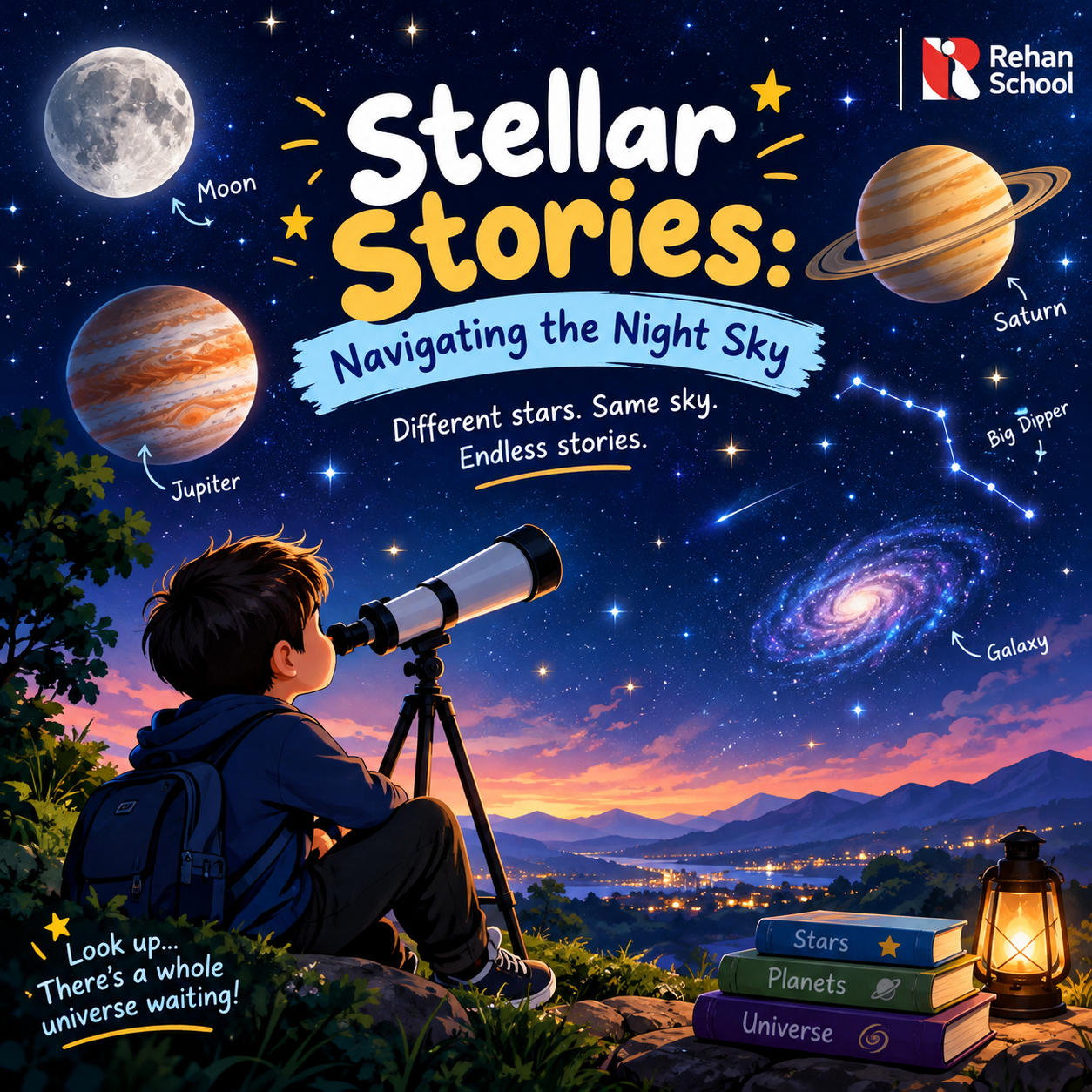
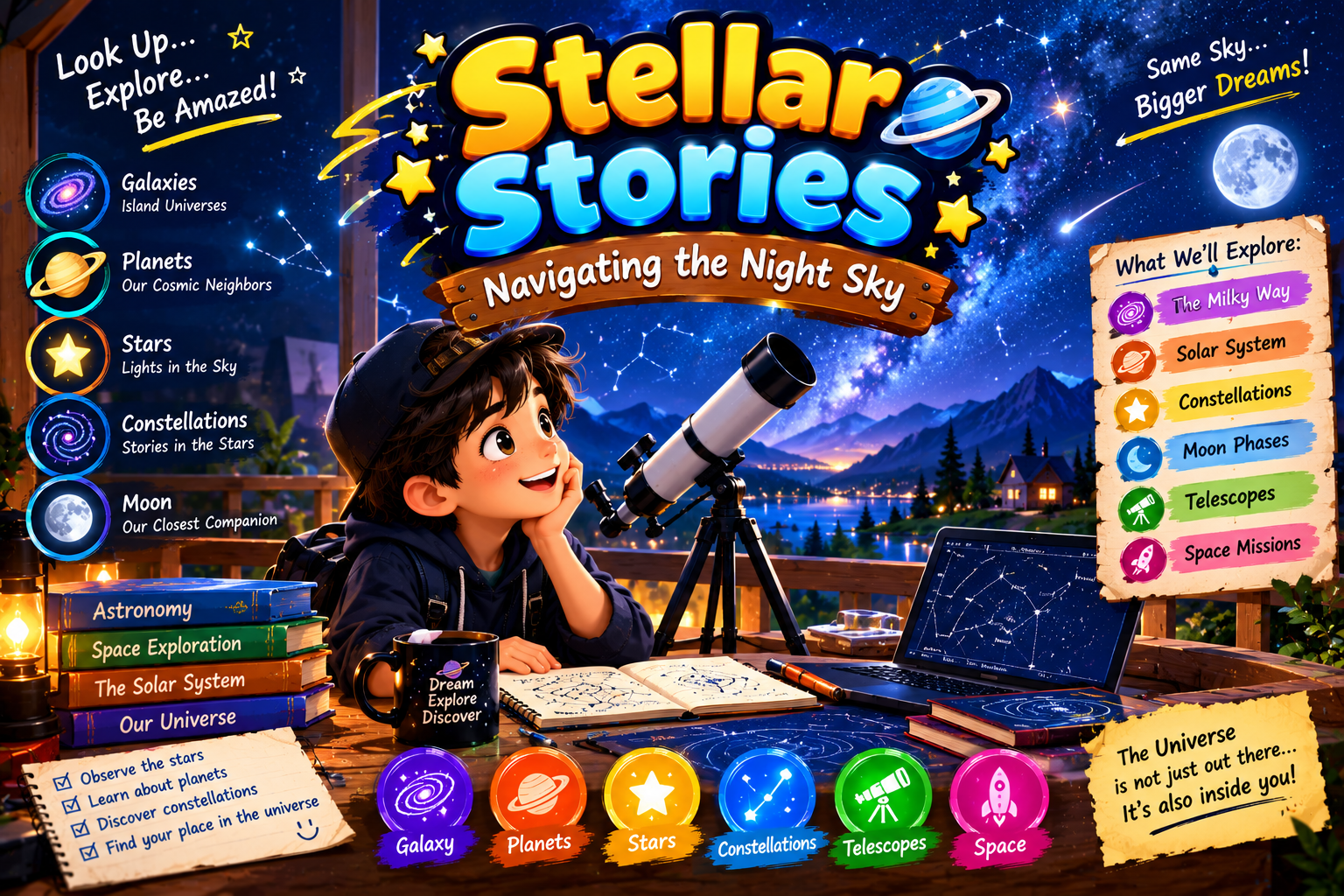
    **Stellar Stories: Navigating the Night Sky**

    **Welcome to Stellar Stories, where the magic of the universe comes alive!** Have you ever looked up at the night sky and wondered how many stars are shining above you? Have you ever imagined traveling through space, discovering distant planets, exploring beautiful galaxies, and learning the secrets hidden among the stars? If yes, then get ready for an amazing journey through the wonders of the cosmos!

    The night sky is like a giant storybook filled with countless stars, fascinating constellations, mysterious planets, and breathtaking galaxies. Every tiny point of light tells us something about our incredible universe. From the bright North Star to the beautiful patterns of Orion's Belt , the sky has inspired explorers, scientists, dreamers, and storytellers for thousands of years.

    **Discover the Wonders of the Night Sky!**

    **Stars:** Learn about the glowing balls of hot gas that light up the universe. Some stars are much larger than our Sun, while others are smaller and cooler. Every star has its own fascinating story!

    **Planets:** Explore the amazing worlds of our solar system, from Mercury's scorching surface to Neptune's distant, deep-blue atmosphere. Discover how planets move around the Sun and why Earth is such a special place for life.

    **Galaxies:** Imagine billions of stars gathered together in enormous cosmic cities! Our home galaxy, the Milky Way, contains stars, planets, gas, and dust, all connected by gravity. Just think about how enormous the universe really is!

    **Constellations:** Discover how people connect stars into recognizable patterns in the sky. These patterns have helped people tell stories, recognize seasons, and navigate throughout history.

    **The Moon:** Observe our closest celestial neighbor and discover why it changes appearance throughout the month. Learn about its phases, its craters, and its important role in Earth's natural systems.

    **Meteors and Comets:** Discover the spectacular streaks of light called meteors and learn about icy comets that travel through space, sometimes developing beautiful glowing tails near the Sun.

    ‍ **Become a Young Space Explorer!**

    You don't need a giant telescope or a spaceship to begin exploring the universe! You can start by looking at the night sky, learning the names of bright stars, identifying visible constellations, and observing the Moon. A simple sky map or astronomy app can help you understand what you're seeing.

    **Why Is Astronomy Important?**

    Astronomy teaches us to ask questions, observe carefully, think scientifically, and search for answers. It helps us understand Earth's place in the universe and reminds us that learning never has to stop. Every discovery begins with curiosity!

    Imagine standing beneath a sky filled with sparkling stars, wondering what exists beyond the worlds we already know. Somewhere out there, new mysteries are waiting to be explored, new discoveries are waiting to be made, and new questions are waiting for curious minds like yours!

    **Remember:** The universe is vast, beautiful, and full of wonders. Keep looking up, keep asking questions, and never stop exploring! Your next great discovery might begin with one simple question: *What's out there?*

    Let's make learning about space exciting, inspiring, and fun! Share this post with your friends and family, encourage young explorers to discover astronomy, and spread the wonder of the night sky across the world.

    **Tell us in the comments!**
    Which would you love to explore first: the Moon, Mars, Saturn's rings, or a distant galaxy?

    Like | Comment | Share | Follow for more amazing stories, educational adventures, science facts, and discoveries!

    **Stellar Stories: Every Star Has a Story, and Every Explorer Has a Question!**

    ━━━━━━━━━━━━━━━━━━━━

    **HASHTAGS**

    #StellarStories #NavigatingTheNightSky #NightSky #Astronomy #SpaceExploration #ExploreTheUniverse #Stars #Planets #Galaxies #MilkyWay #Constellations #Moon #SolarSystem #SpaceScience #ScienceForKids #YoungScientists #YoungExplorers #SpaceLovers #AstronomyForBeginners #LearnAboutSpace #EducationalContent #ScienceEducation #DiscoverTheUniverse #CosmicWonders #Universe #SpaceFacts #Stargazing #Telescope #Astrophysics #ScienceIsFun #Curiosity #KeepLearning #DreamBig #ExploreAndDiscover #KnowledgeIsPower #InspiringMinds #StoryPost #EducationalPost #CreativeLearning #SpaceAdventure #FutureAstronomers #WonderOfTheUniverse #KeepLookingUp
    #rsisb Roll no.247 Story post .9 Foundation level 🌌✨ **Stellar Stories: Navigating the Night Sky** πŸŒŸπŸ”­ 🌠🌌 **Welcome to Stellar Stories, where the magic of the universe comes alive!** πŸš€βœ¨ Have you ever looked up at the night sky and wondered how many stars are shining above you? 🌟 Have you ever imagined traveling through space, discovering distant planets, exploring beautiful galaxies, and learning the secrets hidden among the stars? 🌍πŸͺπŸŒŒ If yes, then get ready for an amazing journey through the wonders of the cosmos! πŸš€πŸ’« πŸŒ™βœ¨ The night sky is like a giant storybook filled with countless stars, fascinating constellations, mysterious planets, and breathtaking galaxies. Every tiny point of light tells us something about our incredible universe. πŸŒŸπŸ“– From the bright North Star ⭐ to the beautiful patterns of Orion's Belt 🌠, the sky has inspired explorers, scientists, dreamers, and storytellers for thousands of years. πŸ”­πŸŒŒ **Discover the Wonders of the Night Sky!** 🌟 **Stars:** Learn about the glowing balls of hot gas that light up the universe. Some stars are much larger than our Sun, while others are smaller and cooler. Every star has its own fascinating story! β˜€οΈβœ¨ πŸͺ **Planets:** Explore the amazing worlds of our solar system, from Mercury's scorching surface to Neptune's distant, deep-blue atmosphere. Discover how planets move around the Sun and why Earth is such a special place for life. πŸŒπŸš€ 🌌 **Galaxies:** Imagine billions of stars gathered together in enormous cosmic cities! Our home galaxy, the Milky Way, contains stars, planets, gas, and dust, all connected by gravity. Just think about how enormous the universe really is! πŸŒ πŸ’« ⭐ **Constellations:** Discover how people connect stars into recognizable patterns in the sky. These patterns have helped people tell stories, recognize seasons, and navigate throughout history. 🧭🌟 πŸŒ™ **The Moon:** Observe our closest celestial neighbor and discover why it changes appearance throughout the month. Learn about its phases, its craters, and its important role in Earth's natural systems. πŸŒ•πŸ”­ β˜„οΈ **Meteors and Comets:** Discover the spectacular streaks of light called meteors and learn about icy comets that travel through space, sometimes developing beautiful glowing tails near the Sun. β˜„οΈβœ¨ πŸ§‘‍πŸš€πŸš€ **Become a Young Space Explorer!** You don't need a giant telescope or a spaceship to begin exploring the universe! πŸŒŒπŸ”­ You can start by looking at the night sky, learning the names of bright stars, identifying visible constellations, and observing the Moon. A simple sky map or astronomy app can help you understand what you're seeing. πŸ“±β­ πŸŒπŸ’‘ **Why Is Astronomy Important?** Astronomy teaches us to ask questions, observe carefully, think scientifically, and search for answers. It helps us understand Earth's place in the universe and reminds us that learning never has to stop. Every discovery begins with curiosity! πŸ§ πŸ”¬βœ¨ 🌠 Imagine standing beneath a sky filled with sparkling stars, wondering what exists beyond the worlds we already know. Somewhere out there, new mysteries are waiting to be explored, new discoveries are waiting to be made, and new questions are waiting for curious minds like yours! πŸš€πŸŒŒ πŸ’« **Remember:** The universe is vast, beautiful, and full of wonders. Keep looking up, keep asking questions, and never stop exploring! Your next great discovery might begin with one simple question: *What's out there?* πŸŒŸπŸ”­πŸŒ ❀️🌌 Let's make learning about space exciting, inspiring, and fun! Share this post with your friends and family, encourage young explorers to discover astronomy, and spread the wonder of the night sky across the world. πŸŒŽπŸš€βœ¨ πŸ‘‡ **Tell us in the comments!** πŸ’¬ 🌟 Which would you love to explore first: the Moon, Mars, Saturn's rings, or a distant galaxy? πŸͺπŸŒ™πŸ”΄πŸŒŒ πŸ‘ Like | πŸ’¬ Comment | πŸ”„ Share | ⭐ Follow for more amazing stories, educational adventures, science facts, and discoveries! 🌌✨ **Stellar Stories: Every Star Has a Story, and Every Explorer Has a Question!** πŸš€πŸŒŸ ━━━━━━━━━━━━━━━━━━━━ 🏷️ **HASHTAGS** 🌠 #StellarStories #NavigatingTheNightSky #NightSky #Astronomy #SpaceExploration #ExploreTheUniverse #Stars #Planets #Galaxies #MilkyWay #Constellations #Moon #SolarSystem #SpaceScience #ScienceForKids #YoungScientists #YoungExplorers #SpaceLovers #AstronomyForBeginners #LearnAboutSpace #EducationalContent #ScienceEducation #DiscoverTheUniverse #CosmicWonders #Universe #SpaceFacts #Stargazing #Telescope #Astrophysics #ScienceIsFun #Curiosity #KeepLearning #DreamBig #ExploreAndDiscover #KnowledgeIsPower #InspiringMinds #StoryPost #EducationalPost #CreativeLearning #SpaceAdventure #FutureAstronomers #WonderOfTheUniverse #KeepLookingUp πŸŒŒπŸ”­πŸš€βœ¨πŸŒŸπŸͺπŸŒ™πŸ’«
    0 Comments 0 Shares 11104 Views
  • RSIF8
    Roll no: 99
    Story post no: 18
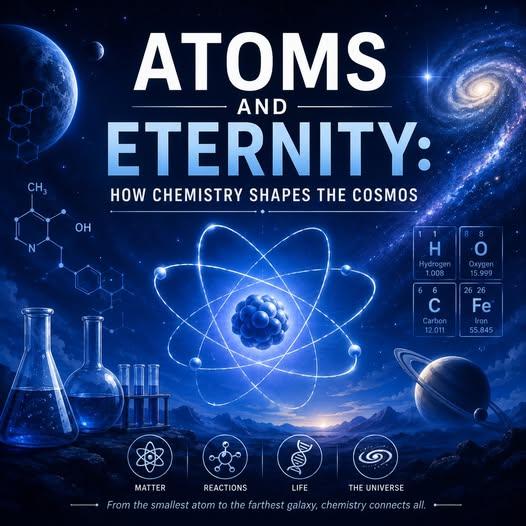
    Story topic: Atoms and Eternity: How Chemistry Shapes the Cosmos
    Everything around us, from the smallest atom to the largest galaxy, is connected through chemistry. Atoms combine to form molecules, molecules take part in reactions, and these processes create the matter and structures that make up our world and the universe.
    Chemistry is not limited to laboratories—it plays a role in stars, planets, living organisms, and the space between them. By understanding atoms and their interactions, we gain a deeper appreciation of how the universe is built and how its incredible complexity comes together.
    #Atoms #Chemistry #Cosmos #Science #Universe #Molecules #Astronomy #ScienceEducation #STEM #LearnScience
    RSIF8 Roll no: 99 Story post no: 18 Story topic: Atoms and Eternity: How Chemistry Shapes the Cosmos Everything around us, from the smallest atom to the largest galaxy, is connected through chemistry. Atoms combine to form molecules, molecules take part in reactions, and these processes create the matter and structures that make up our world and the universe. Chemistry is not limited to laboratories—it plays a role in stars, planets, living organisms, and the space between them. By understanding atoms and their interactions, we gain a deeper appreciation of how the universe is built and how its incredible complexity comes together. #Atoms #Chemistry #Cosmos #Science #Universe #Molecules #Astronomy #ScienceEducation #STEM #LearnScience
    0 Comments 0 Shares 1369 Views
  • #rsisb
    Roll No 253
    Foundation Level
    Story Post 24

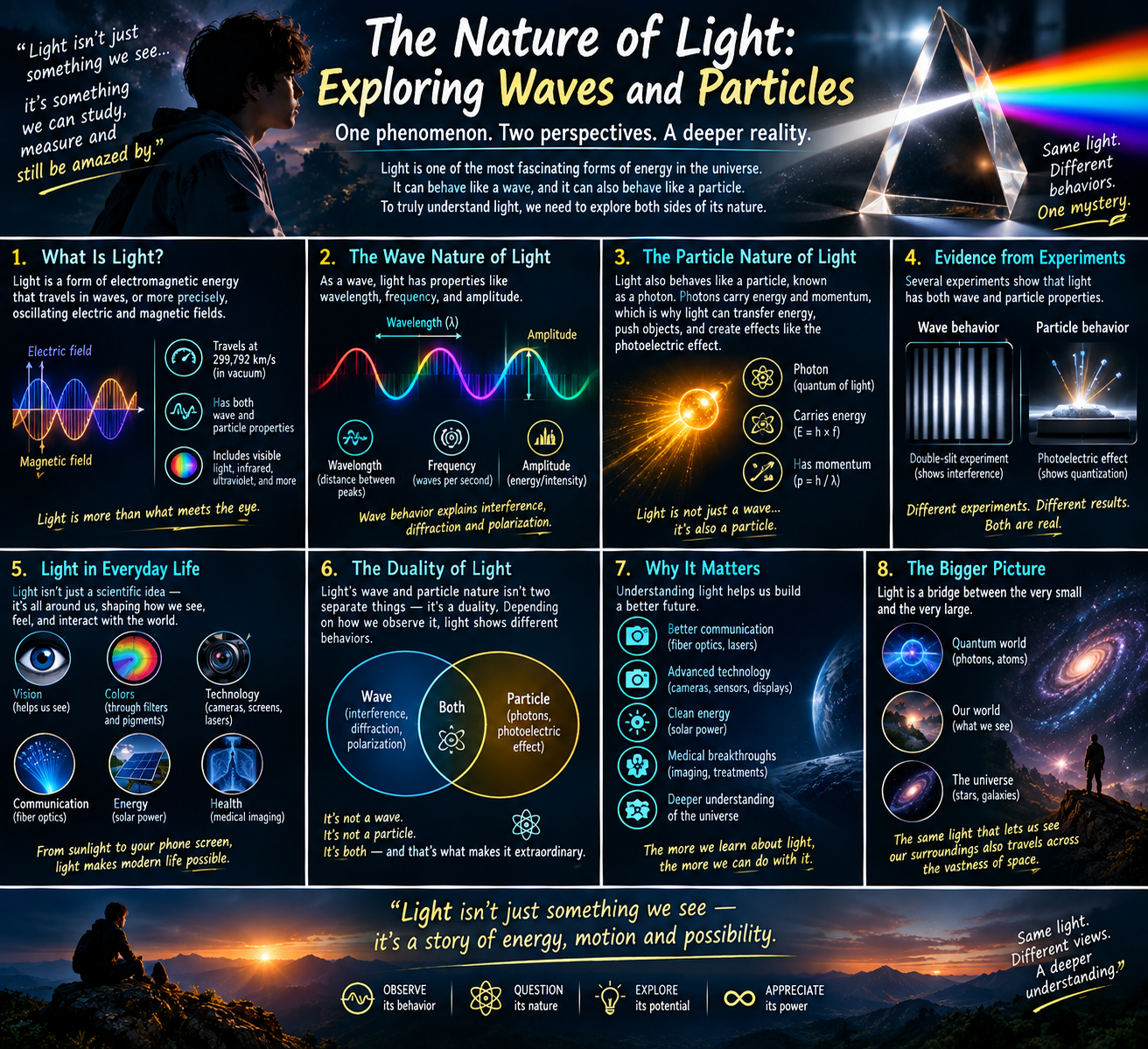
    # The Nature of Light: Exploring Waves and Particles

    Imagine standing beneath a night sky filled with stars.

    Every photon reaching your eyes has traveled across space carrying information from distant worlds. Light allows us to see, measure, communicate, explore, and understand the universe itself.

    But light is far stranger than it first appears.

    Sometimes it behaves like a **wave** .

    Sometimes it behaves like a **particle** .

    And understanding this strange dual nature changed our picture of reality forever.

    ---

    # 1. What Is Light?

    Light is a form of **electromagnetic radiation**—energy carried through oscillating electric and magnetic fields.

    In empty space, electromagnetic waves travel at approximately:

    ### **299,792 kilometers per second**

    That's the speed of light in vacuum.

    Visible light is only a small part of the electromagnetic spectrum.

    Beyond what our eyes can see are:

    Radio waves
    Microwaves
    Infrared
    Visible light
    Ultraviolet
    🩻 X-rays
    Gamma rays

    So light isn't simply what we see.

    ### **It's an enormous family of electromagnetic phenomena.**

    ---

    # 2. The Wave Nature of Light

    When light behaves as a wave, we can describe it using several important properties:

    **Wavelength** — the distance between successive wave peaks
    **Frequency** — how many oscillations occur each second
    **Amplitude** — related to the wave's intensity

    These properties help explain many familiar phenomena.

    **Interference** occurs when waves combine.
    **Diffraction** occurs when waves spread around openings or obstacles.
    **Polarization** describes the orientation of electromagnetic oscillations.

    The wave model explains behaviors that are difficult to understand if we imagine light only as tiny particles.

    ---

    # 3. The Particle Nature of Light

    But the story doesn't end there.

    Light can also behave as if it arrives in discrete packets of energy called **photons**.

    A photon is a quantum of electromagnetic radiation.

    Its energy is related to frequency:

    ### **E = h × f**

    And its momentum is related to its wavelength:

    ### **p = h / λ**

    This particle-like behavior helps explain phenomena such as the **photoelectric effect**, where light can transfer energy to electrons.

    So light isn't simply a smooth continuous wave.

    At the quantum level, energy can be exchanged in discrete amounts.

    ### **Light has another side—and it's quantum.**

    ---

    # 4. Evidence From Experiments

    The strange nature of light isn't merely philosophical.

    Experiments demonstrate it.

    ### Double-Slit Experiment

    When light passes through two narrow openings, an **interference pattern** can appear—strong evidence of wave-like behavior.

    ### Photoelectric Effect

    When light strikes certain materials, it can eject electrons. This behavior is explained using photons and quantized energy.

    Different experiments reveal different aspects of light.

    And that's one of the most fascinating things about physics:

    ### **The same phenomenon can reveal different behaviors depending on how we investigate it.**

    ---

    # 5. Light in Everyday Life

    Light isn't something that exists only inside physics laboratories.

    It's everywhere.

    **Vision** — allows us to see the world
    **Colors** — arise from how different wavelengths interact with matter
    **Cameras** — convert light into images
    **Screens** — produce controlled patterns of light
    **Fiber optics** — carry information using light
    **Solar panels** — convert light energy into electrical energy
    🩻 **Medical imaging** — uses electromagnetic radiation to see inside the body

    From sunrise to smartphone screens…

    ### **Modern civilization depends heavily on our ability to control light.**

    ---

    # 6. The Duality of Light

    Here lies the great mystery.

    Light can display **wave-like behavior**

    and

    **particle-like behavior** .

    This is known as **wave-particle duality**.

    It's important to understand that this doesn't mean light is literally switching between being a classical wave and a classical particle like two separate objects.

    Instead, quantum physics gives us a deeper framework in which classical wave and particle descriptions each capture different aspects of light's behavior.

    ### **Two perspectives. One quantum reality.**

    ---

    # 7. Why Understanding Light Matters

    Learning how light behaves has transformed technology.

    **Communication** — fiber-optic networks
    **Science** — spectroscopy and microscopy
    **Imaging** — cameras and sensors
    **Energy** — solar technology
    **Medicine** — lasers and diagnostic imaging
    **Astronomy** — studying distant stars and galaxies

    When astronomers observe light from a distant star, they aren't simply seeing brightness.

    They can analyze the light's wavelengths and learn about the star's:

    Temperature
    Chemical composition
    Motion
    Environment

    ### **Light carries information across space.**

    ---

    # 8. The Bigger Picture

    Light connects the microscopic and the cosmic.

    At the quantum scale, photons interact with atoms and electrons.

    At human scales, light allows us to see and communicate.

    Across astronomical distances, light travels from stars and galaxies to our telescopes.

    In many ways, light is our messenger from the universe.

    When we look at a distant galaxy, we are receiving photons that may have traveled for millions or billions of years before reaching Earth.

    ### **Looking at the universe means looking at ancient light.**

    ---

    # The Final Thought

    Light is more than something that illuminates a room.

    It is energy.
    It is information.
    It is electromagnetic radiation.
    It has quantum behavior.
    And it is one of the most important tools we have for exploring reality.

    From a photon interacting with an electron…

    to sunlight crossing space…

    to the glow of a distant galaxy…

    ### **Light connects the smallest scales of nature with the largest.**

    So the next time you see sunlight streaming through a window , a rainbow , or stars shining overhead , remember:

    **You aren't simply seeing light.**

    You're witnessing one of the universe's most fascinating mysteries—a phenomenon that behaves in ways far stranger and more beautiful than our everyday experience suggests.

    # **Light isn't just something we see—it's a story of energy, motion, information, and possibility.** ∞


    Asma Shaheen EducationWali
    Saima Empowerment Wali
    Mishaal TrainingWali

    #rsisb Roll No 253 Foundation Level Story Post 24 # 🌈⚑ The Nature of Light: Exploring Waves and Particles Imagine standing beneath a night sky filled with stars. 🌌✨ Every photon reaching your eyes has traveled across space carrying information from distant worlds. Light allows us to see, measure, communicate, explore, and understand the universe itself. πŸ”­πŸ‘οΈπŸ“‘ But light is far stranger than it first appears. Sometimes it behaves like a **wave** 🌊. Sometimes it behaves like a **particle** βš›οΈ. And understanding this strange dual nature changed our picture of reality forever. 🧠🌌 --- # πŸ’‘πŸŒŒ 1. What Is Light? Light is a form of **electromagnetic radiation**—energy carried through oscillating electric and magnetic fields. ⚑🧲 In empty space, electromagnetic waves travel at approximately: ### πŸš€ **299,792 kilometers per second** That's the speed of light in vacuum. Visible light πŸ‘οΈπŸŒˆ is only a small part of the electromagnetic spectrum. Beyond what our eyes can see are: πŸ“» Radio waves πŸ“‘ Microwaves πŸ”₯ Infrared 🌈 Visible light β˜€οΈ Ultraviolet 🩻 X-rays ☒️ Gamma rays So light isn't simply what we see. ### **It's an enormous family of electromagnetic phenomena.** 🌌⚑ --- # πŸŒŠπŸ”¬ 2. The Wave Nature of Light When light behaves as a wave, we can describe it using several important properties: 〰️ **Wavelength** — the distance between successive wave peaks ⚑ **Frequency** — how many oscillations occur each second πŸ“ˆ **Amplitude** — related to the wave's intensity These properties help explain many familiar phenomena. 🌈 **Interference** occurs when waves combine. πŸ” **Diffraction** occurs when waves spread around openings or obstacles. πŸ•ΆοΈ **Polarization** describes the orientation of electromagnetic oscillations. The wave model explains behaviors that are difficult to understand if we imagine light only as tiny particles. --- # βš›οΈβœ¨ 3. The Particle Nature of Light But the story doesn't end there. Light can also behave as if it arrives in discrete packets of energy called **photons**. βš›οΈπŸ’‘ A photon is a quantum of electromagnetic radiation. Its energy is related to frequency: ### **E = h × f** ⚑ And its momentum is related to its wavelength: ### **p = h / λ** πŸŒŠβš›οΈ This particle-like behavior helps explain phenomena such as the **photoelectric effect**, where light can transfer energy to electrons. So light isn't simply a smooth continuous wave. At the quantum level, energy can be exchanged in discrete amounts. ### **Light has another side—and it's quantum.** πŸŒŒβš›οΈ --- # πŸ§ͺπŸ” 4. Evidence From Experiments The strange nature of light isn't merely philosophical. Experiments demonstrate it. ### 🌊 Double-Slit Experiment When light passes through two narrow openings, an **interference pattern** can appear—strong evidence of wave-like behavior. πŸŒŠγ€°οΈ ### ⚑ Photoelectric Effect When light strikes certain materials, it can eject electrons. This behavior is explained using photons and quantized energy. βš›οΈπŸ”‹ Different experiments reveal different aspects of light. And that's one of the most fascinating things about physics: ### **The same phenomenon can reveal different behaviors depending on how we investigate it.** πŸ”¬βœ¨ --- # πŸ‘οΈπŸŒˆ 5. Light in Everyday Life Light isn't something that exists only inside physics laboratories. It's everywhere. πŸŒβ˜€οΈ πŸ‘οΈ **Vision** — allows us to see the world 🌈 **Colors** — arise from how different wavelengths interact with matter πŸ“· **Cameras** — convert light into images πŸ“± **Screens** — produce controlled patterns of light 🌐 **Fiber optics** — carry information using light β˜€οΈ **Solar panels** — convert light energy into electrical energy 🩻 **Medical imaging** — uses electromagnetic radiation to see inside the body From sunrise to smartphone screens… ### **Modern civilization depends heavily on our ability to control light.** πŸ’‘πŸŒ --- # πŸŒŠβš›οΈ 6. The Duality of Light Here lies the great mystery. Light can display **wave-like behavior** 🌊 and **particle-like behavior** βš›οΈ. This is known as **wave-particle duality**. It's important to understand that this doesn't mean light is literally switching between being a classical wave and a classical particle like two separate objects. Instead, quantum physics gives us a deeper framework in which classical wave and particle descriptions each capture different aspects of light's behavior. ### **Two perspectives. One quantum reality.** 🌌✨ --- # πŸš€πŸ”¬ 7. Why Understanding Light Matters Learning how light behaves has transformed technology. πŸ“‘ **Communication** — fiber-optic networks πŸ”¬ **Science** — spectroscopy and microscopy πŸ“· **Imaging** — cameras and sensors β˜€οΈ **Energy** — solar technology 🩺 **Medicine** — lasers and diagnostic imaging πŸš€ **Astronomy** — studying distant stars and galaxies When astronomers observe light from a distant star, they aren't simply seeing brightness. They can analyze the light's wavelengths and learn about the star's: 🌑️ Temperature πŸ§ͺ Chemical composition πŸ’¨ Motion 🌌 Environment ### **Light carries information across space.** --- # πŸŒŒπŸ”­ 8. The Bigger Picture Light connects the microscopic and the cosmic. At the quantum scale, photons interact with atoms and electrons. βš›οΈπŸ”¬ At human scales, light allows us to see and communicate. πŸ‘οΈπŸ“± Across astronomical distances, light travels from stars and galaxies to our telescopes. πŸŒŸπŸ”­ In many ways, light is our messenger from the universe. When we look at a distant galaxy, we are receiving photons that may have traveled for millions or billions of years before reaching Earth. 🌌⏳ ### **Looking at the universe means looking at ancient light.** ✨ --- # πŸŒ…πŸ’‘ The Final Thought Light is more than something that illuminates a room. It is energy. ⚑ It is information. πŸ“‘ It is electromagnetic radiation. 🌊 It has quantum behavior. βš›οΈ And it is one of the most important tools we have for exploring reality. πŸ”­ From a photon interacting with an electron… to sunlight crossing space… to the glow of a distant galaxy… ### **Light connects the smallest scales of nature with the largest.** πŸŒŒβš›οΈ So the next time you see sunlight streaming through a window β˜€οΈ, a rainbow 🌈, or stars shining overhead ⭐, remember: **You aren't simply seeing light.** You're witnessing one of the universe's most fascinating mysteries—a phenomenon that behaves in ways far stranger and more beautiful than our everyday experience suggests. πŸŒŠβš›οΈβœ¨ # 🌈🌌 **Light isn't just something we see—it's a story of energy, motion, information, and possibility.** βš‘πŸ”¬∞ Asma Shaheen EducationWali Saima Empowerment Wali Mishaal TrainingWali

    0 Comments 0 Shares 6609 Views
  • RSIF 8

    Roll no 93

    Story post no 34

    Task topic: "Stellar Stories: Navigating the Night Sky".Bilkul Yeh **“Stellar Stories: Navigating the Night Sky”** ke liye long description hai:


    **Stellar Stories: Navigating the Night Sky**


    Look up at the night sky and you will see much more than twinkling lights. Above us is a vast universe filled with stars, planets, galaxies, constellations, meteors, and countless mysteries waiting to be explored.


    For thousands of years, humans have looked toward the stars for **direction, knowledge, inspiration, and answers**. Ancient travelers used the night sky to navigate, while astronomers today use powerful telescopes and advanced technology to study objects billions of light-years away.


    **Stars** are enormous glowing objects that produce their own light and energy.


    **Planets** orbit stars and come in many different sizes and types.


    **Meteors** are streaks of light created when space rocks enter Earth's atmosphere and heat up.


    **Constellations** are patterns of stars that people have recognized and named throughout history.


    **Galaxies** are enormous collections of stars, gas, dust, and other matter. Our home galaxy is the **Milky Way**.


    One familiar pattern in the sky is the **Big Dipper**, which is part of the larger constellation Ursa Major. It has helped people recognize directions and identify other stars in the night sky.


    The night sky connects us with both the past and the future. Ancient civilizations created stories about the stars, while modern scientists continue searching for new worlds and learning more about our universe.


    **So, the next time you look up, remember:**

    There is a whole universe waiting to be explored.


    **Look up. Stay curious. Keep discovering.**


    #StellarStories #NightSky #Astronomy #Space #Universe #Stars #Planets #Galaxies #MilkyWay #Constellations #BigDipper #Meteor #Science #ScienceEducation #AstronomyLovers #SpaceExploration #STEM #Learning #DiscoverTheUniverse #ExploreSpace #EducationalPost

    RSIF 8 Roll no 93 Story post no 34 Task topic: "Stellar Stories: Navigating the Night Sky".Bilkul πŸ‘ Yeh **“Stellar Stories: Navigating the Night Sky”** ke liye long description hai: 🌌⭐ **Stellar Stories: Navigating the Night Sky** πŸ”­ Look up at the night sky and you will see much more than twinkling lights. Above us is a vast universe filled with stars, planets, galaxies, constellations, meteors, and countless mysteries waiting to be explored. For thousands of years, humans have looked toward the stars for **direction, knowledge, inspiration, and answers**. Ancient travelers used the night sky to navigate, while astronomers today use powerful telescopes and advanced technology to study objects billions of light-years away. ⭐ **Stars** are enormous glowing objects that produce their own light and energy. πŸͺ **Planets** orbit stars and come in many different sizes and types. β˜„οΈ **Meteors** are streaks of light created when space rocks enter Earth's atmosphere and heat up. ✨ **Constellations** are patterns of stars that people have recognized and named throughout history. 🌌 **Galaxies** are enormous collections of stars, gas, dust, and other matter. Our home galaxy is the **Milky Way**. One familiar pattern in the sky is the **Big Dipper**, which is part of the larger constellation Ursa Major. It has helped people recognize directions and identify other stars in the night sky. The night sky connects us with both the past and the future. Ancient civilizations created stories about the stars, while modern scientists continue searching for new worlds and learning more about our universe. πŸ”­ **So, the next time you look up, remember:** There is a whole universe waiting to be explored. 🌟 **Look up. Stay curious. Keep discovering.** #StellarStories #NightSky #Astronomy #Space #Universe #Stars #Planets #Galaxies #MilkyWay #Constellations #BigDipper #Meteor #Science #ScienceEducation #AstronomyLovers #SpaceExploration #STEM #Learning #DiscoverTheUniverse #ExploreSpace #EducationalPost
    0 Comments 0 Shares 5336 Views
  • #rsisb
    Roll NO:232
    Foundation level student.
    Story post:11

    **Stellar Stories: Navigating the Night Sky**

    Get ready for an amazing journey beyond our planet and into the mysterious beauty of the **night sky!** Join us as we explore shining stars , fascinating constellations , planets , the Moon , and other incredible objects across the universe.

    In this exciting educational adventure, we’ll learn how people have used the stars to **navigate, tell stories, understand seasons, and explore the universe** throughout history. We’ll discover how constellations form recognizable patterns and how astronomers use powerful telescopes to study objects that are millions or even billions of light-years away.

    From the sparkling stars above us to distant galaxies , the night sky reminds us that the universe is vast, beautiful, and full of mysteries waiting to be discovered.

    **Look Up • Explore the Stars • Discover the Universe • Keep Wondering!**

    Join us on this stellar adventure and let your curiosity take you beyond Earth and into the incredible world of astronomy!

    #StellarStories #NightSky #Astronomy #Stars #Space #Universe #Constellations #Planets #Moon #Galaxy #SpaceExploration #AstronomyForKids #Science #ScienceEducation #STEM #Learning #EducationalVideo #FunLearning #ExploreSpace #DiscoverTheUniverse #StarGazing #YoungAstronomers #Cosmos
    #rsisb Roll NO:232 Foundation level student. Story post:11 🌌✨ **Stellar Stories: Navigating the Night Sky** πŸ”­β­ Get ready for an amazing journey beyond our planet and into the mysterious beauty of the **night sky!** πŸš€πŸŒ  Join us as we explore shining stars ⭐, fascinating constellations 🌌, planets πŸͺ, the Moon πŸŒ™, and other incredible objects across the universe. In this exciting educational adventure, we’ll learn how people have used the stars to **navigate, tell stories, understand seasons, and explore the universe** throughout history. πŸ§­πŸ“šπŸŒ We’ll discover how constellations form recognizable patterns and how astronomers use powerful telescopes πŸ”­ to study objects that are millions or even billions of light-years away. From the sparkling stars above us ✨ to distant galaxies 🌌, the night sky reminds us that the universe is vast, beautiful, and full of mysteries waiting to be discovered. 🌠πŸͺ 🌟 **Look Up • Explore the Stars • Discover the Universe • Keep Wondering!** πŸ”­πŸš€ Join us on this stellar adventure and let your curiosity take you beyond Earth and into the incredible world of astronomy! πŸŒβž‘οΈπŸŒŒπŸ’« #StellarStories #NightSky #Astronomy #Stars #Space #Universe #Constellations #Planets #Moon #Galaxy #SpaceExploration #AstronomyForKids #Science #ScienceEducation #STEM #Learning #EducationalVideo #FunLearning #ExploreSpace #DiscoverTheUniverse #StarGazing #YoungAstronomers #Cosmos πŸŒŒπŸ”­β­πŸͺπŸŒ™πŸŒ πŸš€πŸ§­βœ¨πŸŒπŸ“šπŸ”¬πŸ’«
    0 Comments 0 Shares 4924 Views
  • #rsisb
    Roll No.221
    Song No.20
    Foundation Level


    ** Black Holes and Beyond: Exploring the Limits of Physics | Urdu Educational Song **

    Journey into the mysteries of the universe with this inspiring Urdu educational song about **black holes, gravity, space, and the limitless wonders of physics**. From the incredible power of black holes to the secrets hidden deep within the cosmos, this song celebrates humanity's curiosity and our endless quest to understand the universe.

    Whether you're passionate about **science, astronomy, astrophysics, or space exploration**, this song is designed to inspire learning, imagination, and discovery.

    If you enjoyed this educational song, don't forget to **Like, Share, Comment, and Subscribe** for more science-based songs and educational content.

    **#BlackHoles #Physics #Astronomy #Space #Universe #Cosmos #Science #Astrophysics #SpaceExploration #EducationalSong #STEM #Learning #Galaxy #CosmicMystery #UrduSong #YouTube #Facebook**
    Asma Shaheen EducationWali
    Irum Asim
    Saima Happinesswali
    @followers
    #rsisb Roll No.221 Song No.20 Foundation Level **🌌 Black Holes and Beyond: Exploring the Limits of Physics | Urdu Educational Song πŸš€** Journey into the mysteries of the universe with this inspiring Urdu educational song about **black holes, gravity, space, and the limitless wonders of physics**. From the incredible power of black holes to the secrets hidden deep within the cosmos, this song celebrates humanity's curiosity and our endless quest to understand the universe. Whether you're passionate about **science, astronomy, astrophysics, or space exploration**, this song is designed to inspire learning, imagination, and discovery. 🎡 If you enjoyed this educational song, don't forget to **Like, Share, Comment, and Subscribe** for more science-based songs and educational content. **#BlackHoles #Physics #Astronomy #Space #Universe #Cosmos #Science #Astrophysics #SpaceExploration #EducationalSong #STEM #Learning #Galaxy #CosmicMystery #UrduSong #YouTube #Facebook** Asma Shaheen EducationWali Irum Asim Saima Happinesswali @followers
    0 Comments 0 Shares 7732 Views 27
  • How much does Galaxy Mega DUOS cost ? And how is it ?
    How much does Galaxy Mega DUOS cost ? And how is it ?
    0 Comments 0 Shares 870 Views
  • There are billions of galaxies, and each has their own star,
    YOU can be a star of your own galaxy :)

    Rehan Allahwala
    There are billions of galaxies, and each has their own star, YOU can be a star of your own galaxy :) Rehan Allahwala
    0 Comments 0 Shares 768 Views
  • Alhamdo Lillah, I’ve completed my 100 MOOCs today. I wanted to compare it with the 100 courses that I’ve taken during my Bachelor, Masters and PhD in Computer Science. The traditional route of diploma/degree took me 12 years and costs $291,000 (tuition fee alone). The MOOCs route costs $9,300 and 4 years only. I’ve taken courses from Coursera, Udacity, Udemy, Lynda, MasterClass, UNIC, eDX, Harvard, DataCamp, Big Data University, YouTube, Hamilton Booz Allen, IBM, Experfy, SimpliLearn and GetSmarter. The cheapest was for Free and the most expensive was for $2,800. The Best Course was from Professor Daniel Chamovitz (What a Plant Knows) of Tel Aviv University. I’ve taken courses from Data Science to Medieval Magic and from Quran to Fashion Design, from Writing to Deep Learning and from Blockchain to Genomics. My 12 years of traditional learning landed me a job of assistant professor at GIKI for $810/month and my MOOCs have prepared me for a CTO job in the US for $20,000/month. Thanks God I am homeschooling my kids. I will be writing a detailed paper on my findings after Eid. Here is the list for you guys to enjoy and learn

    1 Big Data Integration and Processing
    2 Machine Learning with Big Data
    3 Graph Analytics for Big Data
    4 Magic in the middle Ages
    5 Introduction to Big Data
    6 Big Data Modeling and Management Systems
    7 Genomic Data Science with Galaxy
    8 Introduction to Genomic Technologies
    9 Capstone: Create Value from Open Data
    10 Executive Data Science Capstone
    11 Case studies in business analytics with ACCENTURE
    12 Foundations of marketing analytics
    13 People Analytics
    14 What a Plant Knows
    15 Foundations of strategic business analytics
    16 Operations Analytics
    17 A Crash Course in Data Science
    18 Building a Data Science Team
    19 Customer Analytics
    20 Data Science in Real Life
    21 Managing Data Analysis
    22 AWS Certified Solution
    23 Big Data Analysis - Demos
    24 Data Visualization in R with ggvis
    25 The Analytics Edge
    26 Data Manipulation in R with dplyr
    27 Understanding Terrorism and the Terrorist Threat
    28 Geospatial Intelligence & the Geospatial Revolution
    29 Beyond Silicon Valley: Growing Entrepreneurship in Transitioning Economies
    30 Data Science Capstone
    31 Social Entrepreneurship
    32 Tackling the Challenges of Big Data
    33 Developing Data Products
    34 Practical Machine Learning
    35 Regression Models
    36 Reproducible Research
    37 Statistical Inference
    38 Exploratory Data Analysis
    39 Getting and Cleaning Data
    40 R Programming
    41 Data Sciences Toolbox
    42 Big Data Fundamentals
    43 Big Data Analysis with Revolution R Enterprise
    44 Explore Data Science Specialization
    45 Calling Bullshit
    46 Python for Genomic Data Science
    47 Big Data - Capstone Project
    48 Intellectual Humility: Theory
    49 Intellectual Humility: Science
    50 Intellectual Humility: Practise
    51 Importance of India
    52 Bitcoin and Cryptocurrency Technologies
    53 Homeland Security & Cybersecurity Connection - Its Not About the Terrorists
    54 Introduction to Personal Branding
    55 Neural Networks and Deep Learning
    56 Improving Deep Neural Networks: Hyperparameter tuning, Regularization and Optimization
    57 Structuring Machine Learning Projects
    58 Effective Altruism
    59 SAS Enterprise Miner
    60 SAS Analytics
    61 Creative Writing
    62 Introduction to Digital Currencies
    63 Introduction to Self Driving Cars - NanoDegree
    64 Google Adwords - NanoDegree
    65 Strategic Business Analytics Specialization
    66 Executive Data Science Specialization
    67 Accounting Analytics
    68 The Data Scientist’s Toolbox
    69 IBM Blockchain Essentials
    70 Blockchain for Finance Professionals
    71 IBM Blockchain Foundation Developer
    72 Data Science
    73 Big Data
    74 Fashion Design
    75 BlockChain
    76 Money and Banking
    77 Blockchain
    78 Principles of Disruptive Innovation
    79 Working on a Cross-Functional Team
    80 Succession Planning
    81 Selling into Companies
    82 Rewarding Employees
    83 Performance Review Foundations
    84 Onboarding New Hires
    85 New Manager Foundations
    86 Managing for Results
    87 Managing Team Conflict
    88 Learning Python
    89 Learning Bitcoin
    90 Leading Productive Meetings
    91 Hiring Your Team
    92 Facilitation Skills for Managers and Leaders
    93 Digital Currencies in Developing World
    94 Delegating Tasks to Your Team
    95 Building a Recommendation System with Python Machine Learning & AI
    96 Building Accountability into Your Culture
    97 Blockchain: Basics
    98 Blockchain: Beyond the Basics
    99 Blockchain & Cryptocurrency
    100 Writing

    Via Zeeshan-ul-hassan Usmani
    Alhamdo Lillah, I’ve completed my 100 MOOCs today. I wanted to compare it with the 100 courses that I’ve taken during my Bachelor, Masters and PhD in Computer Science. The traditional route of diploma/degree took me 12 years and costs $291,000 (tuition fee alone). The MOOCs route costs $9,300 and 4 years only. I’ve taken courses from Coursera, Udacity, Udemy, Lynda, MasterClass, UNIC, eDX, Harvard, DataCamp, Big Data University, YouTube, Hamilton Booz Allen, IBM, Experfy, SimpliLearn and GetSmarter. The cheapest was for Free and the most expensive was for $2,800. The Best Course was from Professor Daniel Chamovitz (What a Plant Knows) of Tel Aviv University. I’ve taken courses from Data Science to Medieval Magic and from Quran to Fashion Design, from Writing to Deep Learning and from Blockchain to Genomics. My 12 years of traditional learning landed me a job of assistant professor at GIKI for $810/month and my MOOCs have prepared me for a CTO job in the US for $20,000/month. Thanks God I am homeschooling my kids. I will be writing a detailed paper on my findings after Eid. Here is the list for you guys to enjoy and learn 1 Big Data Integration and Processing 2 Machine Learning with Big Data 3 Graph Analytics for Big Data 4 Magic in the middle Ages 5 Introduction to Big Data 6 Big Data Modeling and Management Systems 7 Genomic Data Science with Galaxy 8 Introduction to Genomic Technologies 9 Capstone: Create Value from Open Data 10 Executive Data Science Capstone 11 Case studies in business analytics with ACCENTURE 12 Foundations of marketing analytics 13 People Analytics 14 What a Plant Knows 15 Foundations of strategic business analytics 16 Operations Analytics 17 A Crash Course in Data Science 18 Building a Data Science Team 19 Customer Analytics 20 Data Science in Real Life 21 Managing Data Analysis 22 AWS Certified Solution 23 Big Data Analysis - Demos 24 Data Visualization in R with ggvis 25 The Analytics Edge 26 Data Manipulation in R with dplyr 27 Understanding Terrorism and the Terrorist Threat 28 Geospatial Intelligence & the Geospatial Revolution 29 Beyond Silicon Valley: Growing Entrepreneurship in Transitioning Economies 30 Data Science Capstone 31 Social Entrepreneurship 32 Tackling the Challenges of Big Data 33 Developing Data Products 34 Practical Machine Learning 35 Regression Models 36 Reproducible Research 37 Statistical Inference 38 Exploratory Data Analysis 39 Getting and Cleaning Data 40 R Programming 41 Data Sciences Toolbox 42 Big Data Fundamentals 43 Big Data Analysis with Revolution R Enterprise 44 Explore Data Science Specialization 45 Calling Bullshit 46 Python for Genomic Data Science 47 Big Data - Capstone Project 48 Intellectual Humility: Theory 49 Intellectual Humility: Science 50 Intellectual Humility: Practise 51 Importance of India 52 Bitcoin and Cryptocurrency Technologies 53 Homeland Security & Cybersecurity Connection - It's Not About the Terrorists 54 Introduction to Personal Branding 55 Neural Networks and Deep Learning 56 Improving Deep Neural Networks: Hyperparameter tuning, Regularization and Optimization 57 Structuring Machine Learning Projects 58 Effective Altruism 59 SAS Enterprise Miner 60 SAS Analytics 61 Creative Writing 62 Introduction to Digital Currencies 63 Introduction to Self Driving Cars - NanoDegree 64 Google Adwords - NanoDegree 65 Strategic Business Analytics Specialization 66 Executive Data Science Specialization 67 Accounting Analytics 68 The Data Scientist’s Toolbox 69 IBM Blockchain Essentials 70 Blockchain for Finance Professionals 71 IBM Blockchain Foundation Developer 72 Data Science 73 Big Data 74 Fashion Design 75 BlockChain 76 Money and Banking 77 Blockchain 78 Principles of Disruptive Innovation 79 Working on a Cross-Functional Team 80 Succession Planning 81 Selling into Companies 82 Rewarding Employees 83 Performance Review Foundations 84 Onboarding New Hires 85 New Manager Foundations 86 Managing for Results 87 Managing Team Conflict 88 Learning Python 89 Learning Bitcoin 90 Leading Productive Meetings 91 Hiring Your Team 92 Facilitation Skills for Managers and Leaders 93 Digital Currencies in Developing World 94 Delegating Tasks to Your Team 95 Building a Recommendation System with Python Machine Learning & AI 96 Building Accountability into Your Culture 97 Blockchain: Basics 98 Blockchain: Beyond the Basics 99 Blockchain & Cryptocurrency 100 Writing Via Zeeshan-ul-hassan Usmani
    0 Comments 0 Shares 7855 Views
More Results