• Level 01 Book 01
    Day 02
    Task Story post 02
    Topic : Mulla Nasruddin in about when he found a pot of gold and what he did with it

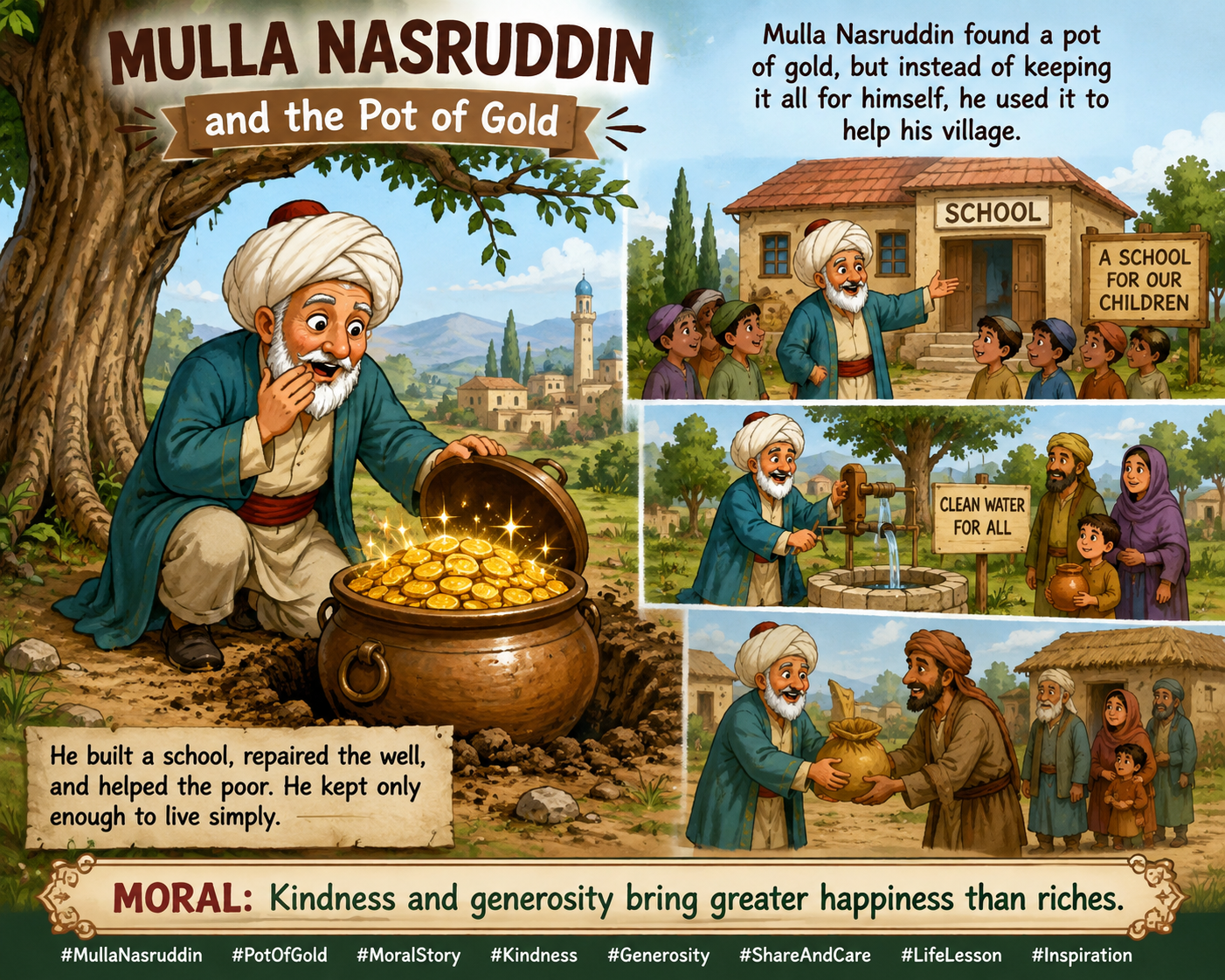
    Mulla Nasruddin and the Pot of Gold

    One sunny morning, Mulla Nasruddin was walking through a quiet forest when he noticed something shining beneath an old tree. Curious, he dug into the ground and discovered a large pot filled with sparkling gold coins.

    At first, Mulla was very excited. But instead of keeping all the gold for himself, he thought about the poor families in his village. He used part of the treasure to build a school, repair the village well, and help people who had no food or shelter. He kept only enough money to live a simple and comfortable life.

    Soon, the entire village became happier and stronger. Everyone respected Mulla, not because he was rich, but because he was kind and generous. Mulla smiled and said, "True wealth is not in what you keep, but in what you share."

    Moral:
    Kindness and generosity bring greater happiness than riches.

    #MullaNasruddin #PotOfGold #MoralStory #Kindness #Generosity #ShareAndCare #LifeLesson #inspiration

    Tania Khan Mentorship Wali
    Mohsin Rathore Seo Wala
    Imran Khan Street Wala
    Shazia EducationWali
    Hafsa Noor
    Rehan School Korangi Campus
    Level 01 Book 01 Day 02 Task Story post 02 Topic : Mulla Nasruddin in about when he found a pot of gold and what he did with it Mulla Nasruddin and the Pot of Gold One sunny morning, Mulla Nasruddin was walking through a quiet forest when he noticed something shining beneath an old tree. Curious, he dug into the ground and discovered a large pot filled with sparkling gold coins. At first, Mulla was very excited. But instead of keeping all the gold for himself, he thought about the poor families in his village. He used part of the treasure to build a school, repair the village well, and help people who had no food or shelter. He kept only enough money to live a simple and comfortable life. Soon, the entire village became happier and stronger. Everyone respected Mulla, not because he was rich, but because he was kind and generous. Mulla smiled and said, "True wealth is not in what you keep, but in what you share." Moral: Kindness and generosity bring greater happiness than riches. #MullaNasruddin #PotOfGold #MoralStory #Kindness #Generosity #ShareAndCare #LifeLesson #inspiration Tania Khan Mentorship Wali Mohsin Rathore Seo Wala Imran Khan Street Wala Shazia EducationWali Hafsa Noor Rehan School Korangi Campus
    0 Commenti 0 condivisioni 304 Views
  • #rsisb
    Roll No.247
    Call Aine 5
    Foundation Level

    "Thank You" – The Etymology of Gratitude (5 Min)

    Have you ever stopped to think about the words "Thank You"? These two simple words carry centuries of history, culture, and heartfelt emotion. Although we say them every day, their origin tells a fascinating story about how humans have expressed appreciation throughout history.

    The English word "thank" comes from the Old English word þanc (thanc), which meant "thought," "gratitude," or "good feeling." In ancient times, expressing thanks wasn't just about being polite—it was a way of recognizing kindness, strengthening relationships, and showing respect. Over time, the phrase "Thank You" evolved into one of the most meaningful expressions in the English language.

    Gratitude is a universal language that crosses cultures, religions, and generations. Whether someone helps you with a small favor or changes your life in a big way, saying "Thank You" acknowledges their kindness and reminds them that their actions matter.

    Scientific studies have even shown that practicing gratitude can improve mental health, reduce stress, strengthen friendships, and increase happiness. A sincere "Thank You" can brighten someone's day, build trust, and create lasting positive connections.

    Across the world, every language has its own beautiful way of expressing gratitude:

    English: Thank You
    French: Merci
    Spanish: Gracias
    Italian: Grazie
    German: Danke
    Urdu: Shukriya (شکریہ)

    No matter how it's spoken, the message remains the same: "I appreciate you."

    So the next time you say "Thank You," remember that you're using a phrase with a rich history that has connected people for hundreds of years. A few simple words can spread kindness, inspire generosity, and make the world a little brighter—one expression of gratitude at a time.

    Never underestimate the power of saying "Thank You." It costs nothing, but it can mean everything.
    #rsisb Roll No.247 Call Aine 5 Foundation Level 🌟 "Thank You" – The Etymology of Gratitude (5 Min) 🙏💖 Have you ever stopped to think about the words "Thank You"? 🤔 These two simple words carry centuries of history, culture, and heartfelt emotion. Although we say them every day, their origin tells a fascinating story about how humans have expressed appreciation throughout history. The English word "thank" comes from the Old English word þanc (thanc), which meant "thought," "gratitude," or "good feeling." In ancient times, expressing thanks wasn't just about being polite—it was a way of recognizing kindness, strengthening relationships, and showing respect. Over time, the phrase "Thank You" evolved into one of the most meaningful expressions in the English language. Gratitude is a universal language that crosses cultures, religions, and generations. Whether someone helps you with a small favor or changes your life in a big way, saying "Thank You" acknowledges their kindness and reminds them that their actions matter. ❤️ Scientific studies have even shown that practicing gratitude can improve mental health, reduce stress, strengthen friendships, and increase happiness. 😊 A sincere "Thank You" can brighten someone's day, build trust, and create lasting positive connections. Across the world, every language has its own beautiful way of expressing gratitude: 🇬🇧 English: Thank You 🇫🇷 French: Merci 🇪🇸 Spanish: Gracias 🇮🇹 Italian: Grazie 🇩🇪 German: Danke 🇵🇰 Urdu: Shukriya (شکریہ) No matter how it's spoken, the message remains the same: "I appreciate you." 🌍💝 So the next time you say "Thank You," remember that you're using a phrase with a rich history that has connected people for hundreds of years. A few simple words can spread kindness, inspire generosity, and make the world a little brighter—one expression of gratitude at a time. 🌟 💬 Never underestimate the power of saying "Thank You." It costs nothing, but it can mean everything.
    0 Commenti 0 condivisioni 2161 Views 15
  • “Beyond Borders : The Art of Pakistan Hospitality”

    Step into the soulful rhythm of Pakistani warmth — a country where chai is more than just tea, and every guest is treated like family. This vibrant musical journey celebrates the unmatched hospitality of Pakistan, where kindness knows no boundaries and generosity flows from heart to heart.

    From bustling chai dhabas to serene village courtyards, from the laughter of children offering sweets to the reverent traditions of welcoming travelers — this song brings alive the everyday poetry of mehmaan-nawazi (hospitality) that defines Pakistani culture.

    Blending folk instruments, regional rhythms, and heartfelt lyrics, “Beyond Borders” is more than a song — it's a tribute to the spirit of connection that transcends language, geography, and culture.

    song no 15
    roll no 51

    Follow Us:
    Instagram: [ / muhammadmujeebasif ]
    LinkedIn: [ / muhammad-mujeeb-asif-a9b3b6363 ]
    Facebook: [ / mujeeb.asif.822421 ]
    YouTube: [ / @mujeeb3810 ]

    FOR any type of song,youtube thumnail,editing,and canva post needed then contect me on whatapps number : 03001040381

    Don’t forget to LIKE, SHARE, and SUBSCRIBE for more inspiring content!

    Fawad BusinessWala
    Mujeeb Asif
    Rubab EducationWali
    Shahzaib Marketing Wala
    “Beyond Borders : The Art of Pakistan Hospitality” Step into the soulful rhythm of Pakistani warmth — a country where chai is more than just tea, and every guest is treated like family. This vibrant musical journey celebrates the unmatched hospitality of Pakistan, where kindness knows no boundaries and generosity flows from heart to heart. From bustling chai dhabas to serene village courtyards, from the laughter of children offering sweets to the reverent traditions of welcoming travelers — this song brings alive the everyday poetry of mehmaan-nawazi (hospitality) that defines Pakistani culture. Blending folk instruments, regional rhythms, and heartfelt lyrics, “Beyond Borders” is more than a song — it's a tribute to the spirit of connection that transcends language, geography, and culture. song no 15 roll no 51 👉 Follow Us: 📸 Instagram: [ / muhammadmujeebasif ] 💼 LinkedIn: [ / muhammad-mujeeb-asif-a9b3b6363 ] 📘 Facebook: [ / mujeeb.asif.822421 ] 🎥 YouTube: [ / @mujeeb3810 ] FOR any type of song,youtube thumnail,editing,and canva post needed then contect me on whatapps number : 03001040381 Don’t forget to LIKE, SHARE, and SUBSCRIBE for more inspiring content! Fawad BusinessWala Mujeeb Asif Rubab EducationWali Shahzaib Marketing Wala
    0 Commenti 0 condivisioni 2062 Views 0
  • "A really great man is known by three signs: generosity in the design, humanity in the execution, moderation in success."

    Ghulam Asghar
    "A really great man is known by three signs: generosity in the design, humanity in the execution, moderation in success." Ghulam Asghar
    0 Commenti 0 condivisioni 113 Views
  • Give generously

    Everything is in balance in the universe. Have you heard about this yet. People call it karma or the law of cause and consequences. Karma is a law to encourage a person to do good. When we light kindness, it comes back and reward us.

    People give and receive on the same principle. When you give, you make room to receive. When you donate something to others, not expecting anything in return, the universe seeks to reward you. Simple words, but it is very hard to believe in them.

    The servants of the light are on the road of generosity. You give up selflessly simply because thats your point. Its natural for you to give, but today I want you to accept.

    The heart is responsible for kindness and altruism. When you truly sacrifice, it opens and shine with a bright light.

    You know how nice it is to give gifts and see happiness in the eyes of a loved one. You are ready to help people even in little things, like the luggage at the train station. You feel joy when you give.

    However, a heart-free heart can fall if you sacrifice too much. When this happens, you get mad at yourself and you feel like you cant give up anymore. In order to maintain balance in your life, you must accept.

    This is your spiritual duty !

    Kyle Grey
    Give generously Everything is in balance in the universe. Have you heard about this yet. People call it karma or the law of cause and consequences. Karma is a law to encourage a person to do good. When we light kindness, it comes back and reward us. People give and receive on the same principle. When you give, you make room to receive. When you donate something to others, not expecting anything in return, the universe seeks to reward you. Simple words, but it is very hard to believe in them. The servants of the light are on the road of generosity. You give up selflessly simply because that's your point. It's natural for you to give, but today I want you to accept. The heart 💖 is responsible for kindness and altruism. When you truly sacrifice, it opens and shine with a bright light. You know how nice it is to give gifts and see happiness in the eyes of a loved one. You are ready to help people even in little things, like the luggage at the train station. You feel joy when you give. However, a heart-free heart can fall if you sacrifice too much. When this happens, you get mad at yourself and you feel like you can't give up anymore. In order to maintain balance in your life, you must accept. This is your spiritual duty ! Kyle Grey
    0 Commenti 0 condivisioni 370 Views
  • Sanatana dharma, in Hinduism, term used to denote the “eternal” or absolute set of duties or religiously ordained practices incumbent upon all Hindus, regardless of class, caste, or sect. Different texts give different lists of the duties, but in general sanatana dharma consists of virtues such as honesty, refraining from injuring living beings, purity, goodwill, mercy, patience, forbearance, self-restraint, generosity, and asceticism. Sanatana dharma is contrasted with svadharma, one’s “own duty” or the particular duties enjoined upon an individual according to his or her class or caste and stage of life. The potential for conflict between the two types of dharma (e.g., between the particular duties of a warrior and the general injunction to practice non-injury) is addressed in Hindu texts such as the Bhagavad Gītā, where it is said that in such casessvadharma must prevail.
    Sanatana dharma, in Hinduism, term used to denote the “eternal” or absolute set of duties or religiously ordained practices incumbent upon all Hindus, regardless of class, caste, or sect. Different texts give different lists of the duties, but in general sanatana dharma consists of virtues such as honesty, refraining from injuring living beings, purity, goodwill, mercy, patience, forbearance, self-restraint, generosity, and asceticism. Sanatana dharma is contrasted with svadharma, one’s “own duty” or the particular duties enjoined upon an individual according to his or her class or caste and stage of life. The potential for conflict between the two types of dharma (e.g., between the particular duties of a warrior and the general injunction to practice non-injury) is addressed in Hindu texts such as the Bhagavad Gītā, where it is said that in such casessvadharma must prevail.
    0 Commenti 0 condivisioni 901 Views
  • Die empty
    One of the most beautiful article that I have read in the book called "Die Empty" by Todd Henry.
    The author was inspired and got this idea of writing ​​this book while attending a business meeting.
    When the director asked the audience: "Where is the richest land in the world?"
    One of the audience answered: "Oil-rich Gulf states."
    Another added: "Diamond mines in Africa."
    Then the director said: "No it is the cemetery. Yes, it is the richest land in the world, because millions of people have departed from it, "they have died" and they carry many valuable ideas that did not come out of the light and benefited others. It is all in the cemetery where they were buried."
    Inspired by this answer, Todd Henry wrote his wonderful book "Die empty." Where he did his best to motivate people to pour out their ideas and potential energies in their communities and turn them into something useful before it is too late.
    The most beautiful of what he said in his book is that: "Do not go to your grave and you carry inside you the best that you have, always choose to die empty."
    Die empty is a new expression and unique on its on way, at first glance you will think it is normal.
    But I was surprised to know the true meaning of this new expression.
    It is to die empty of all the goodness that is within you. Deliver it before you leave this world.
    If you have an idea perform it.
    If you have a knowledge give it out.
    If you have a goal achieve it.
    Love, share and distribute, do not keep it inside.
    Do not keep the goodness inside of you, and die full of ideas and be a delicious meal for the earthworms in the grave.
    Most of us live with the stubborn idea that we will always have tomorrow. But sooner or later all of our tomorrows will run out.
    Are you empty?
    I think we all weigh thousands of tons of goodness, creativity, love and hope that we can give.
    We have not given all of it, except a little.
    How I wish that we start the race to give and remove every atom of goodness inside us. We should learn how to find and sustain our passion and generosity, even in tough times.
    Start the race..
    Die empty One of the most beautiful article that I have read in the book called "Die Empty" by Todd Henry. The author was inspired and got this idea of writing ​​this book while attending a business meeting. When the director asked the audience: "Where is the richest land in the world?" One of the audience answered: "Oil-rich Gulf states." Another added: "Diamond mines in Africa." Then the director said: "No it is the cemetery. Yes, it is the richest land in the world, because millions of people have departed from it, "they have died" and they carry many valuable ideas that did not come out of the light and benefited others. It is all in the cemetery where they were buried." Inspired by this answer, Todd Henry wrote his wonderful book "Die empty." Where he did his best to motivate people to pour out their ideas and potential energies in their communities and turn them into something useful before it is too late. The most beautiful of what he said in his book is that: "Do not go to your grave and you carry inside you the best that you have, always choose to die empty." Die empty is a new expression and unique on its on way, at first glance you will think it is normal. But I was surprised to know the true meaning of this new expression. It is to die empty of all the goodness that is within you. Deliver it before you leave this world. If you have an idea perform it. If you have a knowledge give it out. If you have a goal achieve it. Love, share and distribute, do not keep it inside. Do not keep the goodness inside of you, and die full of ideas and be a delicious meal for the earthworms in the grave. Most of us live with the stubborn idea that we will always have tomorrow. But sooner or later all of our tomorrows will run out. Are you empty? I think we all weigh thousands of tons of goodness, creativity, love and hope that we can give. We have not given all of it, except a little. How I wish that we start the race to give and remove every atom of goodness inside us. We should learn how to find and sustain our passion and generosity, even in tough times. Start the race..
    0 Commenti 0 condivisioni 523 Views
  • One well-known hadith is the saying of the Prophet Muhammad, peace be upon him, "The best of deeds is the one with consistent performance, even if it is small." This hadith teaches us that even small acts of kindness and generosity can be greatly valued in the eyes of God if they are done consistently and with a good intention. It reminds us that we should not overlook the value of consistent, everyday acts of goodness in our lives.
    One well-known hadith is the saying of the Prophet Muhammad, peace be upon him, "The best of deeds is the one with consistent performance, even if it is small." This hadith teaches us that even small acts of kindness and generosity can be greatly valued in the eyes of God if they are done consistently and with a good intention. It reminds us that we should not overlook the value of consistent, everyday acts of goodness in our lives.
    0 Commenti 0 condivisioni 420 Views
  • Once upon a time, in the early days of the United States, there lived a man named John Chapman, better known as Johnny Appleseed. Johnny had a deep passion for nature and a desire to share its bounties with others.

    He wandered across the countryside, planting apple seeds wherever he went. With each seed he carefully placed in the fertile soil, he nurtured hope and possibility. Johnny understood that lifes true joy lay not in the fruits of his labor but in the act of planting itself.

    He believed that by sowing the seeds of goodness and selflessness, one could transform the world around them. Just as he tended to his apple trees, Johnny cared for the well-being of those he encountered. His actions spoke volumes, showing that true fulfillment comes from embracing ones duties with sincerity and dedication.

    With unwavering commitment, Johnny Appleseed spread not only apple orchards but also kindness, compassion, and the spirit of giving. People were touched by his humble presence and the generosity he embodied. He inspired them to cultivate their own gardens of benevolence, making the world a better place.

    Johnnys story teaches us that when we focus on selflessly fulfilling our responsibilities, without getting caught up in the outcomes, we can sow seeds of positive change. Just as an apple tree blossoms and bears fruit, our actions can bear results beyond our imagination.

    So let us, like Johnny Appleseed, strive to plant the seeds of goodness in our daily lives, nurturing them with love and care. By doing so, we can create a more compassionate and harmonious world for ourselves and future generations, guided by the wisdom that true fulfillment lies in the act of giving rather than solely pursuing the fruits of our labor.
    Once upon a time, in the early days of the United States, there lived a man named John Chapman, better known as Johnny Appleseed. Johnny had a deep passion for nature and a desire to share its bounties with others. He wandered across the countryside, planting apple seeds wherever he went. With each seed he carefully placed in the fertile soil, he nurtured hope and possibility. Johnny understood that life's true joy lay not in the fruits of his labor but in the act of planting itself. He believed that by sowing the seeds of goodness and selflessness, one could transform the world around them. Just as he tended to his apple trees, Johnny cared for the well-being of those he encountered. His actions spoke volumes, showing that true fulfillment comes from embracing one's duties with sincerity and dedication. With unwavering commitment, Johnny Appleseed spread not only apple orchards but also kindness, compassion, and the spirit of giving. People were touched by his humble presence and the generosity he embodied. He inspired them to cultivate their own gardens of benevolence, making the world a better place. Johnny's story teaches us that when we focus on selflessly fulfilling our responsibilities, without getting caught up in the outcomes, we can sow seeds of positive change. Just as an apple tree blossoms and bears fruit, our actions can bear results beyond our imagination. So let us, like Johnny Appleseed, strive to plant the seeds of goodness in our daily lives, nurturing them with love and care. By doing so, we can create a more compassionate and harmonious world for ourselves and future generations, guided by the wisdom that true fulfillment lies in the act of giving rather than solely pursuing the fruits of our labor.
    0 Commenti 0 condivisioni 432 Views
  • **The Story of Hatim Tai and the Princess of Yemen**

    Once, there was a beautiful princess in Yemen who was struck by a curse. Anyone who looked upon her would turn into stone. This curse was placed upon her by a jealous sorceress who was envious of the princesss beauty.

    The King of Yemen, deeply concerned for his daughter, proclaimed that anyone who could break the curse would be granted her hand in marriage and half of his kingdom.

    Word of this challenge reached Hatim Tai. Known for his generosity, valor, and kindness, Hatim decided to help the distressed king and his daughter, not for the reward, but because it was the right thing to do.

    Hatim journeyed far and wide, facing numerous challenges. He encountered strange creatures, solved riddles, and faced many adversities. During one such challenge, he met a wise sage who told him that the only way to break the curse was to find and destroy the magical stone which was the source of the sorceresss power.

    After a long and perilous journey, Hatim located the stone in a distant land, guarded by fierce monsters. With courage and intelligence, he defeated the creatures and shattered the stone.

    Upon his return, the curse was lifted. The princess was free, and all those turned to stone were restored to their original form. True to his selfless nature, Hatim declined the kings offer of marriage and the kingdom, stating he undertook the quest to alleviate suffering, not for personal gain.

    The story of Hatim Tai and the Princess of Yemen is a testament to his altruism, bravery, and the belief that doing good is its own reward.

    (Note: This is a summarized version, and there are many versions of Hatim Tais stories across cultures.)
    **The Story of Hatim Tai and the Princess of Yemen** Once, there was a beautiful princess in Yemen who was struck by a curse. Anyone who looked upon her would turn into stone. This curse was placed upon her by a jealous sorceress who was envious of the princess's beauty. The King of Yemen, deeply concerned for his daughter, proclaimed that anyone who could break the curse would be granted her hand in marriage and half of his kingdom. Word of this challenge reached Hatim Tai. Known for his generosity, valor, and kindness, Hatim decided to help the distressed king and his daughter, not for the reward, but because it was the right thing to do. Hatim journeyed far and wide, facing numerous challenges. He encountered strange creatures, solved riddles, and faced many adversities. During one such challenge, he met a wise sage who told him that the only way to break the curse was to find and destroy the magical stone which was the source of the sorceress's power. After a long and perilous journey, Hatim located the stone in a distant land, guarded by fierce monsters. With courage and intelligence, he defeated the creatures and shattered the stone. Upon his return, the curse was lifted. The princess was free, and all those turned to stone were restored to their original form. True to his selfless nature, Hatim declined the king's offer of marriage and the kingdom, stating he undertook the quest to alleviate suffering, not for personal gain. The story of Hatim Tai and the Princess of Yemen is a testament to his altruism, bravery, and the belief that doing good is its own reward. (Note: This is a summarized version, and there are many versions of Hatim Tai's stories across cultures.)
    0 Commenti 0 condivisioni 124 Views
Pagine in Evidenza